
The Executive Presence Trap: Why High-Achieving Leaders Are Burning Out
You’ve done everything right. You deliver exceptional results, mentor your team, and consistently exceed expectations. Yet, you’re stuck. You watch male colleagues with half your track record climb the ladder while you’re given vague feedback like, "You just need more gravitas" or "Find your voice."
It feels like you're playing a game where the rules are invisible and constantly changing. This isn't just frustrating; it's a silent collapse. The constant pressure to perform a version of leadership that isn't authentic to you is exhausting your nervous system, leaving you feeling unseen, isolated, and disconnected from the very drive that made you successful. You're beginning to wonder if the cost of the next level is your own sanity.
Key Takeaways
The Authority Double Bind: Learn why traditional advice fails leaders by forcing them into a no-win scenario where being decisive is seen as "abrasive" and being collaborative is seen as "weak."
Presence is an Inside Job: Discover that true executive presence isn't a performance but the external expression of a regulated nervous system.
The RAMS™ Framework: Get a concrete, 4-part system (Results, Attitude, Mastery, Systems) to build authentic authority without burning out.
Strategic Self-Advocacy: Shift from hoping your work gets noticed to building a deliberate system that amplifies your visibility and influence.
Why Executive Presence Feels Like an Unwinnable Game for leaders

Does this internal dialogue sound familiar? "If I stop performing, I'll disappear. I have to be twice as good to get half as far, but if I show it, I'm seen as aggressive." You’re delivering exceptional results, mentoring your team, you’re checking every single box… yet you keep getting passed over for senior roles. The feedback is useless: "You just need to be more confident."
This isn't a personal failing; it's a systemic trap. The concept of "executive presence for leaders" is often a vague, gendered construct that forces you to second-guess every move. True executive presence is the ability to project calm, confident authority that inspires trust—not an imitation of masculine leadership.
The constant pressure to "perform leadership" instead of simply embodying it is exhausting. It's an unsustainable act that leaves too many brilliant leaders feeling isolated, unseen, and utterly drained, a silent crisis we’ve explored in our article on why successful leaders are often the loneliest leaders.
The Cycle of Performance and Exhaustion
This cycle creates a painful disconnect. On the outside, you’re the picture of success, but inside, you’re burning out. At its core, this "unwinnable game" comes from trying to cram yourself into a leadership mold that was never designed for you.
True executive presence isn’t about adding more performative layers. It's about stripping them away to finally reveal the powerful, inherent authority you already possess. A huge piece of this puzzle involves actively overcoming limiting beliefs that hold leaders back from stepping into their full power.
This struggle is deeply rooted in the unconscious biases and limiting beliefs we've all internalized. True presence emerges when we stop trying to win someone else's game and start defining our own rules for leadership.
Together, we're going to unpack the source of this conflict. More importantly, I'll give you a clear path to reclaim your sovereignty, not by changing who you are, but by learning how to express your true capabilities with unshakable conviction.
The Authority Double Bind: The Hidden Pattern Hijacking Your Career
Most executive presence advice doesn't work for leaders because it ignores the systemic trap we call the Authority Double Bind. It’s the impossible tightrope you walk every single day, a metaphor for the constant balancing act required to be perceived as both competent and likable.
Act decisively, and you risk being labeled "abrasive."
Act collaboratively, and you might get dismissed as "not leadership material."
This isn’t just a perception problem; it’s a constant, draining conflict that hijacks your nervous system. You're trying to navigate a corporate world built on traditionally masculine leadership models, forcing you into an impossible choice that makes authentic presence feel like a pipe dream. By understanding the neuroscience behind this struggle, you can stop blaming yourself and start building a new strategy based on your inherent strengths.
The No-Win Scenario Decoded
The Authority Double Bind is built on contradiction. It’s the invisible set of rules that penalizes leaders for displaying the very leadership traits we're told to develop. This forces you into a state of chronic vigilance, where you’re constantly self-monitoring to avoid triggering bias.
Think about it. A man who is direct is a "strong leader." A leader showing the same behavior? She’s often "aggressive." This isn't just an opinion; it's a well-documented bias. It forces leaders to burn massive emotional energy just to be heard without being judged. That constant self-monitoring is exhausting, and it pulls you right out of a state of embodied presence. This dynamic is especially intense when navigating male-dominated industries, where the pressure to conform while proving your worth is at its peak.
Data Behind the Disparity
This isn’t just anecdotal. The global leadership gap shows a fundamental underrepresentation of leaders in executive roles. While leaders make up 43.4% of the global workforce, they hold only 30.6% of leadership positions worldwide. That's a glaring 12.8 percentage point difference.
The gap widens the higher you go. In US manufacturing, leaders hold a mere 23.3% of leadership roles. In supply chain and transportation, that number drops to a stark 19.0%. You can learn about the findings on leaders statistics to see the full picture. These numbers prove the system has biases baked in.
The Authority Double Bind is the background static of a leader's career. It’s the low-grade, persistent stress of knowing that your actions will be interpreted through a different, often harsher, filter than your male colleagues.
Recognizing this isn't about blaming the system; it's about reclaiming your power. When you understand the game is rigged, you can stop trying to win by its faulty rules and start creating your own.
Deconstructing the Authority Double Bind for leaders
Let's break down exactly how this plays out. Once you see the pattern, you can start navigating it consciously instead of getting caught in the crossfire.
Leadership Trait Traditional Perception (Often Male)Gendered Perception (Often Female)
Assertiveness "Confident," "Decisive," "A Leader" "Aggressive," "Bossy," "Abrasive"
Collaboration "Team Player" (sometimes "Weak,"),"Nurturing," "Lacks Authority"
Direct Communication "Clear," "To the Point," "Blunt," "Harsh," "Not a People Person"
Emotional Expression "Passionate," "Driven," (Anger)"Emotional," "Unstable," "Hysterical"
Ambition "Ambitious," "Visionary," "Self-Serving," "Ruthless"
This table lays bare the core conflict. This isn’t a personal flaw you need to fix with "confidence training." It's a systemic bias that demands a strategic, nervous-system-aware approach to overcome. Moving forward, we’ll shift from diagnosing this problem to providing a concrete framework, the RAMS™ method, to help you express your authority authentically.
The RAMS™ Framework: A New Leadership OS
Knowing about the Authority Double Bind is one thing. Escaping it requires a new operating system for your leadership. This is why I developed the RAMS™ framework. It’s a practical, sustainable method for building authentic executive presence from the inside out.
RAMS™ stands for Results, Attitude, Mastery, and Systems. It’s not a checklist. It’s an integrated approach to reclaim your energy and amplify your impact. It’s the shift from performing leadership to truly embodying it.
Results: Reframe Your Narrative
The first pillar, Results, is about fundamentally shifting how you communicate your value. High-achieving leaders are often taught that their hard work should speak for itself. It rarely does.
Instead of listing tasks, RAMS™ teaches you to build compelling, data-driven stories about your impact. This isn't bragging. It's giving people objective proof of the value you create.
It’s the difference between saying, “I managed the project launch,” and stating, “I led the Q3 product launch, which captured a 12% market share in the first 60 days and exceeded revenue projections by $500k.” One is a task. The other is an undeniable result. When you lead with metrics, you bypass subjective bias.
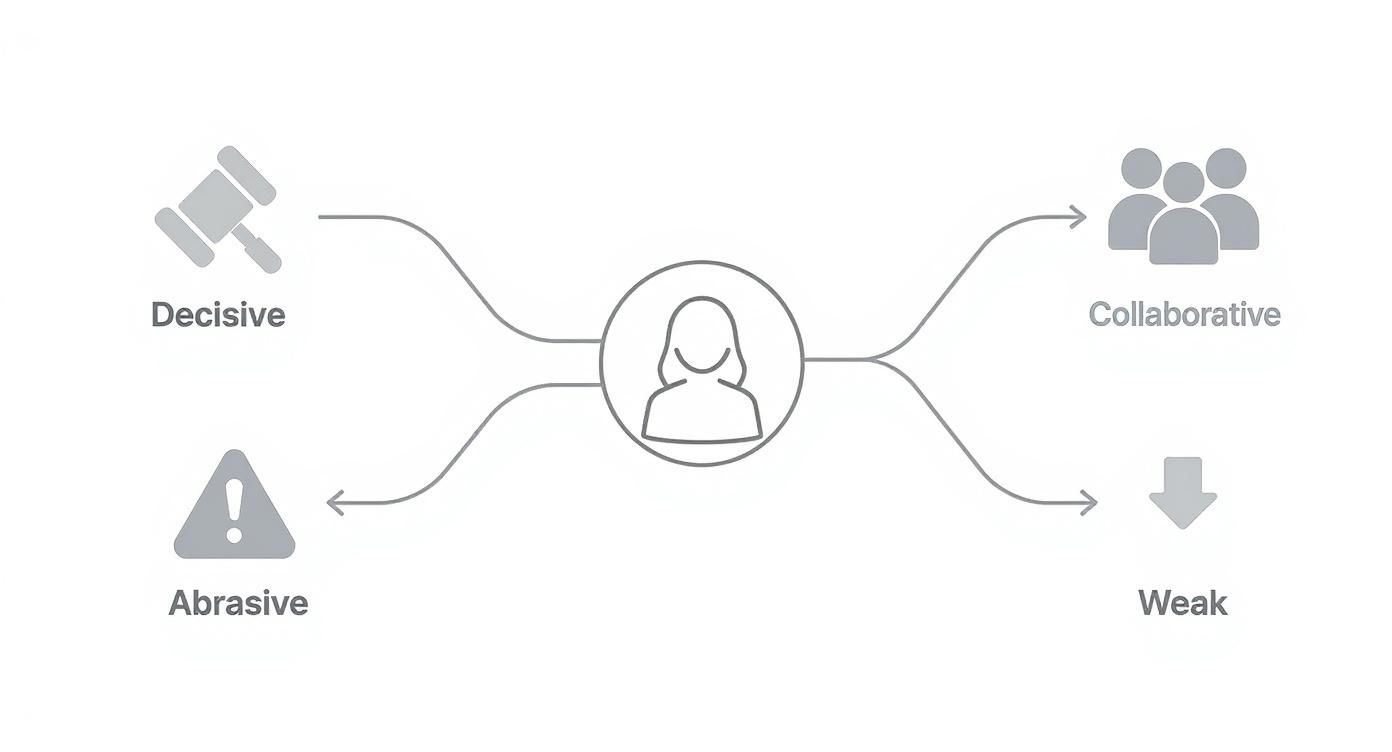
This concept map brings home the frustrating Authority Double Bind that the RAMS™ framework is designed to dismantle. When a leader is decisive, she risks being seen as abrasive. If she's collaborative, she's often labeled weak.
Attitude: Cultivate Calm Conviction
Attitude is the internal bedrock of executive presence. It’s about cultivating a grounded inner state that projects calm conviction, no matter what’s happening around you.
This has nothing to do with faking confidence. It's about learning to regulate your own nervous system so you can access your wisest, most centered self, especially under pressure. When your internal state is solid, you become less reactive, less dependent on external validation, and your presence becomes a stabilizing force.
An embodied attitude means your sense of authority comes from within. It’s a quiet, unwavering self-trust that doesn’t need to be loud to be felt. It’s the energy that silences a room before you even speak.
Here’s how this looks in the real world:
Before a tough conversation: Take three minutes to focus on your breath. Ground yourself in your physical body to calm that fight-or-flight instinct.
When you get biased feedback: Pause. Breathe. Respond from curiosity, not defensiveness. A simple, "Can you provide a specific example?" shifts the dynamic and puts you back in control.
This pillar is about achieving nervous-system sovereignty, where your internal calm dictates your external response.
Mastery: Deepen Your Domain Expertise
Executive presence is built on pure competence. Mastery is the commitment to not only deepening your expertise but also becoming fluent in articulating your strategic vision.
It’s about knowing your subject so thoroughly that you can simplify complex ideas and confidently field any question. This depth creates an undeniable aura of authority.
Mastery has two parts:
Technical Depth: Being the undisputed expert in your functional area.
Strategic Fluency: Connecting your expertise to the organization's bigger picture. You don't just know what to do; you can clearly explain why it matters to the bottom line.
A leader with mastery doesn’t just answer questions, she reframes the conversation. She proves she’s not just a manager but a leader thinking three steps ahead.
Systems: Design Your Protective Architecture
The final pillar, Systems, is about intentionally designing the personal and professional frameworks that showcase your value while fiercely protecting your time and energy.
Without solid systems, even the most talented leaders burn out. They say yes too often and get buried in non-promotable "office housework." Systems are your personal architecture for success and sustainability. They automate your influence and create crucial boundaries. You can explore our complete guide on Baz Porter's revolutionary RAMS leadership framework to go deeper.
Here’s how you can start building your systems today:
The "No" System: Create clear criteria for which requests you accept and which you decline. Your time is your most valuable asset.
The Visibility System: Schedule regular, brief check-ins with key stakeholders to share your team's wins (framed as Results).
The Energy Management System: Identify your peak performance hours and guard them ruthlessly for deep, focused work.
Let's look at how this new OS compares to the old, faulty advice.
Aspect Traditional Advice (The Trap) The RAMS™ Approach (The Reframe)
Focus External perception ("How do they see me?") Internal state and objective value ("How am I creating impact?")
Source of Power Mimicking others, "power posing" Authentic expertise and nervous system regulation
Communication Assertiveness at all costs Narrative storytelling backed by data (Results)
Sustainability Performative and exhausting Systematic and energy-preserving (Systems)
This table shows the fundamental shift. RAMS™ moves you from a fragile, performative presence to something authentic, resilient, and deeply rooted in the value you already create. It is not about adding a mask; it's about finally taking the old ones off.
Mastering Embodied Communication and Presence

Real executive presence is an inside job. It isn't a performance you stage; it's the natural expression of a regulated and grounded internal state. This is where the Attitude and Mastery components of our framework get practical, focusing on embodied communication that projects authority from your very core.
Forget the outdated advice to "power pose." That’s a temporary fix. Lasting presence comes from what I call nervous system sovereignty, the ability to stay centered even when pressure skyrockets. It’s about closing the gap between feeling capable on the inside and being perceived as a powerful leader on the outside.
Grounding Before You Speak
Before any high-stakes meeting, get your nervous system on your side. When your body flips into a fight-or-flight response, your voice constricts and your thinking narrows. A calm internal state is the non-negotiable foundation of powerful communication.
Try this simple grounding exercise minutes before you need to be "on":
The 3x3 Breath: Stand with feet planted firmly. Inhale through your nose for three counts, hold for three, and exhale slowly through your mouth for three. Repeat three times.
Physical Anchor: Press your thumb and forefinger together firmly. This small sensation acts as an anchor, pulling your awareness back into your body.
These are physiological tools to bring your nervous system back into balance. From this centered place, your authentic presence emerges.
Vocal Tone and Strategic Silence
How you say something is often more impactful than the words you use. A steady, clear, and resonant voice commands attention. Many leaders, through social conditioning, adopt a higher pitch or end statements with an upward inflection, which can unintentionally signal uncertainty.
Start by noticing your speech patterns. Do you rush when nervous? Awareness is the first step.
One of the most underutilized and powerful tools for executive presence is the strategic pause. Silence creates space for your message to land. It signals you are in complete control. It pulls listeners in and gives your words undeniable weight.
Instead of filling a silent moment with "um," just take a breath. A one-to-two-second pause before answering a tough question or after making a key point dramatically amplifies your authority. Any effective executive communication skills training focuses heavily on mastering vocal dynamics.
Upgrading Your Language
The words you choose either amplify your authority or chip away at it. Minimizing language, words that soften your statements, is a common habit that subtly undermines your executive presence. It’s the verbal equivalent of shrinking.
Of course, your attire is another powerful form of non-verbal communication. A solid grasp of professional dress, like understanding business casual attire for leaders, is essential for projecting confidence.
The goal is to shift from permissive language to declarative and confident statements.
Instead Of This...Try This..."I just think maybe we should..."
"My analysis shows the best path forward is..."
"Does that make sense?" "I'm happy to clarify any points."
"Sorry to interrupt, but..."
"I have a point to add here." "I feel like this might be a good idea." "This is a strong strategic move because..."
This isn't about being aggressive; it’s about being clear and direct. When you eliminate minimizing language, you stop asking for permission to have a valuable opinion. This linguistic shift reflects an internal shift one where you fully own your expertise.
Building Your Visibility and Influence System
Developing a grounded presence is a monumental achievement. But it's only half the battle. That presence must be seen, felt, and valued by decision-makers. This is where the Systems pillar of the RAMS™ framework becomes your secret weapon.
We're shifting from a reactive stance, hoping your hard work gets noticed, to proactively building an ecosystem that amplifies your influence. This isn't self-promotion. It's strategic self-advocacy, an architecture designed to showcase your value and navigate the biases that render contributions invisible.
From Doer to Director of Your Narrative
The first move is big: stop being just the star player and become the director of your professional story. This means picking projects for their visibility and strategic impact.
Too many high-performing leaders get bogged down by "office housework," non-promotable tasks that keep the lights on but don't get you a seat at the table. A visibility system demands you audit your workload and prioritize initiatives tied to core business objectives.
Your presence is powerful, but your narrative is what travels. A system ensures your story is being told consistently, accurately, and to the right audience, even when you’re not in the room.
To make this real, ask yourself these questions before saying "yes" to anything new:
Who sees this work? Will this project put me in direct contact with influential leaders?
What is the impact? Can the outcome be tied to a core business metric like revenue or market share?
Does this build my brand? Will this work reinforce my expertise in an area critical to the company?
Cultivating Sponsorship, Not Just Mentorship
Mentors give advice. Sponsors spend their political capital to advocate for you. They’re the ones saying your name in promotion meetings. Building a system to cultivate these relationships is non-negotiable for upward mobility.
You earn sponsorship through consistent high performance and by making your value crystal clear. It's about delivering exceptional results and then ensuring potential sponsors understand the strategic impact.
The data backs this up. Leaders hold 29% of C-suite positions, but representation in top roles like CEO is stuck around 11%. That gap screams one thing: you need powerful advocates. Discover more insights about leaders in the workplace on mckinsey.com.
Scripts for Reclaiming Your Power
A robust system anticipates challenges. It equips you with politically savvy, authentic responses. The authority double-bind is real. Have a plan.
Here are a few simple, powerful scripts:
When Interrupted: "Hold that thought, John. I want to finish my point." It's polite, firm, and non-negotiable.
When Your Idea is Co-opted: "Thank you for expanding on my initial point. As I was saying..." This reclaims ownership without starting a fight.
When Given Vague, Biased Feedback: "I'm committed to growth. Can you provide a specific example of when my communication style was not effective so I can understand the impact?" This shifts the focus from subjective opinion to objective behavior.
Building these systems is how you operationalize your executive presence. It ensures your embodied authority translates into tangible influence and real recognition. To make this even more powerful, first understand and describe your own leadership style as a solid foundation.
Return to Yourself: Your Sovereignty is Your Strategy
For years, you've been told to change who you are to fit a faulty model of leadership. The constant performance, the second-guessing, the exhaustion, that is not the price of ambition. It is the cost of disconnection from yourself.
The path to authentic executive presence is not about adding another mask or mastering a new performance. It is a return. It is about reclaiming the parts of yourself you’ve had to quiet to survive in environments that were not built for you. It is about trusting your nervous system, owning your results, and building systems that protect your energy, not just manage your time.
Your sovereignty, your ability to lead from a place of internal alignment and calm conviction—is the most powerful strategy you will ever possess. It is the end of the unwinnable game and the beginning of leadership on your own terms.
At Baz Porter, we specialize in guiding accomplished leaders out of the performative traps that hold them back. We help you cultivate an executive presence that is powerful, authentic, and grounded in who you truly are.
If you're ready to stop playing by faulty rules and start leading from a place of unshakeable authority, it's time for a return.
Discover the framework that helps female executives reclaim their power.
Where to go next
If any of this reads like your own reflection, the Silent Collapse Diagnostic™ is a quiet place to start — a private, one-to-one look at what is really happening beneath the results. And if you want the deeper why beneath the work, read the Sovereign Manifesto.