Executive Coaches Near Me: A Flawed Search for Women
You searched executive coaches near me because you think location will solve a structural failure.
It won’t.
You are not struggling because the right office is missing from your ZIP code. You are struggling because your current leadership system is extracting output from a body and mind that no longer trust the pace, the pressure, or the persona required to maintain it. You still perform. You still deliver. You still look composed. Privately, something has started to go dark.
You call it fatigue. I wouldn’t.
You say you’re overwhelmed, detached, harder to reach, easier to irritate, and strangely empty after wins you used to want. You keep moving because stopping feels dangerous. You have everything you worked for. You feel less and less inside it.
That pattern has a name. Silent Collapse™.
Table of Contents
The Flaw in Your Search for an Executive Coach
Most advice about finding a coach is weak.
It tells you to check credentials, read reviews, book chemistry calls, and pick someone nearby. That advice assumes your problem is access. It isn’t. Your problem is misdiagnosis.
If you are a high-achieving woman in mid-career, the search for executive coaches near me is often a symptom of panic disguised as practicality. You want relief fast. You want proximity because proximity feels safer. You want someone local because your internal system is already overloaded, and your brain is trying to reduce friction.
That instinct makes sense. It also sends you toward the wrong category of help.
Geography is not the selection criteria. Diagnostic precision is.
Generic coaching fails high-achievers in collapse. It addresses stress while missing the operating system beneath it.
Hidden burnout is common among women executives. A cited 2025 claim says 62% report hidden burnout, yet only 15% find specialized coaches in local-style search results for this need, as noted in this summary reference on local coaching search gaps.
If a coach cannot name your pattern, she or he cannot interrupt it. Support without diagnosis becomes maintenance.
The direct answer is simple. The best executive coaches near me are rarely the best choice if your real problem is Silent Collapse™. The right coach is the one with a framework that can diagnose collapse, separate burnout from identity fracture, and rebuild leadership without using your nervous system as fuel.
That’s the only standard that matters.
What local search gets wrong
Local search platforms flatten categories. They mix executive coaching, life coaching, mindset support, and therapy-adjacent work into one convenience bucket. That may help someone who wants general encouragement. It does not help a woman who is still leading at a high level while internally disintegrating.
You don’t need “support.” You need discrimination.
You need to know whether the person in front of you can identify the difference between:
normal fatigue,
chronic overperformance,
identity dependence on output,
and full Silent Collapse™.
You are not looking for the nearest coach. You are looking for the clearest diagnosis.
The symptom behind the search
Women in collapse often search locally because they are trying to contain the damage. They want the fix to stay tidy. They want it to fit between board meetings, caregiving, travel, and the image they’ve built. They do not want a transformation. They want the machinery to stop shaking.
That is the flaw.
A local search assumes the issue is logistical. Silent Collapse™ is structural.
The Hidden Pattern Your Local Coach Will Not See
Most local coaches will hear your language and miss your pattern.
You’ll say you’re exhausted, numb, reactive, overextended, and starting to resent the very success you built. A generic coach will hear workload. A weak coach will hear mindset. A therapy hybrid may hear stress. The pattern underneath all three is usually older, harder, and more expensive.
Silent Collapse™ is what happens when your identity, authority, and survival reflexes fuse with performance.
That fusion works for years. Then it turns.

The nervous system problem hiding inside leadership
High-achievers often treat leadership like a strategy problem. Silent Collapse™ is not primarily a strategy problem. It is a regulation problem with executive consequences.
Your body learns a brutal equation early. Produce, and you stay safe. Anticipate, and you stay ahead. Overfunction, and nobody can accuse you of weakness. The nervous system then starts treating stillness as threat and achievement as temporary permission to exhale.
That is why vacations don’t repair you. They remove stimuli. They don’t change conditioning.
If this feels familiar, the language from this clinical overview on you don’t feel normal at all may land harder than motivational coaching language ever did. The point is not the modality. The point is recognition. When your internal state no longer feels normal, your system is already signaling that compensation has replaced capacity.
One metaphor that fits
Silent Collapse™ is a command center running on emergency generators.
The lights stay on. Screens still work. Messages still go out. From the outside, operations appear stable. Inside, every backup system is burning through reserve power. No one looking at the building knows what it costs to maintain the illusion.
That’s why praise starts to feel insulting. People are admiring the lights. They are not seeing the fuel leak.
Clinical rule: If success requires self-erasure to sustain itself, the system is already failing.
Why diagnosis matters financially
This is not abstract. The wrong coaching engagement wastes more than time. It preserves the exact pattern producing the decline.
A documented review of coaching outcomes found that executive coaching can deliver 788% ROI when it accelerates behavior change, with implementation of new strategies improving by up to 400%, according to American University’s summary of executive coaching ROI. That matters for one reason. The return appears when behavior changes. Not when insight rises. Not when sessions feel good. When the operating pattern shifts.
If your coach treats collapse as a calendar issue, you may gain temporary relief and keep the same code running underneath.
A lot of women I speak to have already tried the respectable fixes. Better boundaries. A lighter Friday. A short leave. Standard mindset work. More delegation. Less email after dinner. Those interventions are not wrong. They are incomplete. They assume the self directing the changes is intact.
In Silent Collapse™, that self is often split. One part wants rest. Another part interprets rest as loss of control.
That is why standard interventions fail to hold.
If you want a sharper language for this split in leadership behavior, read this piece on executive dysregulation. It addresses what happens when a capable leader loses internal command while preserving external function.
What your local coach usually misses
The average coach near you is trained to improve performance. That is not the same as restoring authorship.
A woman in Silent Collapse™ does not need more accountability layered onto depletion. She needs someone who can identify:
Where performance became protection
Where visibility replaced identity
Where leadership became self-betrayal
Where recovery feels dangerous because collapse has become normalized
That is the hidden pattern. Until it is seen, all help remains cosmetic.
Deconstructing Collapse With the RAMS Framework
Collapse follows a sequence.
It does not appear from nowhere. It builds through reinforcement. You do what works. Then you keep doing it after the cost changes. Then the pattern that made you formidable starts consuming the person who built it.
I use the RAMS Framework™. It is not motivational language. It is a system map.

A projection for the broader market puts the executive coaching and leadership development sector at USD 112.98 billion in 2026, with 54% of coaches specializing in leadership, according to this market analysis. That matters because specialization is not a luxury. It is the baseline. A generalist cannot decode a collapse pattern built inside senior leadership pressure.
For a fuller definition of the method itself, see RAMS Method explained.
Reach When Visibility Becomes a Weapon
Reach is where most women think they are winning.
More recognition. More exposure. More responsibility. More access. More people depending on them. From the outside, this looks like growth. In collapse, Reach often becomes a weapon turned inward.
Here is how it happens.
You become highly legible to everyone except yourself. Your teams know your standards. Clients know your value. The market knows your name. You stop knowing what you want outside the role.
You confuse visibility with stability. The more visible you become, the harder it feels to disrupt the image. You stay available to preserve coherence.
You start performing reliability, not living it. Reliability becomes theater. You are still responsive, still decisive, still sharp in public. Privately, the cost rises each week.
You use exposure to avoid repair. If enough is moving, you don’t have to feel the fracture. Reach becomes anesthesia.
The leadership distortion inside Reach
Women in Silent Collapse™ often become the emotional weather system of the company.
Everyone checks your tone. Everyone reads your pace. Everyone calibrates to your output.
That looks like influence. Sometimes it is over-centralization wearing a polished face.
Visibility is useful until your whole identity has to stand guard over it.
The result is brutal. The more seen you are, the less permission you feel to destabilize the image, even when the image is draining the life out of you.
Acquire Chasing Achievements That Deepen the Collapse
Acquire looks rational on paper.
You add credentials, titles, board roles, strategic projects, assets, visibility channels, and higher-value rooms. The external logic is clean. You are compounding advantage. The internal reality can be rotten.
Acquire becomes dangerous when achievement is no longer expansion. It becomes sedation.
Here’s the sequence I watch most often.
You chase proof after proof. Not because the first proof failed. Because none of it settled the underlying insecurity.
You stack wins on a damaged foundation. The structure grows. Capacity does not.
You turn competence into currency for belonging. You earn your right to rest, speak, lead, or disappoint people by outperforming first.
You become intolerant of nonproductive space. If a day does not produce visible value, you feel exposed.
You select coaches who protect the acquisition loop. They help you optimize, package, schedule, and refine. They do not interrupt the compulsion.
How to audit Acquire without lying to yourself
Use this quick field test.
Look at your last major win. Did it create peace, or only the next target?
Check your decision speed. Are you decisive, or unable to tolerate uncertainty?
Review your commitments. Which ones are strategic, and which ones are image maintenance?
Listen to your language. If you keep saying, “Once this season passes,” collapse is already negotiating with you.
The dangerous part is that none of this looks dysfunctional from the outside. It looks elite.
That is why so many women stay stuck. They are rewarded for the exact pattern that is breaking them.
From Exhaustion to Sovereignty A System Comparison
The second half of RAMS™ reveals the cost.
Reach and Acquire explain how collapse gets built. Monetize and Scale show where the leakage is and what changes when the system is rebuilt. Most women in Silent Collapse™ are still generating value. That’s why the problem hides so well. The issue is not whether you can produce. The issue is how much of yourself gets burned to do it.

For a deeper embodiment view of this shift, read Embodied Sovereignty.
Monetize The Value Bled Through Exhaustion Performance
Many leaders think monetization means revenue only. That is amateur thinking.
In collapse, monetization includes attention, trust, authority, clarity, and recovery. Every time you override your limits to preserve performance, you leak value from all five.
Here is what exhaustion-performance usually costs:
Decision quality drops. You still decide fast. You decide from compression.
Team dependence rises. People come to you because the system still bends around your capacity.
Signal gets distorted. You say yes when you mean no, then resent the consequences.
Presence collapses. You are physically there and internally absent.
Strategic thought narrows. You solve immediate pressure and lose spacious judgment.
This is why “high-functioning burnout” fools so many people. Output continues. Margin disappears.
Scale What Sovereign Leadership Makes Possible
Scale is not doing more with less self left.
That is not scale. That is extraction.
Sovereign Leadership™ changes the pattern. Leadership stops depending on adrenaline, self-suppression, and compulsive availability. Authority becomes cleaner. Boundaries stop feeling like threats. Teams stop feeding on your nervous system. Strategy no longer competes with survival.
Read the system difference plainly.
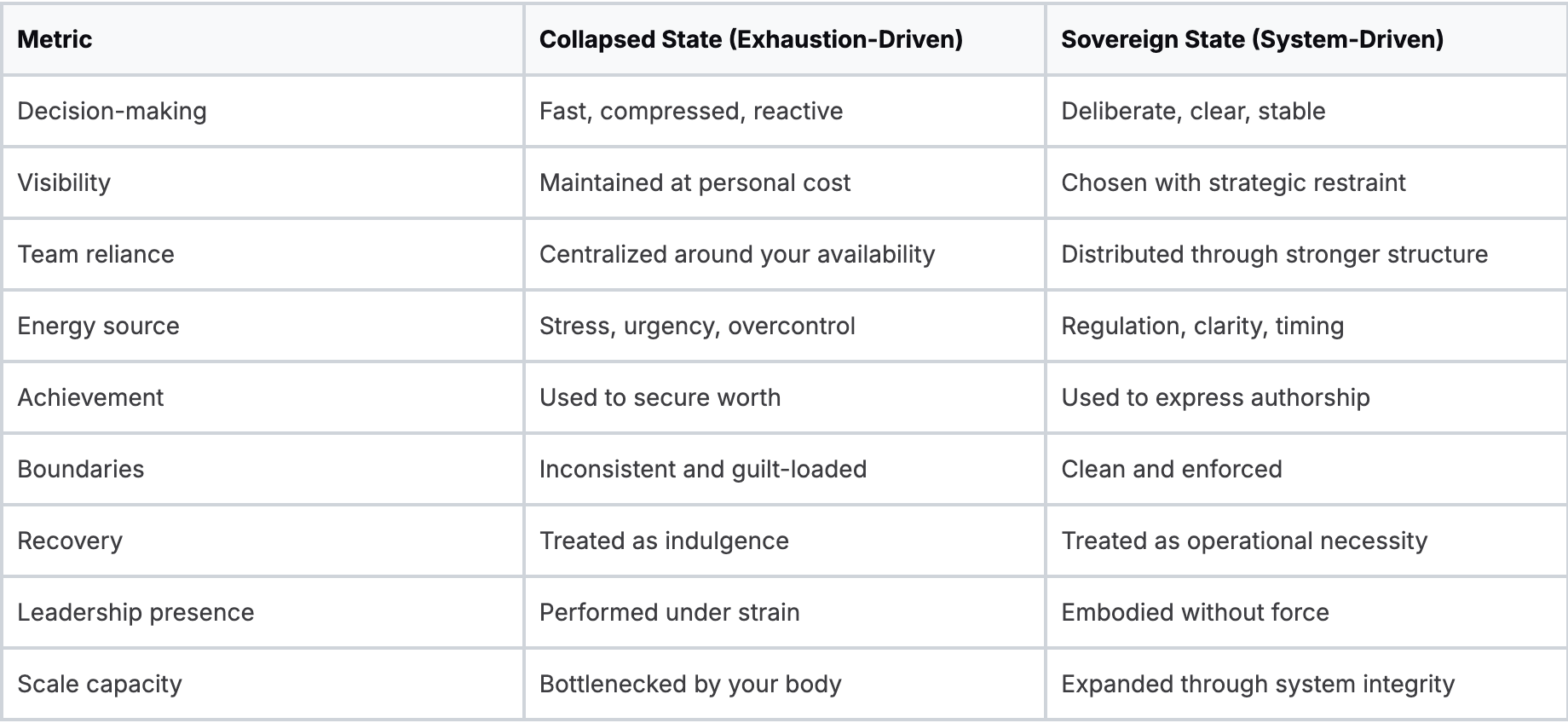
Operational truth: If your business or role grows only when you overextend, you have not built scale. You have built dependency.
What changes in practice
When women move toward sovereignty, the visible changes are almost boring.
They stop narrating every boundary. They make fewer explanations. They choose fewer rooms. They no longer confuse accessibility with leadership. They stop paying for success with self-abandonment.
That shift is not cosmetic. It changes the structure of authority.
If this article has named you accurately, the next step is not more reflection. It is diagnosis. The Silent Collapse Diagnostic will name exactly where you are in the collapse cycle. It takes five minutes.
You can also review deeper material in the Sovereign Leadership Resource Hub if you need more language before action.
The Return Nervous System Sovereignty Is The Only Exit
The exit from Silent Collapse™ is not motivation.
Motivation is unstable. It rises under urgency and vanishes under load. You do not need another push. You need an internal command system that does not panic when performance slows.
That is what I mean by nervous-system sovereignty.

A U.S. market analysis states that the professional coaching sector generates $16 billion annually, with burnout recovery program ROI averaging 5.7:1, and women-focused programs showing 42% higher NPS scores when they use systematic frameworks, according to this industry report. The point is not the market size. The point is that system-led work performs differently from vague support.
For a grounded primer on the physiology underneath this, this piece on understanding what nervous system dysregulation is and how to heal it gives useful language without pretending the problem is solved by insight alone.
You can also read more on nervous system regulation if you want the leadership application of that principle.
Why Motivation Fails Here
Motivation asks you to feel ready.
Women in Silent Collapse™ rarely feel ready. They feel responsible. Those are not the same thing.
The collapsed system treats every demand as morally loaded. If you step back, you fear irrelevance. If you slow down, you fear exposure. If you refuse access, you fear becoming difficult. Motivation cannot repair a structure built on those reflexes.
Only regulation can.
You do not recover by becoming more inspired. You recover by becoming less governed by threat.
What Return Actually Feels Like
Nervous-system sovereignty does not feel dramatic.
It feels quiet. It feels less expensive. It feels like not needing the room to confirm you. It feels like ending the private negotiations that once consumed your mind.
You still lead. You still decide. You still hold standards. But the body is no longer paying for every strategic move as if survival is at stake.
That is the return.
Not softer standards. Not smaller ambition. Not detachment from excellence.
Clean authority.
Critical Questions About Ending Silent Collapse
Why do I feel empty even though I am successful
Because success and self are no longer in alignment.
You built a structure that rewards your output. It may no longer reward your humanity. Emptiness appears when achievement stops producing meaning but you keep chasing it as if it still will. That is not ingratitude. It is diagnostic information.
Why has standard coaching not fixed this
Because most coaching improves function inside the same broken system.
It helps you prioritize, communicate better, delegate more, and regain short-term clarity. Useful. Incomplete. If the underlying issue is collapse, better tactics only make you more efficient inside self-betrayal.
A lot of pricing conversations hide this problem. Content in this area often quotes $80-130/hour, while a cited 2025 claim says 78% of female executives achieve 3x faster transformation through structured frameworks over ad hoc sessions, as referenced in this pricing and coaching format summary. The exact point is simple. Session volume is not the same as system change.
If you need a women-specific lens on that decision, read coaches for women.
Why do I feel guilty when I slow down
Because your identity has been trained to equate motion with worth.
Slowing down threatens the deal you made with yourself years ago. Produce, and you remain valuable. Rest, and you risk becoming ordinary, disappointing, or replaceable. Guilt is not proof that rest is wrong. It is proof that your system has linked stillness with danger.
Do I need a local coach or a specialist
You need a specialist.
If your issue is convenience, local matters. If your issue is Silent Collapse™, specialization matters more. A nearby coach who cannot identify collapse will keep you circling your symptoms. A specialist with the right framework can work across distance and still produce more truth than someone ten minutes away.
What should I screen for when I talk to a coach
Use hard criteria.
Ask what they believe is happening underneath burnout. If they only talk about stress, mindset, or time management, keep moving.
Ask how they diagnose pattern failure. If they cannot explain how they distinguish fatigue from identity fracture, they are guessing.
Ask what they do when high performance is the mask. Many coaches rely on visible dysfunction. Silent Collapse™ often hides behind competence.
Ask whether their process is structured. You need a framework, not a sequence of pleasant conversations.
What if I’m still functioning too well to justify intervention
That is usually when intervention matters most.
The women in deepest collapse are often the ones still delivering at a high level. They are harder to identify because competence conceals the damage. Waiting until visible failure appears is not strength. It is avoidance with a better outfit.
Is therapy enough
Therapy may be useful. It may also be insufficient.
Therapy can help process pain, history, grief, and patterns of attachment. Silent Collapse™ in leadership often also requires rebuilding how authority, visibility, performance, and identity operate in real time. That work needs a framework built for leadership conditions, not only emotional interpretation.
What if I’m afraid that changing will cost me my edge
Then your edge is already unstable.
A real edge does not depend on depletion. If your authority disappears the moment your nervous system stops running hot, that was not edge. That was compensated strain.
If your results confirm what you already suspect, the next step is an application, not a sales call. I do not work with everyone. I work with women ready to stop managing their collapse and start ending it. Apply to Work With Baz
Author bio: British military veteran. Two-time international bestselling author. Founder, The Prestige Architect™. Host, Rise From The Ashes podcast on the C-Suite Network.