The Enneagram Types Description Every High-Achiever Needs
The relentless drive, meticulous planning, and uncanny ability to anticipate every need—these are the very strategies that built your career. But now, they feel like a heavy suit of armor you can’t take off. A quiet, creeping exhaustion has taken root, and the outward markers of success no longer add up to internal fulfillment. You're hitting every target, yet you feel like you're slowly disappearing.
This is the Silent Collapse. It's that moment when you realize the code running your internal operating system is driving you toward burnout, not sovereignty. An Enneagram types description isn't just a personality label; it’s a direct map to the hidden motivations and fears quietly steering your life.
Key Takeaways
Decode Your "Why": The Enneagram reveals the nine core motivations that drive your behavior, explaining why you do what you do, especially under pressure.
Identify Your Burnout Pattern: Each of the nine types has a specific, predictable path to exhaustion. Understanding yours is the first step to reclaiming your energy.
Shift from Reaction to Sovereignty: This guide provides a path to move beyond the automatic patterns of your type and lead from a place of conscious, embodied power.
Leadership Isn't One-Size-Fits-All: Discover how each type’s unique strengths and blind spots show up in leadership, and learn that the "best" leader is the most self-aware one.
An Enneagram types description provides a blueprint of the nine fundamental desires and fears that shape how you think, feel, and act. It is a dynamic system that reveals the unconscious patterns dictating your leadership style, triggering burnout, and, most importantly, showing you the pathway back to your own sovereign energy.
The Hidden Code Driving Your Leadership Style: The Neuroscience of "Why"
Your brain is wired for survival, not fulfillment. It creates predictive models based on early life experiences to keep you safe. The Enneagram types are like nine of these core predictive models. For a high-achiever, the model that once guaranteed safety and success—"If I am perfect, I will be valued" (Type 1), or "If I am accomplished, I am worthy" (Type 3)—becomes a neurological cage.
This pattern is a deeply embedded survival loop. When you feel threatened or stressed, your nervous system defaults to the familiar strategy of your Enneagram type. It’s not a conscious choice; it’s an automatic, physiological response. This is why "thinking your way out" of burnout doesn't work. You are fighting against your own nervous system's definition of safety. To truly grasp the different ways we lead, you can explore our guide on leadership styles and their effectiveness.
To get started, here's a quick look at the nine core archetypes. Think of this table as your first key to decoding the patterns that have defined your career—and your life—up to this point.
The Nine Enneagram Types At a Glance
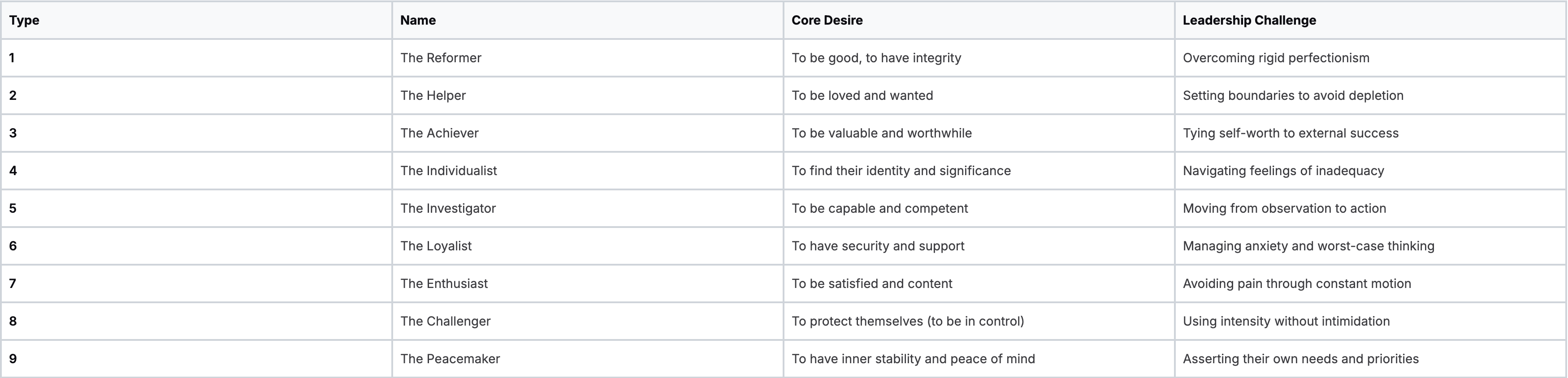
Each type represents a distinct worldview and a specific path back to wholeness. As we dive deeper into each one, you’ll start to see not just your own patterns, but those of the people you lead, love, and work with every single day.
The RAMS Reframe: From Unconscious Patterns to Embodied Power
Insight is not enough. To break the cycle of burnout, you need a system to translate awareness into action. The RAMS Method is a proprietary framework designed to help high-achievers move from being driven by their Enneagram type's unconscious fears to leading from a place of embodied power.
Results: Define outcomes based on your sovereign self, not your type's compulsive needs.
Attitude: Shift your internal state from reactive and fear-based to grounded and centered.
Mastery: Develop nervous system sovereignty, so you are in control of your triggers, not the other way around.
Systems: Create structures that support your energy and authentic power, making burnout impossible.
The rest of this guide will explore each Enneagram type's description through this lens of reclamation.

The Enneagram Leadership Matrix
This table breaks down the essential DNA of each type within a leadership context. Think of it as your cheat sheet for understanding the core engine, the standout strength, and the Achilles' heel for each of the nine types.
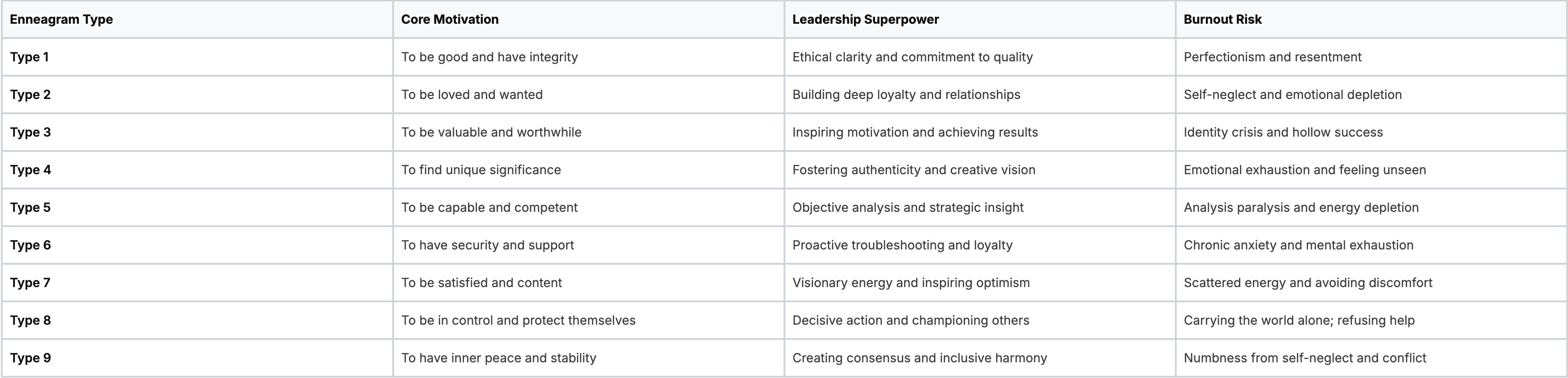
This matrix is just the starting point. Let’s now unpack the nuances, blind spots, and true potential locked inside each of these powerful leadership archetypes.
Type 1: The Reformer
The Reformer is wired with a deep, non-negotiable need to be good, to have integrity, and to make the world a better place. This is the woman who sees the highest potential in everything and everyone—and feels a profound, personal responsibility to make it a reality.
Core Desire: To be good, balanced, and have integrity.
Core Fear: Of being corrupt, evil, or defective.
Internal Dialogue: "If I can just make this perfect, everything will be okay. I must be right."
Leadership Strengths Type Ones are the ethical backbone of any organization. They are diligent, organized, and have an unwavering commitment to quality. Their high standards pull the entire team up, and you can trust them to see complex projects through with precision and fairness. They are champions of process, improvement, and doing things the "right way."
Leadership Blind Spots & Burnout Triggers The One's greatest strength—that relentless inner critic—is also their biggest liability. This voice drives them toward perfection, but it also breeds rigidity, resentment when others don't meet their standards, and a chronic sense of not being good enough. Burnout for a Type One feels like being crushed by the sheer weight of self-imposed responsibility and the frustration that the world remains imperfect despite their heroic efforts.
The Path to Embodied Power For the Type One leader, real power is found in embracing "good enough" and cultivating self-compassion. It's about recognizing that their worth isn't tied to their flawlessness. The work is to quiet that inner critic, access the wisdom of their intuition, and shift from a state of constant striving to one of serene, powerful presence.
Type 2: The Helper
The Helper is motivated by a fundamental need to be loved and wanted. These leaders are exceptionally tuned in to the needs and feelings of others, often anticipating what their team requires before they even ask. Their identity is deeply, and sometimes dangerously, intertwined with being indispensable.
Core Desire: To feel loved and wanted.
Core Fear: Of being unwanted or unworthy of being loved.
Internal Dialogue: "If I meet their needs, they will need me. If they need me, they won't leave me."
Leadership Strengths Type Twos are absolute masters of relationship-building. They create cultures of deep loyalty and support, making people feel seen, valued, and genuinely cared for. Their empathetic and generous nature makes them incredible mentors and team builders who can foster collaboration and morale like no one else.
Leadership Blind Spots & Burnout Triggers The Helper's intense focus on others often comes at a great personal cost. They neglect their own needs, leading to depletion and a growing, unspoken resentment. Their fear of being unwanted can make it incredibly difficult to set boundaries or deliver tough feedback, sometimes sacrificing the team's goals for the sake of interpersonal harmony. Burnout hits when they realize their over-giving has left them completely empty, with their own needs totally unmet.
Key Insight: For the Type Two, the line between supportive leadership and self-abandonment is dangerously thin. The desire to be needed can become a trap that drains their energy and diminishes their impact.
The Path to Embodied Power The journey for the Type Two leader involves turning their immense capacity for care inward. True power is found in recognizing their value is inherent, not something earned through service. It means learning to state their own needs directly and understanding that setting boundaries isn't selfish—it's essential for sustainable, impactful leadership.
Type 3: The Achiever
The Achiever is driven by the need to be valuable and worthwhile. They are highly adaptable, energetic, and laser-focused on success, often becoming role models of what’s possible. Their sense of self is deeply linked to their accomplishments and the external validation that comes with them.
Core Desire: To feel valuable and worthwhile.
Core Fear: Of being worthless or without inherent value.
Internal Dialogue: "I am what I do. If I stop performing, I will disappear."
Leadership Strengths Threes are incredibly effective and inspiring leaders. They are master motivators, able to rally a team around a goal and drive relentlessly towards it. They are pragmatic, efficient, and exceptionally skilled at presenting a polished, successful image. Their "can-do" attitude is contagious and often leads to outstanding results.
Leadership Blind Spots & Burnout Triggers The Achiever's focus on image can lead to a dangerous disconnection from their authentic feelings. They risk prioritizing the appearance of success over genuine fulfillment, for both themselves and their team. Burnout for a Three often manifests as an identity crisis—a hollow, empty feeling when the next big achievement fails to deliver lasting satisfaction. They become human "doings" instead of human "beings."
The Path to Embodied Power The Achiever finds their true power when they learn to value themselves beyond their list of accomplishments. This means slowing down, connecting with their actual inner state, and allowing themselves to be seen in moments of vulnerability, not just victory. It's about shifting the focus from "what I do" to "who I am."
Type 4: The Individualist
The Individualist is motivated by a deep need to find their unique identity and significance. They are profoundly in tune with their emotional world and are driven to create something beautiful and meaningful that expresses their authentic self. They often feel different from others and live with a core fear of being without a distinct identity.
Core Desire: To find themselves and their significance (to create an identity).
Core Fear: Of having no identity or personal significance.
Internal Dialogue: "There is something missing in me. I need to find what makes me special and unique."
Leadership Strengths Type Four leaders bring depth, creativity, and a profound sense of humanity to their roles. They aren't afraid of the emotional undercurrents of a team and can create a culture where people feel safe to be their authentic selves. Their visionary and intuitive nature allows them to spot unique opportunities and inspire others with their genuine passion.
Leadership Blind Spots & Burnout Triggers Fours can become trapped in their own feelings, which can lead to moodiness and a sense of being perpetually misunderstood. They may withdraw when feeling overwhelmed or resist practical, "mundane" tasks in favor of more inspiring work. Burnout for a Four comes from pure emotional exhaustion and the feeling that their unique contributions are not truly seen or valued by the organization.
The Path to Embodied Power The Individualist steps into their power when they learn to balance their deep emotional world with grounded, consistent action. It involves recognizing that their identity is not defined by their feelings, but by their presence and impact. Their path is about bringing their beautiful, unique vision out of their inner world and into concrete reality.
Type 5: The Investigator
The Investigator is driven by the need to be capable and competent. They perceive the world as intrusive and demanding, so they retreat into their minds to observe and understand it from a safe distance. For them, knowledge isn't just power—it's security.
Core Desire: To be capable and competent.
Core Fear: Of being useless, helpless, or incapable.
Internal Dialogue: "If I can understand everything, I won't be overwhelmed. I need more information before I can act."
Leadership Strengths Five leaders are calm, perceptive, and brilliantly objective thinkers. They can detach from emotional chaos and analyze complex problems with stunning clarity. They are the strategic visionaries who see the big picture and devise well-thought-out plans. They respect boundaries and create an environment of intellectual autonomy for their teams.
Leadership Blind Spots & Burnout Triggers The Five's tendency to detach can be perceived as aloofness or disengagement. They risk getting stuck in analysis paralysis, gathering information endlessly instead of taking decisive action. Burnout for a Five happens when their limited energy reserves are depleted by excessive social demands or when they feel their expertise is disrespected, causing them to withdraw even further.
The Path to Embodied Power For the Investigator, embodied power means moving from the mind into the body—from detached observation to active participation. It requires trusting that they have enough information to act and engaging with the world with confidence. Their journey is about sharing their wisdom freely and realizing that true competence is demonstrated through action, not just knowledge. Learning how to be more self-aware is a critical step in this process.
Type 6: The Loyalist
The Loyalist is motivated by a core need for security and support. They are highly attuned to potential threats and worst-case scenarios, constantly scanning the environment for what could go wrong. Their mind is a whirlwind of "what-if" questions as they seek certainty in an uncertain world.
Core Desire: To have security and support.
Core Fear: Of being without support or guidance.
Internal Dialogue: "I can't trust this. What's the hidden agenda? I need to be prepared for the worst."
Leadership Strengths Sixes are incredibly loyal, responsible, and dedicated leaders. They are brilliant troubleshooters, anticipating problems long before they arise. They build strong, committed teams because they foster a sense of mutual trust and dependability. Their questioning nature ensures all risks are considered, making them essential for high-stakes projects.
Leadership Blind spots & Burnout Triggers The Loyalist's anxiety can create a culture of doubt and indecisiveness. They might project their own fears onto their team or become overly reliant on external authority for validation. Burnout for a Six is the direct result of chronic anxiety—the mental exhaustion from constantly preparing for a disaster that may never come. It's the feeling of being perpetually on high alert.
The Path to Embodied Power The Loyalist finds their power when they learn to trust their own inner authority. It's about developing faith in their ability to handle whatever comes their way, rather than trying to predict and control every single outcome. Their path is to quiet the anxious mind and access the calm, courageous wisdom that lies within.
Type 7: The Enthusiast
The Enthusiast is driven by a need to be satisfied and content, and to avoid pain and deprivation at all costs. They are future-oriented, optimistic, and energetic, always on the lookout for exciting new experiences and possibilities.
Core Desire: To be satisfied and content.
Core Fear: Of being deprived and in pain.
Internal Dialogue: "This feels limiting. What's next? I need to keep my options open and stay positive."
Leadership Strengths Seven leaders are visionary, creative, and incredibly motivating. They bring an infectious energy and optimism that can inspire teams to tackle ambitious goals. They are quick thinkers, able to synthesize disparate ideas into innovative solutions. They excel at kicking off projects and generating excitement.
Leadership Blind Spots & Burnout Triggers The Enthusiast's fear of pain can lead to a real difficulty with follow-through and a tendency to avoid necessary but unpleasant conversations. They can overcommit themselves, scattering their energy across too many "exciting" new projects. Burnout happens when the constant forward motion stops working and they are forced to confront the very discomfort they've been outrunning. This leaves them feeling trapped and utterly depleted.
The Path to Embodied Power True power for the Seven comes from finding joy in the present moment, rather than constantly chasing it in the future. It involves learning to stay with difficult feelings and tasks, recognizing that true satisfaction comes from depth, not just breadth. Their journey is about embracing stillness and finding freedom in commitment.
Type 8: The Challenger
The Challenger is motivated by a powerful need to protect themselves and be in control of their own lives and destiny. They are assertive, decisive, and have a commanding presence, driven to protect the innocent and challenge injustice wherever they see it.
Core Desire: To protect themselves (to be in control of their own life and destiny).
Core Fear: Of being controlled or harmed by others.
Internal Dialogue: "I will not be controlled. I need to be strong to survive. Is this person with me or against me?"
Leadership Strengths Eights are powerful, confident leaders who are not afraid to take charge. They are fiercely protective of their people and will champion their team with unwavering energy. They make decisions quickly and are willing to have the tough conversations that others shy away from, driving action and clearing obstacles for their team.
Leadership Blind Spots & Burnout Triggers The Challenger's intensity can easily be perceived as aggression or intimidation, causing others to shut down. Their "my way or the highway" approach can stifle collaboration and crush diverse viewpoints. Burnout for an Eight comes from the relentless, crushing need to always be strong. It's the exhaustion that hits when they refuse to show vulnerability or accept support, burning out from carrying the weight of the world on their shoulders, all alone.
The Path to Embodied Power The Eight leader finds their most potent power in vulnerability. It's about learning that true strength includes the capacity to be open, to trust others, and to lead with heart as well as with will. Their journey is to moderate their intensity and realize that control is not the same as connection.
Type 9: The Peacemaker
The Peacemaker is motivated by a need for inner stability and peace of mind. They are agreeable, accommodating, and can see all sides of an issue, making them natural mediators. They go to great lengths to avoid conflict in order to maintain a sense of internal and external harmony.
Core Desire: To have inner stability ("peace of mind").
Core Fear: Of loss of connection; of fragmentation.
Internal Dialogue: "Don't rock the boat. It's better to go along to get along. My own needs aren't that important."
Leadership Strengths Nine leaders create inclusive, collaborative, and stable work environments. They are excellent listeners who can synthesize multiple perspectives and build consensus. Their calming presence can de-escalate conflict and bring a sense of steadiness to chaotic situations. They are patient and supportive, naturally allowing their team members to shine.
Leadership Blind Spots & Burnout Triggers The Peacemaker's deep aversion to conflict can lead to crippling indecisiveness and a failure to address critical issues directly. They may "merge" with the agendas of others, losing track of their own priorities and opinions. Burnout for a Nine is a deep sense of numbness and disconnection—the result of consistently ignoring their own needs and anger until they no longer even know what they truly want.
The Path to Embodied Power The Peacemaker's path to power is through awakening to their own presence and asserting their own agenda. It involves recognizing that their voice matters and that healthy conflict is actually necessary for growth. Their journey is about moving from a passive, peace-keeping role to one of active, engaged leadership, anchored in their own unshakable sense of self.
The Return: Reclaiming Your Nervous System Sovereignty
Understanding your Enneagram type is the map. Reclaiming your nervous-system sovereignty is the destination. This entire journey is about returning to yourself—the powerful, embodied leader who exists beneath the conditioned patterns and survival strategies. It’s about learning to lead not from a place of fear or obligation, but from a state of grounded, sovereign presence.
The Peacemaker Pattern in the Boardroom
You might assume the most common personality type in the world is the assertive Challenger or the hyper-driven Achiever. But you'd be wrong. Enneagram Type 9, the Peacemaker, is the most prevalent type. A massive survey of nearly 190,000 people found that Type 9s make up about 16.2% of the population. This statistic hits home for many women in leadership who feel that relentless pull to mediate, build consensus, and smooth over conflict.
This constant focus on peacemaking comes with a hidden, and very high, cost. When your main goal is to sidestep conflict, your own brilliant ideas get pushed to the back burner. This self-silencing pattern is a direct flight path to burnout, creating a painful gap between what you truly believe and how you show up.
Your inner world becomes a silent battlefield where your own needs go unheard, all in the name of external peace. This is the quiet erosion of a leader’s power.
Waking up to this pattern is the first real step toward getting your voice back. If you want to go deeper into the art of finding your footing, the book Cultivating Harmony Within offers some fantastic insights. Mastering these dynamics is how you learn to effectively navigate office politics with a renewed sense of confidence and authenticity.

The High Cost of High Standards
For the Enneagram Type 1, the relentless pursuit of perfection is a classic double-edged sword. It’s the engine behind incredible discipline, but it also powers a vicious inner critic. Their deep-seated fear of being flawed drives a compulsive need to correct everything.
This internal rigidity isn't just a mindset; it's a physiological state. The nervous system of a Type 1 leader is often locked in a low-grade state of alert, perpetually scanning for imperfections.
The journey for a Type 1 leader isn’t about trashing their high standards. It’s about learning to cultivate self-compassion. For those who recognize this battle, we’ve developed specific strategies for overcoming perfectionism that can help.
The Helper’s Paradox
For Enneagram Type 2 leaders, the line between supporting others and completely draining themselves is dangerously thin. Their leadership superpower is an almost psychic ability to anticipate needs, but this outward focus is fueled by a core fear of being unwanted.
The Internal Dialogue: "If I meet all their needs, they will need me. If they need me, they will never leave me."
This unconscious belief system is a direct flight path to exhaustion. The path back to sustainable leadership isn't about becoming less caring. It’s about learning that a "no" to someone else is often a profound "yes" to your own well-being. Some women find value in learning about the best crystals for confidence and inner strength.

Ultimately, this journey is a return to yourself. It’s a shift from a leadership style dictated by habit and fear to one rooted in sovereign presence. The next step is not to learn more, but to take the right action.
Your Enneagram Questions, Answered
Can Your Enneagram Type Change Over Time? No. Your core Enneagram type is a fixed aspect of your personality. Real growth isn’t about trying to become a different number. It's about becoming a healthier, more integrated version of your own type—transcending its automatic reactions.
How Is The Enneagram Different From Other Personality Tests? Most personality frameworks describe what you do. The Enneagram goes deeper to uncover the "why"—the core motivations and fears secretly running the show. This makes it a potent tool for genuine transformation.
Which Enneagram Type Is Best For Leadership? There is no "best" type for leadership. Extraordinary leadership has nothing to do with being a certain type. It's about having a profound understanding of your own type’s wiring and learning to consciously borrow the strengths of the other eight types.
How Do I Find Out My Enneagram Type For Sure? Online tests are notoriously unreliable. The most accurate path is through dedicated self-observation and study. Reading comprehensive descriptions of the Enneagram types like this one and reflecting honestly on which core fears and desires hit closest to home is the most reliable method.
Are you ready to stop guessing and start leading from a place of authentic power? The Baz Porter team can help you diagnose the exact patterns draining your energy and build a clear strategy for returning to yourself.