
Beyond Burnout: Leadership Styles and Their Real Impact on Effectiveness
The relentless pressure to perform is suffocating. You've achieved the title, the recognition, the visible markers of success, yet privately, you're running on empty. A silent, gnawing dread has set in: the fear that if you pause, even for a moment, the entire structure you've built will collapse. This isn't just stress; it's a profound disconnect between your external achievements and your internal state of exhaustion. You feel like an imposter, trapped on a treadmill of impossible expectations, where your value is measured solely by your output. The voice in your head is relentless: "If I stop performing, I'll disappear."
Key Takeaways
The Hidden Cost of "Effective" Leadership: Many traditional leadership styles, particularly in high-stakes environments, are built on an unsustainable "Performance Engine" that rewards burnout and leads to a state of chronic nervous system activation.
From Theory to Embodiment: True leadership effectiveness isn't about choosing one rigid style (like Autocratic or Democratic) but about developing the internal capacity to adapt your approach based on the situation, starting with nervous system regulation.
The RAMS Framework as an Alternative: A sustainable leadership model requires a new operating system. The RAMS framework (Results, Attitude, Mastery, Systems) provides a systematic path away from burnout by focusing on sustainable outcomes, nervous system sovereignty, authentic skill-building, and creating structures that protect your energy.
The Ultimate Metric of Success: Measuring leadership effectiveness must go beyond financial KPIs to include team psychological safety, employee retention, and—most critically—your own well-being. A depleted leader cannot sustain a thriving team.
The Hidden Pattern: Your Leadership Style Is Hijacking Your Nervous System

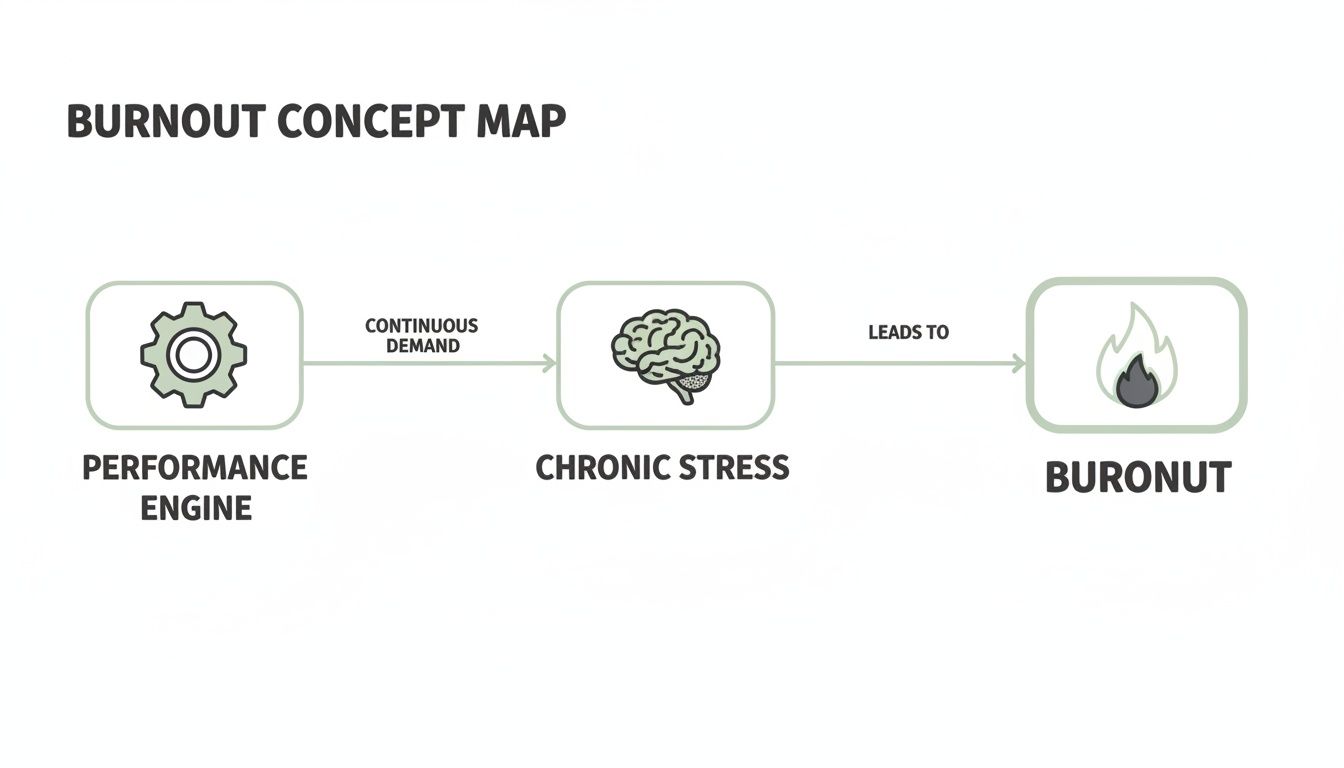
The constant pressure to deliver isn't just a feeling; it's a biological reality hammering your system. Most driven leaders operate from what I call the Performance Engine—a psychological model fueled by adrenaline, cortisol, and a desperate need for external validation. It’s undeniably powerful. It gets results. But it is fundamentally, dangerously unsustainable.
This engine runs hot, constantly demanding more just to keep from stalling. After a while, it redlines. You're not just tired; your nervous system is chronically hijacked, stuck in a fight-or-flight state designed only for short-term survival. The real problem is that many traditional leadership styles, especially those celebrated in high-stakes environments, are built right on top of this faulty engine. They reward the very behaviors that accelerate burnout.
And this isn't just a hunch; it's a measurable, alarming trend. DDI’s 2023 Global Leadership Forecast, a massive study of over 15,000 leaders, found a stark 17% decline in organizations reporting high-quality leaders. The global figure dropped to a dismal 40%, the largest dip in a decade. It's hard proof that rigid, command-driven styles are failing. You can read more on these alarming leadership statistics and see the data for yourself.
The Neuroscience of Command and Control
When your leadership style defaults to command-and-control, you essentially outsource your sense of safety to external scorecards. Did we hit the quarterly target? Did I get the promotion? This approach keeps your sympathetic nervous system—your body's accelerator—floored 24/7. This has deeply corrosive effects on your ability to lead:
Cortisol Overload: Chronic stress floods your system with cortisol, literally impairing the parts of your brain responsible for strategic thinking, creative problem-solving, and emotional regulation.
Adrenal Fatigue: Your adrenal glands get completely overworked. This leads to a profound physical and mental exhaustion that no amount of sleep can fix.
Amygdala Hijack: Your brain's threat-detection center becomes hyperactive. You start seeing threats in neutral situations, making it nearly impossible to trust your team or delegate effectively.
In essence, your body can't tell the difference between a looming project deadline and a predator in the wild. The physiological response is identical. Leading from this state of perpetual red alert is what paves the road to complete collapse.
This cycle isn't your fault. It's the inevitable result of being programmed by a flawed system that mistakes constant activation for effectiveness. Shifting this perspective is the first real step toward reclaiming your energy and leading with true authority. Our guide on overcoming burnout at work offers further strategies for this journey.
The RAMS Reframe: A New Operating System for Leadership
To break the burnout cycle, you need more than a new leadership tactic; you need a fundamentally different operating system. This is where we stop managing external actions and start cultivating internal sovereignty. This is the entire purpose of the RAMS framework. It’s a systematic process for dismantling the Performance Engine and installing a sustainable, embodied leadership model in its place.
The four pillars—Results, Attitude, Mastery, and Systems—are a direct antidote to the drivers of burnout. Each one rebuilds your leadership from the inside out, moving you from reactive survival to calm, conscious creation.
A Practical Comparison of Leadership Approaches
Before diving into the solution, it's crucial to understand the limitations of traditional models. The table below breaks down common leadership styles, showing where they shine and where they ultimately fail to address the leader's own well-being.

Seeing these models laid out highlights a critical truth: no single style is a silver bullet. The limitation of all traditional models is that they focus on what you do, not who you are being while you do it. The RAMS framework addresses this gap. If you’re ready to go deeper, you might be interested in our guide on what is authentic leadership.
Pillar 1: Redefining Results (From Exhaustive Output to Sustainable Outcomes)
The first pillar, Results, goes straight for the jugular of the Performance Engine: its addiction to sheer output. The RAMS model flips this, redefining a "result" as a sustainable, meaningful outcome. This means shifting your focus from frantic activity to leveraged impact. It takes courage to say "no" to low-impact tasks and identify the 20% of efforts that will generate 80% of the value. This pillar is about protecting your most valuable asset—your energy—by working smarter, not just harder.
A sustainable outcome is one that moves the needle without draining your life force. It creates momentum, empowers your team, and frees up your energy for high-level strategic thought.
Pillar 2: Attitude (Regulating Your Nervous System for Calm Authority)
The Attitude pillar is the heart of the framework. We’re talking about nervous-system sovereignty—the learned ability to consciously regulate your own physiological state. When you can maintain a calm internal state, everything changes. Your decision-making becomes crystal clear, your team feels safer, and you build true resilience. This is exactly why so many traditional leadership models are failing. In a 2023 Deloitte Global Human Capital Trends survey of over 10,000 leaders, 94% said leadership effectiveness was crucial, yet only 23% felt their leaders had the adaptive skills to thrive. The gap isn’t in technical skill; it’s in internal stability.
Pillar 3: Mastery (Honing Authentic Skills, Not Just Performing a Role)
The Mastery pillar is about reclaiming your authentic power. So many high-achieving women have learned to succeed by performing a role—the "perfect" executive. This performance is utterly exhausting. Mastery is the process of stripping away that persona and learning to lead from your core strengths and non-negotiable values. When you lead from this place, your presence becomes magnetic. Your team trusts you because they feel the alignment between what you say and who you are.
Pillar 4: Systems (Creating Structures That Make Burnout Obsolete)
Finally, the Systems pillar makes this transformation practical and sustainable. It’s about building external structures—both personal and professional—that protect your energy and automate success. These systems are the guardrails that keep you out of the burnout ditch for good. They include non-negotiable boundaries, clear delegation frameworks, and curated support networks. Together, these four pillars create a powerful, self-reinforcing loop.
The Return: Embodied Leadership Transforms Real Careers

Frameworks are just lines on a page until they crash into the real world. The true measure of the RAMS method is its power to forge tangible, life-altering change in the careers of women who decided to trade burnout for embodied authority.
Case Study: From Decision Fatigue to Decisive Vision
Take Sarah, a VP of Engineering at a fast-growing tech firm. Her "before" was chronic decision fatigue. Privately drowning in micro-decisions, her leadership had become purely reactive. Working with RAMS, her first move was learning to regulate her own nervous system (Attitude). By calming the internal storm, she could finally access higher-level thinking.
The shift was profound. She implemented ruthless Systems to delegate low-impact decisions, fiercely protecting her energy. Her effectiveness was no longer measured by the number of fires she put out, but by the quality of the handful of critical decisions she owned each week. She reclaimed her strategic vision, guiding her department with a clarity that inspired confidence, not anxiety.
This is a critical point. While a Forbes-reported surge saw women in senior management roles hit a record high of 32% in 2022, other findings show a grim reality. Only 40% of organizations report having high-quality leaders. This paradox screams for a new approach. You can discover more insights from the 2023 character and global leadership survey to see the full scope of this challenge.
Case Study: Trading Anxiety for Calm Authority
Then there's Maria, a founder who had built her company from scratch. She led with a white-knuckled grip, her anxiety a palpable force in every meeting. Her team was loyal but terrified. Maria’s journey was about redefining Results and stepping into her authentic Mastery. She had to dismantle the toxic belief that constant worry was the price of success.
Redefined Results: She shifted from obsessively preventing failure to actively enabling her team's success, empowering them to take ownership and make mistakes.
Authentic Mastery: Maria came to see that her true strength was her deep passion for the mission. By leading from that core, she traded anxious micromanagement for inspirational trust.
The "after" was a complete cultural transformation. Her newfound calm authority created the psychological safety her team desperately needed. Maria went from being the bottleneck to being the catalyst. Our article on transformational leadership training explores more strategies for this powerful shift.
These stories prove that a different way of leading isn't just possible; it's the only key to sustainable success. This is not about becoming a better leader. It is about returning to yourself.
At Baz Porter, we architect the return to yourself. If you are ready to trade burnout for embodied authority and build a leadership legacy that is both successful and sustainable, the journey starts here. Explore how the RAMS framework can reshape your career and your life.