Why You Feel Empty When You Stop
You are fine until you stop. The meeting ends. The inbox goes quiet. The house settles. And a flat, cold nothing rises up where the day used to be. This is Silent Collapse™. It is the empty feeling that waits for you in the stillness. You built a good life. It works. And still, when the motion stops, you feel almost nothing. If that lands, read the manifesto before anything else.
What this page covers
Key takeaways
The emptiness is not weakness. It is information.
Motion hides it. Stillness reveals it.
The feeling points to a self you set aside to build the life.
The move is return, never becoming someone new.
Why you feel empty when you stop
You feel empty when you stop because motion was doing the work of meaning. A full calendar drowns out a quiet inside. When the noise ends, the quiet gets loud. The emptiness was there the whole time. Stillness did not cause it. Stillness revealed it.
Silent Collapse™ is the name for this. It is a successful life that feels like nothing inside. On paper it all works. The title. The money. The family photo. Inside there is a flat, quiet nothing. You are not sad. You are not falling apart. You are numb. And the numbness is loudest the moment you sit down.
Most people read this as a rest problem. So they rest, and the empty stays. It is not a rest problem. It is a presence problem. Rest restores the body. It does not restore meaning. That is why a long weekend leaves you rested and still hollow. Many high earners describe it in the same words: empty, numb, going through the motions, a stranger to myself. You are not alone in it. You are early to naming it. See also why success can still feel empty.
The hidden pattern under the numbness
There is a name for feeling nothing where feeling should be. Clinicians call it anhedonia, the loss of pleasure and interest, per the American Psychological Association. There is also a wider state called languishing. The sociologist Corey Keyes defined it as the absence of well-being, not the presence of illness, in his research on the mental health continuum. You are not ill. You are not well. You are in the grey in between.
Here is the pattern. You spent years building a life. To build it, you set parts of yourself aside. The part that rested. The part that felt. The part that wanted things for no reason. Self-abandonment kept the machine running. More on that in self-abandonment. The bill for it does not arrive during the busy day. It arrives in the stillness. That is why the emptiness gets loudest when you finally stop.
The trap tightens over time. The emptiness feels like proof something is wrong with you. So you add more work to outrun it. The work buys quiet for a while. Then the next still hour arrives, and the nothing is a little louder. This is a loop, not a flaw. And loops can be re-architected.
The RAMS™ return
The way back is not more effort. It is a different structure. RAMS™ is the framework I use with leaders in Silent Collapse. It reads across five pillars: Results, Attitude, Authenticity, Mastery, and Systems. The aim is not to feel better today. The aim is to return to the self that can feel at all.
Here is the contrast between the collapsed pattern and the sovereign one:
Results: Collapsed measures output. Sovereign measures whether the output means anything to you.
Attitude: Collapsed pushes through the numbness. Sovereign treats the numbness as a signal to read.
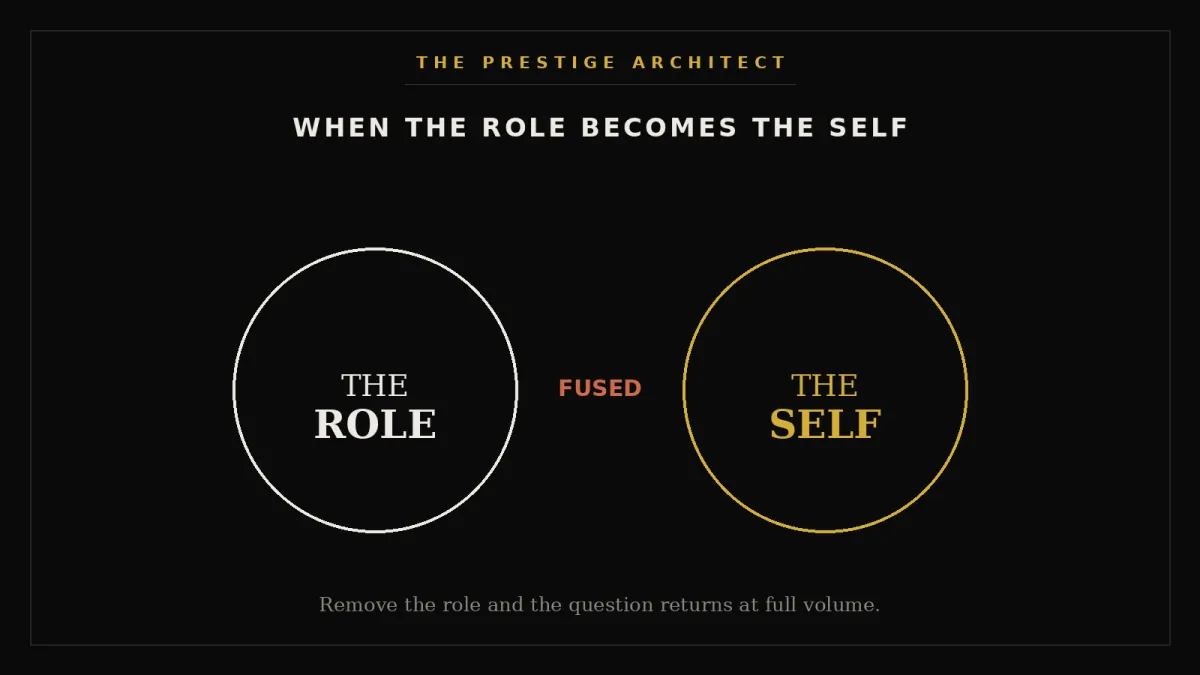
Authenticity: Collapsed performs the role. Sovereign returns to the self under the role.
Mastery: Collapsed masters the work. Sovereign masters the inner life the work rests on.
Systems: Collapsed builds a life that runs without you. Sovereign builds a life you are present inside.
You do not need a new life. You need to come home to the one you already built.
Read the pillars again and notice the shift. Every collapsed line points outward, at output and image. Every sovereign line points inward, at the person doing the work. The numbness is what happens when the outward wins for too long. The return is the inward coming back online. If the stillness keeps showing you the emptiness, that is the door, not the danger. Start with the Silent Collapse Diagnostic™. It names where you actually are in one honest hour.
One leader's stillness
A leader I counsel had every marker of a life that works. Two decades of wins. A strong balance sheet. A family that loves them. They came to me with one sentence. "I feel nothing when I stop." Weekends were the worst. The quiet felt like a threat. They had filled every gap with work to keep the quiet away.
We did not add more rest. We read the emptiness. Under it was a self set aside twenty years ago, on the way up. Piece by piece, we returned that self to the week. A morning hour with no purpose but presence. One relationship tended for its own sake. One want followed for no return. The wins stayed. The numbness went. Not because the schedule changed. Because they came home to it. This is the same ground as executive anhedonia.
The architecture of your return
The return is not a mood. It is a structure you build on purpose. It starts with naming the state instead of outrunning it. Say it plainly: I feel empty when I stop. Naming ends the shame loop. Then you return one abandoned part of yourself to the calendar, and protect it like a client meeting. Then another. Then you build systems that keep you present, not only productive.
None of this asks you to burn down the life you built. The life is not the problem. Your absence from it is. The work is to move back in. You do not have to do it alone, and you do not have to guess. Apply for the Silent Collapse Diagnostic™. In one hour we map where the self went and where the return begins. If you want the philosophy behind the work first, the manifesto holds it.
Questions people ask
Why do I feel empty when I stop working?
Because motion was masking the emptiness, not curing it. A packed schedule keeps the quiet inside from being heard. When you stop, the quiet gets loud. The feeling was always there. Stillness only turned up the volume.
Is feeling nothing a sign of depression or burnout?
Not always. Feeling nothing can be anhedonia or languishing, a grey in-between state rather than clinical illness. It can sit alongside burnout, or stand on its own. If it is heavy or lasting, speak with a licensed clinician. Naming it is still the first honest step.
Why does the emptiness get louder at night or on weekends?
Because those are the hours with no task to hide behind. During the workday, output fills the space. At night and on weekends the space opens up. That is when the set-aside self makes itself heard.
Can you feel empty even when your life is successful?
Yes, and it is common among high achievers. Success and emptiness are not opposites. You can hold the title, the money, and the family photo and still feel a flat nothing inside. Silent Collapse™ names exactly that.
How do I start to feel something again?
Stop trying to feel better and start trying to feel true. Name the state out loud. Return one set-aside part of yourself to your week. Then build a structure that keeps you present. The Silent Collapse Diagnostic™ maps the first move.
About the author
Baz Porter® is the founder of Baz Porter LLC and The Prestige Architect™. He counsels high achievers through Silent Collapse™ back to Sovereign Leadership™, using the RAMS™ framework. His work is return, never a new self. Begin with the manifesto or the Silent Collapse Diagnostic™.