Executive Anhedonia: When Success Stops Feeling Good
Written by Baz Porter®
You hit the number. You closed the round. You should feel something. You feel nothing. This is anhedonia, and in high achievers it wears a suit. Silent Collapse™ is the quiet name for it: the wins keep coming and the reward stops arriving. I do not motivate. I architect the return, and the return starts by reading this page as what it is, a map. If you want the whole map, start with the manifesto.
On this page
What executive anhedonia actually is
Executive anhedonia is the loss of pleasure in a leader who still performs at the top. The wins stop landing. Praise goes flat. The reward that once drove you returns nothing. This is not weakness. This is not ingratitude. It is a measurable shift in how your brain reads reward after years of high stakes. Silent Collapse™ names the state. Sovereign Leadership™ is the rebuild.
Key takeaways
Anhedonia in high achievers is a reward problem, not a character problem.
The wins go quiet first. The rest of life goes quiet next.
Chasing a bigger win makes the flatness worse, not better.
The reward system can be rebuilt with the right architecture.
The first step is a name, not a pep talk.
The hidden pattern under the numbness
Here is the part no one told you. Reward is a system, and systems adapt. Your brain learned to fire on big, rare, high-stakes wins. So it stopped firing on small ones. Researchers call the result a blunted reward response, a core feature of anhedonia mapped in the brain's dopamine circuits (Der-Avakian and Markou, Trends in Neurosciences, 2012). The more extreme the reward you train on, the less ordinary life can reach you. You did not lose the ability to feel. You raised the price of feeling past what a normal day can pay.
This is why the promotion felt like paperwork. This is why the holiday felt like a task. Psychology Today frames anhedonia as a reduced capacity to anticipate and enjoy reward. In leaders, the anticipation is the first casualty. You already know the win will feel like nothing, so you stop looking forward to anything. That flat forecast is the tell.
There is a second layer, and it is the one leaders miss. The people most exposed are the strongest performers. They ran on predictable, high-stakes reward the longest. Harvard Business Review has tracked how chronic overload hollows out even the most capable among us. The reward does not vanish all at once. It fades one flat win at a time, until a whole year passes without a single moment that lands. You call it a plateau. Your wiring calls it depletion.
Notice the order. The wins go quiet first. Work is where the extreme reward lived, so work is where the signal dies first. Then the flatness spreads. Food, rest, family, the things that used to hold you all start reading as neutral. This is the arc of Silent Collapse™. Composure on the outside. Nothing arriving on the inside.
The RAMS™ reframe
RAMS™ is my operating system: Results, Attitude, Authenticity, Mastery, Systems. Anhedonia lives in all five. Here is how a leader turns each one.
Results. Stop measuring output. Start measuring feeling. The metric is not the number you hit. The metric is whether the number registered at all.
Attitude. Name the state without shame. You are not ungrateful. Your reward system is depleted. Naming it ends the private verdict that you are the problem.
Authenticity. Stop performing joy you do not feel. The mask that says "I am thrilled" is expensive. Every hour you fake the feeling, you widen the gap between the room and the real you.
Mastery. Rebuild the reward response on purpose. Small, real, repeated. A meal you taste. A walk you notice. Mastery here is patience with your own wiring.
Systems. Design a life your reward system can read. Fewer extreme peaks. More ordinary signal. The architecture protects the feeling so willpower never has to.
Collapsed against Sovereign
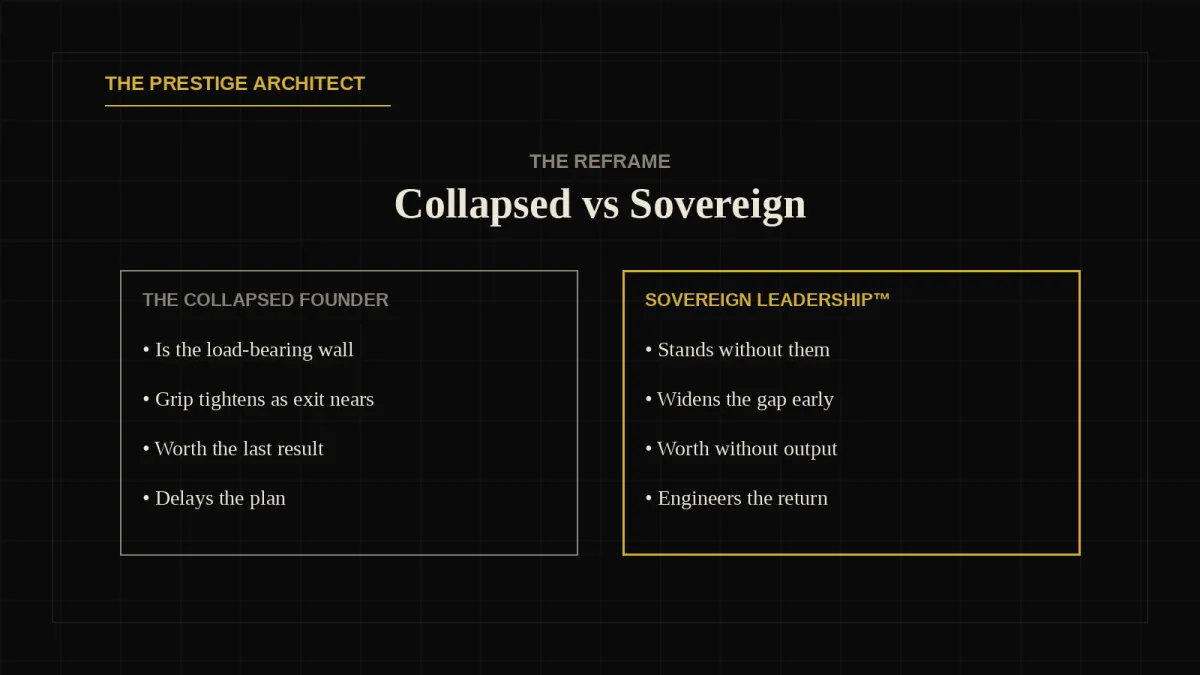
Collapsed: you chase a larger win to feel something. Sovereign: you rebuild the system that reads ordinary life.
Collapsed: you fake the joy in the room. Sovereign: you tell the truth about the flatness and start the repair.
Collapsed: you treat numbness as a personal failing. Sovereign: you treat it as a signal with a known cause.
Collapsed: you add more stakes. Sovereign: you lower the price of feeling.
Baz Porter does not motivate. He does not inspire. He architects the return from Silent Collapse™ to Sovereign Leadership™.
If the flatness is running your days, the first move is a clear read of where you actually are. That is the Silent Collapse Diagnostic™, sixty minutes, live, with me. Not a form. A conversation that names the state and maps the return.
One leader, one turning point
A founder sat across from me after a nine figure exit. He said the wire cleared and he felt nothing. He had waited eleven years for that moment. It arrived and it was silent. He thought something was wrong with him. Nothing was wrong with him. His reward system had run on one enormous target for a decade, and when the target vanished, so did the signal. We did not add a new goal. We rebuilt the reward response from the ground, small and real, until an ordinary Tuesday could reach him again. He did not need a bigger mountain. He needed a system that could feel a hill. Within weeks the small signals returned. A coffee he actually tasted. A morning he did not dread. The wins were never the problem. The wiring was.
The architecture of your return
Understand what this is not. It is not a pep talk. It is not one more goal to chase. Chasing is the habit that flattened you. The rebuild runs the other way. It lowers the price of feeling until an ordinary day can pay it again.
You do not need more drive. You need a reward system that works. That is a build, and builds have blueprints. The rebuild from anhedonia to a life you can feel is the core of Sovereign Leadership™: power without collapse, success without self betrayal. If you are ready to stop performing a joy you cannot feel and start the real repair, apply for the Silent Collapse Diagnostic™. We name the state, we find the cause, we draw the return.
Frequently asked questions
What is executive anhedonia?
Executive anhedonia is the loss of pleasure and interest in a leader who still performs well. The wins stop feeling like wins. It is a reward problem in the brain, not a failure of gratitude or grit.
Why can't I feel joy even though I'm successful?
Your reward system adapted to big, rare, high-stakes wins. Ordinary pleasures now fall below its threshold. The success is real. The signal that should read it has gone quiet, and that can be rebuilt.
Is anhedonia the same as burnout?
No. Burnout is exhaustion from overload. Anhedonia is the flattening of pleasure and reward. They often travel together, but the repair is different. Anhedonia asks you to rebuild feeling, not just to rest.
Can high achievers recover the ability to feel pleasure?
Yes. The reward response is trainable. Small, real, repeated experiences slowly lower the price of feeling. It takes patience and a design that protects the signal, not another extreme goal.
How is anhedonia different from depression?
Anhedonia is one feature that can appear inside depression, but it can also stand alone in a high functioning leader. You can be productive, driven, and outwardly fine while pleasure has quietly switched off. If low mood or hopelessness is also present, speak with a licensed clinician.
About the author
Baz Porter® is the founder of Baz Porter LLC® and the architect of Sovereign Leadership™. A British Army veteran and international bestselling author, he hosts the Rise From The Ashes podcast on the C-Suite Network. He guides high achieving leaders from Silent Collapse™ to a life they can feel: power without collapse, success without self betrayal.