Self-Abandonment: Why High Achievers Disappear
Written by Baz Porter®
You are the one who holds it together. For everyone. Self-abandonment is the quiet cost of that role. It is the slow disappearance of the person behind the performance. You meet every demand except your own. This is the private architecture of Silent Collapse™: outwardly composed, inwardly vacant. You have not failed. You have deserted yourself, one reasonable sacrifice at a time. The manifesto names what that costs, and what it takes to return.
Table of Contents
Key Takeaways
Self-abandonment is overriding your own needs, limits, and values to meet outside expectations.
In high achievers it hides as discipline. That is why no one sees it.
It is not burnout and it is not weakness. It is a learned survival pattern.
The pattern was rewarded early. It grows expensive later.
The return begins by naming it, not by working harder.
What Self-Abandonment Really Is
Self-abandonment is the habit of overriding your own needs, limits, and values to meet external expectations. In high achievers it wears the mask of discipline. You keep delivering while your inner signals go unanswered. Over time the self that once had preferences goes quiet. This is the felt center of Silent Collapse™. It is not weakness. It is not burnout. It is a learned survival pattern, rewarded early and expensive later. The rebuild starts by naming the pattern, not by adding another goal.
Notice the wording. You are not tired. You are absent. Burnout is a fuel problem. Self-abandonment is a presence problem. You can rest for a week and still return to a life you are not actually living.
It rarely arrives as one dramatic choice. It accrues. A cancelled break. A swallowed opinion. A yes that should have been no. Each one is small and defensible. Stacked over years, they hollow you out. The person who once held a clear preference now waits to hear what the room wants first. That pause is the tell.
The Hidden Pattern Behind the Performance
The pattern has a name in the research. Psychologist Dana Crowley Jack called it "silencing the self." In her 1991 work on depression, she mapped how capable people suppress their own voice to hold a relationship or a role. The self goes underground. The performance stays flawless.
The cost is measurable. One long study found that people who habitually stayed silent during conflict carried a markedly higher risk of premature death than those who spoke (TIME). Self-silencing is also linked to depression and physical illness across the literature (ScienceDirect). High performers are the most exposed. You were praised for it. Forbes calls this one of the self-destructive traits leaders quietly normalize (Forbes). The reward taught your nervous system that disappearing was safe.
There is a second cost that leaders feel but rarely name. When you desert yourself, you lose access to your own judgment. Your instinct was the instrument that made you good. Silence it long enough and decisions get slower, not sharper. You start outsourcing your read of a situation to consensus. The company loses the exact edge it hired you for.
The RAMS™ Reframe: From Deserted to Sovereign
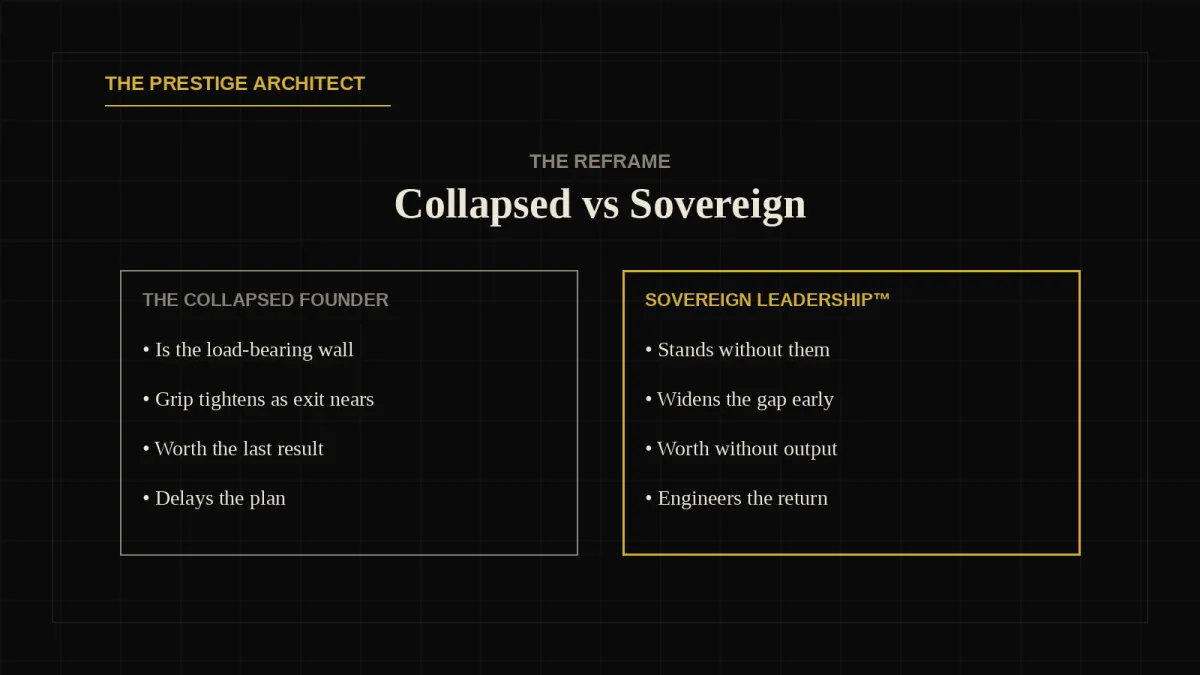
My work runs through one operating system. RAMS™ holds five pillars: Results, Attitude, Authenticity, Mastery, and Systems. It reads self-abandonment at the level of the person, not the schedule. Here is the shift, pillar by pillar.
Results (Collapsed): you measure your worth in output. Sovereign: results serve a life you are present for, not the other way around.
Attitude (Collapsed): your own needs feel like an indulgence. Sovereign: your needs are data the system requires to run.
Authenticity (Collapsed): you show the composed surface and hide the vacancy. Sovereign: what you present and what is true are the same thing.
Mastery (Collapsed): you master every skill except staying with yourself. Sovereign: self-contact becomes the discipline you protect first.
Systems (Collapsed): your boundaries are informal, so they are the first to fall. Sovereign: your limits are built into the structure, not left to willpower.
This is Sovereign Leadership Architecture™. Power without collapse. Success without self-betrayal.
Baz Porter does not motivate. He architects the return from Silent Collapse™, the rebuild of the self that success quietly erased.
You cannot reason your way out of a pattern you cannot see. The Silent Collapse Diagnostic™ is 60 minutes, live with me. It locates where you went missing and names the first repair. Book the Silent Collapse Diagnostic™.
A Case From the Room
A founder I counseled ran a company most people would envy. Board respected them. Revenue climbed. At home they described a strange numbness. Nothing landed. Wins felt like items on a list. When I asked what they wanted, the room went silent for a long time. They did not know. They had answered everyone else for so long that their own voice had no volume left.
We did not add a habit. We rebuilt the structure. We wrote their needs into the operating system as non-negotiable, the same way they wrote a payroll run. Within weeks the numbness lifted. Not because they worked less. Because they came back into the room.
The Architecture of Your Return
Your return is not a mood. It is architecture. You do not find yourself by trying harder at the life that erased you. You rebuild the structure so your presence is required, not optional. That is the work I do inside Sovereign Leadership™. It is a rebuild, not a retreat.
The mechanism is simple to state and hard to hold. What is optional gets sacrificed under load. So your presence cannot be optional. We move your needs out of the category of self-care and into the category of infrastructure. A protected hour is not a reward. It is a load-bearing wall. Remove it and the structure sags, then cracks. Build it in and the whole system holds. This is the difference between a resolution and an architecture.
The first move is to name where you went missing and what it has cost. That is what the Diagnostic is for. Apply for the Silent Collapse Diagnostic™ and start the return. Begin here.
Frequently Asked Questions
What is self-abandonment?
Self-abandonment is the habit of ignoring your own needs, limits, and values to satisfy other people or a role. You override your inner signals until they go quiet. In leaders it often looks like dedication. Underneath, the self has gone missing.
What are the signs of self-abandonment in high achievers?
You cannot name what you want. Rest feels unearned. Your emotions feel flat or far away. You keep performing while feeling absent from your own life. Praise for your output no longer reaches you.
Is self-abandonment the same as burnout?
No. Burnout is a depletion of energy. Self-abandonment is a loss of presence. You can rest and recover energy yet still return to a life you are not living. They often travel together, but they are different problems with different repairs.
Why do successful people abandon themselves?
Because it worked. Early on, disappearing your needs earned safety, approval, and results. The nervous system learned that self-silence was rewarded. Success then locked the pattern in place. This is the private engine of Silent Collapse™.
How do you stop self-abandonment?
You name the pattern first, then rebuild the structure around your presence. Willpower alone fails because the pattern is built in. The Silent Collapse Diagnostic™ locates where you went missing and names the first repair. From there you build limits into the system, not into your resolve.
About the Author
Baz Porter® is the founder of Baz Porter LLC® and The Prestige Architect™. A British Army veteran, he is an international bestselling author and the host of the Rise From The Ashes podcast on the C-Suite Network. He architects the return from Silent Collapse™ to Sovereign Leadership™: power without collapse, success without self-betrayal.