Stop Performing: How to Describe Your Leadership Style
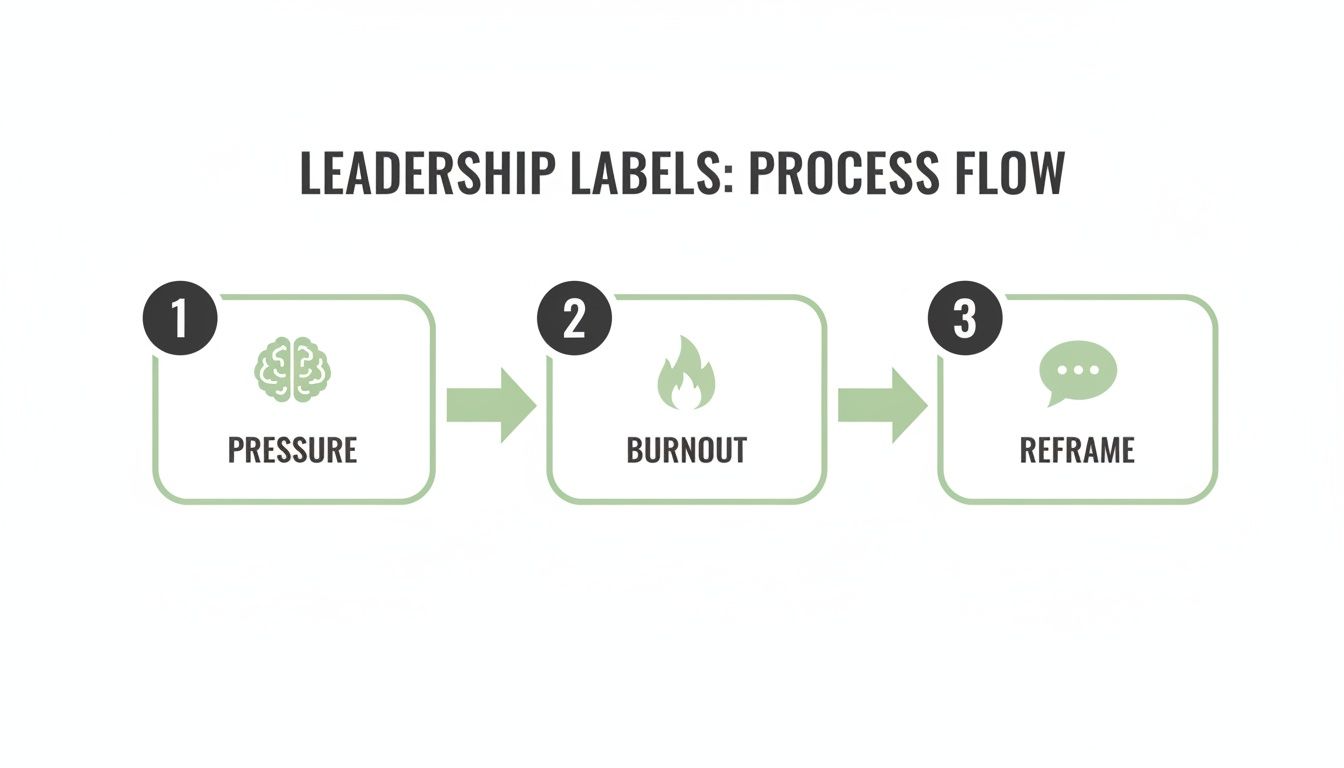
You know the moment. The interviewer leans in and asks, "So, describe your leadership style." For many high-achievers, this question triggers a silent collapse. Your mind scrambles through a Rolodex of "right" answers. Servant? Transformational? Collaborative? The pressure to perform, to deliver a polished, perfect response, is immense. It pushes you toward a generic label that feels hollow and completely inauthentic. This isn't just interview anxiety. It's a physiological signal that you're about to betray your own experience.
This reaction isn't a sign of weakness. It’s a symptom of trying to cram your complex, nuanced, and hard-won leadership into a one-size-fits-all box designed by someone else. The interviewer isn't testing your knowledge of textbook theories. They're probing for something deeper: evidence of your self-awareness and the authentic impact you create when the pressure is on.
Key Takeaways:
Generic Labels Fail You: Terms like "transformational" or "democratic" are outdated blueprints. They force you to perform leadership rather than embody it, creating a misalignment that leads to burnout.
Build a Narrative, Not a Label: The RAMS (Results, Attitude, Mastery, Systems) Method provides a framework to build an answer based on your actual impact, not abstract theory. It helps you tell a story grounded in proof.
Adaptability Is Authority: Craft a modular answer that you can adapt to any context—from a 30-second bio to a 15-minute interview deep-dive—without losing its power or authenticity.
Embodied Leadership Is the Goal: True leadership isn't a performance. It's the grounded, authentic expression of your core values, a state of nervous-system sovereignty where your actions and identity are fully aligned.

To describe your leadership style effectively, you must shift from reciting borrowed labels to narrating your proven impact. This involves articulating your unique process for driving quantifiable outcomes, the core mindset that guides your decisions, and the repeatable systems you build to empower others.
The Hidden Pattern: Why Generic Labels Feel Like a Betrayal
Ever grabbed for a label like "democratic" or "transformational" in an interview? It feels like the right answer, but for many high-achieving women, it also feels like putting on a suit that's a few sizes too small. It's stiff, uncomfortable, and doesn't quite fit. That feeling of discomfort is your nervous system telling you something important: You are not failing the question. The labels are failing you.
This pressure to conform to a pre-approved mold creates what I call the "Borrowed Blueprint." It’s the unconscious belief that to be taken seriously, you must adopt a style someone else designed—often one that's traditionally masculine-coded and heavy on command-and-control. You end up trying to cram your nuanced, real-world experience into a box you didn't build.
This isn't just a mental game. The internal conflict between your authentic self and the role you feel you have to perform triggers a genuine biological stress response. It’s like trying to run an operating system on incompatible hardware. Your body flags the misalignment as a threat.
This chronic misalignment is a primary driver of executive burnout. It’s an exhaustion that comes not from working hard, but from the constant, low-grade effort of suppressing your natural leadership instincts to fit a flawed, outdated model.
That "imposter" feeling isn't just in your head; it’s a full-body experience of being out of integrity with who you are. The unfortunate truth is that many traditional women's leadership development programs can make this worse. They often teach women how to adapt to broken systems instead of empowering them to architect new ones that amplify their unique, powerful impact.
So, instead of asking, "Which label fits me?" let's ask a much better question: "What is the authentic story of my impact?"
The RAMS Reframe: Architecting Your Authentic Leadership Narrative
Moving beyond tired, ill-fitting leadership labels requires a new foundation. Instead of squeezing into a blueprint that was never designed for you, it's time to architect your own. This is the critical shift from performing leadership to truly embodying it.
The RAMS Method is the framework I developed to ground your leadership style in tangible, undeniable proof of your impact. It deconstructs your achievements and rebuilds them into a story that is both compelling and deeply authentic. This is how you break the cycle of pressure and burnout.
The four pillars—Results, Attitude, Mastery, and Systems—give you a structure to describe your leadership style with unshakeable confidence. Let's break down each one.
Results: Quantify Your Impact
This is the bedrock of your narrative. It’s where you replace fuzzy claims with hard proof. So many high-achievers are already chasing the next goal they forget to catalog the incredible value they've already created.
What It Is: Concrete, measurable outcomes you have driven. Think in percentages, revenue figures, and efficiency gains.
Reflection Prompt: List three major projects you led. What was the exact, quantifiable outcome? Be specific.
This turns a cliché like "I'm a results-oriented leader" into a power statement: "I led the team that increased customer retention by 18% in six months by redesigning our onboarding process."
Attitude: Define Your Why
Your attitude is the energetic signature of your leadership—the core mindset that informs every decision, especially under pressure. This is the "how" behind your "what." Are you driven by relentless curiosity, fierce resilience, or an unwavering commitment to integrity?
Your attitude isn't about slapping on a positive smile; it’s about the fundamental principles that guide your actions when nobody is watching. It’s the source of your consistency and trustworthiness.
My leadership philosophy is engineered to connect strategic ambition with nervous-system resilience. This attitude ensures that high performance is sustainable, not a fast track to burnout.
Mastery: Showcase Your Unique Genius
Mastery is your specific, differentiated skill set—the unique combination of talents that makes you irreplaceable. This isn't a generic list of strengths; it's your “zone of genius.”
What It Is: The unique skills you’ve honed through experience, like navigating complex negotiations or building high-trust teams in dysfunctional environments.
Reflection Prompt: What is the one complex problem people consistently come to you to solve?
This helps you go from "I'm a good communicator" to "I have a mastery of translating complex technical roadmaps into compelling commercial narratives that secure investor buy-in."
Systems: Create Repeatable Success
This pillar is the ultimate force multiplier. Your systems prove your successes aren't accidents; they are the result of intentional, repeatable design. This shows you think beyond your own contributions and build frameworks that empower your entire team.
True leadership isn't just about what you can do—it's about the sustainable, scalable structures you create. As you build out this part of your story, you might want to explore how to develop a strong brand storytelling framework that aligns with the systems you create.
By weaving these four elements together, you build a leadership story that is both powerful and undeniably yours. You can learn more about how to apply the revolutionary RAMS framework in our detailed guide. It's time to stop trying to fit into a box and start building a platform from which you can lead with integrity.
From Theory to Impact: Crafting Your Modular Leadership Answer
Once you've deconstructed your leadership using RAMS, it’s time to assemble those pieces into a dynamic story. Generic labels are static, but your leadership is not. Your answer needs to be just as adaptable. The goal is to build a modular framework—a collection of your core components (Results, Attitude, Mastery, Systems) that you can snap together depending on the situation.
This approach moves you from reactive panic to grounded, prepared authority.
Building Your Core Statement
Start by distilling your RAMS reflections into a single, potent sentence. This is the spine of your answer.
A simple structure works wonders: I use my [Mastery] to build [Systems] that enable teams to achieve [Results], all driven by an Attitude of [Core Value].
Here’s what that looks like in practice:
"My leadership style is centered on using my mastery of strategic foresight to build high-trust, autonomous systems. This framework empowers teams to deliver complex tech projects an average of 15% ahead of schedule, all guided by a core attitude of transparent communication."
That single sentence is packed with substance. It immediately shows your unique value, your process, and your proven impact.
From Generic Phrases to Embodied Leadership Statements
The power of RAMS becomes clear when you contrast it with the weak, generic statements most people use. Honing this kind of messaging is a critical part of developing executive presence. The table below shows this transformation in action.

This modular approach gives you a flexible toolkit. You can lead with your core statement, then elaborate with specific examples. Your description of your leadership style becomes a demonstration of your value.
The Return: Embodying Your Sovereign Leadership Style
This exercise of defining your leadership style isn't really for the interviewer. It’s for you.
When you can articulate your approach with clarity and conviction, it becomes an act of self-reclamation. You shift from seeking external validation to a state of grounded internal authority. This is what I call nervous-system sovereignty—the ability to lead from your core, guided by your values, not by reactive pressure or the need to perform. Describing your leadership style authentically is a declaration of who you are.

From Performance to Presence
True leadership isn't a mask. It’s a direct expression of your integrated self. Every time you use the RAMS framework, you strengthen the neural pathways of this sovereign state. You condition yourself to lead with unwavering presence.
The goal is to close the gap between how you lead and who you are. This alignment is the source of sustainable performance, ending the cycle of burnout for good.
This shift is the bedrock of a lasting legacy. It’s about building a career that energizes you instead of drains you. I dive deeper into this philosophy of embodied sovereignty in my dedicated article.
Your Next Step Toward Embodied Authority
Crafting your answer is a crucial first step. The real work is embodying it in every decision you make. A great way to start is to practice articulating your approach publicly, for example by learning how to build a personal brand on LinkedIn that genuinely reflects your style. This ensures your external narrative finally matches your internal authority.
It's time to stop chasing someone else's definition of leadership and return to yourself.
At Baz Porter, we know that powerful leadership isn't about slapping on a generic label. It’s about architecting a style that is uniquely yours, deeply authentic, and ruthlessly effective. It's about building a presence that is both powerful and sustainable.
If you're ready to stop performing and start embodying the leader you were meant to be, it’s time to explore how we can work together. Discover the path to your authentic authority at https://bazporter.com.