
How High-Achieving Women Define Full Potential Beyond Burnout
You've checked every box. Climbed every ladder. You’ve built a life that, from the outside, looks like the very definition of success. And yet, in the quiet moments after the applause dies down, a silent collapse is happening just beneath the surface—a hollowness that whispers, “If I stop performing, I’ll disappear.” You live with a persistent, low-grade hum of anxiety, the first tremors of burnout disguised as ambition. This isn't just about being tired. It’s a profound disconnect from the person you are underneath all those layers of achievement.
Key Takeaways
Your Definition is a Trap: The conventional idea of "full potential"—chasing external validation like promotions and accolades—is a neurologically addictive cycle that leads directly to burnout, not fulfillment.
It's a System Problem, Not a You Problem: High-achieving women are trapped in a "Gilded Cage" forged by corporate structures that reward unsustainable performance and punish authenticity. This is a systemic issue, not a personal failure.
The RAMS Reframe is the Solution: A new blueprint for embodied leadership, the RAMS Method (Results, Attitude, Mastery, Systems), shifts your focus from external chasing to internal sovereignty, starting with nervous system regulation.
Sovereignty is the Goal: True potential is not a destination you reach but a state of being you inhabit. The ultimate measure of success is nervous-system sovereignty—the ability to lead from a place of regulated calm and unwavering clarity.
The Silent Collapse of High-Achieving Women
This isn't drama; it's the private, gut-wrenching realization that the relentless chase for external validation has cost you something essential on the inside. An insidious little voice has taken up residence in your head, whispering, “If I stop performing, I’ll disappear.”
You live with a persistent, low-grade hum of anxiety—the first tremors of burnout, cleverly disguised as ambition. This isn't just about being tired. It’s a profound disconnect from the person you are underneath all those layers of achievement.
For high-achieving women, breaking free from this cycle means making mental health a non-negotiable priority. A great starting point for self-assessment in these demanding roles is this Founder Mental Wellness Checklist. It’s a first step toward recognizing a crucial truth: the model is broken, not you.

Why Your Definition of Full Potential Is Holding You Captive
To define full potential for a high-achieving woman, you must first understand that the conventional definition is a trap. It is a soul-crushing climb toward a summit that keeps moving, fueled by the fleeting high of external validation from promotions, accolades, and revenue milestones. This pursuit of a flawed definition is the primary obstacle to reaching your actual potential.
This isn’t just a bad habit; it’s a powerful neurological loop. Each success gives your brain a temporary hit of dopamine, hardwiring the belief that your worth is welded to your last win. You’re conditioned to chase, to achieve, to perform.
This endless pursuit leads you straight into what I call the Gilded Cage. From the outside, your life looks perfect, even enviable. You’ve got the title, the income, the influence. But inside? You’re a prisoner, locked in by the very success you worked so hard to build. The bars of this cage are forged from societal expectations, rigid corporate structures, and your own deeply ingrained patterns of over-functioning.
The Neuroscience of the Achievement Trap
Here’s the raw truth: your brain doesn't know the difference between productive stress and the kind that’s slowly killing you. It only registers threat and reward. The constant pressure to perform keeps your nervous system stuck in overdrive, a state of chronic activation known as "sympathetic dominance."
This isn't just mentally exhausting—it’s a physiological beatdown. It torches your energy reserves, messes with your decision-making, and completely severs the connection to your intuition. You become so accustomed to the high-stakes hum of pressure that a moment of calm feels dangerously unproductive, and taking a real break feels like giving up. This is a topic I explore more deeply in my article on overcoming the hidden cost of success and reclaiming your energy.
This biological reality is causing a seismic shift. Recent workplace research is clear: women are now less likely than men to want a promotion, and the ambition gap is widening at senior levels. When you pair that with data showing only half of women rate their mental health as good, the conclusion is unavoidable. The old model is broken. Women are waking up to the fact that the price of the next rung on the ladder is often their own well-being.
The ultimate irony of the Gilded Cage is that the relentless pursuit of your 'potential' becomes the very thing that prevents you from ever truly embodying it. You are running on a hamster wheel, mistaking motion for progress.
This profound disconnect isn't a personal failure. It's the predictable outcome of chasing a definition of success that was never designed for you to thrive sustainably. Breaking free requires a radical reframe—a deliberate shift from a model based on external achievement to one founded on internal sovereignty.
That feeling of being trapped inside a life you worked so hard to build? It’s not a personal failure. It’s a perfectly rational response to a system that’s fundamentally broken.
You’ve been sold a dangerous lie: just work harder, lean in further, optimize every last minute, and you’ll finally break through. But you’re starting to suspect the truth.
You cannot outwork systemic barriers that were designed to reward unsustainable performance while quietly punishing authenticity. The corporate structure itself is the architect of this Gilded Cage. It champions a specific, often masculine, leadership mold that forces women to suppress their intuition and emotional intelligence, leading them straight into burnout.
Your struggle isn't a sign that you're weak. It’s proof that you’re pushing against invisible walls. And this isn’t just a feeling; it's a statistical reality.
The Numbers Don’t Lie
The global leadership gap is a stark, quantifiable reminder of these hurdles. While women make up 43.4% of the global workforce, they hold a mere 30.6% of leadership positions.
This isn't an accident. It’s a deep-seated disconnect between participation and power. It gets worse when you look at specific industries. In manufacturing, female leadership drops to just 23.3%. In oil and gas, it plummets to a dismal 15.6%.
These figures validate what you feel in your bones: the game is rigged. These aren't just numbers; they are the evidence of the systemic challenges standing between talented women and their ability to define what full potential even means on their own terms. For a deeper analysis of this dynamic, you might be interested in our article on key statistics for women in leadership.
The system wasn't built for your sustainable success. It was built to extract value, and often, the price is your well-being.
The constant pressure to prove your worth in a system not designed for you is a form of chronic stress. It forces you into a survival mode that is the absolute opposite of thriving.
Shifting from Self-Blame to Systemic Awareness
This realization is the first, most crucial step toward liberation. It allows you to stop asking, “What’s wrong with me?” and start asking, “What’s wrong with this model?”
When you acknowledge these external forces, you begin to reclaim your power. You stop trying to contort yourself to fit into a broken paradigm and start looking for a new one altogether.
This isn’t about blaming the system and giving up. It’s about understanding the battlefield so you can choose a different way to fight—or better yet, a different game to play entirely. True potential is unlocked not by conquering a flawed system, but by building a personal and professional ecosystem that honors your sovereignty.
The RAMS Reframe: A New Blueprint for Embodied Leadership
Breaking free from the Gilded Cage requires more than just trying harder. It demands a completely new blueprint—a practical, embodied framework that rebuilds what it means to operate at your full potential from the ground up. This isn't about tweaking your existing strategy; it’s a fundamental redesign of your entire operating system.
The RAMS Method provides that blueprint. It is a system engineered to shift you from a state of exhaustion-driven performance to one of sovereign, embodied leadership. It's built on four interconnected pillars: Results, Attitude, Mastery, and Systems.
Redefining Your Core Components
Each pillar of RAMS is designed to directly dismantle a core component of the burnout cycle. Instead of chasing external validation, you learn to build unwavering internal alignment. Instead of overriding your intuition, you learn to trust its signals as your most reliable GPS.
Results: We stop defining results as metrics to be chased at all costs. Instead, they become sustainable outcomes deeply aligned with your core values. This is about achieving goals that actually energize you, not drain your life force.
Attitude: Forget toxic positivity or faking confidence. Attitude is about achieving nervous-system sovereignty. It's the capacity to remain grounded and clear-headed in the middle of chaos, making decisions from a place of regulation, not reaction.
Mastery: True mastery isn't just accumulating more skills and accolades. It’s the deep integration of your expertise with your embodied presence and intuition. It’s about knowing your craft so intimately that your authentic self can finally take the lead.
Systems: These are the proactive personal and professional structures you build to protect your energy and focus. Think of them as non-negotiable boundaries and workflows that eliminate chaos and create the space you need for deep, meaningful work.
The visualization below shows the destructive path from systemic pressures to burnout—the exact cycle the RAMS method is designed to break for good.
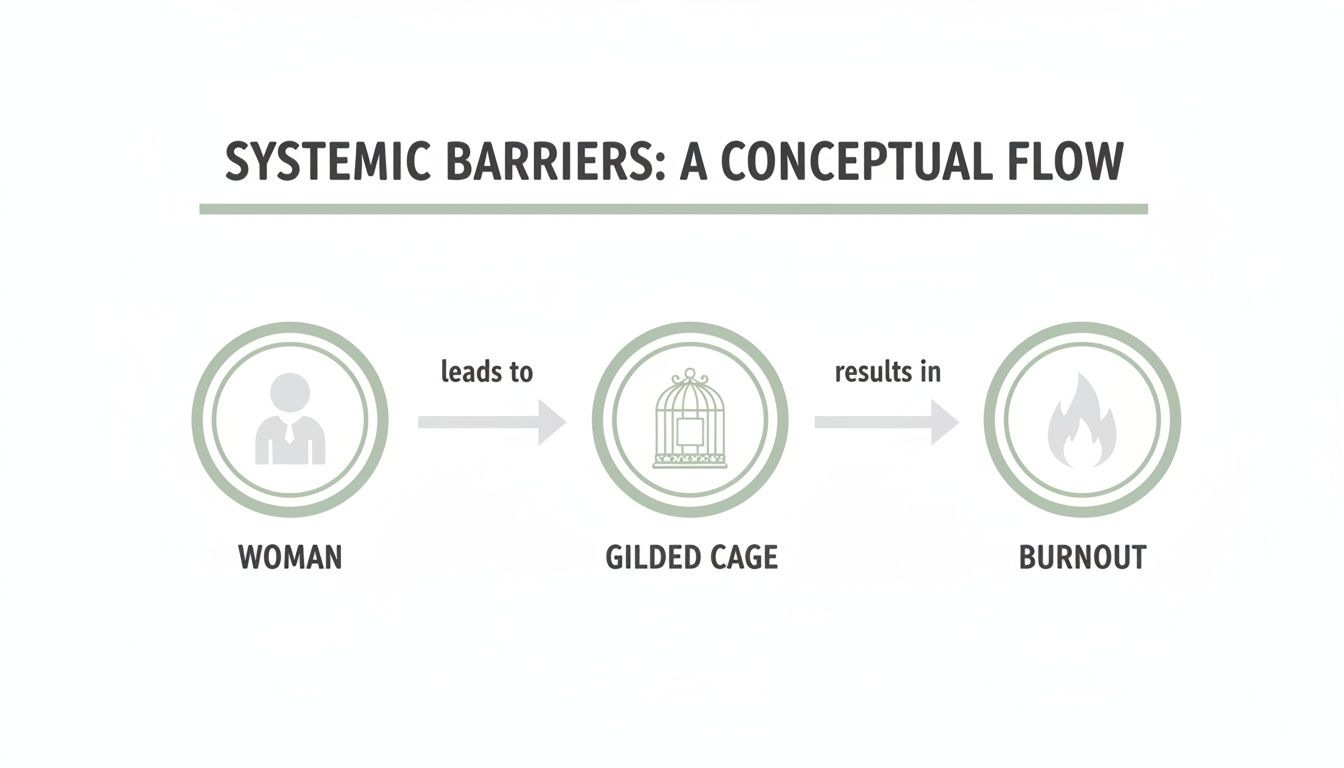
This diagram shows how systemic pressures can trap women in a "gilded cage" of performative success, a path that almost inevitably leads to burnout.
The current corporate landscape is accelerating this cycle. As of early 2025, women held only 27.9% of S&P 500 leadership roles. Even more telling, women leaders are leaving their jobs at the highest rate ever recorded, far outpacing men in similar positions. This mass exodus proves that high-achievers are no longer willing to trade their well-being for a broken definition of success. You can read the full research on gender diversity in corporate America to see just how unsustainable this trend has become.
From Burnout-Driven Performance to Embodied Leadership
The difference between the traditional, burnout-driven model and the RAMS approach is stark. It’s a shift from an external, depleting game to an internal, sustainable one. The table below lays out this critical transition.

This isn't just theory; it's a field-tested system for real-world transformation. I worked with a CEO in the tech space who was running on fumes. Her "Results" were impressive quarterly reports that left her feeling completely hollow. Her "Attitude" was a brittle mask of unshakeable confidence hiding deep, persistent anxiety.
By implementing RAMS, she first redefined her results to include her own well-being as a non-negotiable metric. She then developed the "Attitude" of nervous system regulation, which allowed her to handle high-stakes board meetings without her heart pounding out of her chest. Finally, she built "Systems" that fiercely protected her creative time.
The outcome? She didn't just meet her revenue targets—she exceeded them, all while working fewer hours. For the first time in a decade, she felt truly in command of her life and her leadership.
This shift is available to you, too. To see how this framework is fundamentally different from traditional coaching, you can learn more about the RAMS method coaching revolution here.
Putting RAMS Into Practice: Your First Steps Toward Sovereignty
Understanding the RAMS framework is one thing. Living it is another entirely. True change never happens from intellectual agreement alone; it happens when you translate insight into direct, tangible action. This is the moment you stop just recognizing the Gilded Cage and start actively dismantling it, one strategic choice at a time.
The goal here isn't to burn your life down and start over. That’s the old, burnout-driven way of thinking. Instead, we begin with small, intentional inquiries—the kind that create significant shifts in your awareness and energy. Think of these not as simple questions, but as diagnostic tools. They're designed to reveal exactly where your energy is leaking and where your true power lies dormant.

A Practical Diagnostic for Each Pillar
To start, block out just 15 minutes this week. Treat it like a non-negotiable meeting with your most important stakeholder: you. Use these prompts to begin a quiet, brutally honest audit of your current operating system.
1. Results: An Energy Audit
Your results are far more than KPIs on a dashboard; they are direct reflections of your life force. The critical distinction is whether the goals you're chasing are actually fueling you or just draining the tank.
Diagnostic Question: Look at your to-do list for this week. Which single task makes you feel expansive and energized just thinking about it? Now, which one makes your shoulders tighten and your jaw clench? That physical reaction isn't noise. It's data.
2. Attitude: A Nervous System Check-In
Sovereignty begins in the body. Before you can lead with clarity and presence, you must learn to find your center in the middle of the storm. This is about discovering peace in the midst of chaos, not waiting for the chaos to pass.
Diagnostic Question: The very next time you feel that familiar surge of stress or pressure, just pause. For 60 seconds. Place a hand on your chest and simply notice the rhythm of your breath. You’re not trying to fix or change anything. You are just observing your own physiological state. This is the first, non-negotiable step toward self-regulation.
"Mastery isn't about achieving a flawless state; it is the consistent practice of returning to your center. It is the commitment to the process of self-regulation, moment by moment."
3. Mastery: An Authenticity Probe
Mastery is that electric intersection where your innate talents and your hard-won skills meet your most authentic self-expression. It’s the feeling of operating in your absolute zone of genius, where work feels less like a grind and more like a state of flow.
Diagnostic Question: When was the last time you felt completely, unapologetically yourself at work? What were you doing? Who were you with? The answer points directly to the conditions required for your unique mastery to emerge.
4. Systems: A Boundary Inventory
Your systems are the guardrails. They exist for one reason: to protect your most valuable and non-renewable resources—your time, your energy, and your focus. Without strong systems, even the most powerful intentions get eroded by the constant flood of demands and distractions.
Diagnostic Question: What is one small, clear boundary you can set this week to reclaim just 30 minutes of your time? This could be declining a non-essential meeting, turning off email notifications after 6 PM, or finally delegating a task that doesn’t truly require your direct oversight.
These questions aren't meant to be answered once and then filed away. They are your new tools for an ongoing practice. They represent your first steps toward embodying a new way to define full potential—one built on internal sovereignty, not the endless chase for external validation. This is how you begin the journey back to yourself.
The Return to Your True Leadership State
The journey to your full potential isn't some frantic race to become a new, improved version of yourself. It's the exact opposite.
It’s about dismantling. It’s about tearing down the scaffolding of conditioning, expectations, and years of high-stakes performance that have hidden the powerful, intuitive leader who was there from the very beginning.
This is a return, not a chase.
The ultimate measure of your success is no longer a title on a business card, a revenue target, or a laundry list of achievements. It's something far more profound: nervous-system sovereignty. This is the embodied, undeniable capacity to lead from a state of regulated calm, unwavering clarity, and bone-deep authenticity. This is the bedrock of real leadership.
When you lead from this grounded place, your impact multiplies. Your decisions become sharper, your presence commands rooms without you saying a word, and your work finally feels like a true expression of who you are. As you step back into this true leadership state, it’s critical that your external presence reflects that internal shift. For those in consulting or client-facing roles, a powerful way to do this is by attracting high-value clients through personal branding.
Leadership is not a role you play; it is a state of being you inhabit. The return to yourself is the most powerful strategic move you will ever make.
This journey back to your core, this reclamation of self, is the very essence of embodied sovereignty.
If you feel that pull—that deep, quiet call to move from performative success to this potent state of authentic leadership—the next step is clear. It’s time to map your unique path back to yourself.
Your Questions, Answered
Let’s tackle some of the common questions that come up when high-achieving leaders consider a different path to success.
How Can I Redefine My Full Potential Without Sacrificing My Career Ambitions?
This is a critical point, and it’s a misconception I see all the time. Redefining your potential isn’t about lowering your ambitions—it’s about aligning them with your well-being so you can actually sustain them for the long haul.
The RAMS framework helps you build the systems that protect your energy and focus. This means you can pursue massive goals without the inevitable burnout that comes from brute force. The result is more impactful, lasting success, not short-term wins that cost you everything.
Is It Really Possible to Change Leadership Habits I Have Had for Decades?
Absolutely. Because most of these habits—the over-functioning, the people-pleasing, the relentless drive—aren't fixed personality traits. They're deeply ingrained nervous system responses you learned to survive and succeed.
By learning to regulate your nervous system (which is the core of the 'Attitude' pillar in RAMS), you can fundamentally shift those patterns at their root. It’s less about adding new habits and more about unlearning the performative behaviors to get back to an authentic leadership style that feels natural and is far more effective.
What Makes This Approach Different From Other Executive Coaching Programs?
Most executive coaching stays in the mind, focusing on strategy and mindset shifts. That's useful, but it's only half the picture. The RAMS method is a holistic, embodied approach that starts with the nervous system as the true foundation of leadership.
Instead of just talking about burnout, it addresses the physiological roots that keep you stuck in that cycle. It provides a practical, ground-up structure (Results, Attitude, Mastery, Systems) to rebuild how you operate. This ensures the changes stick because they become part of who you are, not just something you’re trying to remember to do. We're changing the engine, not just painting the car.
At Baz Porter, we work exclusively with accomplished women ready to move from burnout-driven performance to embodied, sustainable leadership. If you know you're meant for more than chasing a flawed definition of success, it’s time to reconnect with your true power.
Discover how the RAMS method can fundamentally reshape your impact and your well-being at https://bazporter.com.