How to Deal with a Difficult Boss and Reclaim Your Power
The Sunday evening dread. The knot in your stomach before a one-on-one. The mental gymnastics of trying to anticipate their next impossible demand or passive-aggressive jab. You’re a high-achiever, used to excelling, but dealing with a difficult boss has turned your professional life into a high-stakes game of survival. You find yourself second-guessing every email, replaying every conversation, and questioning the very competence that got you here.
This is the silent collapse. It's the slow, steady erosion of your confidence, draining your energy and hijacking your focus. The job is no longer about the work; it’s about navigating a personality precision-engineered to undermine you. You're not just stressed; your entire nervous system is in a state of chronic, low-grade emergency.
Key Takeaways
Stop Trying to Change Them: The only winning move is to stop wasting energy on changing your boss and focus entirely on managing yourself and the situation with unshakable professionalism and documented facts.
Leverage the RAMS Framework: Use the Results, Attitude, Mastery, and Systems (RAMS) method to build an undeniable case for your value, regulate your emotional state, and create firm professional boundaries that toxic behavior cannot penetrate.
Understand the Neuroscience: A difficult boss triggers your body's fight-or-flight response, trapping you in a state of hypervigilance that leads directly to burnout. This is a biological reality, not a personal failing.
Choose Your Path: Escalate or Exit: Learn the clear-cut criteria for deciding when to escalate to HR with irrefutable proof versus when to execute a strategic, quiet exit that protects your career and sanity.
The Definitive Answer to a Difficult Boss
To effectively deal with a difficult boss, you must stop trying to change them and instead focus on managing yourself and the situation with strategic professionalism. This means meticulously documenting your achievements to create an objective record of your value, regulating your own nervous system to maintain calm authority, and establishing firm boundaries to protect your time and well-being. This pivot from emotional reaction to strategic action neutralizes their negative impact and reclaims your power.
The Hidden Pattern: When Your Competence Becomes a Threat

When you're in the trenches with a difficult boss, the daily frustrations are obvious. The micromanagement. The credit-stealing. The relentless criticism. But what you're feeling on the surface is just the shockwave. The real damage is happening silently, far beneath the day-to-day grind.
This dynamic creates something I call the "Performance Paradox." You're a high-achiever, hardwired to deliver exceptional work. But here’s the brutal truth: your competence can be a direct trigger for an insecure leader. Your success isn't seen as a win for the team; it's perceived as a threat to their authority.
Your boss isn't seeing a star player. They're seeing someone who might outshine them, expose their own shortcomings, or challenge their control. This isn't some Machiavellian plot they've consciously hatched. It's a primal, fear-based reaction firing off deep inside their own nervous system. You keep wondering, “What did I do wrong?” when the internal dialogue of your boss is, “If they keep performing like this, I’ll disappear.”
The Neuroscience of a Hostile Workplace
Every condescending email, every undermined project, and every impossible demand sends a clear signal to your brain: threat detected. This instantly kicks your sympathetic nervous system—your body's ancient fight-or-flight mechanism—into high gear. Your heart pounds, cortisol floods your system, and your focus narrows to one thing: survival.
In a life-or-death situation, this response saves you. In the office, it's a slow-drip poison.
When the source of that threat is your boss, the alarm bells never stop ringing. You're forced to exist in a state of chronic hypervigilance, constantly on edge, waiting for the next attack. This isn't just "stress." This is your biology being hijacked, trapping you in a low-grade but relentless state of emergency that leads directly to burnout, anxiety, and even physical illness.
Your body doesn't know the difference between a predator in the wild and a toxic boss in the boardroom. The biological cost is the same: a complete drain on your physical, mental, and emotional resources.
This constant state of alert also demolishes your ability to think strategically, innovate, and lead with confidence. All your best energy gets diverted from high-value work to simply managing the threat in the room. If this feels familiar, it might be time to get smarter about how you navigate office politics to protect your career.
The RAMS Reframe: From Reaction to Sovereignty

That constant feeling of walking on eggshells. The mental exhaustion of replaying every conversation. The sheer biological toll of dealing with a difficult boss is enough to make anyone feel utterly powerless.
But what if you stopped managing their chaos and started architecting your own stability? This is the moment you shift from reacting to their dysfunction to strategically reclaiming your power.
The RAMS (Results, Attitude, Mastery, Systems) framework is the toolkit for this exact fight. It’s not about confrontation. It’s about building a fortress of competence, composure, and undeniable proof of your value that toxic behavior simply can’t penetrate. It's a proprietary method we use with executive clients to move them from survival to sovereignty.
Let’s get into how you can put these pillars into play, right now.
R is for Results: Document Everything
Your greatest shield against subjective, unfair criticism is objective, cold-hard data. When a difficult boss tries to paint a story of your underperformance, your documented results become an undeniable wall of facts they can't argue with.
Start today. Create a private document—your "Performance Ledger"—and start tracking every single win.
Quantify Your Victories. Don't just write "finished the project." Instead, document it like this: "Launched Project X two weeks ahead of schedule, driving a 15% increase in Q3 lead generation and saving an estimated 40 man-hours." Numbers don't have opinions.
Capture Every Piece of Praise. Did a client rave about you in an email? Did a colleague from another department commend your work? Screenshot it. Save it. Log it in your ledger with the date.
Track the Metrics That Matter. Keep a running tally of your contributions to revenue, cost savings, efficiency gains, and team morale. These are the languages the leaders above your boss speak and respect.
This isn't about arrogance; it's about building an evidence-based case for your competence. When you walk into a performance review, or if things escalate, you won’t be armed with feelings. You’ll be armed with a dossier of irrefutable proof. This meticulous documentation is also the first step to overcome imposter syndrome at work.
A is for Attitude: Master Your Internal State
Difficult bosses, especially the insecure or manipulative types, often feed on emotional reactions. Your frustration, your visible anxiety, your anger—it’s all fuel for their fire. The most powerful thing you can do is regulate your own nervous system before you ever walk into their office.
You can’t control their behavior. But you can absolutely own your response.
"When you’re calm, you’re not just more effective. You can also see more clearly: Everyone has their own reasons for saying no. Even when we don’t understand or fully agree, we can choose to stay in the dance." - Leadership Coach Jamie Lee
Before that next challenging meeting, take five minutes. Go for a quick walk, do some deep breathing, or just step away from your screen. This small act shifts you from a primal fight-or-flight state to a centered, strategic presence. This inner stability is your shield.
M is for Mastery: Showcase Your Expertise
Micromanagers, in particular, are almost always operating from a place of deep-seated insecurity. They obsess over details because they don't trust their team's expertise—or worse, they're afraid of being outshined.
The answer isn't to dim your own light. It’s to strategically showcase your mastery in a way that builds their confidence in you.
"Pace, Then Lead." Start conversations by acknowledging their stated priorities. This builds common ground immediately. For instance, "I agree that hitting the Q4 target is the most critical priority."
Get Ahead with Proactive Updates. Don't make them hunt you down for information. Send concise, regular updates on your progress. This shows you're in control and systematically reduces their anxiety-driven need to meddle.
Bring Solutions, Not Just Problems. Instead of walking in and saying, "We have a problem with the vendor," shift your approach. Try this: "I've flagged a potential risk with the vendor, and I've already drafted two possible solutions for us to review." This frames you as a strategic partner, not just an employee reporting an issue.
When you consistently demonstrate foresight and competence, you slowly starve their impulse to micromanage. For a deeper look at this leadership model, you can learn more about the RAMS Method and its revolutionary framework.
S is for Systems: Create Firm Boundaries
Systems are the professional guardrails that protect your time, your energy, and your sanity. A difficult boss will relentlessly test your boundaries, whether it’s with late-night emails, impossible demands, or constant scope creep. Your job is to systematically and professionally enforce them.
This means getting out of survival mode and getting into sovereign leadership. When you’re just reacting, you’re losing. When you’re implementing a proactive strategy, you’re in control.
Reactive Tactics vs Proactive RAMS Strategies
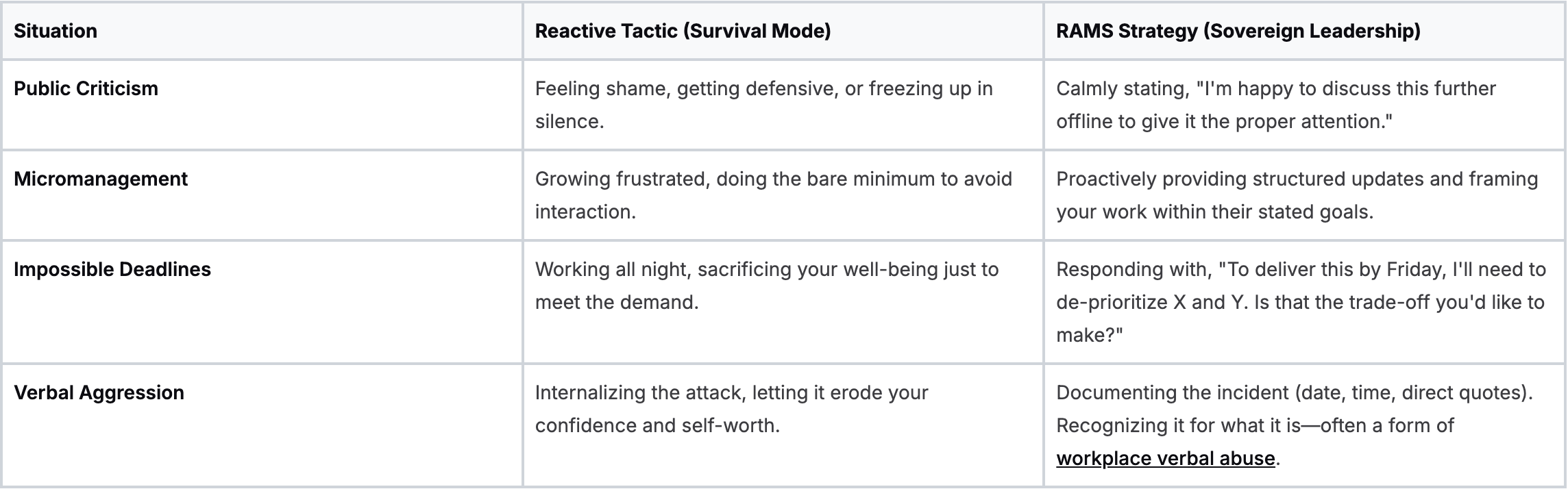
These systems aren’t about being difficult; they’re about being a high-caliber professional. You are, in effect, teaching your boss how you expect to be treated.
By consistently applying the RAMS framework, you stop being a casualty of their behavior and become the architect of your professional reality. You take back control—not by trying to change them, but by mastering yourself.
Deciding Whether to Escalate or Exit Strategically

You’ve done the work. You’ve put the RAMS framework into play, meticulously documenting your results, managing your attitude, and showcasing your mastery. You’ve even built systems to protect your focus and your sanity.
But the situation with your boss is still toxic. Unworkable.
Now comes the moment of truth, the decision every high-performer dreads: do you escalate this, or is it time to plan a strategic exit? This isn't a choice you make out of frustration. It's a calculated move. Staying indefinitely in a toxic environment is a career death sentence, a direct flight to burnout and stagnation. That's not an option for you.
The Decision Flow: Moving from Emotion to Strategy
To make the right call, you need to pull yourself out of the emotional chaos and into a strategic mindset. Here are the critical checkpoints:
What is the real impact on your well-being? Is the stress seeping into your weekends? Are you losing sleep or feeling a constant knot of anxiety? No salary is worth your health.
How is this affecting your career trajectory? Is this boss actively blocking your growth or quietly damaging your reputation? A stagnant role is a career risk.
What’s the truth about the company culture? Does the organization have a track record of dealing with problematic managers, or does it protect them? The past is the best predictor of the future.
When to Escalate to HR
Let’s be crystal clear: escalating to Human Resources is a serious move that carries its own set of risks. You only go to HR when specific conditions are met:
You Have Irrefutable Documentation. This is where your "Performance Ledger" becomes your greatest ally. You need a cold, hard, dated log of incidents, direct quotes, and project impacts. Without proof, it's your word against theirs.
The Behavior Crosses a Legal or Ethical Line. This is non-negotiable. If you are facing harassment, discrimination, bullying, or anything that violates company policy or the law, HR is the appropriate channel. Explore effective workplace conflict resolution strategies to understand where these lines are drawn.
You Have an Internal Sponsor. If possible, have a confidential conversation with a trusted senior leader or mentor. They can offer invaluable guidance and may be able to advocate for you from behind the scenes.
Remember, HR’s primary function is to protect the company. Frame your boss's behavior as a direct risk to the business—highlighting the impact on productivity, team morale, and potential legal exposure.
The Art of the Strategic Exit
Sometimes, the only winning move is to walk away. An exit isn't failure. It's a powerful, strategic business decision you make for the most important company you'll ever run: You, Inc.
This isn’t about rage-quitting. This is about a quiet, deliberate, and professional transition.
Quietly Activate Your Network. Start having hushed conversations with trusted contacts. Your best opportunities often come from a warm introduction.
Polish Your Assets. Update your LinkedIn profile and resume with the quantified achievements from your Performance Ledger.
Maintain Peak Performance. Continue to deliver excellent work right up until the end. You want to leave on a high note, with your professional reputation sparkling.
A recent 2024 report on workplace conflict shows that while conflict is rampant, structured approaches work. Mediation has a 74% success rate. This proves that having a clear strategy, whether for intervention or for an exit, is what separates a career setback from a career checkmate.
Ultimately, deciding whether to escalate or exit is about choosing the path that serves your future, not your frustration. If you're ready to think about what's next, our guide on how to advance your career provides a clear roadmap.
The Return: Back to Nervous-System Sovereignty

We’ve covered the frameworks and tactical moves to deal with a difficult boss. But now we arrive at the most critical pivot: the shift from managing an external problem to mastering your own internal world. This is where your real, lasting power is forged. True professional sovereignty isn’t about hoping you never face another difficult person. It’s about building an internal stability so solid that their chaos can’t touch your calm.
Returning to Yourself
This whole ordeal has felt like a battle against someone else. But the real journey is the one back to yourself. It's about shedding the armor you’ve been wearing for survival and stepping back into your own inherent strength and authority. You are not defined by this experience. You are defined by how you chose to reclaim your power and strategically carve your own path forward.
The ultimate victory is not in changing them, but in ensuring they can no longer change you. It's about returning to a state where your professional worth and personal peace are non-negotiable.
This experience, as challenging as it’s been, has forged a new level of resilience in you. You’ve learned how to document your value, command your emotional state, and enforce boundaries with unshakeable professionalism. These aren't just coping mechanisms; they are the hallmarks of exceptional leadership. A vital part of that is knowing how to be more assertive at work. Dive deeper into how to be assertive at work and continue mastering this critical skill.
Your next move is to integrate these lessons so they become part of your leadership DNA. This is your return to yourself—to a career that is not just successful, but deeply fulfilling and sovereign.
Ultimately, the strategies to deal with a difficult boss are about reclaiming your professional sovereignty. It’s about building a career so strong and a sense of self so solid that no single person can derail your path. If you are an accomplished woman ready to move from exhaustion-driven performance to embodied, burnout-free leadership, Baz Porter provides the framework to make that happen.
Discover how the RAMS Method can transform your career at https://bazporter.com.