Confident Performance Coaching for Peak Leaders
You’re still delivering. The calendar is full. The numbers look fine. Your team still calls you decisive.
Privately, the signal is different.
You wake up tired. You finish major work and feel nothing. Small decisions drain you. Praise lands flat. Rest doesn’t restore you. You aren’t lazy, fragile, or ungrateful. Your system is overloaded and still being asked to perform at executive speed.
That’s why this form of collapse gets missed. It hides inside competence. It looks like discipline from the outside and depletion from the inside. If this pattern feels familiar, read my article on success dysregulation. The physiology is often closer to performance overtraining than people think, which is why Zing Coach's guide on overtraining is useful context.
Table of Contents
The RAMS Framework A Clinical Protocol for Rebuilding Authority
Frequently Asked Questions About Confident Performance Coaching
The Hidden Cost of High Achievement
High achievement can hide severe internal failure.
Many leaders think confidence loss means they need more discipline, more resilience, or better mindset control. That diagnosis is wrong. The issue is often a leader whose external performance stayed high while the internal operating system degraded.
Key takeaways
Confident performance coaching is not motivational support. It is a structured performance intervention for leaders whose capacity, authority, and clarity have been compromised under chronic pressure.
Silent Collapse™ often presents inside visible success. The leader still performs, but meaning, steadiness, and decision quality begin to erode.
Confidence is not the first problem. Nervous system dysregulation is. Confidence falls after the system loses safety, recovery, and coherent self-trust.
The correct response is protocol, not pep talk. You need diagnosis, metrics, and repeated behavioral correction.
Confident performance coaching, used correctly, is a clinical protocol for restoring reliable performance under pressure. I use it to assess where authority has fractured, where identity has fused with output, and where the leader’s nervous system has become the primary operational bottleneck.
Clinical view: When a high-performer says, “I have everything I wanted. Why do I feel nothing?”, I don’t hear lack of gratitude. I hear system failure.
What high achievement often costs
The public version of your life can stay intact long after the internal structure starts failing.
You still meet deadlines. You still solve problems fast. You still carry the emotional weight of the room. But your work starts extracting more from you than it returns. What used to feel precise now feels heavy. What used to feel chosen now feels compulsory.
That is the hidden tax of elite performance without internal regulation.
It shows up in predictable ways:
Decision drag: simple choices start consuming disproportionate energy.
Flat reward response: milestones stop producing satisfaction.
Authority leakage: you second-guess what you already know.
Compensatory over-functioning: you carry more because trusting others feels unsafe.
This is not a character flaw. It is a degraded operating state.
The High-Achiever's System Failure
Silent Collapse™ is what happens when a leader keeps producing on a compromised internal base.
A skyscraper can stand tall with a cracked foundation, for a while. From the street, it still looks impressive. Inside, pressure is moving through every load-bearing point. That is what I see in high-achievers with private collapse. Their calendar, title, and reputation are still standing. Their internal structure is not.

If this pattern is familiar, read my piece on executive dysregulation. It maps the leadership version of this failure state.
Silent Collapse is a nervous system problem
Most leaders are given a bad explanation for what’s happening. They’re told they need better boundaries, a vacation, or renewed confidence. Those recommendations miss the mechanism.
When the nervous system is conditioned for chronic threat, the leader cannot access stable confidence on demand. The body keeps scanning, bracing, over-preparing, and controlling. That state can still produce output. It cannot produce clean authority for long.
Confident performance coaching becomes useful. Not as encouragement. As intervention.
Bandura’s self-efficacy framework matters here because confidence is strengthened through mastery experiences, modeling, and reinforcement. In plain terms, the leader regains confidence by seeing evidence of capability in action, not by repeating affirmations. The problem in Silent Collapse™ is that the leader’s system has stopped registering competence as safety. Performance continues. trust does not.
Confidence fails last. Regulation failed first.
Why generic burnout advice fails
Generic burnout content treats the leader like a tired employee. That is a category error.
High-performers in Silent Collapse™ are often still effective. They’re still revenue-generating, decision-making, and carrying institutional memory. That’s why the collapse gets missed by teams, boards, and even therapists who focus only on mood.
The better question is not, “Are you burnt out?” The better question is, “What functions are degrading beneath your visible success?”
Watch for these markers:
Your output remains high, but recovery stops working.
Your authority becomes performative. You can sound clear while feeling fragmented.
Your identity fuses with usefulness. Rest starts feeling dangerous.
Your confidence becomes situational. It appears in expertise, then disappears in conflict, visibility, or intimacy.
These are not random symptoms. They form a system pattern.
Structured coaching works because it measures reality
A proper intervention must produce observable movement. Otherwise, the leader keeps guessing.
According to the International Coaching Federation, 80% of coaching clients reported improved self-confidence, 70% reported enhanced work performance, and 86% of organizations saw a measurable return on investment through coaching engagements, as cited in this ICF statistics summary. For leaders in Silent Collapse™, that matters because the issue isn’t inspiration. It’s whether a structured process can restore confidence and performance in ways that can be seen.
A leader in collapse does not need more insight alone. The leader needs proof that internal repair changes external function.
The RAMS Framework A Clinical Protocol for Rebuilding Authority
Most coaching fails because it treats confidence as a feeling problem.
I treat it as an operating problem.
The RAMS Framework™ is the protocol I use to move a leader from Silent Collapse™ toward Sovereign Leadership™. The four pillars are Results, Attitude, Mastery, and Systems. Together, they address the output distortion, the internal narrative corruption, the confidence erosion, and the structural weaknesses that keep relapse in place.

If you want the broader methodology behind this work, read my article on the RAMS Method, the coaching revolution that's leaving traditional models in the dust.
A solid protocol includes prompting, scaffolding, performance feedback, data use, and a collaborative context. Those five components define effective coaching, and the same source identifies the top benefits as increased self-confidence (80%), improved relationships (73%), communication skills (72%), interpersonal skills (71%), and work performance (70%) in this coaching framework reference.
Leadership operating states
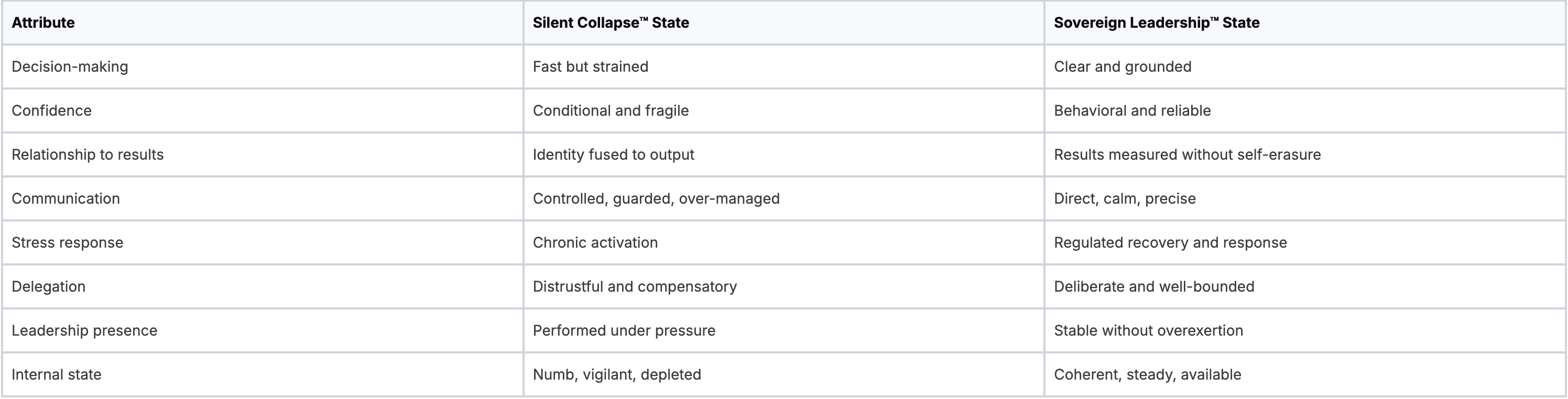
Operational truth: Confidence that depends on perfect conditions is not confidence. It is temporary symptom control.
Results
The first pillar is Results. Within this pillar, I separate output from identity.
Leaders in collapse often produce strong numbers while privately disintegrating. That creates confusion. They assume success disproves the severity of the issue. It doesn’t. It often hides it.
Results work starts with a direct audit:
What are you producing?
What is it costing your body, attention, and relationships?
Which outcomes are genuine performance, and which are compensation?
A collapsed leader often gets rewarded for dysfunctional excellence. They answer faster than everyone else. They fix what others should own. They absorb ambiguity because they no longer trust the system around them. Those behaviors look valuable. They are expensive.
I look for the output versus identity gap. If your self-worth rises and falls with execution, you are not leading from authority. You are leading from dependency.
That has to be corrected first.
What I change inside Results
I reclassify performance into three categories:
Essential output that belongs to your role.
Compensatory output you perform to manage fear, control, or visibility.
Identity output you continue because stopping would threaten who you think you are.
This distinction is clinical. It stops leaders from calling every form of effort “commitment.”
If your success requires self-abandonment, the result is contaminated.
A founder scaling, for example, may still close deals and lead strategy while secretly spending huge energy managing everyone’s emotions. On paper, they’re succeeding. In reality, they’re using executive function to compensate for a dysregulated system. The result is short-term performance and long-term erosion.
Attitude
The second pillar is Attitude. This isn’t positive thinking. It’s your internal operating system.
Collapse lives here.
By attitude, I mean the assumptions driving behavior under pressure. What do you believe about rest, control, value, visibility, conflict, and safety? Most high-achievers never inspect these assumptions because their old ones used to work.
Then the same beliefs start distorting everything:
If I stop, everything falls apart.
If I’m not useful, I lose relevance.
If I’m fully seen, I become exposed.
If I need support, I’ve failed.
Those beliefs produce real performance consequences. They harden communication. They increase overwork. They distort delegation. They turn confidence into theater.
The Five Imposters and internal corruption
The Five Imposters™ often appear. I use that lens to identify who is driving the leader’s behavior. Not the sovereign self. The compensatory identity.
One leader speaks from the perfectionist. Another from the rescuer. Another from the over-controller. Different mask, same mechanism. The system learned that over-functioning prevents threat. It kept the leader alive in earlier contexts. It now keeps the leader trapped.
Attitude work requires brutal accuracy.
You do not fix collapse by “being kinder to yourself” in the abstract. You identify the false command structure and remove it from operational control. The leader must know which voice is issuing orders when pressure rises.
A practical correction looks like this:
Identify the command belief. Example: “If I delegate, standards collapse.”
Track the behavior it drives. Micromanaging, rework, late-night checking.
Measure the cost. Fatigue, resentment, decision bottlenecks, poor team ownership.
Install a replacement standard. Clearer role design, visible accountability, cleaner review cadence.
That is how attitude becomes measurable.
Mastery
The third pillar is Mastery. Here, confident performance coaching becomes behaviorally precise.
Confidence is rebuilt through evidence. That is the core insight from self-efficacy theory. The leader needs repeated mastery experiences that the nervous system can register as safe, real, and transferable.
Not vague wins. Specific ones.
The behavioral model I use here is simple. Set a clear target. Create controlled exposure. Track the response. Review the evidence. Repeat until authority stops feeling accidental.
Mastery is not more skill accumulation
Many collapsed leaders already have advanced skill. Their issue is not incompetence. It is interrupted access to their own capability under pressure.
That distinction matters.
A senior executive may know exactly how to handle conflict, but lose verbal precision in one high-stakes board conversation. A founder may know how to pitch, but freeze in funding conversations because identity threat hijacks function. A clinically sound protocol doesn’t assume “learn more and feel better.” It tests where capability fails to transfer under load.
The confidence work here includes:
Behavioral metrics tied to visible change
Perception shifts from colleagues or stakeholders
Performance indicators that show business impact
Personal indicators such as stress and clarity patterns
That measurement model is one reason generic confidence work is too soft for this population. High-performers need evidence. Monthly ratings, structured check-ins, and feedback loops matter because they convert internal change into observable proof.
Mastery is the moment your system stops arguing with your capability.
One option for leaders who want this level of structure is to Take the Silent Collapse Diagnostic. It gives you a starting point before any intervention.
What mastery looks like in practice
I often prescribe narrow, high-value tests rather than broad reinventions.
Examples:
One decision made without over-explaining
One strategic conversation held without rehearsing every branch
One delegation with clear ownership and no rescue behavior
One visible boundary enforced without apology
These aren’t motivational tasks. They are confidence recalibration drills.
When repeated, they create a new body of evidence. The leader no longer says, “I hope I can hold authority.” They know they can because they’ve done it under pressure, repeatedly.
Systems
The fourth pillar is Systems. This is the architecture of the return.
Most leaders relapse because they try to heal inside the same conditions that produced the collapse. Their calendar is still hostile. Their team still depends on their over-functioning. Their business still rewards urgency over coherence. They work on mindset while the system keeps attacking the repair.
That approach fails.
Systems work asks a harder question. What in your environment requires your dysregulation to keep functioning?
The system often rewards your worst pattern
A leader can become indispensable for all the wrong reasons. They become the human patch for weak processes, unclear authority, poor communication, and emotional inconsistency across the team. Then everyone praises their leadership while depending on their self-erasure.
I cut through that quickly.
Systems correction may include:
Decision architecture that reduces repeated low-value choices
Meeting redesign so urgency stops masquerading as importance
Role clarity so responsibility is not pooled into one exhausted person
Recovery structures that are scheduled, defended, and tied to performance
Feedback loops so confidence isn’t based on guesswork
Nervous system work and business architecture converge. That’s why the S in RAMS Framework™ covers both the body and the operating environment. If either remains chaotic, confidence stays unstable.
A performance protocol without systems correction is symptom management.
The leader is not the only system in the room. The business trains behavior too.
There’s also a clear market gap here. Most confidence coaching addresses individual performance. It doesn’t address how a founder or senior leader builds collective confidence, team clarity, and psychological steadiness around them. That omission matters. Leaders don’t operate in isolation. Their confidence is either reinforced or taxed by the system they run.
The work is complete only when authority no longer requires self-betrayal.
The Return to Sovereign Leadership
Monday, 8:07 a.m. The leader walks into a routine meeting with a full brief, clear priorities, and a competent team. Ten minutes later, they are over-explaining a simple decision, scanning faces for threat, and rewriting their own direction in real time. Nothing external failed. The bottleneck is internal regulation.
Sovereign Leadership™ is the return from that condition. It is a stable leadership state in which authority is available without cortisol, over-functioning, or self-abandonment. Pressure remains. Consequence remains. The difference is operational. The leader stops treating every demand as an emergency and stops using stress chemistry as the access point for command.

If you need a fuller definition, read my article on embodied sovereignty.
What the return actually feels like
The first marker is relief.
Relief is diagnostic. It shows that the system is no longer spending excessive energy on vigilance, impression management, and internal bracing. Leaders often expect this phase to feel dramatic. It does not. It feels quieter. Clean authority usually does.
Several shifts show up fast:
Decisions stop draining disproportionate energy
Boundaries stop feeling hostile
Delegation stops carrying guilt and hidden control
Speech becomes direct, shorter, and more precise
Recovery starts working again because the system can stand down
That is the aim of confident performance coaching under this model. It is not motivation. It is a clinical protocol for reversing Silent Collapse™ by correcting the leader’s nervous system, the primary operational bottleneck in the business.
What changes in your leadership
The team detects the shift before the leader names it. Meetings lose static. Instructions become easier to follow because they are no longer distorted by urgency, appeasement, or concealed strain. Authority stops leaking through speed, verbosity, and emotional overreach.
Execution improves for a simple reason. Regulated leaders send cleaner signals.
That affects everything downstream. People waste less energy interpreting tone. Standards become easier to enforce because they are not fused with reactivity. Trust becomes behavioral, not rhetorical. The leader still experiences stress, but stress no longer dictates the room.
Sovereign Leadership™ is not permanent calm. It is retained self-command under load, followed by rapid recovery without self-loss.
For additional reading on this body of work, use the Sovereign Leadership Resource Hub.
Frequently Asked Questions About Confident Performance Coaching
Why do I feel less confident even though I’m still performing well
Because performance and regulation are not the same thing. You can still execute while your internal system is losing coherence. In Silent Collapse™, confidence erodes after prolonged over-functioning, not before.
Is confident performance coaching the same as mindset coaching
No. Mindset coaching often stays at the level of thought reframing. Confident performance coaching, as I use it, measures behavior, pressure response, decision quality, and authority under load. It is built for transfer into real leadership conditions.
How is this different from therapy
Therapy can be useful, but it usually does not target executive performance architecture. This work examines how your nervous system, identity, business demands, and leadership behaviors interact. If you need general answers about process and fit, review the coaching FAQ.
What if my problem isn’t burnout, but loss of meaning
That distinction often collapses on contact. Many leaders call it a meaning crisis because numbness is easier to admit than depletion. Loss of meaning, flat reward response, and authority erosion often sit inside the same system failure.
How do I know if I’m in Silent Collapse™
Look at function, not labels. If rest doesn’t restore you, success feels empty, pressure feels constant, and your confidence has become erratic, treat that as diagnostic data. Don’t wait for total dysfunction.
Can confident performance coaching help if I’m still leading at a high level
Yes. In fact, that’s when it matters most. Silent Collapse™ usually appears before visible failure. Early intervention protects decision quality, health, and authority before the external system catches up with the internal cost.
About The Author
British military veteran. Two-time international bestselling author. Founder, The Prestige Architect™. Host, Rise From The Ashes podcast, C-Suite Network. Boulder, Colorado.
If this article described your private reality with uncomfortable accuracy, the next step is not more content. It is structured intervention. Apply to Work With Baz.