Building Resilience in the Workplace: A Guide for High Achievers
For high-achieving leaders, the relentless pursuit of excellence often leads to a silent, internal collapse. You're told that building resilience in the workplace is about adding more armor or "toughing it out," but that advice is a trap. It's the very reason you're running on empty despite a track record of success.
The promotions, the accolades, the view from the corner office—they can’t quiet the internal whisper that says, “If I stop performing, I’ll disappear.” Every win feels less like a victory and more like another heavy plate added to an already crushing barbell. This is the brutal paradox of the high-performer: your greatest strengths have become the architects of your own exhaustion. This isn't a time management problem; it's a nervous system problem.
Key Takeaways for Building Lasting Resilience
Resilience is Energy Management, Not Stress Endurance: True resilience for high-achievers isn't about absorbing more stress. It’s about creating systems that restore your energy and protect your nervous system.
"Success Dysregulation" is a Real Threat: The very drive that fuels your success can hijack your physiology, locking you into a constant loop of high-alert and deep exhaustion, a state we call success dysregulation.
Sovereignty is the Goal, Not Survival: The objective isn't merely to survive your career. It’s to lead from a place of sovereignty, where your actions align with your authentic self, not external pressures or internal fears.
A Systematic Approach is Non-Negotiable: Building sustainable resilience is a skill, not an innate trait. It requires a structured framework, like the RAMS Method, to systematically rebuild your capacity from the ground up.
Building resilience in the workplace requires a radical shift away from enduring more stress and toward strategically managing your energy. It involves understanding how your nervous system reacts to high-stakes environments and implementing a systematic approach to regulate it, allowing you to sustain high performance without self-sacrifice.
The Hidden Pattern: Your Nervous System is Paying the Price
You’re running on empty. I’ve seen it hundreds of times. That feeling isn't a sign of weakness; it's a physiological reality.
Your body’s threat-detection system—your autonomic nervous system—doesn’t distinguish between a lion in the grass and the chronic, grinding stress of a high-stakes career. When it's constantly activated, it leads to predictable, damaging outcomes:
Decision Fatigue: Your brain is flooded with stress hormones, making complex problem-solving feel like wading through mud.
Emotional Volatility: With your capacity for regulation worn thin, even small triggers can spark disproportionate reactions.
Physical Exhaustion: Your body is perpetually geared up for a fight that never comes, leading to a deep, cellular fatigue that sleep can't fix.
This is the Silent Collapse. It's why traditional advice like "practice more self-care" feels like putting a bandage on a wound that needs stitches. It completely misses the physiological root cause. To stop the collapse, you must learn to prevent burnout with strategies that work directly with your nervous system.

The Invisible Resilience Tax on Women Leaders
For high-achieving women, this physiological load is amplified. Every day, you pay what I call a "Resilience Tax"—an invisible surcharge on your energy and nervous system just for operating on a playing field that wasn't built for you.
It's the extra energy burned proving competence in a room of doubters. It’s the emotional labor of holding the team together. It's the mental weight of batting away microaggressions. This tax is why you can leave a day of successful meetings feeling utterly depleted. Acknowledging this tax is the first real step—a core focus in specialized women's leadership development programs.
The data validates this disparity. A wellbeing and resilience report found working women feel up to 7% less resilient than male colleagues. Even more telling, men score a staggering 11% higher in self-belief.
Your Challenge Isn't Performance—It's Preservation. You’re already a high performer. The real work is learning to preserve your nervous system while you perform, so that success doesn't lead directly to burnout.
The Alarming Risk for Emerging Women Leaders
While senior leaders grapple with the Resilience Tax, the next generation faces an even more immediate threat. A comprehensive 2023 Global Resilience Report revealed a stark generational gap:
More than 20% of females under 30 are at high risk due to alarmingly low Resilience Ratios, compared to just 10% of women over 30.
This isn't a small statistical blip. It's a profound vulnerability. It means a huge portion of our future female leadership pipeline is starting with their internal battery already in the red. For emerging leaders, resilience isn't a "soft skill"; it's a non-negotiable survival tool.
The RAMS Reframe: A New Architecture for Resilience
Acknowledging the problem isn’t enough. True change demands a new way of operating. The old advice to “toughen up” is like trying to fix a nervous system issue with a spreadsheet. It was never going to work.
The answer isn’t more armor; it’s rebuilding your core from the ground up. This requires a methodical, embodied approach that works with your physiology, not against it. That's why I created the RAMS Method—a systematic framework to move you from depletion to sovereignty. It’s built on four interdependent pillars: Results, Attitude, Mastery, and Systems.
The diagram below shows how risk factors for emerging leaders cascade from external pressures down to specific internal weak spots—a problem the RAMS method is built to solve.
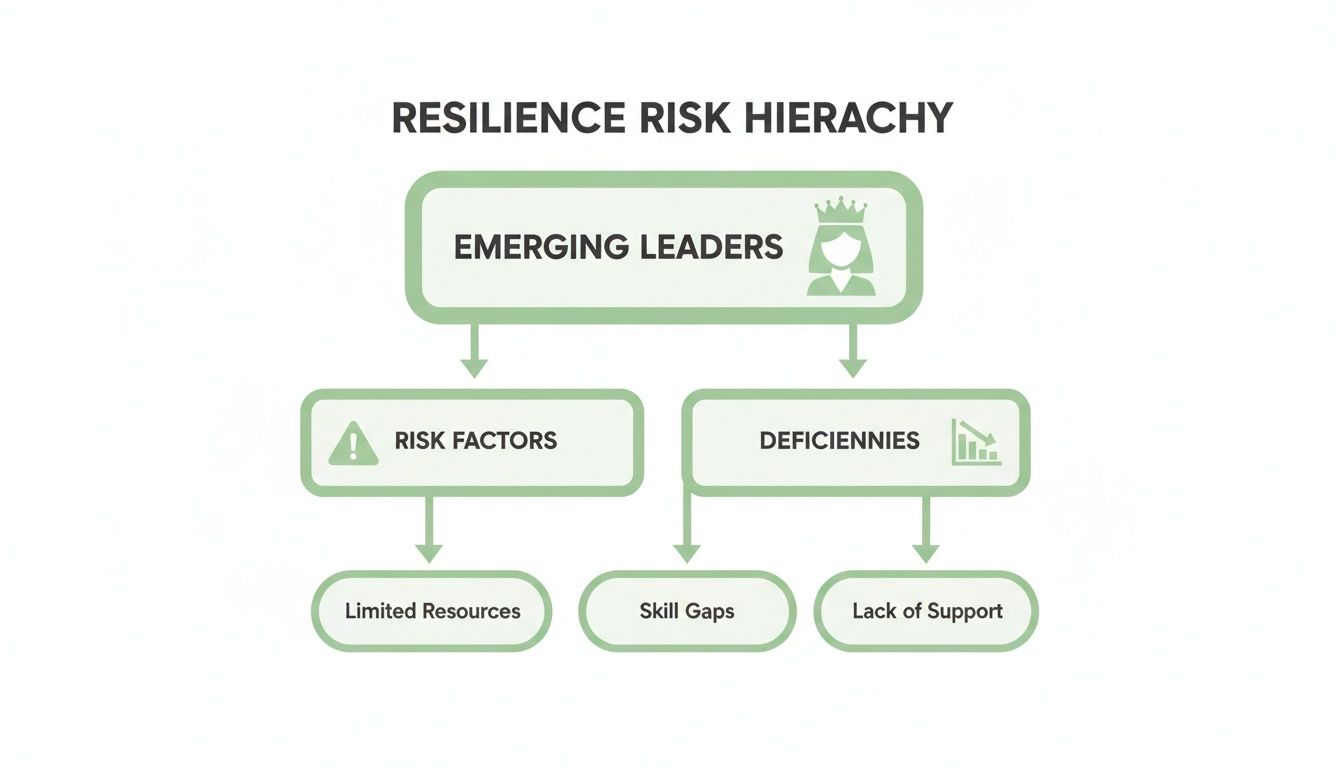
This visual makes it clear: without a solid internal foundation (Attitude and Mastery), external risks will inevitably punch through and create critical gaps in your core resilience.
1. Results: Redefining Success Beyond Burnout
The first pillar, Results, tackles our addiction to external validation. For high-achievers, the relentless chase for more creates "success dysregulation," locking the nervous system into high alert.
Here, we redefine a “result.” Instead of chasing outcomes that leave you hollowed out, the focus shifts to achieving goals in a way that restores your energy. A tangible result is no longer just finishing the project; it’s finishing it without torching your well-being.
2. Attitude: Mastering Your Internal State
The second pillar, Attitude, is about mastering your internal state—not through toxic positivity, but through radical self-observation. Your internal monologue dictates your physiological reality. If it’s a stream of self-criticism, your body floods with stress hormones.
Mastering your attitude involves somatic practices that create a crucial gap between a trigger and your reaction. In that space of choice, you reclaim your power and decide how to respond instead of being driven by old, automatic patterns. We’ve explored this in our guide to the RAMS Method leadership framework.
3. Mastery: Achieving Nervous System Sovereignty
The third pillar is Mastery—the practical work of gaining sovereignty over your nervous system. You are no longer at the mercy of your environment. You learn to consciously shift your physiological state from stressed to grounded through consistent, non-negotiable practices.
Somatic Check-ins: Pausing for two minutes to notice physical sensations.
Physiological Sighs: A scientifically proven technique (two sharp inhales, one long exhale) to quickly calm your system.
Boundary Setting: Treating "no" as a complete sentence.
These small, consistent actions compound over time, building your capacity to handle immense pressure.
4. Systems: Architecting a Supportive Environment
Finally, Systems. An individual cannot stay resilient inside a broken system. This pillar is about architecting your external environment—your team, schedule, and communication—to support your well-being, not sabotage it.
This means doing a full audit of your life and work to eliminate chronic friction. It means delegating ruthlessly, automating what you can, and curating a powerful support network. When your systems align with your resilience goals, high performance finally becomes sustainable.
A New Paradigm for Leadership Resilience

Making the shift from the left column to the right is the core work of building resilience in the workplace. It’s a move from brute force toward intelligent, embodied leadership.
Putting Resilience Into Practice
Theory without action is procrastination. This is where we turn the pillars of RAMS into the daily practices that forge real, unshakable resilience. This isn't about cramming more into your schedule. It's about strategic subtraction and intentional integration.
Your Non-Negotiable Daily Practices
The 5-Minute Somatic Check-In: Before your first task, or between meetings, pause. Take three deep breaths and scan your body for tension. Simply noticing is a powerful act of self-regulation.
The 'Digital Sunset' Ritual: Create a clear signal that the workday is over. Close your laptop, turn off notifications, and take a five-minute walk. This creates a hard boundary between professional and personal energy.
Physiological Sighs: When stress builds, use this science-backed tool. Two sharp inhales through your nose, one long, slow exhale through your mouth. This can down-regulate your system in seconds.
Setting Boundaries with Scripts and Strategy
Boundaries are not walls; they are a strategic tool for preserving your energy. Learning how to build emotional resilience and thrive in these environments is non-negotiable. Have scripts ready.
Scenario 1: The "Urgent" After-Hours Request
Resilient Script: "Thanks for flagging this. I'm offline for the evening but will make it a priority first thing in the morning."
Scenario 2: The "One More Thing" Project
Resilient Script: "This sounds important. My current project load is at maximum capacity to ensure high-quality work. To take this on, which of my current priorities should we de-prioritize?"
These scripts are not rejection; they are clarification. For more, see our guide on preventing burnout at work.
Case Study: Reclaiming Energy in the C-Suite
Sarah, a CTO on the brink of collapse, was celebrated for her massive workload but privately suffered from insomnia and decision fatigue. Her "always-on" approach was creating a toxic culture.
We implemented two core RAMS practices. First, a hard 'Digital Sunset' at 6 PM. Second, a 'priority clarification' script. When new projects came her way, she’d ask, "To give this the focus it deserves, what current initiative should we pause?"
Within three weeks, the change was dramatic. Her CEO became more strategic. Her team stopped sending late-night emails. Sarah slept through the night, and her thinking became sharper. She didn't work less; she worked with more focused, potent energy. This is the essence of putting resilience into practice.
The Return: Leading from a Place of Sovereignty

This path isn't just about building resilience in the workplace. That’s the symptom, not the goal. The true north of this work is returning to a state of sovereignty.
Sovereignty is the opposite of leading from depletion or fear. It is the deep, unshakable sense of embodied power where your decisions and energy flow from authentic alignment. You are no longer a victim of your calendar or the demands of others. You are operating from a regulated nervous system, making strategic choices that honor both your ambition and your well-being.
Sovereignty isn't a destination; it's a state you return to. It’s the reclamation of your authentic self, allowing you to lead with clarity, conviction, and an unwavering internal compass.
This return isn’t a quick fix. It is a methodical process of rebuilding. It demands you understand your unique patterns of dysregulation before you can architect a new way forward. The next step is to map your personal path. Find out more about the principles of embodied sovereignty and begin your path back to yourself.
FAQ: Answering Your Toughest Questions
"How can I build resilience when my workload is already insane?"
The secret isn't managing time; it's managing energy. Your workload may be fixed, but how you deploy your internal resources is up to you. RAMS principles focus on strategically protecting and replenishing your energy. It's about plugging the leaks so the hours you do work are potent and focused.
"Isn't focusing on my own resilience selfish when my team is drowning?"
This is a dangerous myth. A leader with a dysregulated nervous system is a liability. Your chaos ripples out, creating anxiety for your team. Your resilience is a core leadership responsibility, not an indulgence. By regulating your own system, you create the psychological safety your team needs to do their best work.
"I've tried mindfulness apps and they didn't work. How is this different?"
Asking a high-alert brain to just be still is a recipe for frustration. The RAMS Method is different. We don't start with the mind; we start with the body. We use active, physical practices like the physiological sigh to regulate your physiology first. Once your body gets the message that it's safe, your mind naturally follows.
True leadership sovereignty isn't about managing burnout better. It's about fundamentally redesigning your relationship with your work. The Baz Porter methodology gives you the framework to make that shift stick.
If you're ready to move from a state of constant depletion to one of embodied, powerful leadership, the next step is to understand your unique resilience profile. Find out how you can begin your return to sovereignty at https://bazporter.com.
Where to go next. If any of this reads like your own reflection, the Silent Collapse Diagnostic™ is a quiet place to start — a private read on how close to the edge you really are. And if you want the deeper why beneath the work, read the Sovereign Manifesto.