
For High-Achieving Women
Who Are Done Being Strangers to Themselves
You've built the empire. The multi-6-figure business. The corner office everyone envies.
But here's what nobody sees...
You're dying inside The 4 AM anxiety attacks. The calendar as armor.
The terrifying question that keeps you awake...
"If I stopped performing... would I disappear?"
Finally Choose Themselves Over Their To-Do Lists
Discover Why 97% of "Successful"
Women Are Secretly Collapsing Yours Free.


Dear Beautiful Soul,
I see you.
Not just your achievements or your carefully curated LinkedIn profile.
I see the woman behind the titles, beyond the metrics, beneath the mask of "having it all together."
I see you at 3AM, when the world is quiet but your mind isn't.
When the questions you can't ask in the boardroom become too loud to ignore.
"Why does achieving everything I wanted feel like losing myself?"
"When did success start feeling this heavy?"
I know this journey intimately.
Not because I'm another coach with strategies and systems (though yes, those matter).
But because I've walked alongside women who dared to question everything they built.
Like Lorraine, who found herself in the darkest place imaginable both personally and professionally.
Today, she's not just surviving; she's reaching heights she "didn't even realize she was looking for."
Her words, not mine:
"What Baz does is life altering. He reached my heart, my soul, and allowed me to come alive again."
Or Angela, who transformed her relationship with power entirely.
She stopped pushing through exhaustion and started leading from authentic presence.
Now her team doesn't just respect her they're inspired by her whole, unfiltered truth.
Then there's Sabrina, who discovered what happens when you stop trying to fit into old leadership models.
"Baz doesn't just offer advice," she shares, "he ignites a fire within. He empowers you to unlock unprecedented potential not just in yourself, but in your entire organization."
This isn't just about executive burnout or stress management.
Those are just symptoms of a deeper truth.
This is about reclaiming your soul in the midst of success.
About remembering who you were before the world told you who to be.
About leading from a place of power that doesn't require perfection.
I've watched women step into boardrooms not with rehearsed speeches, but with unshakeable presence.
I've seen them make million-dollar decisions from a place of inner knowing, not endless analysis.
I've witnessed them build global teams while staying deeply connected to themselves.
Your success got you here.
But your truth will take you further.
You don't need another strategy.
You need permission to lead differently.
To breathe differently.
To succeed differently.
To be differently.
The transformation you're seeking isn't about adding more to your already full plate.
It's about coming home to the woman you've always been beneath the achievements.
Ready to remember who you are beyond the titles?
With deep understanding and unwavering belief in your next chapter,
Baz
P.S. The fact that you're still reading means your soul knows something your schedule hasn't admitted yet.
It's time for real change.
Not the kind that looks good on paper, but the kind that feels true in your bones.

12 week Private Mentorship Program
Strategic Identity Reset
- 6 Private 90-Minute Sessions with Baz Porter
- Comprehensive Identity & Authenticity Assessment
- Success Wound Identification & Healing Protocols
- Authentic Leadership Development Protocols
- 4-Week Post-Program Integration Period
- Custom Identity Reclamation Resources
- Stop waking up at 4 AM wondering if you matter beyond what you produce
- End the exhausting performance that's killing your soul while keeping your success
- Make decisions from your authentic self, not from fear of disappointing others
- Lead without the armor and watch people finally connect with the real you
- Create legacy impact that feeds your soul, not just your bank account
Million Dreams Community
Where High-Achieving Women Transform Together
- Weekly hot seat calls with direct solutions
- Immediate executive strategy planning
- Elite peer accountability
- Direct access to proven frameworks
- Reclaim 10+ hours weekly
- Transform your energy in 30 days
- Build unshakeable leadership presence
- Create impact without exhaustion


Hi I'm Baz...
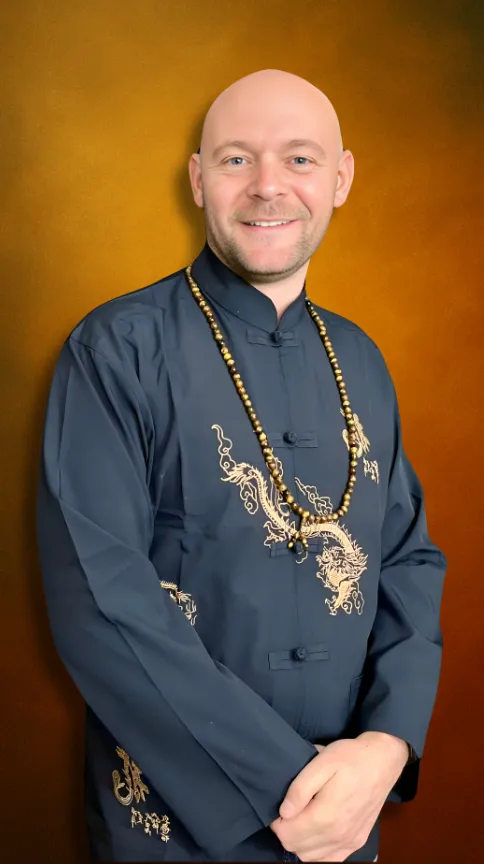
I know what it's like to look successful on the outside while falling apart on the inside.
My journey from British military veteran to rock bottom taught me the hardest truth, sometimes you have to lose everything to find yourself.
After my own dark night of the soul battling depression, facing homelessness, and questioning everything I discovered something powerful.
Real transformation isn't about pushing harder. It's about coming home to yourself.
Today, I guide high-achieving women from exhaustion to embodied leadership. Featured in Yahoo, CEO Weekly, Women Leaders Magazine, and Digital Journal, my work goes beyond traditional coaching.
Not because I have all the answers, but because I understand the questions that keep you up at 3AM.
This isn't about adding more strategies to your life. It's about remembering who you were before the world told you who to be.
Ready to come home to yourself?
TAKE YOUR FIRST STEP
Begin With Your Private Reset Ritual
Join hundreds of female executives who started their transformation here.
No pressure. No performance. Just presence.
(Start sleeping better in 5 days or less)
The Silent Collapse: How Chronic Executive Anxiety Kills High-Achieving Women
Chronic executive anxiety isn't just a fancy term for stress. It's a sustained, high-alert state unique to leaders, driven by a nervous system that has learned to equate high achievement with sheer survival. This relentless internal pressure shows up as chronic worry and a crippling need for perfection, creating a strange paradox where your external success masks an internal feeling that you’re about to collapse. If you stop performing, you feel like you’ll disappear.
Key Takeaways
The Silent Collapse: Executive anxiety isn't just stress; it's a "silent collapse" where external success hides a deep internal dysregulation, making you feel perpetually on the verge of burnout.
The Amygdala Hijack: Understand the neuroscience behind the constant "fight-or-flight" state. Learn how your brain's threat detector gets stuck in the "on" position, sabotaging your strategic thinking and decision-making.
The RAMS™ Framework: Discover a four-part system—Redefining Results, Architecting Attitude, Mastery of State, and Systems for Sustainability—to move from a fear-based operating system to one of embodied confidence and nervous system sovereignty.
The Return to Yourself: Learn that the true solution isn't to sacrifice ambition but to shift your power source from adrenaline and fear to a more sustainable, embodied presence, protecting your legacy and well-being.
The Unseen Toll of Peak Performance
You’ve built an impressive career. You lead teams, drive results, and command respect in every room you enter. From the outside, you are the very picture of success—calm, capable, and always in control.
But behind the closed doors of your office or in the quiet, lonely hours of the night, a different story plays out. A persistent hum of dread follows every major decision. The satisfaction of a win is gone in a flash, immediately crushed by the weight of the next challenge.
This is what I call the silent collapse—the gut-wrenching experience of feeling on top of your game yet perpetually on the verge of burning out. It’s the secret fear that if you pause, even for a moment, everything you’ve built will turn to dust. This isn't just stress; it's a deep, systemic dysregulation that chips away at your confidence, clarity, and well-being.
Chronic executive anxiety is a state of sustained nervous system dysregulation, common in high-achieving leaders, where the brain's threat response becomes chronically activated by work-related pressures. This leads to a cycle of perfectionism, catastrophic thinking, and physiological exhaustion, even in the absence of an immediate crisis.
The Paradox of High Achievement
For so many high-performing women, the very drive that fueled your ascent becomes the bars of your own cage. You get so used to operating in a state of high alert that it starts to feel normal, even necessary.
The constant pressure to appear infallible leaves no room for vulnerability or rest, creating an isolating reality where you feel completely and utterly alone in your struggle. Let me be clear: this isn't a personal failing. It is the predictable outcome of a nervous system conditioned for relentless performance. If this sounds familiar, you might recognize the hidden cost of success for high-achieving women.
This experience is far more common than you could ever imagine. Anxiety disorders impacted 359 million people globally in 2021, with women hit disproportionately hard. For women in their peak career years (ages 35-50), the prevalence of these disorders has seen a staggering 77% increase since 1990. Imagine climbing the corporate ladder to the C-suite, only to find yourself gripped by an inescapable wave of worry. That’s the reality for countless leaders battling chronic executive anxiety.
The Hidden Pattern: Neuroscience of the Gilded Cage
Your success is a beautiful, intricate structure. But let’s be honest, it can also feel like a gilded cage—a prison of your own making that looks secure from the outside but is deeply isolating within. This feeling isn't a sign of weakness or some character flaw. It’s a predictable biological response to a life lived on high alert.
To really get to the bottom of chronic executive anxiety, we have to look past mindset clichés and go straight to the nervous system. Your brain is fundamentally wired for one thing: survival. When you’re faced with a genuine threat, your sympathetic nervous system kicks into gear, flooding your body with cortisol and adrenaline. This is the classic "fight-or-flight" response, and it’s brilliant—as a short-term solution to immediate danger.
But for high-performing leaders, the "threats" never seem to let up. A high-stakes negotiation, a looming project deadline, a difficult conversation with a board member—your brain perceives these challenges with the same life-or-death intensity as a physical attack. Over time, your nervous system simply gets stuck in the "on" position.
The Amygdala on Overdrive
Think of the amygdala as your brain's smoke detector and emotional processing center. In this state of constant pressure, it becomes hyper-vigilant. It starts flagging everyday work situations as full-blown emergencies, triggering that same cascade of stress hormones even when you're just sitting at your desk answering emails. This is the biological root of that constant, low-grade hum of dread you feel.
This chronic activation leads to what’s known as an amygdala hijack. When it happens, your prefrontal cortex—the part of your brain responsible for rational thought, strategic planning, and emotional regulation—gets completely sidelined.
"When anxiety hijacks the brain’s attention, executive function suffers. You might find yourself procrastinating, forgetting details, or feeling paralyzed when faced with decisions."
In practical terms, your ability to lead with clarity and foresight gets compromised. You become more reactive, less creative, and far more prone to decision fatigue. It’s not that you’ve lost your edge; it’s that your brain’s resources are being diverted to fight phantom tigers in the boardroom.
The True Cost of Cortisol Fatigue
Your body was never meant to sustain this level of hormonal output. That constant flood of cortisol eventually leads to adrenal fatigue, a state of profound, bone-deep exhaustion. This isn't just "feeling tired"; it's a deep, cellular depletion that leaves you feeling "wired but tired." You struggle to fall asleep because your mind is racing, yet you wake up feeling as if you haven't rested at all.
This sustained chemical imbalance has very real consequences:
Impaired Cognitive Function: Chronically high cortisol levels are directly linked to problems with working memory and cognitive flexibility, making complex problem-solving much, much harder.
Weakened Immunity: Your body’s ability to fight off illness is suppressed. You become more vulnerable to getting sick, especially during the most critical periods at work.
Emotional Dysregulation: You might find yourself experiencing sudden mood swings, increased irritability, or even a sense of emotional numbness and detachment from your work and your life.
Understanding this biological pattern is the first real step toward reclaiming control. It shifts the narrative from self-blame ("What's wrong with me?") to scientific understanding ("My system is dysregulated"). Your body isn't failing you; it's responding exactly as it was designed to under conditions of chronic threat.
By learning to work with your body's wiring, you can begin to rewire it. Building a new foundation starts with a deep knowledge of your personal nervous system architecture and how it responds to pressure. From this place of awareness, you can architect a new way of leading—one that is both powerful and sustainable.
Recognizing the Symptoms Before They Derail You
Chronic executive anxiety rarely arrives like a lightning strike. It’s not a single, dramatic collapse. Instead, it seeps into your life through a thousand subtle paper cuts—a missed detail here, a sleepless night there, a flash of irritation with your team that you later regret.
You might write these moments off as the normal cost of ambition. But they are warning signs. They're flares sent up from a nervous system pushed far beyond its sustainable limits.
Recognizing these symptoms isn’t about diagnosing a disorder; it's about reclaiming your power. It’s learning to read the language of your own body and mind before the whisper of distress becomes a roar that can derail your career and your life. The pattern is almost always a tangled web of high pressure, constant over-stimulation, and a profound sense of isolation, even when you're surrounded by people.
This map shows how these three forces—pressure, over-stimulation, and isolation—feed into each other, creating a vicious cycle.
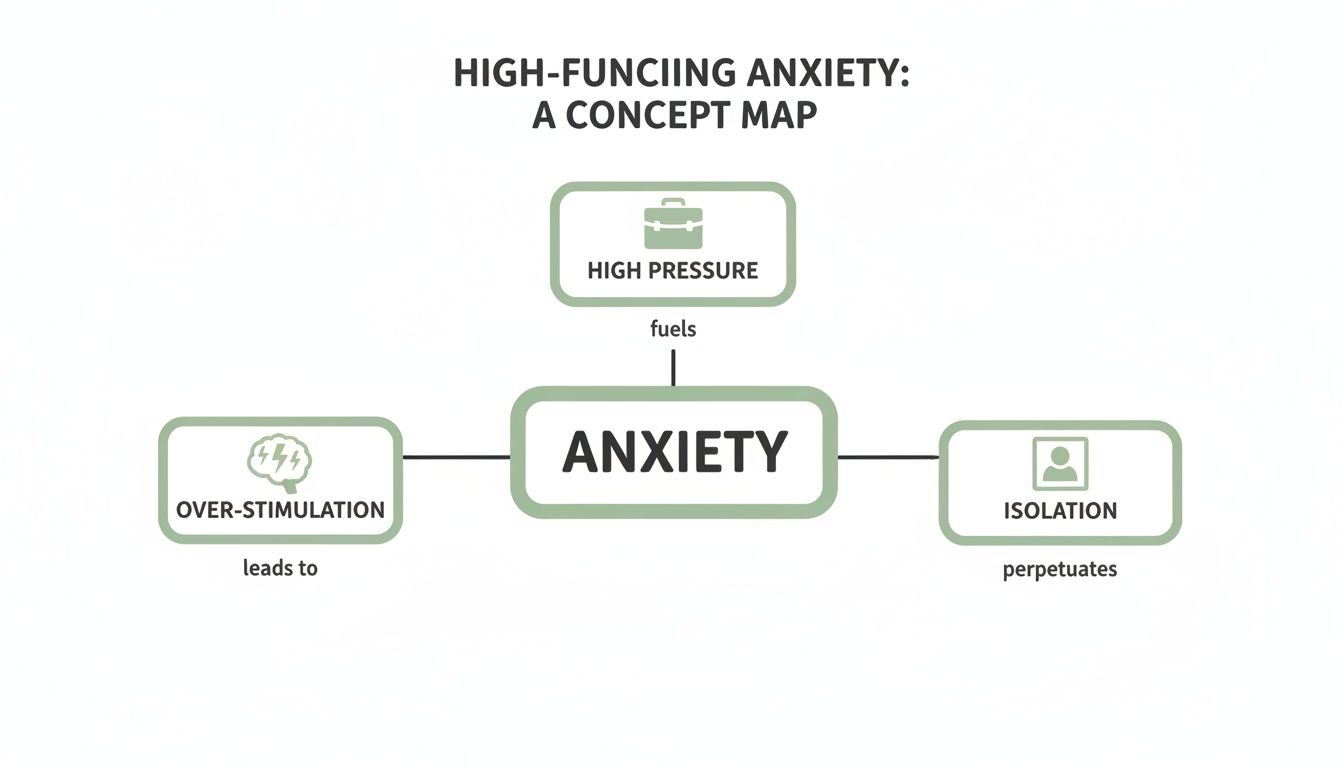
They aren't separate issues. They are a reinforcing loop where professional demands fuel mental overload, which leads to withdrawal and, in turn, deeper anxiety.
Cognitive and Emotional Signals
The first signs almost always appear in your head. Your mind, once your greatest asset, starts to feel like a liability.
Analysis Paralysis: You get stuck on decisions you used to make with ease, endlessly replaying scenarios and second-guessing your own judgment.
Perfectionism Overdrive: The idea of "good enough" vanishes. Every report, presentation, and email has to be flawless, leading to hours of obsessive, low-value work.
Catastrophic Thinking: Your mind immediately leaps to the worst-case scenario for any situation, no matter how unlikely. A minor setback feels like a sign of impending failure.
Emotional Volatility: You snap at colleagues or loved ones over small things, only to be hit with a wave of guilt moments later.
This state is a silent saboteur, especially for women juggling immense professional and personal demands. U.S. data shows a sharp rise in generalized anxiety disorder (GAD)—a key part of this chronic state—with prevalence jumping from 5.4% in 2020 to 6.6% in 2023. Women accounted for a staggering 67.4% of new diagnoses, with a median age of 41—the absolute prime of an executive's career.
Physical and Behavioral Manifestations
While your mind stays on high alert, your body starts keeping score. Chronic executive anxiety is a full-body experience, and the physical symptoms are often the ones we ignore the longest.
You might feel "wired but tired"—a state of agitated exhaustion where your body is depleted but your mind refuses to switch off. This is a classic sign of adrenal and nervous system overload.
This dysregulation shows up in your daily actions and physical health.
Physical Symptoms:
Persistent muscle tension, especially in your neck, shoulders, and jaw.
Chronic digestive issues like bloating or stomach upset with no clear medical cause.
Trouble falling or staying asleep, even when you're bone-tired.
A racing heart or shallow breathing, even when you’re just sitting at your desk.
Behavioral Symptoms:
Micromanagement: You feel an intense need to control every detail, driven by a deep fear that things will fall apart if you don't.
Conflict Avoidance: You go to great lengths to sidestep difficult conversations, even when they are critical for your team's success.
Social Withdrawal: You start turning down networking events or team lunches because you feel too drained to engage, which only deepens the isolation fueling the anxiety.
These symptoms often look like other conditions, which is why getting clear is so crucial. For example, it's helpful to distinguish between ADHD and anxiety symptoms, as they can present similarly. The same goes for burnout, another common challenge in high-pressure roles.
Understanding the subtle differences in your experience is the first step toward addressing the specific patterns of executive dysregulation holding you back.
While anxiety and burnout often travel together, they are not the same thing. Knowing which one you’re truly dealing with is critical because the solutions are fundamentally different. This table breaks down the key distinctions.
Anxiety vs Burnout in Executive Women

Spotting your own patterns in these descriptions is the first step. Anxiety pulls you into an endless future of what-ifs, while burnout chains you to the exhaustion of the past. Recognizing which force is driving you is the key to finally breaking free.
The RAMS™ Reframe: A Framework For Nervous System Sovereignty
Knowing the science behind your chronic executive anxiety is a game-changer. It shifts the narrative from “What’s wrong with me?” to “This is what’s happening in my body.” It moves you out of self-blame and into biological awareness.
But awareness alone won't break the cycle. To truly shift from a high-alert, survival-driven state to one of sustainable, embodied leadership, you need a framework that works in the real world.
The RAMS™ Method is a structured approach developed specifically for high-performing leaders like you to dismantle the very architecture of anxiety. This isn’t about slapping on another coping mechanism. It’s about re-architecting your internal world so you can lead with the clarity, power, and presence you’ve been fighting to maintain.
R is for Redefining Results
For most high-achievers, "results" are all about external validation. Hitting KPIs. Closing deals. Nailing the next promotion. This relentless chase is the primary fuel for anxiety because the goalposts are always moving, and your self-worth is perpetually on the line.
The first pillar of RAMS is to redefine your results, shifting the focus from external validation to internal alignment. Your primary measure of success is no longer what you achieve but how you feel while achieving it.
The ultimate result isn't a bigger title. It's a regulated nervous system—the capacity to stay calm, centered, and clear-headed even when all hell is breaking loose around you.
When your internal state becomes the KPI, everything changes. You make decisions that protect your energy, not just your P&L. You set boundaries not from weakness, but as a strategic imperative for long-term impact. This is taking your power back.
A is for Architecting Attitude
Your attitude is the tactical filter through which you interpret every event. For leaders with chronic executive anxiety, the default filter is fear—of failure, of judgment, of not being enough. This fear-based operating system keeps your fight-or-flight response on a hair trigger.
Architecting your attitude means rebuilding that filter, shifting from fear to embodied confidence. This isn't about affirmations. It's about cultivating a deep, cellular-level trust in your ability to handle whatever comes.
This shift requires:
Somatic Awareness: Learning to feel and interpret your body's signals, instead of ignoring them.
Threat De-escalation: Training your brain to know the difference between a genuine survival threat (a lion) and a high-stakes work challenge (a quarterly review).
Radical Self-Trust: Making the conscious decision to trust your own judgment, even when it cuts against conventional wisdom.
This new attitude doesn't make challenges disappear. It changes your capacity to meet them.
M is for Mastery Over Your State
You cannot control the market, your board, or your competitors. You can achieve mastery over your internal state. For any leader, this is the single most valuable skill. Chronic executive anxiety robs you of this, leaving you reactive and hijacked by racing thoughts.
Mastery is building the practical skills of emotional and physiological regulation. It’s learning to consciously influence your own nervous system. For those looking for immediate ways to manage acute physical symptoms, exploring options like Propranolol for anxiety relief can be part of establishing that initial control.
Key practices for building mastery include:
Breathwork Protocols: Using specific breathing techniques to deliberately shift your body from a sympathetic (fight-or-flight) state to a parasympathetic (rest-and-digest) state in minutes.
Emotional Granularity: Learning to identify and name your emotions with accuracy, an act that immediately reduces their power to overwhelm you.
Strategic Disengagement: Mastering the art of stepping away to reset your system before you hit your breaking point.
This isn’t about suppressing emotions; it’s about navigating them with skill. This is the core of what it means to achieve embodied sovereignty.
S is for Systems for Sustainability
Your internal state doesn’t exist in a vacuum. A dysregulated nervous system cannot heal in a chaotic, unsustainable environment. The final pillar of RAMS™ is building robust systems for sustainable high performance.
This means taking an unflinching look at your life—your schedule, your relationships, your health habits—and redesigning it to support a regulated state. Imagine a female founder pitching to investors, her mind a storm of 'what-ifs'. This is chronic executive anxiety in action.
And it’s a global crisis. WHO data shows anxiety affected 359 million people in 2021 and is the second-leading cause of long-term disability for women. Globally, governments allocate a mere 2% of health budgets to mental health. With treatment access as low as 27.6%, the $1 trillion in annual productivity losses from anxiety and depression shouldn't surprise anyone.
Systems for sustainability include:
Energy Management Protocols: Structuring your day around your natural energy cycles, not just the tyranny of your to-do list.
High-Quality Recovery: Treating deep rest, nutrition, and movement as non-negotiable components of your performance strategy.
Curated Support: Building a small, trusted circle of advisors and peers who provide unvarnished feedback and genuine support, not just applause.
These systems are the guardrails that protect your most valuable asset: your well-being. They make resilience your default setting.
The Return: From High Performer to Embodied Leader
The way out of chronic executive anxiety isn't about dialing back your ambition. It’s about a fundamental shift in where you get your power. For years, you’ve run on adrenaline and fear—a potent but corrosive fuel that always leads to burnout.
The path forward is about trading that fuel for something far more sustainable and infinitely more powerful: embodied presence. This is the ultimate return. It’s a return to yourself—to the centered, clear-headed leader who exists beneath the constant noise of anxiety.
This isn’t about becoming someone new. It's about stripping away the conditioning that told you your worth was welded to your last win. It's about coming home to your own body and trusting its wisdom.

The Power of Nervous System Sovereignty
Embodied leadership is born from nervous system sovereignty. This is the state where you are no longer at the mercy of your amygdala’s constant false alarms. You develop the skill to regulate your internal state, no matter what external chaos is thrown your way.
Sovereignty means you own your internal territory. You can feel the rise of anxiety without being consumed by it. You can face immense pressure without losing your center. This isn't a superpower; it's a skill that can be learned.
When you lead from this place, your presence changes the dynamic of a room. Your team feels your stability. Your decisions become rooted in clarity, not frantic reactivity. Your energy becomes a strategic asset.
Architecting a Sustainable Legacy
The constant battle with chronic executive anxiety is exhausting. It forces you to operate in a defensive crouch, braced for the next perceived threat. That posture is unsustainable. It will derail the very career you’ve fought so hard to build.
Becoming an embodied leader means you stop playing defense and start architecting a life and career built for the long haul.
From Reactivity to Responsiveness: Instead of being hijacked by every trigger, you learn to pause, regulate, and respond from a place of solid intention.
From Isolation to Connection: You build genuine support systems, understanding that true strength lies in strategic vulnerability, not infallible independence.
From External Validation to Internal Alignment: Your primary metric for success becomes your own well-being, which in turn amplifies your external impact tenfold.
This is a deeper way of leading. You stop managing crises and start creating possibilities. You trade frantic energy for grounded power. This shift is explored in our specialized transformational leadership training designed for leaders ready to make this profound change.
Your Next Step Is a Return
Overcoming chronic executive anxiety isn't just about feeling better. It's about leading better. It’s about ensuring the drive that got you here doesn’t burn you to the ground.
You can be ambitious and at peace. You can drive world-class results without sacrificing your soul. The work ahead is to reclaim the parts of yourself sidelined by the relentless demands of high achievement. It’s a journey back to your own nervous system, back to your own truth, and back to the embodied leader you were always meant to be.
The next step isn't another mountain to climb. It’s a commitment to returning home to yourself.
Your Questions About Executive Anxiety, Answered
When you're navigating the constant pressure of leadership, it's natural to have questions about what you're feeling. Let's get straight to the real answers for the most common concerns I hear from high-performing women leaders.
How Is Chronic Executive Anxiety Different From Normal Work Stress?
Think of it this way: normal work stress is like a thunderstorm. It’s intense and focused on a specific event—like a massive project deadline. But once the event is over, the storm passes. Your system returns to baseline.
Chronic executive anxiety isn’t a storm; it’s a change in the entire climate. The high-alert, fight-or-flight feeling becomes your new normal. The dread doesn't leave when the stressful task is done. It latches onto the next thing, fueled by a relentless fear of failing. It’s the difference between temporary pressure and a permanent state of being.
Can I Overcome This Without Sacrificing My Career Ambitions?
Let’s be crystal clear: addressing this anxiety is the only way to protect your career ambitions. Running on a constant drip of adrenaline isn't sustainable. It's a direct flight to burnout, and burnout is the real career killer. It will take you out of the game completely.
The goal isn't to kill your drive; it's to change the fuel source. By learning to lead from a place of regulated energy and internal clarity, you upgrade your fuel. You become more resilient, more creative, and more effective—leading to sustainable success. This isn't about stepping back; it's about shifting gears to go further, faster.
What Is The First Practical Step I Can Take Today?
Start with a simple, 24-hour “nervous system audit.” Your only job for one day is to become a curious observer of your own internal state, without judgment. Just notice. Pay attention to the moments when your heart starts racing, your jaw clenches, or your thoughts start to spiral.
What are the triggers? Is it a specific person’s name in your inbox? A certain type of meeting? The quiet pressure of a looming deadline?
You can't change a pattern you aren't aware of. This simple act of noticing is the first, most powerful step. It's like turning on the lights in a dark room. It shows you exactly where your energy is leaking and where you can start to reclaim control.
When Should I Seek Professional Help For Executive Anxiety?
It's time to bring in professional support when the symptoms are consistently getting in the way of your work, relationships, or health. If you find yourself avoiding important tasks, struggling with chronic insomnia, or feeling persistently overwhelmed, that’s your signal.
High-functioning anxiety is sneaky. It often convinces you you're "fine" right up until you hit a wall. Waiting until you are completely depleted is a reactive strategy. Strong leaders don't wait for systems to fail; they address vulnerabilities before they become disasters. Seeking specialized guidance isn’t an admission of weakness—it's a strategic investment in your single most valuable asset: you.
If you are ready to move from a state of constant anxiety to one of embodied, sustainable leadership, Baz Porter provides the framework and support to guide your transformation. Explore the RAMS Method and begin your journey back to yourself at https://bazporter.com.

Voted number #1 for Leadership by the Best of the Best 2024. Real growth for High performing women who love life & demand more.
⭐⭐⭐⭐⭐
1630 30th Street Ste A - 418
Boulder Colorado 80301
United States
Phone: +1-646-212-4807
CUSTOMER CARE
NEWS
LEGAL


© 2019 - 2026 | Baz Porter LLC. All rights reserved.
Protected by all the possible laws. If you wanna try and copy it. We are gonna come after you. Liam Neeson Style.
Terms Of Use | Privacy Policy | Disclaimer