
For High-Achieving Women
Who Are Done Being Strangers to Themselves
You've built the empire. The multi-6-figure business. The corner office everyone envies.
But here's what nobody sees...
You're dying inside The 4 AM anxiety attacks. The calendar as armor.
The terrifying question that keeps you awake...
"If I stopped performing... would I disappear?"
Finally Choose Themselves Over Their To-Do Lists
Discover Why 97% of "Successful"
Women Are Secretly Collapsing Yours Free.


Dear Beautiful Soul,
I see you.
Not just your achievements or your carefully curated LinkedIn profile.
I see the woman behind the titles, beyond the metrics, beneath the mask of "having it all together."
I see you at 3AM, when the world is quiet but your mind isn't.
When the questions you can't ask in the boardroom become too loud to ignore.
"Why does achieving everything I wanted feel like losing myself?"
"When did success start feeling this heavy?"
I know this journey intimately.
Not because I'm another coach with strategies and systems (though yes, those matter).
But because I've walked alongside women who dared to question everything they built.
Like Lorraine, who found herself in the darkest place imaginable both personally and professionally.
Today, she's not just surviving; she's reaching heights she "didn't even realize she was looking for."
Her words, not mine:
"What Baz does is life altering. He reached my heart, my soul, and allowed me to come alive again."
Or Angela, who transformed her relationship with power entirely.
She stopped pushing through exhaustion and started leading from authentic presence.
Now her team doesn't just respect her they're inspired by her whole, unfiltered truth.
Then there's Sabrina, who discovered what happens when you stop trying to fit into old leadership models.
"Baz doesn't just offer advice," she shares, "he ignites a fire within. He empowers you to unlock unprecedented potential not just in yourself, but in your entire organization."
This isn't just about executive burnout or stress management.
Those are just symptoms of a deeper truth.
This is about reclaiming your soul in the midst of success.
About remembering who you were before the world told you who to be.
About leading from a place of power that doesn't require perfection.
I've watched women step into boardrooms not with rehearsed speeches, but with unshakeable presence.
I've seen them make million-dollar decisions from a place of inner knowing, not endless analysis.
I've witnessed them build global teams while staying deeply connected to themselves.
Your success got you here.
But your truth will take you further.
You don't need another strategy.
You need permission to lead differently.
To breathe differently.
To succeed differently.
To be differently.
The transformation you're seeking isn't about adding more to your already full plate.
It's about coming home to the woman you've always been beneath the achievements.
Ready to remember who you are beyond the titles?
With deep understanding and unwavering belief in your next chapter,
Baz
P.S. The fact that you're still reading means your soul knows something your schedule hasn't admitted yet.
It's time for real change.
Not the kind that looks good on paper, but the kind that feels true in your bones.

12 week Private Mentorship Program
Strategic Identity Reset
- 6 Private 90-Minute Sessions with Baz Porter
- Comprehensive Identity & Authenticity Assessment
- Success Wound Identification & Healing Protocols
- Authentic Leadership Development Protocols
- 4-Week Post-Program Integration Period
- Custom Identity Reclamation Resources
- Stop waking up at 4 AM wondering if you matter beyond what you produce
- End the exhausting performance that's killing your soul while keeping your success
- Make decisions from your authentic self, not from fear of disappointing others
- Lead without the armor and watch people finally connect with the real you
- Create legacy impact that feeds your soul, not just your bank account
A Million Dreams Community
Where High-Achieving Women Transform Together
- Trauma-informed Guidance (weekly sessions)
- Somatic nervous system reset
- Health optimization
- Executive performance coaching
- Specialized breathwork
- Direct access to proven frameworks
- You'll sleep through the night because your body finally feels safe in your success
- You'll make decisions faster because you trust yourself more than others' opinions
- You'll stay regulated in rooms that used to dysregulate you
- You'll be present with your children without guilt eating you alive
- You'll lead from sovereignty, not survival
- You'll stop performing your life and start living it


Hi I'm Baz...

I know what it's like to look successful on the outside while falling apart on the inside.
My journey from British military veteran to rock bottom taught me the hardest truth, sometimes you have to lose everything to find yourself.
After my own dark night of the soul battling depression, facing homelessness, and questioning everything I discovered something powerful.
Real transformation isn't about pushing harder. It's about coming home to yourself.
Today, I guide high-achieving women from exhaustion to embodied leadership. Featured in Yahoo, CEO Weekly, Women Leaders Magazine, and Digital Journal, my work goes beyond traditional coaching.
Not because I have all the answers, but because I understand the questions that keep you up at 3AM.
This isn't about adding more strategies to your life. It's about remembering who you were before the world told you who to be.
Ready to come home to yourself?
TAKE YOUR FIRST STEP
Begin With Your Private Reset Ritual
Join hundreds of female executives who started their transformation here.
No pressure. No performance. Just presence.
(Start sleeping better in 5 days or less)

Being Promoted at Work Without Burning Out
Getting that promotion should be a moment of pure victory. You earned it. So why does it feel less like a celebration and more like the starting gun for a race you aren't ready to run? That excitement is almost immediately eclipsed by a crushing, unspoken pressure. Your internal chatter starts: “If I stop performing, I’ll disappear.” This milestone, the very thing you worked for, suddenly feels like an invitation to burnout. This is the silent collapse—that moment your new responsibilities start to outrun your internal sense of readiness, and your nervous system signals it's struggling to keep up.
Key Takeaways
The Hidden Cost: Being promoted often triggers a "silent collapse"—a physiological stress response where new demands outpace your internal readiness, leading directly to burnout if unmanaged.
The High-Altitude Climb Metaphor: Leadership is like climbing at high altitude. The air is thinner, support feels distant, and small issues become dangerous crevices. Success requires navigating these invisible dynamics, not just technical tasks.
Negotiation as Authority: Negotiating your title and compensation isn't about greed; it's a critical step in claiming your new authority and signaling to the organization that you understand your value.
The RAMS™ Method: Sustainable success requires a new internal operating system. The RAMS™ Method (Results, Attitude, Mastery, Systems) provides a framework to lead from a place of grounded power, managing your energy, not just your time.
Being promoted at work successfully requires a different skill set than the one that got you the job. It demands a shift from pure execution to strategic leadership, managing not just tasks, but your own nervous system to sustain performance without collapsing under the pressure.
The Hidden Pattern of Post-Promotion Collapse
The internal chatter starts almost right away. “Can I actually do this? What if they find out I’m not as capable as they think?”
This isn't just "new job jitters." It’s a deep, physiological signal that your nervous system is struggling to keep up with the increased demands. Without the right tools to manage this internal state, this pressure is a direct path to exhaustion and burnout.
If you're already feeling the edges of this struggle, my guide on overcoming burnout at work offers foundational strategies. The most critical thing to realize is that sustaining success requires a completely different skill set than the one that got you the promotion in the first place.

Why Your New Role Feels So Heavy
A new title changes a lot more than what’s on your business card—it completely rewires your professional world. This upheaval can trigger deep-seated survival responses, making you feel like an imposter right when you should feel most powerful.
The neuroscience here is clear. When we’re thrown into new, high-stakes social situations, our brain's threat detector—the amygdala—can go into overdrive. It starts scanning for social threats with the same intensity it would a lion on the savanna. Is my new team really with me? Are my peers actually supportive? Is my boss truly in my corner? Every one of these questions fuels a low-grade hum of anxiety.
Metaphor: The High-Altitude Climb of Leadership
Think of your promotion as a high-altitude climb. Down at base camp, the path was obvious and the team was tight. But as you ascend into a leadership role, the air gets thinner, the footing is less certain, and your support systems can feel miles away. Those small cracks in team alignment or unclear performance metrics that were once minor annoyances? They're now dangerous crevices that can stop your progress cold.
This is exactly where so many new leaders get stuck. They fixate on the summit—the big, splashy results—while completely ignoring the subtle, dangerous shifts in the environment all around them.
The biggest hurdles in a new leadership role are rarely the technical tasks. They are the invisible dynamics: the unspoken expectations, the shifting alliances, and the internal war against self-doubt. Seeing these for what they are is the first real step to leading.
Your ability to lead effectively hinges on navigating these less obvious, often political, currents. You can find deeper strategies for handling these complex relationships in our guide on how to navigate office politics.
Why Employer Investment is a Key Predictor of Your Success
That heavy feeling is amplified when organizations toss you into a bigger role without creating a supportive environment for your growth. The data from the ADP Research Institute shows a crystal-clear link between employer investment and promotion rates.

Source: ADP Research Institute, People at Work 2024
The massive 20-point difference proves that when a company truly invests in you, it doesn't just build your skills—it builds your momentum and confidence to step into that next role, ready to own it. Without it, you're left climbing solo in thin air. For anyone stepping into new leadership, a solid Leadership Transition Communication Guide can be invaluable for setting clear expectations from day one.
The Reframe—Proactively Engineering Your Promotion
Most people treat promotions like a lottery. A role opens up, they throw their hat in the ring, and hope for the best. This is a reactive, low-percentage game.
True career momentum isn’t about luck; it's about making yourself the undeniable choice long before the job description even exists. The real work starts months before any formal announcement. It's a quiet, consistent process of building value, making your impact visible, and aligning your growth with where the company is headed.
You stop hoping an opportunity finds you and start creating the conditions where it has no choice but to.
Crafting Your Personal Skills Roadmap
Waiting for your annual review to talk about development is a critical mistake. Your growth is your responsibility, not your manager's. You need to get in the driver's seat.
Start by getting clear on the role you want next. Then, work backward. What specific skills, experiences, and political capital does that role demand?
Technical Skills: Does the next level require a certification you don't have? Is there a software platform everyone at that level has mastered? Get on it.
Strategic Skills: Can you prove you think beyond the next deadline? This is non-negotiable for leadership. Check out our guide to developing your strategic thinking for leaders.
Leadership Skills: Have you managed a complex project? Mentored a junior colleague? These aren't just nice-to-haves; they are proof of your leadership potential.
Once you have this roadmap, you can stop taking on random tasks and start hunting for the specific projects that fill those gaps.
Documenting Your Impact, Not Just Your Tasks
Your boss might see your day-to-day hustle, but the executives who sign off on promotions don't. They care about the impact you had on the business.
Start a running "impact journal." For every significant project, document it like a case study:
The Problem: What was the business challenge?
The Action: What specific steps did you take?
The Result: What was the quantifiable outcome? Did you increase revenue by 15%? Cut process time by 20 hours per week?
Promotions are awarded based on past performance as an indicator of future potential. If you can't clearly articulate the value you've already delivered, you make it incredibly difficult for others to envision the value you could bring to a larger role.
This isn't just for your resume. This is your arsenal for the promotion conversation. You won't be talking in vague terms. You'll be presenting a data-backed business case for your own advancement.
Building Your Coalition of Advocates
Decisions about who gets promoted are rarely made by one person. They're made in meetings you're not invited to. Your job is to make sure you have allies in that room.
This isn't about slimy politics. It's about building genuine professional capital.
Identify key influencers and decision-makers. Don't just ask for mentorship; that's taking. Offer to help them solve a problem. Ask for their feedback on a project. Make yourself valuable to them.
I coached a healthcare administrator gunning for a Director role who set up 30-minute meetings with leaders in Finance and IT to genuinely understand their headaches. When the promotion board met, she had three different leaders who could vouch for her collaborative spirit and business-wide perspective. She had built a coalition.
When you combine a clear skills roadmap, hard data on your impact, and a network of genuine supporters, you are no longer just another candidate. You are the inevitable conclusion.
How to Negotiate Your New Title and Compensation
A promotion isn’t just a pat on the back; it’s a new contract for the future value you’re expected to create. When that promotion lands without the right title and compensation, it feels less like a step up and more like you’ve been handed more responsibility with no real recognition.
This is the moment where many capable leaders falter. They default to gratitude instead of advocating for their full worth. Let's be clear: this isn't about being greedy. It’s about ensuring your new role is properly resourced and the organization is formally acknowledging the value you’re about to deliver.
Getting your negotiation right sends a powerful signal. It tells them you know your value and are ready to stand behind your contributions. This isn't just about money; it’s about claiming your new authority.
Benchmarking Your Role Against the Market
Before you mention a number, arm yourself with cold, hard data. Anchor your request in the undeniable reality of the market.
Gather Intel: Use sites like Glassdoor, Payscale, and especially Levels.fyi if you're in tech. Look for similar responsibilities, company sizes, and geographic areas.
Talk to Recruiters: Executive recruiters are a goldmine of real-time compensation data.
Look at Internal Peers: Observe the organizational structure to estimate pay bands for people at the level you’re moving into.
This research does more than give you a number. It gives you unshakeable confidence. Your ask stops being a personal request and becomes a straightforward business discussion.
Structuring a Value-Driven Ask
Frame your negotiation around the value you deliver, not just the job title. Companies don’t pay for titles; they invest in results.
Your negotiation isn't a confrontation; it's a collaborative conversation about the value you're going to create. Frame your ask as the return on their investment in you.
Instead of saying, "I'd like a salary of $180,000," try this:
"Based on my research for a Director-level role in our industry, the market rate is between $175,000 and $190,000. Considering my work on the Q3 launch generated over $2 million in new pipeline, I believe a base salary of $185,000 accurately reflects the impact I'll be bringing to this expanded role."
It's non-confrontational and rooted in evidence. You can find more powerful reframes in our guide on the fundamental principles of negotiating.
Looking Beyond the Base Salary
Total compensation is a package, not a single number. A promotion into leadership opens the door to other valuable forms of compensation.

Broadening the negotiation creates more pathways to a win-win outcome. It shows you're thinking strategically about a long-term partnership. For a deep dive on equity, check out A Strategic Guide on How to Exercise Stock Options.
Mastering Your First 90 Days in a Leadership Role
The ink on your new contract is barely dry. Those first three months in a new leadership role are the foundation you'll build your entire tenure on. This is your window to establish credibility, build trust, and set the tone.
Many new leaders feel intense pressure to prove themselves right away, spiraling into a frantic cycle of doing and fixing. But the real work of these first 90 days isn't about having all the answers. It’s about asking the right questions and listening like your career depends on it.
Redefining Your Team and Scope
You've inherited a team, but you haven't yet built one. Your first job is to understand the existing dynamics before you try to change them. This means shifting your mindset from a "doer" to a "facilitator."
Get one-on-one meetings on the calendar with every person on your team. This is a discovery mission.
See It Through Their Eyes: Ask, "If you had a magic wand, what's the one thing you'd change about how we operate?"
Map Out Strengths and Gaps: Learn what motivates them, where they shine, and where they need support.
Set Expectations (Both Ways): Ask them point-blank: "What do you need from me as your leader to do your absolute best work?"
This initial listening tour gives you the unfiltered data you need to set new objectives that are grounded in reality.
Establishing Authority Through Trust
A title doesn't grant you authority. It's earned, one trustworthy action at a time. Your former peers and new reports are watching, waiting to see if you'll lead with integrity or ego.
The fastest way to kill trust as a new leader is to pretend you know everything. The quickest way to build it is to show you're committed to learning—about the business, the work, and the people you now have the privilege to lead.
Transparency is your most powerful asset. Share your 30-60-90 day plan with the team. Be honest about what you know and, just as importantly, what you don't know yet. That vulnerability doesn't make you look weak; it makes you human.
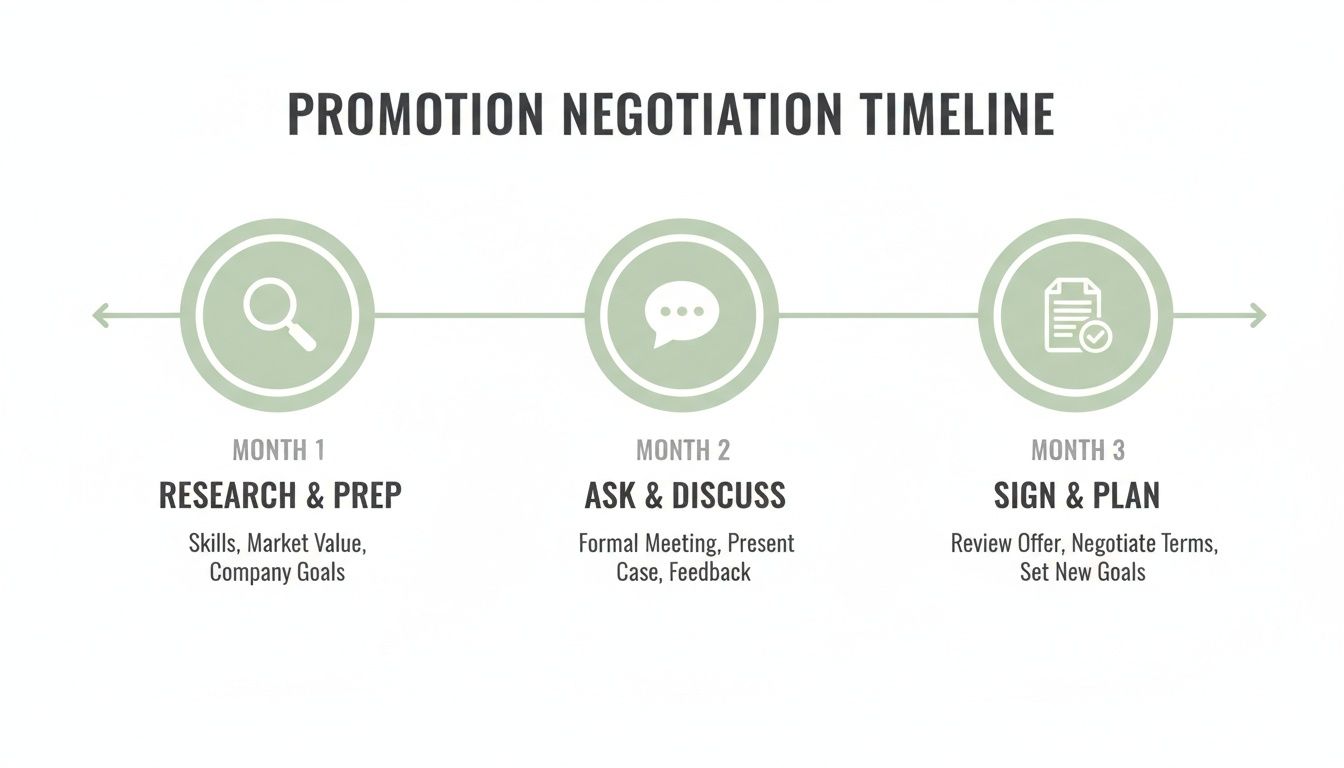
As you can see, a successful transition starts long before you ever sign the offer. It begins with deep preparation.
Managing Your New Identity
The most overlooked challenge is the internal one. You're no longer responsible for just your output; you're responsible for the collective results of others. It requires a profound identity shift.
Your value isn't measured by how many tasks you check off. It's measured by your ability to empower, guide, and unblock your team. You'll feel the pull to jump in and solve problems yourself. Resist that urge. Your new job is to build a system where problems get solved without your direct intervention.
Delegate Outcomes, Not Tasks: Define the desired result and give them the autonomy to figure out the path.
Shine the Spotlight on Your Team: When they win, you win. Give credit publicly and privately.
Guard Your Time Fiercely: Your calendar is now your most valuable asset. Protect it for the high-impact, strategic work only you can do.
Nailing these first 90 days isn't about sprinting. It's about setting a sustainable pace for the long haul.
The Return to Nervous System Sovereignty
Getting the promotion wasn't the finish line. It was the starting gate for a much longer marathon. Thriving in your new role isn't about working harder; it's about a complete internal rewiring. It's a return to yourself.
This is where you stop just managing tasks and start architecting a sustainable system for both your performance and your well-being. This is nervous system sovereignty.

The RAMS™ Method is a practical framework designed for exactly this. It anchors your leadership in four core pillars: Results, Attitude, Mastery, and Systems. By integrating this approach, you stop running on adrenaline and start leading from a place of grounded power.
Results Driven by Intention, Not Exhaustion
In your last role, results were about your direct output. Now, they're about the output you inspire. Your focus must narrow to the 2-3 critical outcomes that only you can drive forward. Everything else must be delegated or eliminated.
Sustained leadership isn't about the volume of work you do; it's about the precision of your impact. Your primary job is no longer to do the work, but to create the conditions for the work to be done brilliantly by others.
Attitude Regulated by Your Nervous System
Your attitude as a leader is a direct reflection of your internal state. When your nervous system is in a constant state of fight-or-flight, your attitude becomes reactive and controlling. Cultivating a grounded presence starts with physiological regulation.
Box Breathing: Before a high-stakes meeting, try a 4-4-4-4 cycle (inhale, hold, exhale, hold). This lowers cortisol and brings you back to your rational mind.
Physiological Sigh: When overwhelmed, take two sharp inhales through your nose followed by one long, slow exhale through your mouth. This is one of the fastest ways to down-regulate your nervous system.
These are essential performance tools for modern leadership.
Mastery Through Continuous Adaptation
Mastery isn't about collecting certificates. It’s about cultivating deep competence in the areas that matter now: strategic communication, team empowerment, and navigating complex political landscapes. The World Economic Forum reports that 50% of workers have recently upskilled. Sustainable leadership is impossible without continuous adaptation. You can explore the full report on the future of jobs and skills for context.
Systems That Create Freedom
Systems free you from the tyranny of the urgent. Your brain has finite decision-making energy. Wasting it on low-impact, repetitive tasks is a recipe for exhaustion. Create systems to automate your work:
Decision Matrix: For recurring decisions, create a simple matrix with clear criteria.
Communication Cadence: Establish a predictable rhythm for team check-ins and updates.
Energy Audits: At the end of each week, review your calendar. What gave you energy? What drained it? Systematically reduce the drains.
By implementing the RAMS™ Method, you build a resilient foundation. This is how you turn a career milestone from a moment of intense pressure into a platform for lasting, authentic impact. To learn more, read our deep dive into the RAMS Method leadership framework explained.
Your Promotion Questions, Answered
Getting the promotion is one thing. Thriving in it is another. Let's tackle the most common questions so you can walk into your new role with clarity.
I got the promotion. What is the absolute first thing I should do?
Your first move isn't to prove you can do the work. It's to prove you understand the new work. Get on the calendars of your direct reports, new peers, and key stakeholders. Your mission is to understand one thing: what do they expect from you in this role? What does success look like from their perspective? Use that intel to build a solid 30-60-90 day plan that shows you’ve been listening and are ready to lead with intention from day one.
They’re pushing back on my salary request. Now what?
When you hit a wall in salary negotiations, take the emotion out of it and ground the conversation in hard data. This isn't about what you want; it's about what the role is worth in the market. Circle back to your market research and calmly connect that data to the tangible value you’ve already brought to the company. Frame the discussion around mutual success, not personal gain.
Try this shift: "Ensuring my compensation is aligned with the market rate for this level of responsibility allows me to focus 100% on delivering the results we've talked about for the team." It’s no longer a request. It’s a partnership focused on a shared goal.
How do I actually build new leadership habits that stick?
Sustainable change happens in small, consistent increments. Pick one—just one—new habit to integrate. Maybe it's blocking off the last five minutes of your day for a quick reflection on your leadership decisions. Did you empower or micromanage? Another powerful move is to consciously delegate one task each week that you’d normally just do yourself. It builds trust and frees up your mental space for the strategic thinking your new role demands.
True leadership sovereignty isn't about the title; it's about embodying your authority without sacrificing your well-being. It's about returning to yourself. If you're ready to lead from a place of grounded power instead of burnout, explore the RAMS Method. This is the first step.

Voted number #1 for Leadership by the Best of the Best 2024. Real growth for High performing women who love life & demand more.
⭐⭐⭐⭐⭐
1630 30th Street Ste A - 418
Boulder Colorado 80301
United States
Phone: +1-646-212-4807
CUSTOMER CARE
NEWS
LEGAL


© 2019 - 2026 | Baz Porter LLC. All rights reserved.
Protected by all the possible laws. If you wanna try and copy it. We are gonna come after you. Liam Neeson Style.
Terms Of Use | Privacy Policy | Disclaimer