Women's History Month Speakers: Sovereign Leadership
The room applauds. The keynote praises resilience. The slides celebrate progress. You sit there with a polished face and a dead nervous system.
That split is the problem.
You’ve built results. You lead teams. You carry the revenue line, the board pressure, the family logistics, the political load. Then Women's History Month arrives, and your organization books another speaker who talks about inspiration as if your issue is a lack of admiration for successful women.
It isn’t.
The core symptom is Silent Collapse™. You still perform. You still deliver. But your internal command system is running hot, numb, and distorted. You don’t need another story about possibility. You need a speaker who can identify operational failure inside high performance.
Table of Contents
Selecting Women's History Month Speakers for Systemic Repair
Frequently Asked Questions About Leadership Speaker Selection
The Hollow Keynote Why Typical Speakers Fail High-Achievers
A standard Women's History Month talk often fails the highest performers in the room. It praises endurance while ignoring depletion. It celebrates visible success while missing internal collapse.

I see the same pattern repeatedly. A senior leader sits through a polished keynote on courage, legacy, or representation. Everyone leaves feeling virtuous. The leader leaves more isolated than before, because none of it touched the actual condition.
A review of major Women's History Month speaker listings found zero mentions of burnout, impostor syndrome, or nervous system recovery frameworks, despite the reported reality that 42% of women in leadership experience burnout symptoms, as noted in this review of Women's History Month speaking topics. That is not a content gap. It is a diagnostic failure.
When leaders want to extend influence beyond one event, they often also explore adjacent channels such as turning podcasts into a marketing channel, because a single keynote rarely repairs a damaged leadership system.
If your organization still thinks uplifting language is enough, read this critique of uplifting leadership messaging. It names the same problem from another angle.
A keynote that ignores internal collapse doesn’t inspire high-achievers. It confirms that nobody in the room can see them.
Selecting Women's History Month Speakers for Systemic Repair
Women's history month speakers should be selected as a strategic intervention, not a ceremonial booking. If the audience includes senior leaders, founders, or executives under chronic load, the speaker must address system strain, identity strain, and recovery architecture.
This is not a DEI checkbox. It is leadership maintenance.
A useful side discipline here is message clarity. If your event team struggles to define what the speaker should stand for in one sentence, these templates for social media bios can sharpen positioning language before outreach. The same principle applies to speaker selection. Clarity first.
For a more direct look at the category itself, review this page on women's leadership speakers. Then raise the standard. Don’t book for applause. Book for repair.
Key takeaways
Most speaker rosters are misaligned: They honor history but ignore present-day executive collapse.
The right speaker changes the operating conditions: They address pressure, identity, and recovery, not just inspiration.
A strong event brief is diagnostic: If you can’t name the audience’s internal failure point, you’ll book the wrong voice.
The selection criterion is simple: Choose speakers who can rebuild authority without self-betrayal.
The Performance Paradox When Achievement Becomes a Threat
The high performer’s problem isn’t a lack of capacity. It’s that capacity became fused with survival.
That fusion is why praise stops landing. It’s why rest feels dangerous. It’s why competent people become hostile to help. The same traits that built authority start consuming the operator inside the machine.

The booking surge hides a deeper problem
Demand for female keynote experts has increased sharply. Speaker bureaus reported 75-85% booking growth for female keynote experts in 2025-2026, while 42% of executive women report burnout, according to this analysis on female keynote demand and executive burnout.
That combination matters.
Organizations see the cultural demand. They see the calendar. They see the optics. What they often miss is the clinical reality. If a large portion of the audience is depleted, then the speaker is not just there to commemorate. The speaker is there to influence whether leadership pressure gets named accurately or disguised again.
Silent Collapse lives in a corrupted operating system
I describe this as a corrupted operating system. The exterior still loads. Meetings run. Decisions get made. Revenue still moves. But the code underneath has been rewritten by overexposure to pressure.
The hidden rule becomes brutal. Produce, and you’re safe. Need, and you’re exposed.
That is Silent Collapse™. The leader isn’t visibly failing. The leader is internally narrowing. Curiosity drops. Emotional range thins. Recovery starts to feel inefficient. Relationships become functional assets instead of places of contact.
Clinical read: The audience member who looks most composed is often the one compensating hardest.
Chronic stress changes how people process threat, attention, and regulation. This is not a character flaw. It is a system state. A useful academic anchor is the American Psychological Association summary on stress effects across cognition and physiology in Stress effects on the body.
The practical implication is simple. A speaker who treats collapse as a mindset problem will lose the room. A speaker who understands stress physiology, identity fusion, and overfunctioning will name what the audience has been unable to articulate.
Why high-achievers reject the very thing they need
The trapped executive usually says some version of this. “If I ease off, standards will drop.” “If I delegate, quality will slip.” “If I admit the cost, I’ll lose authority.”
None of those statements are random. They’re protective logic.
Under sustained pressure, the nervous system stops distinguishing between real operational threat and symbolic threat. A delayed response, a boundary, a pause, or an honest admission can all register as danger. So the leader doubles down on the one behavior that has always restored temporary control. More output.
That is why many Women's History Month talks miss the mark. The content assumes the audience needs encouragement. The audience often needs accurate threat mapping.
You can see the same pattern explored from a leadership distortion angle in this piece on success dysregulation. It explains why external achievement can intensify internal instability.
Here is the paradox. The stronger the performer, the harder collapse is to detect. High output conceals internal system failure.
The machine still moves. That doesn’t mean the machine is stable.
When I assess a speaker for this audience, I listen for one thing first. Do they understand that elite performance can become a threat response? If not, they’re still operating at the surface.
The RAMS Framework A Clinical Vetting System for Speakers
Most event teams choose speakers with the wrong filter. They ask whether the person is visible, inspiring, polished, or timely. Those questions produce a stage event. They do not produce repair.
I use RAMS Framework™ as the filter. Results. Attitude. Mastery. Systems. It is a leadership architecture test. If the speaker fails one pillar, they fail the assignment.
Another factor now matters. Virtual and hybrid Women's History Month events are growing, and data shows up to 30% higher engagement for burnout and mental health topics in virtual settings, yet programming guidance still focuses on logistics over strategic speaker fit, as noted by the National Women's History Alliance speakers guidance. That means format can help, but only if the content is designed for reality.
For leaders who also need public authority outside a single event, there’s value in studying how to build your LinkedIn brand. Not as vanity. As message discipline. The same discipline exposes weak speakers fast.
A deeper explanation of the model sits here in the RAMS Method overview. What matters now is how to use it to vet women's history month speakers.
Results means the speaker understands output without identity fusion
A weak speaker talks about achievement as if more is always better. A stronger one understands the output versus identity gap.
That gap is where many leaders vanish. They hit targets and lose access to self. They become known for execution while privately detached from meaning, signal, and rest.
Ask direct questions.
What do you believe success costs most leaders? Listen for whether they can name overfunctioning, overidentification, or role entrapment.
How do you address the leader whose results are still strong but internal capacity is dropping? If they only discuss productivity, mindset, or confidence, reject them.
Can you separate high standards from self-erasure? If they cannot, they’ll reinforce the problem from the stage.
A speaker with a real Results lens will challenge the hidden equation: performance equals worth. They won’t glorify endless endurance. They’ll expose it.
Decision rule: If the speaker celebrates resilience without examining cost, they are training your audience to ignore warning lights.
Use this pillar to screen out story-only keynotes. Personal triumph isn’t enough. If the audience leaves with admiration but no better map of destructive output patterns, the event failed.
Attitude is the internal operating system
Most event buyers often get lost here.
They hear “attitude” and think positivity. I don’t. I mean the internal command environment. The private assumptions driving behavior under pressure. The beliefs that become automatic responses.
In collapse, the internal operating system says:
Worth must be earned: Rest feels like exposure.
Control equals safety: Delegation feels unsafe.
Composure is essential: Honest internal states stay hidden.
Need is weakness: Support gets deferred until crisis.
A competent speaker for this audience must be able to name these patterns without reducing them to slogans. They need language for shame, vigilance, emotional compression, and role dependency. Not as therapy. As leadership mechanics.
A useful screen is to ask what they do with contradiction. A high-achieving executive often reports two realities at once. “I’m succeeding, and I feel nothing.” “I’m respected, and I don’t feel safe.” “I wanted this, and I resent what it requires.” If the speaker rushes to inspiration, they cannot hold the truth.
Look for evidence that they can work in complexity.
Signals to reject
Constant positivity: They confuse suppression with strength.
Generic confidence talk: They talk around the wound.
No language for identity strain: They only address behavior, never internal structure.
Signals to keep
They can discuss numbness without panic
They understand high performance as adaptation
They don’t shame competence
They can name hidden fear inside visible authority
The audience doesn’t need reassurance first. They need accurate naming.
A speaker who gets Attitude right helps the room stop self-misdiagnosing. That is often the first real relief.
Mastery is sovereign capability under pressure
Mastery is not knowledge. It is not having a polished backstory. It is not stage charisma.
Mastery is whether the speaker can teach the audience to function cleanly under pressure without defaulting to self-betrayal. That is the difference between performance advice and Sovereign Leadership™.
This is also where many “expert” talks collapse into abstraction. They speak at the audience, not into the mechanics of command. Senior leaders need applied capability.
A speaker with Mastery should be able to address at least three domains in practical language:
Decision integrity: How to make high-stakes calls without panic-driven overreach.
Boundary authority: How to hold limits without guilt narratives.
Identity separation: How to stop role from consuming the person.
I also look for whether they can teach what I call transfer under load. Can the audience use the material on a Monday under pressure? Or does it only sound good in the ballroom?
Here’s a useful contrast.

Mastery also requires tolerance for resistance. High performers don’t always nod along. They test. They evaluate. They withhold trust until the message proves structurally sound. Good. That means the audience still has discernment.
The right speaker won’t demand emotional surrender from the room. They’ll earn cognitive respect.
Systems is the architecture of return
Most collapse is sustained by architecture, not attitude alone.
A leader stays trapped because calendars, reporting structures, communication norms, delegation habits, and unexamined role agreements keep reproducing the same strain. That means a competent speaker must speak beyond feelings and into systems.
Women's history month speakers usually fail hardest when they stay inside narrative and never enter operating design.
Ask whether the speaker can address practical architecture such as:
Meeting load and cognitive fragmentation Can they discuss how constant switching erodes decision quality?
Role creep Can they identify how senior leaders absorb tasks that should never remain on their desk?
Recovery design Can they explain how restoration must be scheduled into systems, not left to chance?
Communication load Can they show how leaders become captive to availability?
Authority drift Can they address what happens when everyone has access to the leader’s attention but no one carries true ownership?
A strong Systems speaker gives the room language for redesign. They don’t tell leaders to “take better care of themselves” while ignoring the machine that consumes them.
A depleted leader inside a bad system is not a wellness problem. It is a design problem.
This matters even more for hybrid events. If the event format allows more psychological safety for difficult topics, use that advantage. But only with a speaker who can convert insight into operating change.
Collapsed Protocol vs Sovereign Protocol
This is the simplest way to see whether a speaker is qualified for this audience.
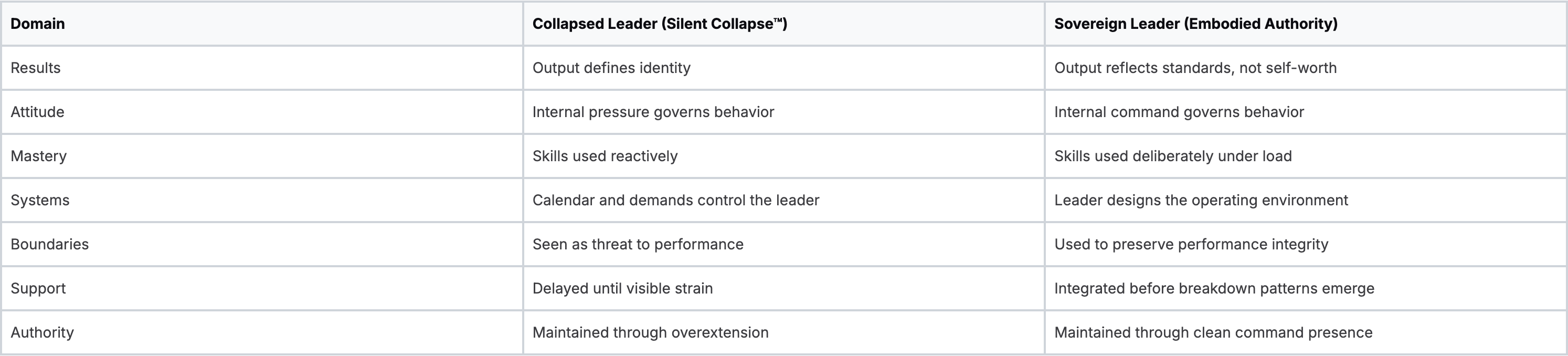
If a speaker cannot describe this difference in their own language, they are not equipped to address Silent Collapse™.
How to vet a speaker in one meeting
You do not need a long process. You need disciplined questions.
Use this shortlist.
Ask for the core problem: “What do you believe senior leaders are dealing with beneath visible success?”
Test for system awareness: “How does your talk address structural causes, not just personal mindset?”
Probe for pressure competence: “What changes for a leader the week after hearing you?”
Check for executive fit: “How do you speak to authority, power, and hidden depletion without reducing the audience?”
Verify practical transfer: “What language, model, or decision framework will they take back into the business?”
Then watch what happens.
If the answers drift into inspiration, biography, or abstract encouragement, move on. If the speaker can identify collapse patterns, explain leadership mechanics, and offer an architecture for return, keep talking.
This is the threshold. Not fame. Not polish. Not a good reel.
A Women's History Month stage should honor contribution. It should also protect the people currently carrying institutions. Those two duties are not in conflict.
If you recognize yourself in the patterns above, take the next step clinically. Take the Silent Collapse Diagnostic.
Case Study Baz Porter on Sovereign Leadership
A Women's History Month event fails the room when senior women walk out praised, seen, and still structurally unchanged. That is the standard failure pattern. The keynote produces heat, not repair.
Baz Porter’s work is built for a different objective. It addresses the hidden breakdown that high-achieving women often mask with competence, polish, and continued output. That is the core issue this guide has been naming all along. Silent Collapse™ is not a branding theme. It is an operating condition.

Why this message fits the month
Women's History Month began in protest, not ceremony. Its roots sit in resistance to punishing conditions and the demand for better terms. As described in this history of Women's History Month milestones, the month carries a structural legacy, not just a commemorative one.
That history matters because the pressure did not disappear. It changed form.
For many high-achieving women in leadership, the modern version looks cleaner. The system rewards overfunctioning, absorbs self-erasure, and praises endurance until the person begins to hollow out behind the role. Standard Women's History Month programming rarely addresses that failure mode. It celebrates contribution while ignoring the internal cost of sustained authority.
Sovereign Leadership™ closes that gap. It treats leadership as a system that must be governed from within, not a performance that must be sustained at any price.
For background on the formation behind that approach, read Baz Porter’s story from soldier to success architect. The military influence shows up in the method. Strip away sentiment. Assess condition. Restore command.
What this kind of speaker changes in the room
A speaker working at this level resets diagnosis first.
High performers often misread their own symptoms. They call collapse fatigue. They call resentment a time-management issue. They call identity erosion ambition. A weak keynote leaves those errors intact. A strong one cuts through them and names the operating failure correctly.
That change has consequences.
The room gets a sharper vocabulary for hidden strain. Leaders stop treating chronic overextension as proof of commitment. They identify role fusion, reflexive compliance, status maintenance, and threat-based performance for what they are. Once the pattern is visible, authority becomes usable again.
The result is not a short emotional lift.
The result is cleaner judgment, firmer boundaries, and reduced self-betrayal under pressure. That is what organizations should buy when they select women's history month speakers for senior audiences. Anything less is stagecraft.
What makes Baz Porter a fit
Baz Porter fits the brief when the event is designed to address pressure inside performance, not just celebrate visible achievement.
That includes audiences dealing with executive burnout, identity strain under success, hidden depletion in high-achievers, The Five Imposters™, and the move from Silent Collapse™ into Sovereign Leadership™. The message is direct. The frame respects authority. The work does not reduce accomplished women to fragile case studies or ask them to perform recovery for the room.
British military veteran. Two-time international bestselling author. Founder, The Prestige Architect™. Host, Rise From The Ashes podcast, C-Suite Network. Boulder, Colorado.
If your Women's History Month program needs systemic repair instead of another inspirational spike, Baz Porter belongs on the shortlist.
Frequently Asked Questions About Leadership Speaker Selection
Our team says the event should feel inspiring, not clinical. Is that a problem
Yes, if “inspiring” means evasive.
A senior audience can tolerate truth. What they don’t tolerate is irrelevance. If the room contains leaders under chronic strain, then a clinical keynote is not cold. It is respectful. It names the actual operating conditions instead of decorating them.
In many sectors, women already hold visible leadership presence. For example, in U.S. public charities, women hold 53% of board positions, and 51% of women-led nonprofits have majority-women boards, according to data on women-led nonprofits. Representation does not remove collapse risk. Leadership presence is not immunity.
What if our audience expects a historical or celebratory speaker
Then keep the history. Upgrade the application.
The strongest programming connects historical struggle to current operating reality. If the month honors contribution, sacrifice, and structural change, then a speaker who addresses internalized overfunctioning is aligned with the purpose. Celebration without application becomes ceremony.
How do I know a speaker can handle an executive audience
Listen for pressure language.
A qualified speaker can discuss authority, identity strain, hidden depletion, and systems failure without turning the audience into patients or mascots. They understand that high performers resist shallow fixes. They can hold complexity without diluting the message.
Use a practical filter.
Ask how they define burnout in leaders
Ask what behavior changes after the event
Ask how they address overresponsibility
Ask whether they speak to systems, not only mindset
If they stay abstract, move on.
We already have employee wellness programming. Isn’t that enough
No.
Wellness content often sits downstream from the problem. It addresses symptoms after the leadership system has already normalized overextension. A keynote for this audience should address command structure, decision load, identity fusion, and authority drift. That is executive architecture, not general wellness.
Is virtual speaker delivery strong enough for this topic
Yes, if the speaker knows how to work with depth through a screen.
Some leaders disclose more in virtual settings because the environment is more contained and less performative. But the format alone won’t save weak content. The speaker still needs authority, precision, and an applied framework.
Where can I review more of your leadership position before making a decision
Use the Baz Porter FAQ for direct answers. Then review the broader Sovereign Leadership Resource Hub if you need deeper context on Silent Collapse™, leadership authority, and the RAMS Framework™.
If your organization needs a speaker who can diagnose Silent Collapse™, restore authority, and deliver a framework instead of fluff, review Baz Porter. If the fit is clear, Apply to Work With Baz.