What Is Image Consulting: Achieve Sovereign Leadership
You look polished. Your calendar is full. Your reputation is intact. Then you catch your reflection before a board meeting and feel nothing. The suit fits. The face is composed. The person in the glass feels fabricated.
That's the failure point.
You've trained the market to trust your performance while your internal command structure has gone absent. You keep producing because stopping feels dangerous. You keep refining the exterior because the exterior still wins compliance. If you've ever searched a guide to elegant styling while privately questioning who you've become, the issue isn't taste. It's identity drift under pressure.
I see the same pattern in leaders trying to repair presence with polish alone. Their image is managed. Their authority is not. Their title still works. Their nervous system doesn't. That's why executive presence often collapses under scrutiny even when the wardrobe is flawless.
Image consulting is not just styling. It is the alignment of appearance, behavior, and communication with the role you hold and the authority you need to project.
Most leaders ask the wrong question. They ask how to look better, when the true issue is why their external image no longer matches their internal state.
Surface fixes fail under pressure. If your image requires constant performance, it becomes another drain on leadership capacity.
The true return is sovereignty. The point isn't admiration. The point is command without self-betrayal.
Table of Contents
The Costume of Success
The leader in the mirror looks expensive. The leader inside feels absent.
You know the pattern. You can brief the board, negotiate a deal, and command a room on depleted reserves. You've become efficient at looking certain. The problem is that certainty no longer feels real. It feels issued. Worn. Maintained like a uniform that no longer belongs to the body wearing it.
High performers often get deceived. They mistake external coherence for internal stability. They assume the wardrobe, the grooming, the practiced voice, and the controlled gestures prove they're fine. They aren't fine. They're functioning.
Your image can become a costume long before anyone else notices the split.
The collapse starts subtly. You edit yourself before you speak. You choose what reads as credible, not what feels true. You optimize for perception because perception still pays. Then one day you realize your public identity has become a shell around a private vacancy.
That's not vanity. That's strategic danger.
What Image Consulting Is and Is Not
A senior leader walks into the room dressed for authority, then weakens the message before the first sentence lands. I see this failure constantly. The clothes are expensive. The signal is still fragmented.
Image consulting corrects that fragmentation. It is the disciplined work of bringing appearance, behavior, communication, and role into one command structure. A professional body for the field describes image consultants as specialists who advise on appearance, behavior, and communication in support of personal and professional goals, according to the Association of Image Consultants International.
That scope matters because the true job is not shopping. The true job is signal control. A competent consultant studies fit, proportion, grooming, posture, movement, vocal delivery, and social conduct. Then those elements are organized around the authority the client needs to project and sustain.

Here is the distinction that serious operators need:
Image consulting is strategic alignment between how you look, how you behave, and how you communicate under scrutiny.
Styling is a narrow execution layer inside that larger system.
A makeover creates contrast. It does not create credibility, authority, or consistency.
Real image work supports reputation. It strengthens trust signals across presence, speech, conduct, and context.
I reject the shallow version of this field because it misses the operational failure underneath. The client does not need better outfits alone. The client needs external order that reduces internal friction. When your presentation matches your actual standards, your system stops wasting energy managing contradiction. That is why image consulting, done correctly, helps restore executive authority instead of decorating the shell of it.
If you want the broader leadership context, study executive reputation management.
The Link Between External Image and Internal Collapse
Most content on this subject fails at the exact point where serious leaders need precision. It defines the service, lists the features, and avoids the core decision. The missing question is return. Not fashion return. Authority return. Identity return. As noted in this analysis of what an image consultant is, the stronger frame is image consulting as a strategic intervention for identity, authority, and communication coherence.
That missing frame is where Silent Collapse™ lives.

Your image became a survival tactic
I diagnose this clinically. Your external image can become a biological credit score. Every act of self-betrayal lowers it. Every time you wear authority instead of inhabiting it, your system records debt.
At first, the strategy works. You dress the part. You regulate your expression. You control the voice. You suppress uncertainty. Others respond well. The market rewards clarity. The body reads danger.
This split matters because the nervous system doesn't care about optics. It tracks congruence. When your outer presentation repeatedly contradicts your inner state, your body treats authentic expression as risk. So you default to the safer move. Performance.
Diagnostic rule: If your presence works in public but collapses in private, the issue isn't confidence. It's incongruence.
A useful research anchor here is enclothed cognition. Clothing and symbolic presentation don't just affect how others read you. They can shape how you think and behave in the moment. See the paper indexed at DOI 10.1016/j.jesp.2012.02.008. That doesn't mean clothes solve identity fracture. It means external signals and internal state are linked more tightly than most leaders admit.
Why surface-only consulting fails
Conventional image work often stops at appearance. That is operationally incomplete.
If a consultant improves the wardrobe but ignores the body carrying it, they've built a cleaner mask. The leader may look sharper and feel briefly relieved. Then pressure hits. Old speech patterns return. Camera fatigue spikes. Posture hardens. The curated image starts slipping because it was never anchored in internal stability.
I've seen leaders with strong titles and expensive presentation lose authority in simple situations:
Video calls where their face looks controlled but their voice sounds detached.
Team meetings where the outfit communicates status but the behavior communicates strain.
Public visibility where personal branding says certainty and the body says threat.
That's why executive dysregulation sits underneath many image problems. The image isn't the root cause. It exposes the root cause.
A Framework for Rebuilding Authority from the Inside Out
If your image has become a performance shell, random fixes will fail. You need a system. I use the RAMS Framework™. It stands for Results, Attitude, Mastery, Systems. Not branding theater. Not cosmetic optimization. Structural realignment.
Modern image consulting also has to include virtual presence, social media consistency, and camera-ready communication because leadership now happens across Zoom, LinkedIn, podcasts, and public digital channels. The field has expanded beyond dress and etiquette into broader perception management, as outlined by the Image Consulting Institute.

Results means closing the identity gap
Most executives define results too narrowly. Revenue. Promotions. Visibility. Influence. Those metrics matter. They are not enough.
In Silent Collapse™, the true failure is the widening gap between what you produce and who you are becoming while producing it. If your image supports outcomes while eroding self-trust, the result is contaminated.
Start with three questions:
What does your current image secure? Access, approval, perceived competence, authority.
What does it cost? Tension, exhaustion, hypervigilance, detachment from self.
What must remain true when pressure rises? That answer defines the standard.
Leaders usually resist this because the old image worked. That's irrelevant. A tactic that built the career can destabilize the person running it.
The first result that matters is internal congruence. Without it, every external win extracts more from the operator.
I've worked with leaders who didn't need more wardrobe options. They needed fewer contradictions. Their clothes said command. Their calendar said importance. Their speech still leaked apology, overcontrol, or guardedness. Once the image and internal standard were forced into alignment, their presence stopped oscillating.
Attitude is the internal operating system
Attitude in the RAMS Framework™ isn't positivity. I reject that language because it hides the problem. Attitude is your internal operating system. It decides what your body interprets as safe, what your mind interprets as threat, and what identity you default to under scrutiny.
Collapse lives here.
A leader in Silent Collapse™ often runs on these hidden commands:
If I stop performing, I become irrelevant.
If I tell the truth, I lose authority.
If I relax, standards will drop.
If they see the strain, I lose control.
Those commands shape image more than taste ever will. They decide the colors you think you need, the formality you hide behind, the body language you overcorrect, and the persona you deploy. This is why external refinement without internal recalibration doesn't hold.
If identity strain is already active, it helps to study grounded strategies for navigating identity challenges. Not because you need more content. Because you need language for the fracture you've been disguising.
Use this audit:
Observe your default persona. Who appears when pressure enters the room?
Track your self-editing. Where do you become less direct, less human, or more ornamental?
Name the hidden rule. Every image distortion serves a protective belief.
Once the rule is named, you can stop obeying it blindly.
Mastery is command not performance
Most leaders confuse mastery with polish. That's amateur thinking.
Mastery means you can regulate your presence without turning yourself into a role. You know when to intensify. You know when to simplify. You don't over-decorate communication. You don't rely on status signals to manufacture credibility. You carry authority because your signals are coherent.
That includes the technical side of image work:
Clothing fit that supports command rather than distraction.
Color choices that reinforce clarity instead of noise.
Grooming and visual consistency that reduce friction.
Body language that communicates decision, not defense.
Communication patterns that sound clean under pressure.
But mastery goes further. It governs digital visibility. The leader who appears decisive in person and confused online is fragmented. The leader whose public content says conviction while their delivery says depletion is leaking instability.
Here is the harder rule. Your image must survive the medium:
In person, authority is read through movement, pace, and spatial command.
On camera, authority is read through framing, facial tension, vocal steadiness, and brevity.
In writing, authority is read through clarity, consistency, and signal discipline.
That's why serious leaders need more than wardrobe advice. They need a method for carrying one identity across every channel without distortion.
Systems decides whether change holds
Without systems, insight degrades. You revert.
Systems in RAMS Framework™ means both nervous system architecture and business architecture. The first stabilizes the operator. The second protects the role from dragging the operator back into collapse.
The practical system has to cover:
Wardrobe architecture
Fewer decisions. Stronger consistency. Defined standards for key contexts.Communication architecture
Signature language, cleaner boundaries, fewer verbal apologies, stronger meeting entry.Visibility architecture
One coherent digital identity across profile, headshot, public messaging, and on-camera behavior.Recovery architecture
Specific practices that reduce activation before high-stakes interactions.Decision architecture
Rules for what you no longer wear, say, tolerate, or perform.
If you want a deeper lens on the architecture itself, review the RAMS method.
The contrast becomes obvious when you map the operating systems side by side.
Leadership Operating System Comparison
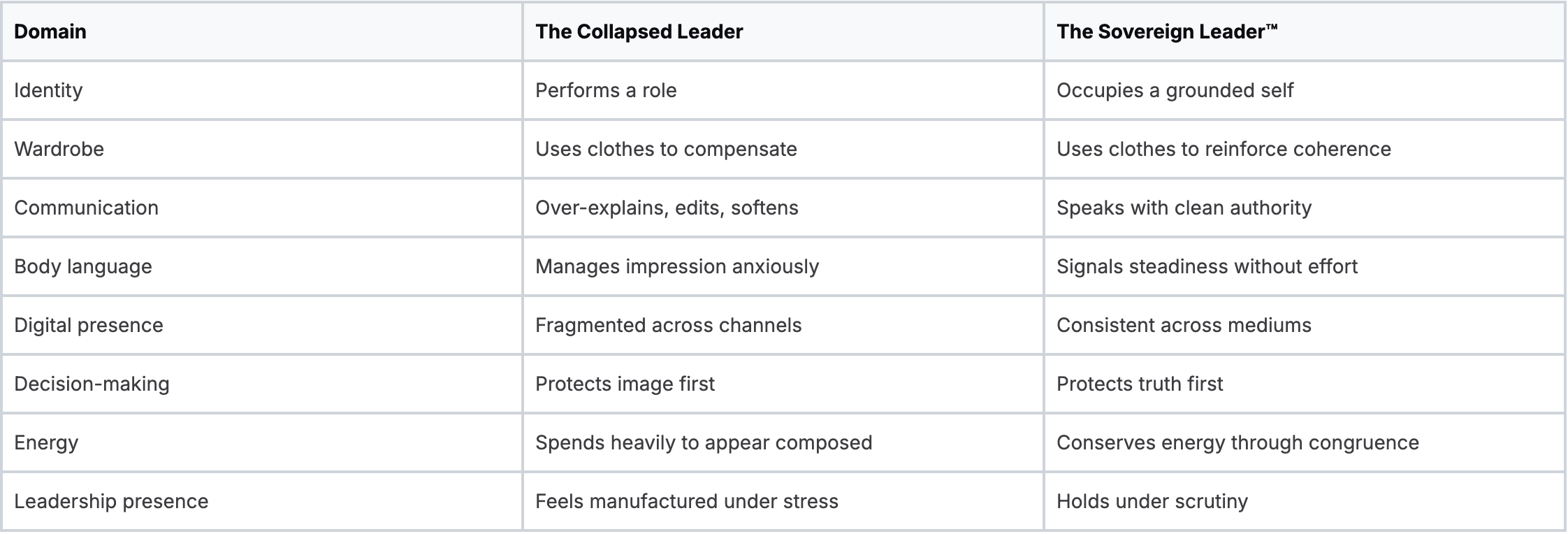
Operational truth: If a change requires constant willpower, it isn't integrated. It's temporary theater.
This is why image consulting, done properly, becomes a strategic intervention. Not because appearance is supreme. Because appearance is one of the clearest places internal fracture becomes visible.
If you recognize Silent Collapse™ in your own pattern, Take the Silent Collapse Diagnostic.
Beyond Image The Return to Nervous System Sovereignty
You walk into the boardroom dressed for authority, then your body betrays you. Your jaw tightens. Your breathing shortens. Your voice loses weight on the first hard question. The room reads the split before you finish your sentence.
That is the failure point.
Image consulting reaches its highest value when it restores command between your internal state and your external signal. I do not treat this work as a wardrobe upgrade. I treat it as a strategic intervention for leaders trapped in Silent Collapse™. The clothes matter because they either stabilize authority or expose fracture. Your appearance becomes a visible report on whether your nervous system is governing the room or reacting to it.

The target is Sovereign Leadership™. Authority stops depending on costume, overcontrol, or borrowed status signals. You stop dressing to compensate for self-doubt. You start presenting from a regulated center that can hold pressure without performing for approval.
Demand for image work exists for a reason. Leaders know perception affects trust, credibility, and follow-through. Demand alone changes nothing. Precision changes outcomes.
The return is energetic and operational. You stop wasting cognitive load on managing an identity your body cannot sustain. You stop creating a polished exterior that collapses under scrutiny. You recover command. That is what nervous system regulation in leadership is for.
Read The Manifesto if you want the full position.
Frequently Asked Questions
My wardrobe is fine, so why do I still feel like an imposter?
Because the problem may not be your clothes. It may be the gap between your external presentation and your internal state. When your image says certainty and your body feels threat, the split registers as fraud.
Is image consulting just personal styling for executives?
No. Styling deals with clothes. Image consulting addresses appearance, behavior, and communication. For executives, that means the full signal set tied to trust, authority, and visibility.
How is this different from therapy?
Therapy often addresses psychological history and emotional processing. Image consulting addresses perception, signal alignment, and how identity is carried externally. When done well, it also accounts for the nervous system stress that distorts presence under pressure.
Does image consulting still matter if I work mostly online?
Yes. The medium changed. The stakes didn't. Virtual leadership still relies on coherent signals. Camera presence, vocal steadiness, visual consistency, and digital identity now matter more because people read you through compressed channels.
When do I need image consulting instead of leadership coaching?
You need image consulting when the issue is visible misalignment. Your words, appearance, and behavior aren't carrying the same authority. You need leadership coaching when the issue is broader capability or decision-making. In many cases, the two intersect. The mistake is treating image as superficial when it is often where collapse first becomes visible.
Baz Porter helps high-achieving leaders rebuild authority without self-betrayal. If your success has become a costume and your presence no longer feels like your own, the work is deeper than polish. Visit Baz Porter, explore the Sovereign Leadership Resource Hub, or Apply to Work With Baz.
British military veteran. Two-time international bestselling author. Founder, The Prestige Architect™. Host, Rise From The Ashes podcast, C-Suite Network. Boulder, Colorado.