
Why Am I So Unmotivated to Work? A High Achiever's Guide to Reclaiming Drive
The feeling hits you in the gut. You’re staring at a screen, a task you could once do in your sleep, and there’s just… nothing. No spark. No drive. Just a heavy, relentless drag where your ambition used to be. For a high-achiever, feeling unmotivated to work isn't just an off day; it feels like a total system failure.
It’s not a moral failing. It’s not laziness. It's a flare gun your nervous system is firing into the air, a desperate signal that the way you've been operating is no longer sustainable. You can look wildly successful on the outside while a quiet, grinding collapse is happening on the inside.
Key Takeaways
Your Motivation Isn't Gone, It's Mismanaged: A lack of motivation is a biological signal, not a character flaw. It's a sign your nervous system is hitting the emergency brake in response to chronic stress and misalignment.
The Hustle Playbook Has Expired: The very strategies that got you here—relentless hustle, perfectionism, and control—are the same ones now burning you out. Pushing harder is the problem, not the solution.
Systems Protect Energy, Willpower Doesn't: Sustainable drive isn't found; it's built. The path forward requires creating intentional systems and boundaries that protect your energy, not just manage your tasks.
The RAMS™ Method is Your New OS: Reclaim your drive by shifting your focus from external validation to internal alignment using the four pillars of the RAMS™ Method: Results, Attitude, Mastery, and Systems.
Feeling unmotivated to work is a biological response to a system that is overdrawn. It's your body's way of forcing a necessary course correction away from unsustainable pressure and toward a more aligned way of leading and living. This guide will show you how to answer that call.

This feeling of being stuck often spirals into corrosive self-doubt, making you question if you even have what it takes anymore. It’s a vicious cycle I see all the time in leaders who feel immense pressure to appear invincible.
Your drive hasn't disappeared—it's just buried under layers of pressure and burnout. This guide is your shovel. Let's start digging.
The Hidden Pattern: Why Your Drive Disappeared
If you’re feeling unmotivated at work, it’s not because you need more coffee or a better to-do list. The drive that propelled you to this point hasn't just vanished. It has been systematically drained by a set of hidden forces you were probably taught to ignore.
This is a biological signal, not a character flaw.

I call this phenomenon the Performance Paradox. The very traits that secured your success—your relentless drive, perfectionism, and unwavering commitment—are the same ones now fueling your burnout. Your nervous system, which is hardwired for survival, can't tell the difference between a looming project deadline and a saber-toothed tiger.
To your body, the threat is the same. The result is a steady, corrosive drip of stress hormones like cortisol that, over time, completely empties your motivational reserves.
The Myth of Invulnerability
In the high-stakes corporate world, there's an unspoken rule you learned early: project total, unshakable invulnerability. Admitting you’re overloaded or showing a moment of uncertainty feels like career suicide. So, you're forced into a state of hypervigilance, constantly scanning for threats while maintaining a flawless exterior.
This constant performance of strength erodes any sense of psychological safety. You're operating in an arena where it feels fundamentally unsafe to be a human being. In response, your nervous system starts shutting down non-essential functions to conserve energy for survival. And right now, ambitious drive feels highly non-essential.
The exhaustion you feel is a biological intervention. It's a survival mechanism designed to force you to stop and retreat from the perceived danger. Pushing through is like flooring the accelerator when the engine is already overheating—it only leads to a more catastrophic breakdown. To really dig into this cycle, check out our guide on how to beat burnout at work.
Your lack of motivation is not a character flaw. It's a protective mechanism. Your body is hitting the emergency brake because the way you've been driving is leading toward a cliff.
The Disconnect Between Safety and Performance
The data backs this up. Workers who feel psychologically safe are 72% more motivated than their counterparts. When employees feel aligned with their leadership's goals, they show 78% greater motivation. Yet, only 56% of workers feel it's safe to innovate at their jobs, and just 54% believe failures are treated as learning opportunities.
This gap is even more pronounced for women in leadership. Hormonal fluctuations often play a huge, yet completely unacknowledged, role in energy and motivation. Understanding and addressing hormone balance for women can be a critical piece of the puzzle, but this biological reality is often dismissed in corporate cultures that demand machine-like consistency.
To get a clearer picture of what’s happening, it helps to compare the outdated patterns that drain your drive against the aligned, embodied approaches that rebuild it. This isn't about working harder; it’s about leading from a completely different place.
Outdated Driver vs. Embodied Leadership

Your body isn't broken; it's communicating. That feeling of being unmotivated to work is a clear, urgent message that the old strategies are no longer working for you. The only way forward requires a fundamental shift—not in how much effort you put in, but in your entire approach to leadership and your own well-being.
The RAMS™ Reframe: A New System for Sustainable Drive
That feeling of being unmotivated to work? It’s a signal. It’s your old operating system finally crashing after running on fumes for too long. Trying to reboot it with the same old commands—just push harder, be more disciplined, get it done—is like hitting CTRL+ALT+DEL on a dead machine. It won't work.
It’s time for a complete system upgrade. One designed for sustainable performance, not just another short-term sprint that ends in the same place.
This is where we shift from diagnosis to action. I developed the RAMS Method™ specifically for high-achievers who are sick of the boom-and-bust cycle of motivation. This isn't about finding a magic bullet; it's about building a fundamentally new engine for your drive.
RAMS™ stands for Results, Attitude, Mastery, and Systems. Each one is a pillar supporting the others, creating a structure that protects your energy and fosters genuine motivation from the inside out. Let’s break it down.
Redefining Results From Validation to Alignment
The first pillar, Results, directly challenges the high-achiever’s addiction to external validation. For years, you’ve measured success by what you can point to on the outside: promotions, revenue targets, industry awards. Using them as your primary fuel source is precisely why you burn out.
True, sustainable drive is an inside job. It comes from internal alignment. This means shifting your definition of a "win" from something you get from the world to something you feel within yourself. It’s the difference between closing a deal just to hit a quota versus closing one because it connects to your core values and serves a mission you actually believe in.
Reflection Prompt: What if the most important result of your work wasn't a number on a spreadsheet, but the feeling of being aligned and energized at the end of the day? What one small task could you do this week that feels genuinely meaningful, regardless of its ROI?
Shifting Your Attitude From Control to Embodiment
Attitude in the RAMS™ framework has nothing to do with toxic positivity. It’s about your fundamental state of being. The control-based attitude that got you here—micromanaging outcomes, white-knuckling projects, and planning for every possible failure—is incredibly expensive from an energy standpoint. It keeps your nervous system in a constant state of threat.
An embodied attitude, on the other hand, is one of presence and trust. It’s the ability to be fully in the moment, responding to challenges from a place of calm capability instead of panicked reaction. This shift frees up the mental and emotional bandwidth that's currently being eaten up by worry and hyper-vigilance.
Elevating Mastery From Skills to Sovereignty
You’re already a master of your craft. The next level of Mastery isn’t about grabbing another certification. It’s about achieving nervous system sovereignty.
This is the ultimate form of self-mastery. It’s the ability to recognize when you’re being driven by stress and to consciously shift your physiological state back to one of calm and focus. It’s knowing how to complete a stress cycle after a tense meeting. It’s knowing how to create a sense of internal safety even when everything outside is chaotic. This is the bedrock of real resilience.
This flowchart shows the flawed process that outdated tactics create, moving from hustle to inevitable burnout and stagnation.
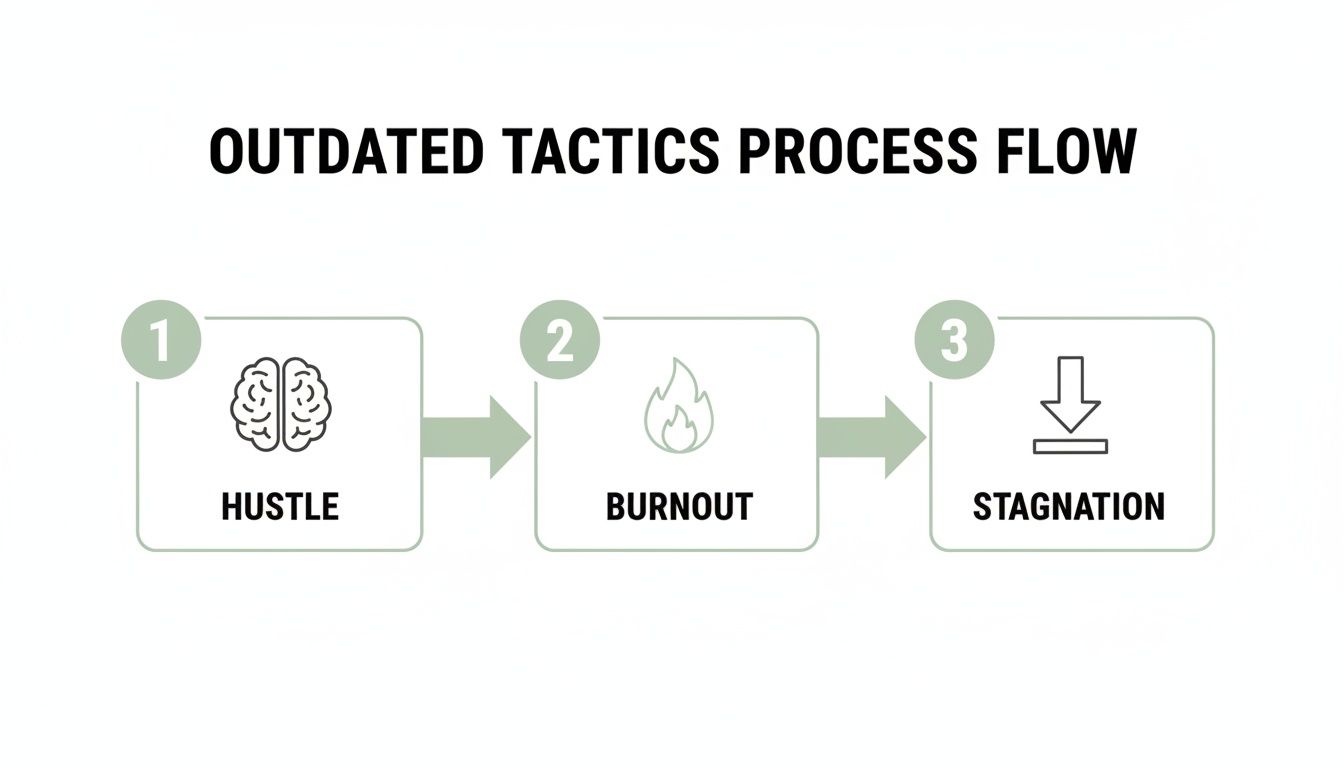
As the visualization makes clear, the traditional path of relentless hustle isn't a sustainable loop but a linear path straight to diminished returns.
Building Systems That Protect Your Energy
Finally, Systems are the structures that make all the other pillars possible. Here’s a hard truth: your willpower is a finite resource. Relying on it to set boundaries or prioritize rest is a losing battle. You need to build systems that automate these protections for you.
Think of these systems as your non-negotiables. They are the guardrails that keep you from driving right off the cliff of burnout. If you're struggling to stay motivated and your old tactics are failing, practical advice is essential. You can learn how to stay motivated working from home with practical tips to start building better structures.
Examples of protective systems I build with my clients include:
Time Blocking: Scheduling non-negotiable "deep work" and "recovery" blocks directly into your calendar. They get treated with the same respect as a client meeting.
Decision Filters: Creating a simple set of questions based on your values to run every new opportunity through. (e.g., "Does this energize me?" "Does this align with my mission?")
Energy Audits: A weekly check-in to identify what activities drained you and what replenished you, giving you the data to adjust your schedule for the following week.
The RAMS Method™ is a comprehensive approach that goes way beyond simple productivity hacks. To see how these components integrate into a powerful whole, you can explore a deeper dive into the revolutionary RAMS leadership framework explained. It's about fundamentally redesigning your relationship with work, ambition, and yourself. This is how you stop chasing motivation and start creating the conditions for it to show up naturally and sustainably.
Designing Systems to Protect Your Energy
Let’s be honest. Motivation isn't something you find hiding under a rock. It's a resource you protect. That feeling of being completely unmotivated is an alarm bell telling you that your energy account has been consistently overdrawn by an always-on culture.
Sustainable drive doesn't come from pushing through exhaustion. It’s a result of building intentional structures that shield your energy. It's about designing your work around your biology, not forcing your biology to conform to the relentless demands of your work.
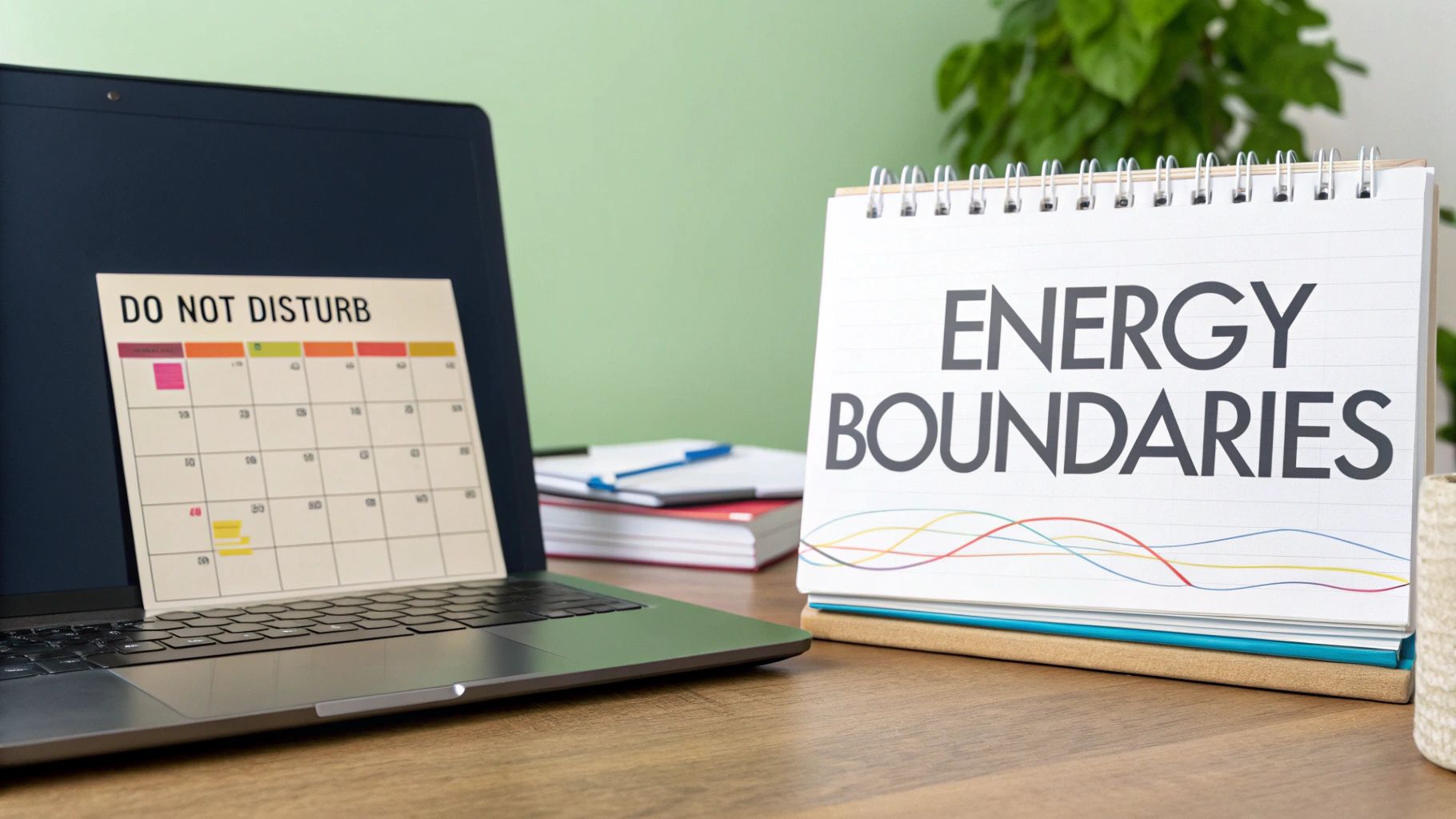
This means getting ruthlessly practical about setting and defending boundaries. A boundary isn't a rejection of others; it's a profound act of self-preservation and leadership. Think of it as the gatekeeper that stops your precious energy from leaking out on things that simply don't matter.
The Critical Skill of Boundary Setting
The modern workplace has blurred the lines between work and life so completely that a lack of respect for personal time is now a top reason people just get up and quit. The data on this is stark.
There's a massive disconnect between where employees are and where they want to be. While a staggering 59% of employees work full-time in an office, only 19% actually prefer it. This tension points to a much deeper issue: a lack of autonomy and respect for personal boundaries now ranks among the top five reasons employees leave, second only to low pay. You can dig into more of these trends on Korn Ferry's workforce planning insights page.
For the high-achieving women I work with, this isn't just an inconvenience. It’s a direct assault on the energy reserves they need for peak performance and, more importantly, personal fulfillment.
"A lack of boundaries invites a lack of respect." – Brené Brown
Setting boundaries is the ultimate system for protecting your energy. It’s a skill, and like any skill, it requires practice. It will probably feel uncomfortable at first, especially if you've built a reputation on being endlessly available. That's okay.
Actionable Strategies for Reclaiming Your Time
Let’s get out of theory and into action. Building systems to protect your energy requires concrete, repeatable behaviors. You don't need to blow up your life overnight; small, consistent micro-actions are what create significant change over time.
Here are three areas you can focus on immediately:
Digital Boundaries: The digital world is designed to be boundaryless. You have to create your own. This means turning off non-essential notifications, setting clear "do not disturb" hours on your devices, and killing the habit of checking email first thing in the morning or last thing at night.
Professional Renegotiation: The expectations people have of you might be based on old patterns of over-delivering at your own expense. It's time for a renegotiation. This can be as simple as stating, "To do this right, I'll need until Friday," instead of automatically saying yes to an impossible deadline. It’s about communicating your capacity honestly and professionally.
Recharge Rituals: These are non-negotiable appointments with yourself for recovery. You have to schedule them with the same seriousness as a board meeting. Maybe it's a 20-minute walk without your phone, a dedicated hour for reading, or a Saturday morning that is completely free of obligations.
A Practical Example of System Design
Let's walk through a common scenario for a senior executive: the constant flood of late-night emails that seem to demand an immediate response. The old, burnout-driven approach is to answer them instantly to show how committed you are. A systems-based approach looks entirely different.
The System:
The Rule: No work emails are opened or answered between 7 PM and 8 AM. This is a hard rule, not a suggestion.
The Communication: Proactively tell your team. "To be fully present and effective, I disconnect from email after 7 PM. For true emergencies, you can reach me via text."
The Automation: Set up an auto-responder during these hours that reinforces the boundary. "Thank you for your message. I am offline until 8 AM and will respond then."
This isn't about working less; it’s about working smarter. It creates a predictable structure that allows your nervous system to fully down-regulate—which is absolutely essential for creative problem-solving and strategic thinking the next day. By designing these small but powerful systems, you stop chasing motivation and start creating an environment where it can thrive naturally.
You take back control, one boundary at a time.
The Return: The Path Back to Yourself
Feeling completely unmotivated to work is not your final destination. It is a powerful, even necessary, course correction. It’s an invitation from your own biology to stop performing leadership and start embodying it.
The way forward isn’t about finding a quick fix to "get your motivation back." It’s about fundamentally rewiring your relationship with your work, your energy, and yourself. This is the shift from exhaustion-driven achievement to sustainable, embodied impact.
From Fixing a Problem to Answering an Invitation
For a high-performer, feeling unmotivated is deeply unsettling. The immediate temptation is to label it as a problem to be solved. But what if it isn't a problem at all?
What if this feeling is actually an invitation to a more authentic way of living and leading?
That single shift in perspective changes everything. You move from self-judgment ("What the hell is wrong with me?") to profound curiosity ("What is my body trying to tell me right now?"). This is the first step toward nervous system sovereignty—the ability to lead not from chronic stress, but from a state of grounded presence. It's a journey into what embodied sovereignty truly means for leaders.
Reclaiming Your Nervous System Sovereignty
Embodied leadership isn’t a soft skill; it’s a biological necessity for long-term success. It means finally recognizing that your energy is your single most valuable asset, and protecting it is your primary responsibility as a leader. This is about building the non-negotiable systems that allow you to show up as the powerful, clear-headed leader you are.
This looks like:
Honoring Your Capacity: Saying "no" not because you can't do something, but because you are choosing to allocate your energy with ruthless intention.
Trusting Your Intuition: Making decisions that align with your core values, even when they fly in the face of conventional wisdom.
Prioritizing Recovery: Treating rest not as a reward, but as a crucial, non-negotiable part of the work itself.
Your drive hasn't vanished. It's just buried under layers of outdated conditioning and unsustainable habits. The real work isn't to create new motivation from scratch, but to clear away the debris so your natural, intrinsic drive can finally re-emerge.
This shift is a return—a return to yourself. It’s about dismantling the persona of the leader you thought you were supposed to be and stepping fully into the one you actually are.
The feeling of being unmotivated to work was the catalyst. The journey back to embodied leadership is the real work. It’s where your next level of impact, fulfillment, and freedom is waiting.
If you're ready to move from burnout to building a leadership style that energizes and sustains you, the path starts here. At Baz Porter, we help accomplished women like you build the systems for embodied leadership.
Discover how the RAMS Method can help you reclaim your drive.
Frequently Asked Questions
Why am I suddenly so unmotivated to work when I used to be driven?
Lost drive after years of high performance rarely means you are lazy. It usually means the old engine that ran on validation and pressure has run out. Your system is asking for a new source of drive, one built on alignment instead of proving yourself.
Is losing motivation a sign of burnout?
Not always. Burnout is running on empty. This can be quieter than that. It is often your nervous system pulling the brake because the way you were working was never safe or sustainable. The drive did not fail. The old system did.
I have ideas but cannot make myself start. What is going on?
When you have ideas but cannot begin, the problem is usually not willpower. It is a missing system. Without boundaries and structures that protect your energy, every task pulls from the same drained tank. Build the system first and the drive returns.
How do I get my motivation back for good?
You get it back by changing what drives you, not by pushing harder. That means results measured by alignment, an attitude of embodiment over control, mastery of your inner state, and systems that guard your energy. Drive that lasts is built from the inside.
Where to go next
If any of this reads like your own reflection, the Silent Collapse Diagnostic™ is a quiet place to start. It is a private space to see what is really running underneath the work. And if you want the deeper why beneath it all, read the Sovereign Manifesto.