Why You Need a Therapist for Executives, Not Just Another Coach
You’ve reached the top of your game. The C-suite, the board seat, the successful exit. Yet, late at night, when the emails stop and the house is quiet, a different reality surfaces. It’s the feeling of running a marathon at a sprinter’s pace, with no finish line in sight. If I stop performing, I'll disappear.
This is the silent collapse—an invisible, internal exhaustion that external success cannot fix.
Key Takeaways
Coaching vs. Therapy: An executive coach focuses on future performance and strategy, while a therapist for executives heals the underlying patterns and nervous system dysregulation that make high performance unsustainable.
The Overheated Chassis Metaphor: Your ambition is a powerful engine, but it's bolted to a chassis—your nervous system—that is redlining. Conventional advice fails because it polishes the hood while the engine smokes.
Nervous System Sovereignty: True power comes not from more strategies but from mastering your internal state. The goal is to regulate your physiology to handle pressure without compromising your health.
The RAMS Framework: A practical method (Results, Attitude, Mastery, Systems) to rewire your internal operating system, moving from chasing external validation to building internal stability and embodied leadership.
The High Cost of Relentless Performance
You are celebrated for your resilience, your strategic mind, and your unwavering drive. But behind the closed doors of your office, the internal dialogue tells a different story. It’s a constant hum of pressure, a quiet fear that if you stop performing, you’ll be irrelevant.
Every win feels temporary, quickly replaced by the weight of the next objective.

This relentless cycle of achievement and anxiety creates a profound disconnect. You feel hollowed out, as if you’re playing a role rather than living a life. The very ambition that built your career now feels like a cage, and the strategies that guaranteed your success have begun to erode your well-being.
A therapist for executives provides a specialized space to address the unique psychological and physiological toll of high-stakes leadership, moving beyond surface-level performance coaching to heal the root causes of burnout and disconnection. This process rebuilds your internal foundation, enabling sustainable success without sacrificing your well-being.
The Invisible Toll of Peak Performance
The cost of this constant performance is steep, showing up in ways often dismissed as just "the price of success." But this is more than stress; it’s a systemic breakdown. The relentless pursuit of performance leads to significant personal costs, including chronic stress and sleep deprivation. For those struggling, learning how to improve sleep quality naturally can be a vital first step.
This depletion shows up as:
Emotional Numbness: A difficulty connecting with joy or satisfaction, even after major accomplishments.
Persistent Imposter Syndrome: A nagging belief that you are a fraud, despite overwhelming evidence of your competence.
Decision Fatigue: A mental exhaustion that makes even simple choices feel monumental.
Relationship Strain: The energy required for work leaves little left for partners, family, or friends.
The hollow feeling isn’t a sign of weakness; it’s a symptom of a system that has been pushed beyond its sustainable limits. Your body and nervous system are sending distress signals that the mind is trained to ignore.
This experience is a specific form of burnout unique to high-achievers. While many face workplace stress, leaders grapple with an isolating pressure cooker of responsibility and expectation. For more on this, explore our detailed guide on overcoming burnout at work.
Finding a therapist for executives isn't about admitting defeat. It's about acknowledging that the tools that got you here are not the ones that will get you to a place of integrated, sustainable success. It's a strategic move to reclaim your internal authority.
Why Conventional Advice Fails High Achievers
If you’re a high-performing leader, you’ve probably been fed a steady diet of well-intentioned but utterly useless advice. “Practice more self-care.” “Work smarter, not harder.” “Just take a vacation.” You may have even tried it all—the yoga retreats, the mindfulness apps, the productivity hacks—only to find yourself right back where you started, just with a longer to-do list.
This isn’t a personal failure. That advice is failing you because it’s designed to treat a surface-level symptom, not the deep, systemic issue. It’s like trying to fix an overheating engine by polishing the hood. Your performance engine is a finely tuned machine, but it’s running on a chassis—your nervous system—that has been redlining for years.
The Overheated Chassis Metaphor
Picture your career as a high-performance vehicle. Your drive, intellect, and strategic mind are the powerful engine that has launched you to incredible heights. It’s a beast.
But that engine is bolted to a chassis—your body, your emotional reserves, and your nervous system. For years, maybe decades, you’ve pushed that engine to its absolute limit, ignoring every single warning light flickering on the dashboard.
Now, the chassis is overheating. The suspension is shot. The tires are bald.
Conventional advice like “more self-care” is the equivalent of getting a car wash when the engine is smoking. Sure, it looks a little better on the surface, but the core mechanics are still dangerously compromised. The problem isn’t the engine’s power; it’s the chassis’s inability to handle that power any longer.
The very strategies that built your success—relentless drive, pushing past limits, and ignoring fatigue—are now the architects of your burnout. Your nervous system is dysregulated, and surface-level fixes can’t restore its core function.
A therapist who specializes in working with executives gets this. They don't waste time trying to tune the engine; they get their hands dirty and work with you to rebuild the chassis from the ground up.
The Neurobiology of Executive Burnout
When you operate under chronic stress, your body is flooded with cortisol and adrenaline. This fight-or-flight response was designed for short-term threats, like outrunning a predator—not for back-to-back board meetings and quarterly reports. Over time, this sustained state of high alert dysregulates your entire autonomic nervous system.
This dysregulation shows up in a few critical ways:
Hypervigilance: Your internal threat-detection system is always on, making it impossible to truly rest or feel safe. Every email notification can feel like a genuine threat.
Diminished Vagal Tone: The vagus nerve, your stress response’s brake pedal, becomes less effective. This cripples your body's ability to recover, leading to digestive issues and poor sleep.
Cognitive Rigidity: Your brain, stuck in survival mode, loses its capacity for creative, flexible thinking. You rely on old patterns because your system lacks the energy for innovation.
This is precisely why simple solutions fail. You cannot meditate your way out of a nervous system that is biologically wired for danger. It’s a reality that has fueled a massive industry aimed at supporting leaders. The executive coaching market is projected to reach a staggering $161.1 billion by 2030, with companies scrambling to sponsor support to retain their top talent. You can discover more about this trend in the Mordor Intelligence report.
But here’s the critical distinction: a coach addresses performance, while a specialized therapist addresses the system that enables that performance. This is a crucial difference for women in leadership, who often face a unique and compounding set of pressures. To explore this further, you might find our guide on specific leadership training for women insightful.
True recovery and sustainable success require more than strategy. It requires rebuilding your physiological foundation.
Therapy vs Coaching: What Executives Need to Know
Figuring out whether you need a therapist or a coach can feel like splitting hairs, but for a high-performing leader, this is one of the most critical decisions you'll make. It’s the difference between slapping a bandage on burnout and actually healing the wound that’s causing it.
Coaching is fundamentally forward-facing. It’s about optimizing your performance, sharpening your leadership skills, and plotting your next strategic move. A coach asks, "What do you want to achieve, and how do we get you there?" It’s tactical, goal-oriented, and focused on your external world.
Therapy, especially the kind designed for executives, goes much deeper. It gets to the "why" behind your actions and feelings. It asks, "What old patterns, beliefs, or unresolved experiences are fueling this constant state of burnout, anxiety, or feeling of being disconnected?" A therapist for executives doesn't just help you perform better; they help you heal the foundational issues that make high performance feel so damn unsustainable.
Healing The Past vs. Strategizing The Future
Think of an executive coach as your strategic ally. They're in the trenches with you, helping you set and smash professional goals, master the art of communication, and navigate the shark-infested waters of corporate politics. The work is laser-focused on skills and outcomes, designed to make you more effective in your role.
A therapist, on the other hand, is your partner for the internal work. Their entire focus is your mental and emotional well-being. They help you connect the dots between past trauma, your family dynamics, or that nagging voice of imposter syndrome and how it’s hijacking your nervous system and clouding your judgment today.
The problem with most advice is that it’s all action, no awareness. As the diagram below shows, simply trying to "optimize" or add more "self-care" to a system that's already overloaded just makes things worse.

It’s like trying to run complex new software on a computer that’s riddled with viruses. You don't need a better program; you need to clean the hard drive first.
Therapy is about rewiring the nervous system for safety and connection. Coaching is about programming the system for a specific outcome. You need the first to truly benefit from the second.
Therapy vs Coaching: A Decision Framework for Executives
To make this crystal clear, let's break down the fundamental differences between therapy and coaching. This framework is designed to help you pinpoint exactly which type of support you need right now. While coaching is an incredibly valuable tool, many leaders discover they need to do the foundational work in therapy before they can truly reap the benefits of performance coaching.
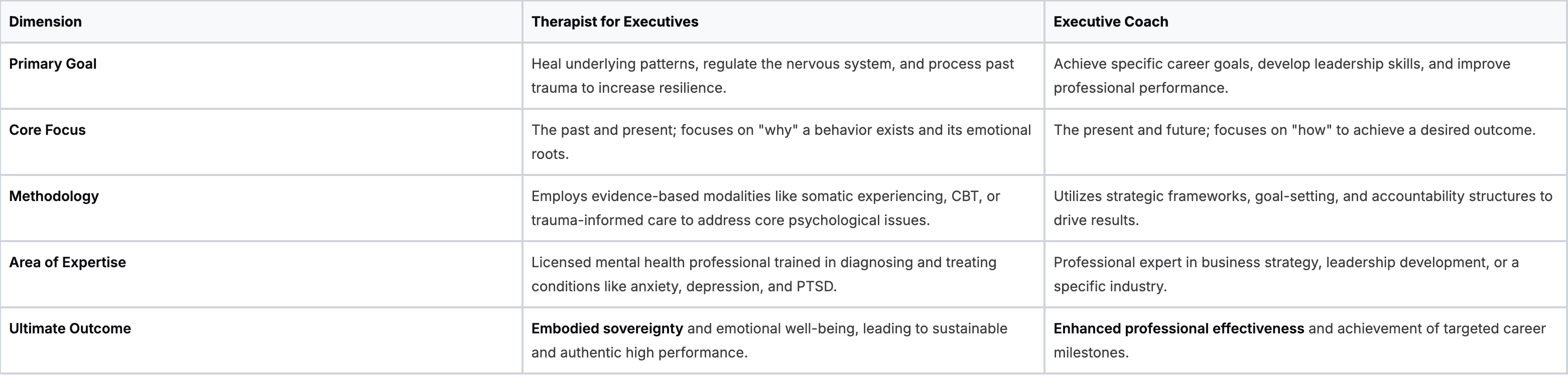
Choosing a therapist for executives isn't an admission of weakness; it’s a strategic investment in building a foundation strong enough to sustain your ambition without destroying your health. It's not about fixing something that's broken. It's about upgrading your entire internal operating system for the demands of modern leadership.
Once that foundation is solid, the power of coaching can be truly unlocked. We explore this in more detail in our guide on unlocking C-suite potential with executive coaching.
Ultimately, you cannot strategize your way out of a nervous system that’s locked in survival mode. Real power and authentic leadership come from a place of internal stability—and that's precisely what this specialized therapy is designed to build.
Your C-Suite Checklist for Finding the Right Therapist

When you’re operating in a high-stakes leadership role, choosing a therapist isn’t like finding any other professional service. This person needs to be more than a skilled clinician; they have to possess a deep, real-world understanding of the corporate battlefield you live on every single day. A generic approach just won’t cut it.
The search itself can feel like another full-time job, especially when you’re already stretched thin. To cut through the noise, you need a non-negotiable set of criteria. Think of this checklist as your tool for vetting potential partners and making sure you find a therapist for executives who can actually meet you where you are.
This demand for specialized support is exploding. While hard data on executive therapy is often kept under wraps, the meteoric rise of adjacent fields tells the story. In the US alone, the executive coaching industry has morphed into a $16 billion market, more than doubling since 2016. An ICF and PwC study revealed that global coaching revenue rocketed to $5.34 billion in 2025, a staggering 60% leap from 2019, as leaders desperately seek expert guidance to manage crushing levels of burnout. You can find more on this explosive growth here.
The Non-Negotiable Criteria
Treat your first consultation like you’re conducting a high-level interview. Because you are. You’re hiring for a critical seat on your personal advisory board.
Use these points to steer your questions and assess whether they’re the right fit:
Corporate Fluency: Do they understand what "fiduciary duty" or "stakeholder management" mean without needing a lesson? A therapist who gets lost in corporate lingo can’t grasp the context of the pressure you’re under.
Experience with High-Performers: Ask them directly about their work with C-suite clients, founders, or other intense achievers. What specific, gnarly challenges have they helped leaders navigate? Get concrete examples.
Focus on the Nervous System: Do they talk about more than just your thoughts and behaviors? A top-tier therapist for executives will immediately bring up somatic (body-based) work, nervous system regulation, and the actual physiology of stress.
Clear Methodological Approach: Can they clearly explain their framework for creating real change? Whether it’s a proprietary system like RAMS or an established modality like Somatic Experiencing, they should be able to walk you through their process, step by step.
A great therapist for an executive doesn't just listen to your problems; they understand the ecosystem in which those problems were created. They should feel like a strategic partner, not just a sympathetic ear.
Critical Red Flags to Watch For
Knowing what to look for is only half the battle. Knowing what to run from is just as important. The wrong therapeutic partner is a massive waste of your time, money, and emotional energy.
Stay sharp and watch for these warning signs in your initial conversations:
Reliance on Corporate Jargon: If they start spouting phrases like “leveraging synergies” or “blue-sky thinking,” run. A therapist who sounds more like a generic business consultant lacks the clinical depth you need.
Ignoring the Somatic Component: A therapist who focuses only on "mindset" without addressing how trauma and stress are physically stored in the body is giving you half a solution. You cannot think your way out of a dysregulated nervous system.
Pathologizing Ambition: Your drive is your superpower, not a personality flaw. A therapist who tries to make you “less ambitious” fundamentally misunderstands high-performers. The goal is to integrate your ambition with your well-being, not to extinguish it.
Lack of Professional Boundaries: Pay close attention to how they handle confidentiality, scheduling, and communication from the very first interaction. In your world, discretion and professionalism aren’t negotiable. They are the entire game.
The RAMS Method: A Framework for Reclaiming Your Power
Traditional therapy can feel painfully slow, especially when you’re operating at a high level. On the flip side, most coaching just scratches the surface, never getting to the deep-seated patterns that drive you to the brink of burnout. As a leader, your time is non-negotiable, and you need something that creates real shifts without taking years to get there.
This is exactly why the RAMS method was developed. It’s not a quick fix or another mindset hack. Think of it as a fundamental rewiring of your internal operating system, engineered for sustainable high performance.
This framework was born from years in the trenches, working with executives who were sick of being told they had to choose between their ambition and their sanity. RAMS moves you beyond just talking about your problems and hands you a practical, repeatable process for building power from the inside out.
R: Redefining Your Relationship with Results
The first pillar, Results, goes straight for the jugular of the high-achiever’s primary addiction: external validation. For years, your sense of self-worth has been tethered to KPIs, stock prices, and the next big win. This creates a fragile foundation for your identity, leaving you at the mercy of forces you can’t control.
RAMS completely redefines "Results." We shift the focus from external metrics to internal states of being. The goal is no longer to chase success, but to embody it.
Suddenly, a "win" isn't just closing a deal. A win becomes:
Navigating a high-stakes negotiation without your nervous system hijacking the conversation.
Receiving tough feedback without it sending you into an imposter-syndrome spiral.
Ending your workday and being present with your family, instead of replaying office drama in your head.
This pivot moves you from a position of constantly seeking validation to one of generating your own internal stability. You learn to source your power from within, making you unshakable no matter how volatile the market or boardroom gets.
A: Cultivating an Attitude of Embodied Presence
The second pillar, Attitude, has nothing to do with "positive thinking." This is about cultivating a state of embodied presence—the ability to be fully in your body, acutely aware of your internal landscape, and able to respond to the world instead of just reacting to it.
For many leaders, the body is just a taxi for the brain, shuttling it from one meeting to the next. This profound disconnection is the silent killer behind burnout.
Your body holds the data. That racing heart, the tightness in your chest, the knot in your stomach—these are not annoyances to be powered through. They are vital intelligence reports from your nervous system. An embodied attitude means learning to finally read and act on that intelligence.
We use specific, targeted practices to forge this mind-body connection, turning abstract concepts like "intuition" into a felt sense you can rely on. This is how you reclaim the authority of your own gut feelings and stop outsourcing your decisions to anxiety and fear.
M: Achieving Mastery Over Your Internal State
Pillar number three is Mastery. This is where we get tactical. It's about directly engaging with your nervous system to give you command over your internal state. If you’ve ever felt your voice tremble before a big presentation or snapped with disproportionate anger over a minor setback, you’ve experienced a nervous system that isn't under your control.
Achieving mastery means you learn to:
Recognize Dysregulation: You can feel the precise moment your body starts shifting into a stress response.
Interrupt the Pattern: You have a toolkit of somatic techniques ready to deploy, stopping the escalation before it takes over.
Return to Center: You can consciously guide yourself back to a state of calm, focused clarity, even when all hell is breaking loose.
This is the very definition of grace under fire. It’s not a personality trait you’re born with; it's a skill you can build. It’s the difference between being a passenger on an emotional rollercoaster and being the operator, in full control of the ride.
S: Implementing Systems for Sustainable Power
Finally, Systems are what make the transformation stick. Willpower is a finite resource; you can't rely on it to sustain change. For any leader, robust systems are the architecture of success, and the same applies to your personal well-being. And no, this isn't about scheduling more yoga classes.
These systems are practical and potent:
A 10-minute nervous system reset protocol you do in your car before walking in the door at home.
A structured "rage-to-clarity" journaling practice to process professional frustrations constructively.
Clear communication frameworks for setting and holding firm boundaries with your team, your boss, and your stakeholders.
These aren't more items for your to-do list. They are the guardrails that prevent you from redlining. They are the automated processes that ensure your "chassis" is as well-maintained as your "engine," creating a powerful feedback loop of resilience and power. You can learn more about how this framework offers a revolutionary approach to leadership by exploring the RAMS Method in our detailed article.
The Return: Reclaiming Your Nervous System Sovereignty

The decision to find the right therapist for executives isn't about admitting you're broken. It’s an act of reclamation. It’s a deliberate choice to return to yourself—peeling back the layers of pressure and performance to get back to the core of who you are.
This isn’t just another strategy for managing burnout. It's a profound move toward achieving what we call nervous-system sovereignty—the unshakable, grounded ability to lead from a place of deep internal stability, not constant reaction. It's about wielding immense power without your well-being paying the price. It's about making your biggest decisions from clarity, not anxiety.
The Return to Self
Embodied leadership isn't a new tactic you add to your playbook; it’s a state of being you inhabit. It’s the palpable, quiet confidence that radiates from someone who knows they can handle immense pressure because their internal world is solid. You become a leader who is fully present, grounded, and commands a room not with force, but with an undeniable sense of self.
This work fundamentally changes how you show up:
From reactive to responsive: You stop getting yanked around by every email, market shift, or difficult conversation. You start responding with clear intention.
From depleted to energized: You learn to plug the leaks in your own energy system, leaving you with far more capacity for what truly matters.
From fragmented to whole: The driven, high-achieving part of you finally learns to coexist with your deep human need for rest and genuine connection.
The goal isn't to become a different person. It's to become more of the person you already are, integrated and whole. It’s the return to a state where your professional success and your personal fulfillment are no longer at war with each other.
Your Next Step Toward a Lasting Legacy
This journey isn’t about cramming another task onto your overflowing plate. It’s about giving yourself the one tool that makes everything else sustainable. Think of it as a strategic investment in the single most valuable asset you will ever manage: you.
Building a legacy that lasts requires a leader who isn't just effective, but whole. It demands a leader who operates from a place of profound inner authority. The work we do within the RAMS ecosystem is engineered to build exactly that. For a deeper look at how this applies to your growth as a leader, you can explore our guide on transformational leadership training.
Choosing to start this work isn’t a sale. It is an empowered decision to return to yourself. It is the next logical step in your evolution as a leader.
Frequently Asked Questions About Therapy for Executives
Deciding to start therapy while leading a high-stakes career always brings up a specific set of questions. Here are the direct answers to the most common concerns we hear from C-suite leaders, founders, and other top-tier performers.
How Is Confidentiality Ensured for High-Profile Leaders?
Confidentiality is non-negotiable.
Every reputable therapist operates under a strict code of ethics and legal mandates (like HIPAA in the U.S.) that demand absolute privacy. For high-profile clients, it goes deeper. A therapist specializing in this world understands the unique risks you face.
They use secure, encrypted communication platforms, maintain discreet office practices, and have ironclad protocols to protect your identity. In your first conversation, you should feel completely empowered to ask them to detail their specific confidentiality measures. Their response will tell you everything you need to know.
What Is the Tangible ROI of Therapy on My Career?
Therapy doesn't show up as a line item on a balance sheet, but its ROI is absolutely real. It appears as a direct upgrade to your leadership capacity and personal sustainability.
You’ll see the KPIs of successful therapy in areas like:
Sharper Decision-Making: By learning to regulate your nervous system, you stop making choices from a place of anxiety or reactivity. The result is clearer, more strategic thinking under pressure.
Dramatically Increased Resilience: You build the capacity to handle major setbacks, tough feedback, and high-stakes situations without spiraling into burnout or crippling self-doubt.
Enhanced Executive Presence: Real self-awareness translates into a more grounded, authentic, and commanding presence in the boardroom and with your team.
The real ROI is the shift from constantly managing crises—both internal and external—to proactive, intentional leadership. This move conserves a massive amount of mental and emotional energy, which you can then reinvest into innovation, vision, and growth.
How Can I Fit This Deep Work into a Demanding Schedule?
Any therapist experienced with executives knows the standard, rigid one-hour-a-week model is often a non-starter. They get it. Many offer flexible formats designed to fit the realities of your life.
This can look like:
Varied Session Lengths: Longer, less frequent "deep dive" sessions, or shorter, more frequent check-ins to stay on track.
Secure Telehealth Options: The ability to conduct sessions remotely from your office, home, or even while traveling eliminates commute time and opens up scheduling possibilities.
Intensive Formats: Some practitioners offer weekend or multi-day intensives designed to accelerate progress and create major breakthroughs in a compressed timeframe.
The right therapist works with you to design a structure that supports your growth, rather than adding another layer of pressure to your calendar.
Beyond these specific questions, you might find more answers in these general frequently asked questions about mental health. Ultimately, the key is to find a therapeutic partner who respects the demands of your role while creating the space you need for profound, lasting change.
The work we do with a Baz Porter therapist isn't about sacrificing your ambition for your well-being. It’s about integrating the two so they fuel each other. If you’re ready to stop just surviving your success and start truly embodying it, explore your next step at https://bazporter.com.