
Regulated Leadership: From Compliance Burden To Competitive Edge
You’ve built your career on performance. But every success just adds another layer of scrutiny. The higher you climb, the heavier the invisible weight of compliance, oversight, and the relentless expectation to be perpetually “on.” This is what I call the silent collapse. It’s not a dramatic flameout; it's a quiet, internal state of constant, low-grade activation where your nervous system runs a marathon every single day, and a single misstep feels absolutely catastrophic. The very drive that fueled your ascent now traps you in a cycle of hyper-vigilance.
Key Takeaways
Internal State is Primary: Regulated leadership is less about managing external rules and more about mastering your internal nervous system. Physiological stability is the non-negotiable foundation for effective leadership under pressure.
Turn Threat into Advantage: A regulated nervous system allows you to reframe compliance burdens from a threat into a strategic opportunity, building trust and market share where competitors only see costs.
The RAMS Method is the Path: The RAMS framework (Results, Attitude, Mastery, Systems) provides a structured blueprint to shift from reactive, high-alert survival mode to proactive, embodied leadership.
Sovereignty is the Goal: True authority comes from internal sovereignty—the ability to remain centered and decisive amidst external chaos. This is the ultimate competitive edge.
The Unspoken Cost Of Leading In A Regulated World
You’re not just managing a team or a P&L; you're navigating a complex web of rules where the personal cost of failure feels immense. This constant pressure is a direct pipeline to high-functioning burnout, a state that erodes top performers from the inside out. I explore the deeper impacts of this phenomenon in my work on executive dysregulation.
Regulated leadership is the embodied ability to maintain nervous-system sovereignty amidst chaos. It’s the capacity to stay grounded, think clearly, and make decisive choices when the pressure feels unbearable. Without this internal regulation, managing external rules becomes an exhausting, soul-crushing battle against burnout.

Understanding the personal toll is the first step, and you can begin to quantify this impact if you assess your burnout risk with a comprehensive index. This guide is about mastering that internal state, so you can command the external world with an unwavering and authentic presence.
Why Regulation Hits Women Leaders Harder
For women at the top, the world of external rules and regulations often magnifies a harsh internal reality. The pressure isn't just about ticking compliance boxes; it’s deeply personal. Societal conditioning to be perfect, to never drop the ball, and to be the responsible one holding everything together doesn't vanish with a corner office. It morphs into relentless perfectionism, turning the demands of a regulated environment into a personal crucible.
The Gilded Cage Of High Achievement
This internal state is what I call The Gilded Cage. From the outside, you have all the markers of success—the title, the influence, the results. But internally, you're trapped. Every decision is second-guessed, and the fear of one wrong move is constant. This isn't just a feeling; it's a physiological reality. Your nervous system becomes wired for threat detection, operating in a perpetual state of low-grade fight-or-flight. It's an exhausting way to live.
The statistics on women in leadership often point to external barriers, but this internal battle is where the real war is waged. You can explore more data and context in our guide on key statistics for women in leadership.
This internal pressure is now colliding with a major external trend. Increased regulation has emerged as a critical threat, with 28% of global leaders naming it a top concern. This marks a significant jump, happening alongside a rise in policy uncertainty, which climbed to 38% in just six months. You can read more about these findings in the Global Leadership Monitor H2 2025.
For the woman leader in The Gilded Cage, these external statistics aren't abstract data points. They are additional bars on the cage, each one amplifying the internal pressure to be flawless.
To break free, the answer isn't managing compliance better. It's fundamentally shifting your internal state—moving from reaction to one of regulated leadership.
Mastering Your Internal State With The RAMS Method
The constant weight of external regulations and that inner voice of perfectionism creates chronic activation in your nervous system. Breaking free requires a new operating system for your leadership. This is where you shift from managing compliance to embodying regulated leadership.
The framework for this shift is the RAMS Method. It’s a systematic approach designed to move you from reactive survival to proactive, embodied control. It isn’t about piling more on your plate; it’s about fundamentally changing how you carry the load. You can go deeper into how this powerful system works in our complete guide to the RAMS Method.
Results Beyond The Balance Sheet
The first pillar, Results, reframes success. In a world governed by rules, it's easy to think "results" just mean flawless compliance. This narrow view breeds fear. RAMS expands the definition of results to include your internal state. A true win isn't just a successful audit; it's navigating that audit while keeping your internal calm intact. It’s about achieving outstanding outcomes without sacrificing your well-being.
Attitude As An Embodied Stance
Next is Attitude. This is about moving from a mindset of reactive fear to a proactive, embodied presence. A dysregulated attitude is defensive, always scanning for threats. A regulated attitude is grounded and centered. This isn't "positive thinking"; it's achieving physiological stability that allows you to see challenges as data points, not personal attacks.
This infographic lays out the specific pressures that make this internal regulation so difficult for women leaders, highlighting how stress, societal conditioning, and perfectionism intersect.
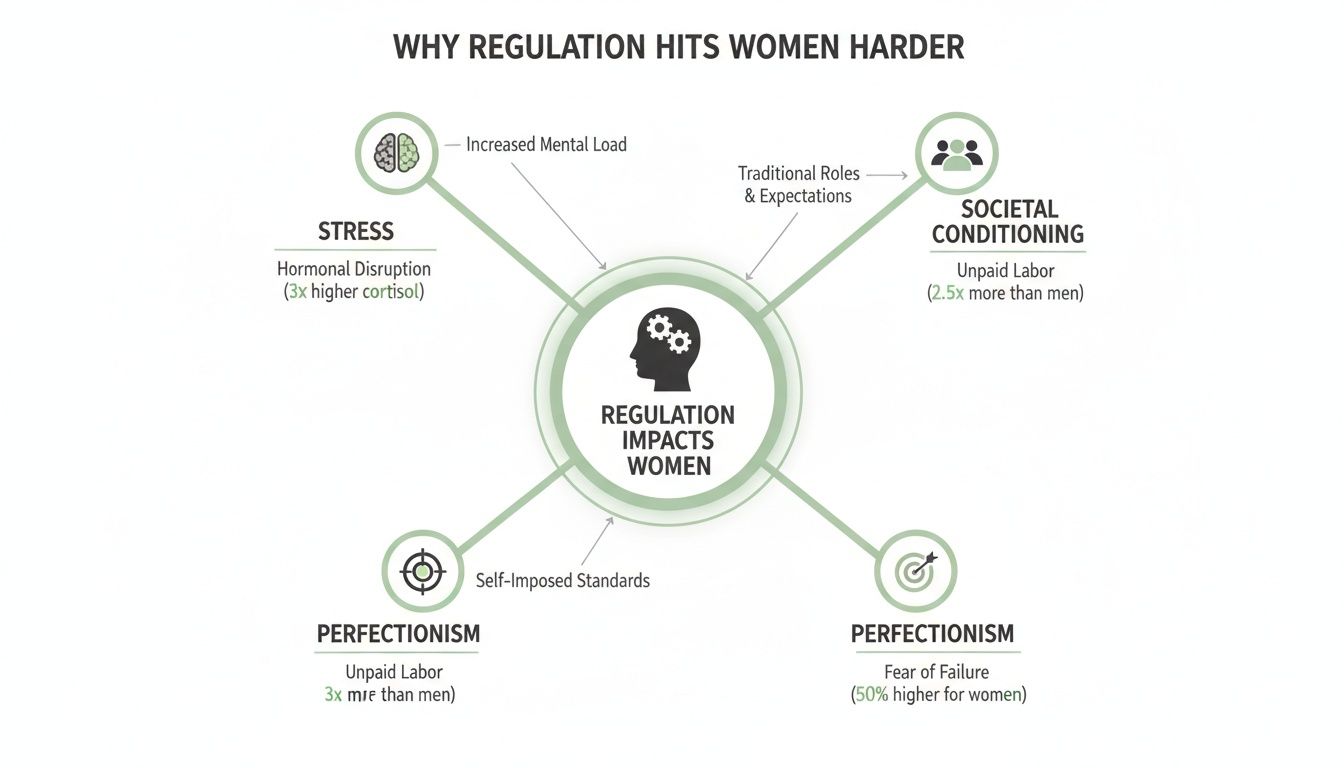
As you can see, the need for regulated leadership is amplified by these overlapping forces. This makes having a structured method for self-regulation an absolute necessity.
Mastery Of Your Physiology
Mastery is the practical application of emotional and physiological self-regulation. This is where you learn the actual tools to actively manage your nervous system on command—before a high-stakes meeting, during a difficult conversation, or after a draining day. It’s about processing emotions efficiently so they don't hijack your decision-making.
True mastery means your internal state is no longer at the mercy of your external circumstances. You become the thermostat, not the thermometer.
Systems For Sustainable Performance
Finally, Systems are the personal and professional structures you build to protect your energy and focus. A dysregulated leader relies on sheer effort, a direct path to burnout. A regulated leader builds systems that make excellence sustainable. This looks like:
Boundary Systems: Clearly defined and defended limits on your time and energy.
Delegation Systems: Robust processes that strengthen your team and free your capacity.
Recovery Systems: Intentional, non-negotiable practices for rest and nervous system repair.
The table below contrasts the two states of leadership. It clearly shows the difference between reacting to the world from a state of dysregulation versus intentionally leading from a place of embodied, internal control.
Navigating Leadership Dysregulation vs Embodied Regulation

This comparison isn't about judgment; it’s about clarity. It highlights the choice every leader has: to be driven by chaos or guided by calm. These four pillars—Results, Attitude, Mastery, and Systems—create a rock-solid foundation for a new kind of leadership that is both devastatingly effective and deeply sustainable.
Turning Compliance Into Your Competitive Advantage
For the leader trapped in The Gilded Cage, every new regulation feels like another bar locking them in. The conventional view treats compliance as a cost center—a box-ticking exercise. But that perspective is a direct symptom of a dysregulated nervous system. It’s a threat response.
A truly regulated leader sees something entirely different. They understand that at the core of every regulation is a fundamental human need: for safety, fairness, and trust. By mastering their own internal state, they meet these demands not with fear, but with strategic creativity. They turn compliance from a defensive chore into an offensive weapon.

From Threat To Opportunity
The global business landscape is already shifting. Top executives are no longer fighting regulation but are actively calling for it, especially in complex areas like AI. A fascinating 37-50% of C-suite leaders across major markets are now pushing for stricter rules on AI. They worry that a lack of ethical guardrails is stalling adoption.
This creates a massive opening. While reactive leaders see only roadblocks, a regulated leader sees a clear path to build unshakable trust and capture market share. As you can see in these eye-opening leadership statistics, the hunt is on for leaders who can handle intense scrutiny.
A leader with a regulated nervous system can hold the complexity of ethical innovation without becoming overwhelmed. They build teams that are not just compliant, but deeply committed to the principles behind the rules.
Regulated Leadership In Action
Let’s look at how this plays out in the real world.
Case Vignette 1 - The Tech CEO: Faced with new data privacy laws, a CEO could have just updated legal policies. Instead, she launched a company-wide initiative on "digital trust." By openly championing user privacy, her company attracted security-conscious customers, turning a compliance cost into a revenue driver.
Case Vignette 2 - The Healthcare Executive: A hospital administrator was tasked with implementing complex new patient-care protocols. Instead of just enforcing rules, she used RAMS principles for scaling impact by creating resilient systems. This not only reduced staff burnout but also improved patient satisfaction scores by 15%.
In both scenarios, the leader’s internal stability allowed them to see beyond the immediate problem. This isn’t just about following the rules; it's about leading from grounded clarity, whether navigating patient data or leveraging AI voice agents for HIPAA compliance.
Your Path To Embodied Sovereignty
The path out of the Gilded Cage isn’t about learning another leadership tactic. It’s a fundamental return to yourself. It’s the reclamation of your energy, clarity, and internal authority in a world engineered to pull you off-center.
You’ve felt how chronic stress creates internal chaos, quietly eroding your success. Regulated leadership is the antidote. It’s the conscious choice to master your own nervous system first, so you can command your external world with an unwavering presence.
This isn't about performing better; it's about leading differently. It's about building a legacy from a place of authentic power, not from depletion.
Sustainable success is impossible without this internal stability. The frameworks we've explored guide you back to that core of calm, potent leadership. This is the essence of true embodied sovereignty.
The next step isn't a transaction. It's a commitment to your own return.
Your Questions About Regulated Leadership, Answered
Let's cut through the noise. This is where we get straight to the point, moving from theory to tangible actions.
What Does Regulated Leadership Actually Mean?
Forget textbook definitions. This term operates on two critical levels. Externally, it’s about leading effectively within industries bound by iron-clad compliance, like finance or tech. But the real work—the foundation for that mastery—is internal. At its core, regulated leadership is the embodied skill of maintaining your own nervous system stability when the pressure is immense. One is impossible to sustain without the other.
Where Is the Best Place to Start This Work?
The most powerful first step isn't a massive life overhaul. That just tells your nervous system that change is another threat. Instead, start small. Begin with a single, consistent practice that proves you can create safety on demand.
Choose one simple regulation tool, like a 60-second box breathing exercise. Commit to doing it three times a day, especially before a stressful meeting. This simple act builds the foundational muscle of intentional state-shifting.
How Do You Even Measure the ROI on This?
The return on investment shows up in hard numbers and priceless intangibles. You'll see direct, measurable improvements in:
Decision-Making Speed and Quality: A regulated mind processes complex information without the distortion of stress, slashing the risk of costly errors.
Team Retention: Leaders who operate from calm create psychological safety, a non-negotiable for keeping top talent.
Your Own Health: Lowering chronic stress has a direct, quantifiable impact on your physical and mental health, ending the burnout cycle.
The true ROI is found in the reclaimed capacity for visionary thinking and the sustainable energy you bring to every part of your life. It's knowing you can handle whatever comes next without sacrificing yourself in the process.
Where to go next. If any of this reads like your own reflection, the Silent Collapse Diagnostic™ is a quiet place to start — a clear read on where your leadership is running dysregulated. And if you want the deeper why beneath the work, read the Sovereign Manifesto.