Quiet Cracking: Why Strong Leaders Quietly Erode
You look fine. Your numbers hold. Your calendar is full. And something underneath has started to give way. Not a crash. A hairline fracture. This is quiet cracking, and it is the first felt sign of Silent Collapse™. It does not announce itself. It erodes. You still perform, so no one asks. You still deliver, so you tell yourself it is nothing. It is not nothing. It is the slow structural failure of a leader carrying too much for too long. There is a way back, and it starts with seeing the pattern clearly. The Sovereign Manifesto names what most advice refuses to.
Written by Baz Porter®
On This Page
Key Takeaways
Quiet cracking is the slow erosion of a high performer who still looks fine.
It is involuntary. You did not choose to check out. You wore down.
It is distinct from burnout, which is acute. Quiet cracking is chronic and quiet.
The cause is load without recovery, held under a mask of competence.
The Silent Collapse Diagnostic™ maps where the fracture began and how to rebuild.
What Is Quiet Cracking?
Quiet cracking is the slow, involuntary erosion of a high performer under sustained pressure. It is an early felt signal of Silent Collapse™. You are not quitting. You are not lazy. You are wearing thin while still hitting every mark. The term named a real 2026 pattern. A TalentLMS workplace study found that most employees feel some level of it, and one in five feel it often. Gallup reported that only around a third of workers were actively engaged. Behind those numbers sit your best people. They do not walk out. They quietly fracture in place. The danger is the mask. Competence hides the crack. So the person most at risk is the one no one worries about. That is you, if the room still runs on your steadiness while your own is thinning. The word matters. Quiet cracking is not a personality problem. It is a load problem. Two leaders under the same weight can give way at different points, and neither is weak for it. What decides the outcome is the structure around them, not the size of their will.
The Hidden Pattern Beneath the Cracks
Quiet cracking is not weakness. It is physiology. The body keeps a running tab on stress. When demand never lets up, that tab compounds. Neuroscientist Bruce McEwen called this allostatic load, the wear that accumulates when the stress response stays switched on. The system does not fail all at once. It degrades. Focus dulls. Sleep frays. Warmth flattens into function. You start running on cortisol and willpower. For a while it works. High performers are very good at overriding their own alarms. That override is the trap. Gallup's engagement research shows the cost lands first as quiet disengagement, long before anyone resigns. The crack is not a mood. It is a measurable load your system can no longer carry silently. Naming it is not defeat. It is the first accurate read you have had in months.
Baz Porter does not motivate. He does not inspire. He architects the return from collapse.
The RAMS™ Reframe
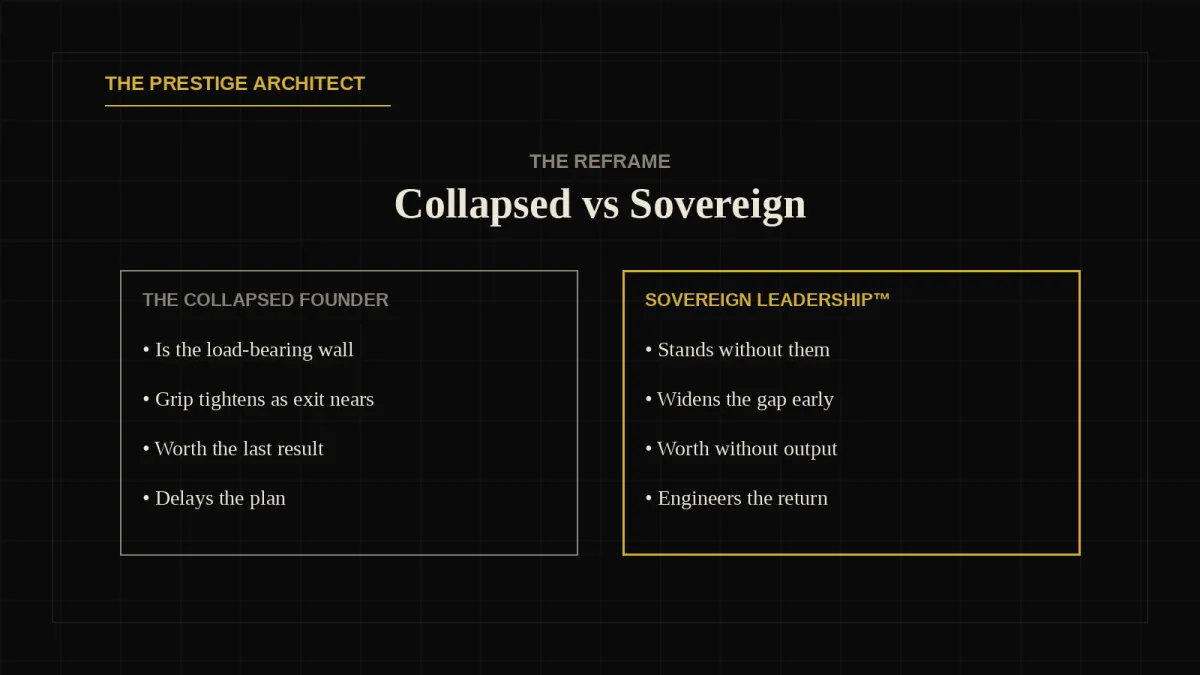
Most advice tells you to rest and push on. That treats a structural problem as a scheduling one. RAMS™ works the architecture instead. It runs across five pillars: Results, Attitude, Authenticity, Mastery, and Systems. Here is the collapsed pattern next to the sovereign one.
Results: Collapsed measures output only. Sovereign measures output and the cost of producing it.
Attitude: Collapsed reads the crack as a character flaw. Sovereign reads it as data.
Authenticity: Collapsed performs fine for the room. Sovereign tells the truth about the load.
Mastery: Collapsed grips harder when tired. Sovereign builds recovery into the craft.
Systems: Collapsed makes you the load-bearing wall. Sovereign moves weight off the one person.
The shift is not a mindset trick. It is a redesign of what carries the weight. When the system holds part of the load, your nervous system stops absorbing all of it. That is where the erosion stops. If you want to see where your own fracture started, the Silent Collapse Diagnostic™ is the honest first read.
A Case From the Room
A managing partner sat across from me. Record year. Strong team. She said the work still got done, but she felt nothing when it did. No dread, no joy. Flat. She had called it discipline for two years. It was quiet cracking. We did not add a retreat or a reset week. We rebuilt the Systems pillar first. Three decisions that only she made moved to a clear structure. Two standing meetings that ran on her presence were re-architected to run without it. Within weeks the flatness lifted, because the load finally had somewhere to go besides her body. She did not become a different leader. She stopped being the only wall holding the roof.
The Architecture of Your Return
Quiet cracking does not resolve by trying harder at the thing that caused it. It resolves when the architecture changes. You are not asked to feel more grateful or to rest one more weekend. You are asked to see the load clearly and move it. That is a build, not a mood. The one door to that build is the Silent Collapse Diagnostic™, sixty minutes, one to one, where we map where the fracture began and what the return requires. You do not need to be at the edge to start. Quiet cracking is the early warning. It is the best time to act, while you still have range. Waiting costs range. The longer the crack runs unseen, the more the return asks of you later. Early action keeps the repair small and keeps the choice yours.
Frequently Asked Questions
What is quiet cracking at work?
Quiet cracking is the slow, involuntary erosion of an employee's morale and steadiness under sustained pressure. Unlike a dramatic collapse, it happens gradually while the person still performs. It is an early felt signal of deeper strain, common in high performers who mask it well.
How is quiet cracking different from burnout?
Burnout is acute and exhausting, a state you clearly notice. Quiet cracking is chronic and quiet, a hairline fracture you can hide for months. Burnout stops you. Quiet cracking lets you keep going while you slowly wear down, which is what makes it easy to miss.
Why do high performers experience quiet cracking most?
High performers are skilled at overriding their own stress signals. That override lets them deliver through strain that would stop others. The cost accumulates as physiological load. Because they still produce, no one intervenes, so the erosion continues unseen until it becomes serious.
Is quiet cracking a sign of Silent Collapse?
Yes, it is often the earliest felt sign. Silent Collapse™ is the deeper structural failure that follows unaddressed erosion. Quiet cracking is the warning tremor before the deeper break. Catching it early gives you the widest range of options for a full return.
How do I recover from quiet cracking?
Recovery starts by naming the load accurately, then redesigning what carries it. Rest alone does not hold if the same structure resumes on Monday. The Silent Collapse Diagnostic™ maps where your fracture began and rebuilds the systems so the weight no longer lands on you alone.
Can you recover from quiet cracking without leaving your role?
Yes. Most leaders do not need a new job. They need a new architecture inside the one they have. When decisions and load move off a single person and into clear systems, the erosion stops and range returns, often without any change in title or company.
Baz Porter® is a leadership architect and the founder of Baz Porter LLC®. He guides high-achieving leaders from Silent Collapse™ to Sovereign Leadership™. Related reading: executive languishing, boreout, and high-functioning burnout.