High-Functioning Burnout: When You Still Perform And Feel Nothing
You still hit every number. You still run the room. And somewhere behind your own eyes, you have gone quiet. This is Silent Collapse™ — the structural erosion of identity underneath intact performance. High-functioning burnout does not look like falling apart. It looks like competence. That is what makes it dangerous. The output holds while the person inside it thins out. If you recognize the feeling but cannot name it, start here: Read The Manifesto.
Table of Contents
Key Takeaways
Burnout is not exhaustion. It is the gap between what you produce and who you have become.
High-functioning burnout hides inside competence. The collapse is internal long before the calendar shows it.
Your capacity is not gone. Research shows executive function returns. The architecture beneath it was never built.
The fix is structural, not motivational. You rebuild the system, not the willpower.
What High-Functioning Burnout Actually Is
High-functioning burnout is the state where performance stays intact while the identity driving it erodes. You ask, "Am I burnt out, or is this something worse?" The honest answer: it is both, and the difference is structural. Burnout is the symptom. Silent Collapse™ is the condition underneath.
The Hidden Pattern: Burnout vs Breakdown
The World Health Organization names burnout an occupational syndrome with three dimensions: energy depletion, mental distance from the work, and reduced efficacy (WHO, ICD-11). That definition is accurate and incomplete. It describes the weather. It does not describe the architecture.
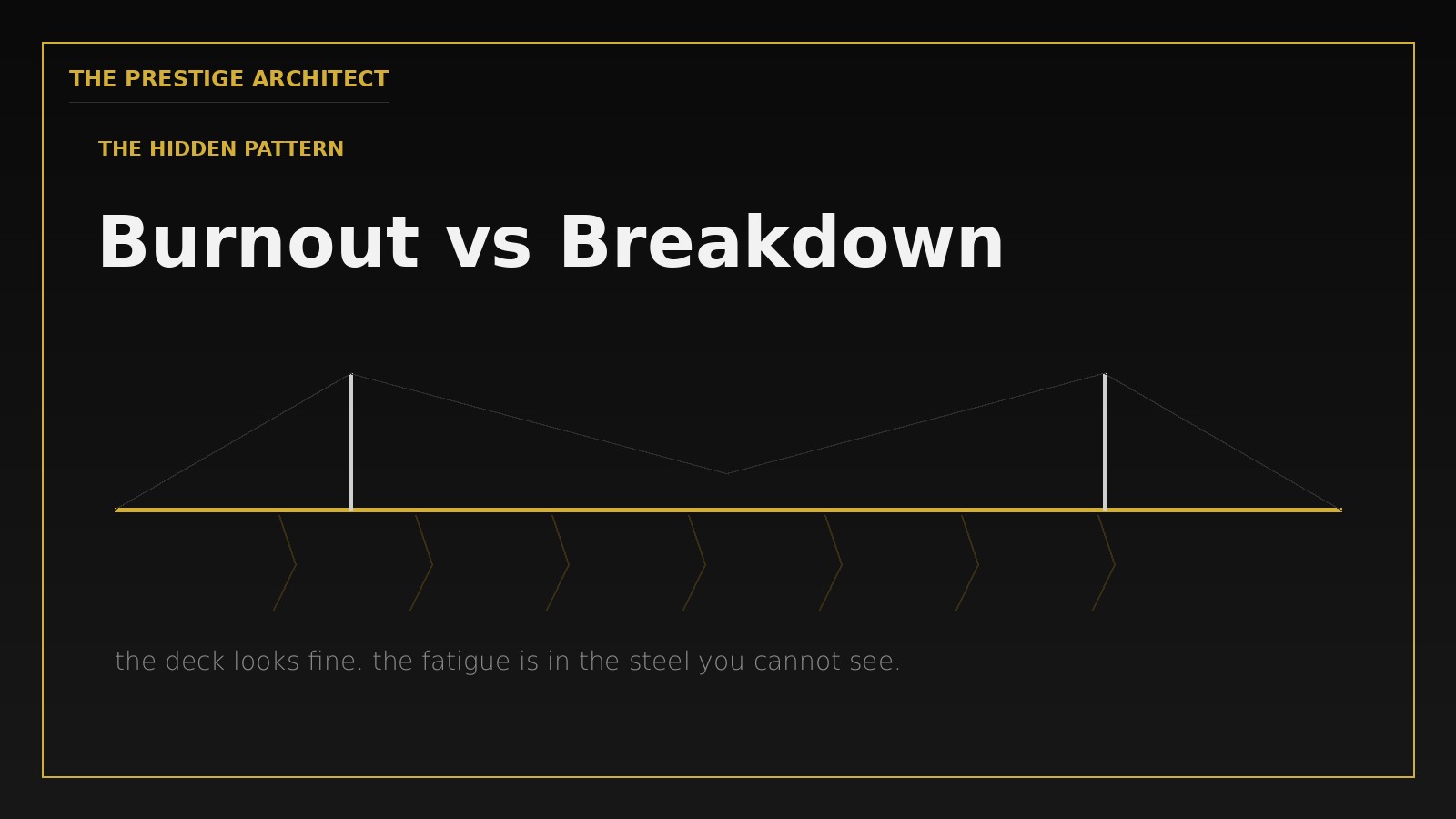
Here is the pattern most leaders miss. A breakdown is loud. It stops the output. Burnout in a high performer is silent. The output never stops — that is the trap. You override the warning signs because your identity is fused to competence. Admitting depletion feels like betraying the person everyone relies on.
Think of the nervous system as a bridge under constant load. The traffic keeps moving. The deck looks fine. The fatigue is in the steel you cannot see. By the time cracks reach the surface, the erosion is years deep. This is Silent Collapse™: function intact, foundation hollow.
The research carries a sharper edge. Executive function is impaired during acute burnout, yet it recovers to the level of healthy controls once the load is addressed (Oosterholt et al., PubMed). Read that twice. Your capacity is not damaged. It is suppressed by an environment you have not redesigned. The capability waits. The architecture was never built. If that lands, the next step is recognition, not effort: Sovereign Leadership Resource Hub.
Burnout is not the price of high performance. It is the receipt for performing without architecture.
The RAMS™ Reframe: Five Pillars of Your Return
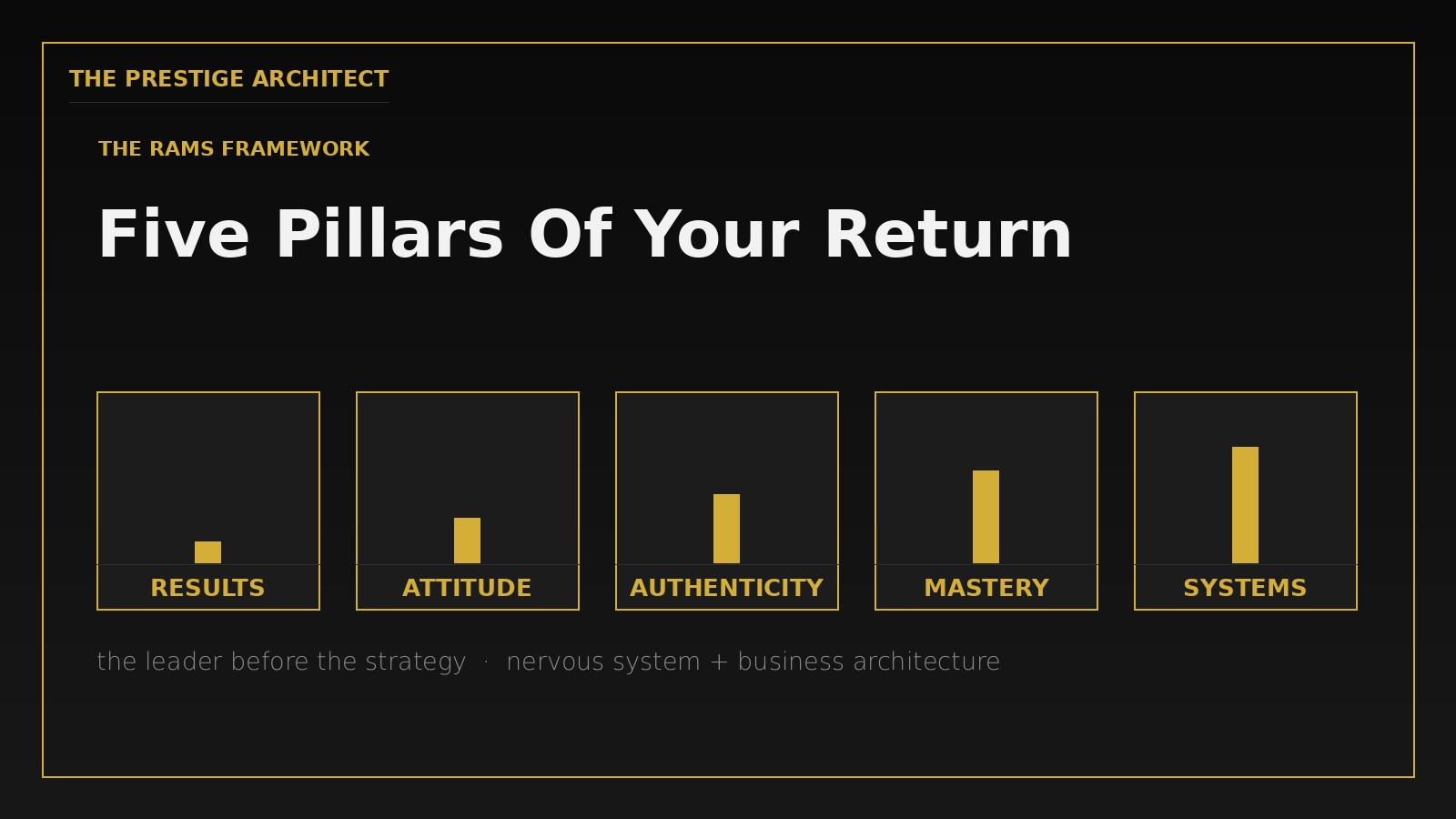
The RAMS Framework™ rebuilds the leader before it touches the strategy. Five pillars — Results, Attitude, Authenticity, Mastery, Systems. The body and the business run on the same architecture. When one is dysregulated, both are compromised. Sovereign Leadership™ is the outcome: power without collapse.
Results — The Output and Identity Gap
You measure yourself by output. The number goes up. The person goes quiet. That space between what you produce and who you are is the gap where burnout breeds.
The trap: more output is read as more proof you are fine.
The truth: output is a lagging signal. Identity erodes first.
Operational rule: measure the state of the operator, not only the yield of the operation.
Attitude — Where Collapse Lives
Attitude is the internal operating system. Not positivity — the running narrative under pressure. "If I stop, everything falls apart." That sentence is where the collapse lives. It keeps you moving and keeps you hollow.
The story that protects your output is the same story that erodes your identity.
Authenticity — The Private and Public Divide
The performed self and the lived self drift apart. In the room you are decisive. Alone you feel nothing. That divide is the engine of Silent Collapse™. Closing it is not weakness. It is structural repair.
Mastery — Skill vs Sovereign Capability
You have skill. Skill executes under good conditions. Sovereign capability holds under load without consuming the operator. The difference is regulation, not talent.
Command decision: stop adding skills to a dysregulated system. Regulate the system first.
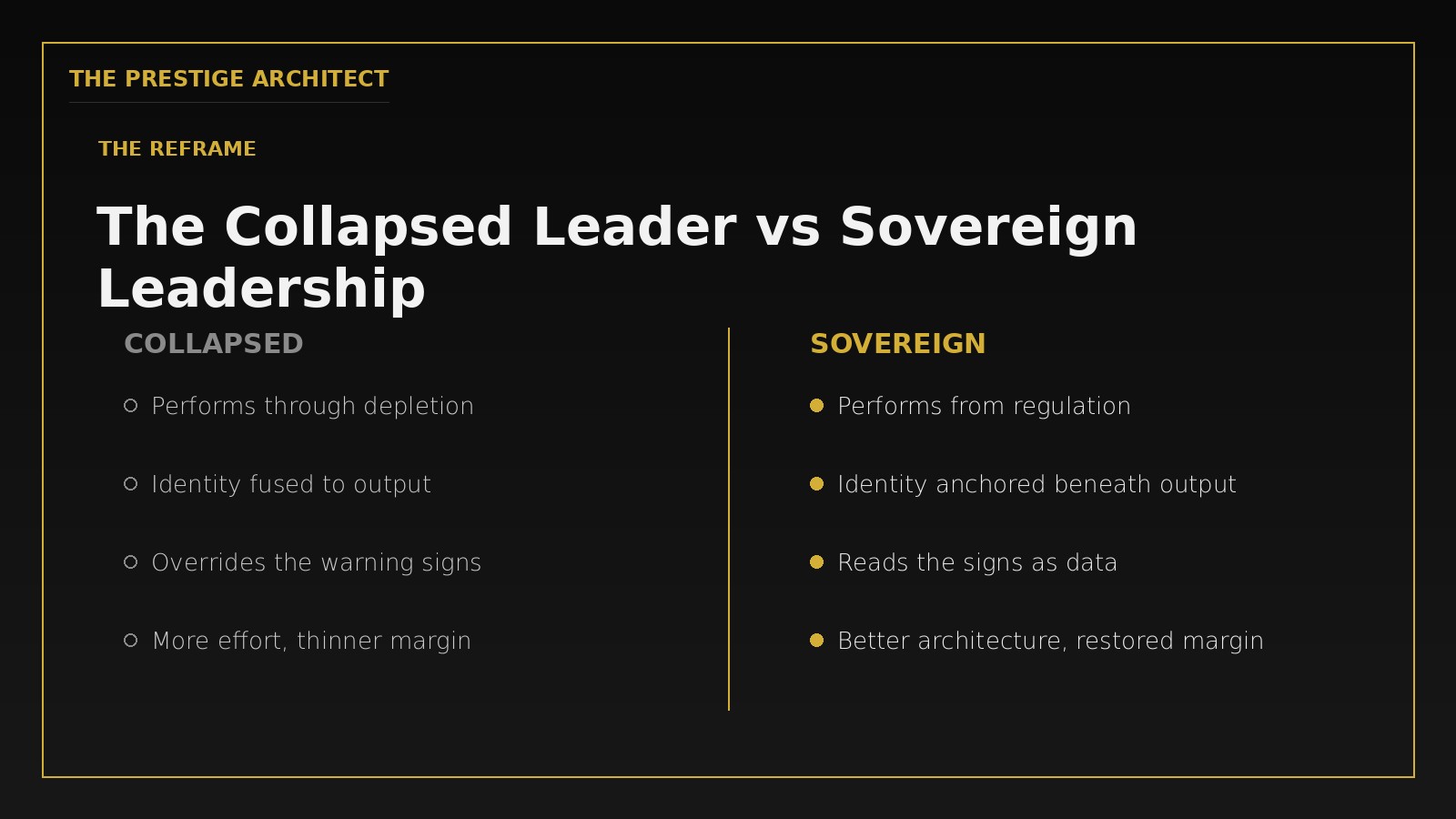
The Collapsed LeaderSovereign Leadership™Performs through depletionPerforms from regulationIdentity fused to outputIdentity anchored beneath outputOverrides the warning signsReads the warning signs as dataMore effort, thinner marginBetter architecture, restored margin
Systems — The Architecture of the Return
Willpower is not a system. It is a tax. Systems decide what the day demands of your nervous system before the day starts. This is the pillar that ends the cycle. If you want the precise read on where your collapse is structured, this is the first instrument: Take the Silent Collapse Diagnostic.
A Case Vignette: The Quiet Return
A founder ran a nine-figure operation. Every metric green. Privately, blank. No crisis — that was the problem. We did not address motivation. We rebuilt the architecture: how decisions entered her day, where recovery was structured, which outputs were load-bearing and which were noise. We moved three standing meetings off her calendar and put a hard regulation block where the day used to fragment. We named the two outputs that actually moved the business and let the rest fall to the team. Inside one quarter the numbers held and the operator came back online. She described it in one line: the noise stopped and she could hear herself think again. The capacity was always there. The system around it was not.
The Architecture of Your Return
Your return is not a feeling you summon. It is a structure you build. Nervous-system sovereignty is the foundation: a regulated operator who performs without paying in identity. The work is clinical, not inspirational. You stop asking your willpower to absorb a design flaw. You redesign.
You do not need more willpower. You need a system that stops taxing the operator.
This is the difference between burnout managed and Silent Collapse™ resolved. One survives the week. The other rebuilds the person who lives the year. When you are ready to architect the return, the door is application-gated for a reason — the work is real: Apply to Work With Baz.
Frequently Asked Questions
How do I know if I have high-functioning burnout?
Your performance holds while your meaning drains. You hit targets and feel nothing. You override fatigue because the work cannot stop. The external picture looks like success. The internal picture is empty. That split is the signature.
What is the difference between burnout and a breakdown?
A breakdown stops the output and is visible. Burnout in a high performer keeps the output running and stays hidden. The breakdown announces itself. The burnout erodes silently underneath intact function — which is why it runs for years undiagnosed.
Can executive capacity actually recover from burnout?
Yes. Executive function is impaired during burnout and returns to healthy baseline once the load and the architecture are addressed. Your capability is suppressed, not destroyed. The work is rebuilding the system around it, not forcing more output through it.
Why does success feel empty even when nothing is wrong?
The achievement was a proxy for a need it was never built to meet. When output is fused to identity, each win raises the baseline and the emptiness returns. The fix is structural: anchor identity beneath the output instead of inside it.
British military veteran. Two-time international bestselling author. Founder, The Prestige Architect®. Host, Rise From The Ashes podcast, C-Suite Network. Boulder, Colorado.