Mind Map On Myself: A Guide for High-Achieving Women to Reclaim Focus
You’ve built a life that looks perfect on paper. The promotions, the accolades, the leadership roles—it's a portfolio of undeniable success.
But when you finally pause and look at the life you’ve constructed, the feeling isn’t victory. It’s a quiet, crushing weight of exhaustion. This chasm between external achievement and internal fulfillment is the "silent collapse" so many high-performing women experience. This isn’t a personal failure. It's a systemic breakdown.
Key Takeaways:
Diagnose the Hidden Disconnect: Learn how to use a mind map as a diagnostic tool to make the invisible link between your relentless drive and your internal exhaustion visible for the first time.
Map Your Inner World: Get tactical, step-by-step instructions for creating the four foundational pillars of your personal mind map: Career, Values, Health, and Relationships.
Uncover Invisible Anchors: Discover how to identify the subconscious beliefs, fears, and systemic pressures that are holding you back, and learn how to map them to regain control.
Turn Insight into Action: Transition from diagnosis to a clear action plan using the RAMS™ (Results, Attitude, Mastery, Systems) framework, designed to build sustainable leadership.
A "mind map on myself" is a strategic diagnostic tool used to visualize your internal world—your roles, values, ambitions, and struggles—on a single page. It's an essential first step for high-achieving women to untangle their self-worth from their work, identify hidden patterns of burnout, and begin the process of reclaiming their focus and internal authority.
The Hidden Pattern: The Cost of Your Capacity
The narrative sold to ambitious women is one of relentless climbing. You’re told that with enough grit, you can have it all. The hidden cost is the slow erosion of self that happens when your identity becomes chained to your performance. This is more than burnout. It's a profound misalignment, a gut-wrenching feeling that the person collecting all those awards is a stranger.
This disconnect is a shared reality. For countless female leaders, the internal monologue sounds dangerously familiar: "If I stop performing, I will cease to exist." This is the pressure cooker where success dysregulation takes root—a state where your nervous system is perpetually stuck in overdrive. It’s a dangerous feedback loop where your capacity becomes your cage. The more you accomplish, the more is demanded, trapping you in a cycle of ever-increasing performance.
You're celebrated for your capacity to handle immense pressure, but internally, you're running on fumes. You constantly fight the fear that one wrong move will bring the whole house of cards crashing down. This is the very dynamic we explore in depth in our article on success dysregulation.
To get ahead of the burnout so often tied to high achievement, a practical tool like this founder mental wellness checklist can be an invaluable first step. It gives you a structured way to check in with yourself before you hit a breaking point.
The Cycle of Exhaustion and Expectation
This feeling isn't just in your head. It's the predictable outcome of a system that rewards unsustainable work habits, particularly in women. You push through the exhaustion, deliver exceptional results, and are "rewarded" with even greater expectations.
It becomes a vicious, soul-crushing cycle:
Your capacity becomes your cage. The more you accomplish, the more is demanded of you, trapping you in a cycle of ever-increasing performance.
Rest feels like a risk. Taking time for yourself feels like you're willingly falling behind, a luxury you simply cannot afford.
Your identity merges with your role. You start to forget who you are outside of your professional accomplishments. Who are you without the title?
This is precisely why creating a mind map on myself isn't a luxury or a self-indulgent exercise. It is a critical, non-negotiable act of leadership. It’s the first real step in untangling your worth from your work and beginning the journey back to yourself.
How to Create Your Personal Mind Map
Let’s get tactical. A personal mind map isn't just a brainstorming exercise; it’s a strategic diagnostic tool I use with leaders to map their internal world. It’s about getting everything—your roles, values, ambitions, and struggles—out of your head and onto a single page.
This is where you start to see the hidden connections and patterns you’ve been missing. For high-achieving women, this clarity is the critical first step to breaking the cycle of exhaustion and reclaiming control.
Many of the leaders I work with are trapped in the exact cycle shown below. Their relentless drive for success is the very thing that fuels their exhaustion and pulls them away from who they are.

This flowchart isn’t just a diagram; it's a feedback loop. The pursuit of achievement reinforces the very habits that drain your energy and disconnect you from what truly matters. Your mind map is the tool to break it.
Laying the Foundation: Your Central Idea
Grab a blank sheet of paper or open a digital mind-mapping tool. Don’t overthink it.
In the dead center, write the word "Myself."
This is your anchor. Every goal, every role, every challenge you map will radiate from this single point. It represents you—separate from your job title, your responsibilities, and the expectations of others. This simple act is surprisingly powerful. It’s a declaration that you are the focal point of this entire operation.
From that center, draw four main lines branching out. Think of these as the primary pillars holding up your life.
Label them:
Career & Ambition
Personal Values
Health & Wellbeing
Key Relationships
These first four branches create your personal diagnostic. They force you to see your life as an interconnected system, not a series of siloed compartments. The journey to becoming more self-aware is a journey of integration, not separation.
Populating the Branches: Beyond Generic Labels
Now, we breathe life into the map. This is where you go beyond generic labels like "success" or "family." We need specifics.
Under each of the four main branches, start adding sub-branches. Use these prompts—specifically crafted for the high-performing women I coach—to dig deeper than you normally would.
For the "Career & Ambition" Branch:
What achievement am I most proud of, and why? What was the feeling it gave me?
If the fear of failure were completely off the table, what professional risk would I take right now?
What specific part of my job drains 80% of my energy? And what part gives me 80% of my fulfillment?
For the "Personal Values" Branch:
When did I last feel completely aligned and authentic? What was I doing, and who was I with?
What is a "hell yes!" for me? What is an absolute, non-negotiable "no"?
Which of my core values feels compromised in my life right now?
By asking these pointed questions, you stop drawing a simple diagram and start creating a dynamic tool for real self-discovery. Exploring these domains is a fundamental part of authentic leadership. You can go deeper into this process by reading our guide on how to be more self-aware.
Consider this map your first draft of a new, more aligned reality.
Uncovering the Patterns Holding You Back

Your initial map shows you the "what" of your life; now it’s time to find the "why" behind the burnout.
Think of what’s holding you back as an Invisible Anchor. It’s that heavy, unseen collection of subconscious beliefs, old habits, and systemic pressures that keeps you stuck in an unsustainable loop. No matter how hard you try to sail forward, it's there, dragging you down. A mind map of yourself is how you make that anchor visible.
For so many of the high-achieving women I work with, this is a brutal moment of truth. Research from McKinsey shows a dramatic "drop to the top": for every 100 men promoted from entry-level to manager, only 87 women are. By the time you get to the C-suite, only 1 in 4 leaders is a woman.
This external reality creates a ton of internal friction. When you see the path narrowing so dramatically, it’s easy to internalize the message that you have to work twice as hard just to stay in the game. That belief alone is exhausting.
Mapping Your Obstacles and Emotions
To get these patterns out of your head and onto the page, you need to add two new, non-negotiable branches to your mind map: Obstacles and Emotions. This isn’t about wallowing in negativity. It’s about honest diagnosis.
First, under the Obstacles branch, dump everything that gets in your way. No filter.
What specific fears are stopping you? (e.g., "Fear of losing my status," "Fear of being seen as difficult if I set boundaries.")
What external pressures are killing your energy? (e.g., "The constant expectation to be available 24/7," "Navigating the boys' club politics.")
What’s the one self-sabotaging belief that always pops up? (e.g., "I have to be perfect," "Rest is a sign of weakness.")
Next, create your Emotions branch. This is where you start connecting the dots. Your body is sending you signals all day long—this is your chance to finally listen. An unregulated nervous system can quietly destroy your best-laid plans, a concept we dive deep into in our guide to nervous system regulation.
By mapping these "shadow" elements, you turn a simple diagram into a powerful tool for insight. You start to see the direct line connecting a systemic pressure (like the leadership drop-off), to a personal obstacle (like imposter syndrome), and an emotional state (like chronic anxiety).
When you’re ready to go even deeper and face those unconscious drivers head-on, understanding What Is Shadow Work can be a powerful framework for integrating these hidden parts of yourself.
Your completed mind map is now a true chart of your inner world, finally revealing the invisible anchors holding you back. This clarity is the essential first step to cutting the rope for good.
The RAMS Reframe: Turning Insights Into Aligned Action

That mind map in front of you is a diagnostic snapshot of your inner world. It holds the clues to your Invisible Anchors, emotional drains, and the real reasons behind your exhaustion.
But insight alone doesn't change a thing. It’s just interesting information. To turn this diagnosis into real, lasting change, we use the RAMS Method. This isn't about working harder; it’s a proven framework for translating what you’ve just uncovered into sustainable leadership action. RAMS stands for Results, Attitude, Mastery, and Systems—the four pillars that shift you from burnout to embodied leadership.
Redefining Your Results
First, we dismantle the definition of "success" that has you on a treadmill. The Results pillar is about taking back the scorecard. Instead of chasing the next rung on a ladder that’s leaning against the wrong wall, you define what a "win" actually feels like in your body. Maybe a win is white space in your calendar for deep, strategic thinking. Maybe it’s ending your day with enough energy left for your family.
When you redefine your results, you stop pushing yourself from a place of fear and start being pulled forward by a powerful, internal motivation.
Shifting Your Attitude
Your mind map also put a spotlight on the internal narrator holding you hostage—the perfectionist, the imposter, the people-pleaser. The Attitude pillar is about rewiring that toxic inner dialogue at the nervous system level. This is far more than reciting affirmations; it's a targeted intervention.
For example, if your map revealed a deep-seated fear of being seen as "difficult" for setting a boundary, we don't just tell you to be more assertive. We dig into the root belief that your value is tied to your likability. This is the foundational work that empowers leaders to finally follow through on commitments to themselves. This is how you move from an attitude of constantly proving your worth to one of simply owning your authority.
Building Your Mastery
The Mastery pillar is about getting damn good at the skills that actually create sustainable leadership. Most high-achievers are masters of their technical craft but novices at managing their own energy. This is where you cultivate practical capabilities, like:
Somatic Awareness: Learning to read your body’s signals for stress before they turn into burnout.
Boundary Setting: Communicating your limits with conviction and clarity, without apology.
Strategic Disengagement: Mastering the art of when to step back, delegate, or just say "no" to protect your focus.
Installing Your Systems
Finally, the Systems pillar is where you create the external structures to make all this internal work stick. Relying on willpower to fight a system designed for burnout is a losing battle. You will lose every time. Instead, we build your personal operating system:
Time Blocking: Fiercely protect time for both deep work and genuine recovery.
Delegation Protocols: Create clear processes for offloading tasks that drain your energy.
Energy Audits: Set up a regular practice of reviewing what fuels you versus what depletes you, then adjust accordingly.
These systems are the guardrails that prevent you from sliding back into old, destructive habits.
The table below contrasts the traditional, exhausting approach to leadership with the empowering RAMS reframe. It clearly shows the shift from a cycle of burnout to a system of sustainable, embodied power.
From Burnout to Embodied Leadership: The RAMS Reframe
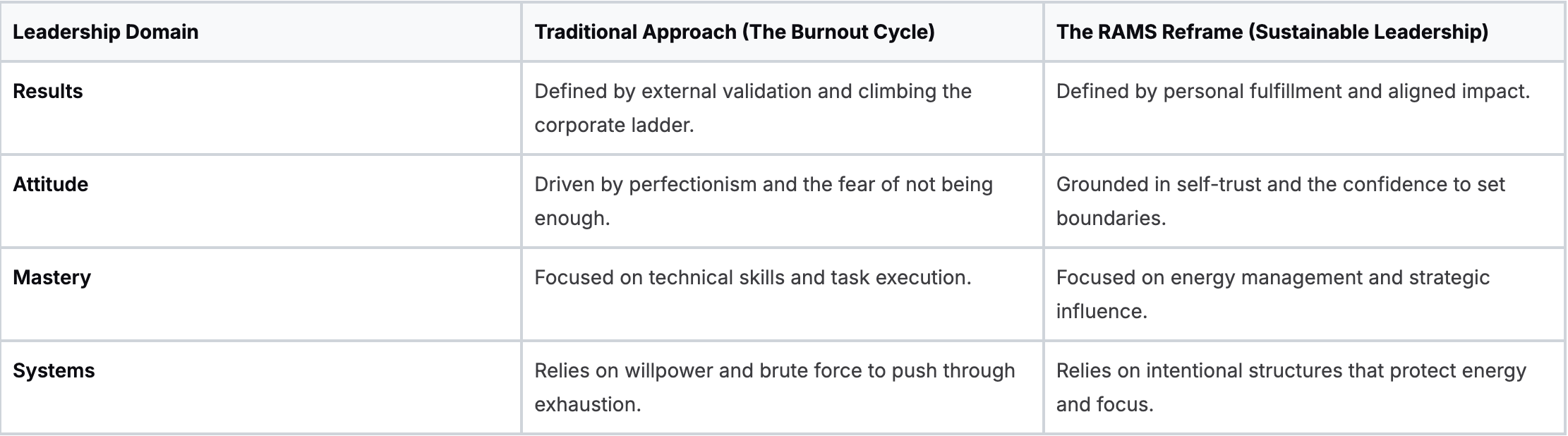
This isn't just a different way to lead; it's a completely different way to live. It's about building a career and a life that don't just look good on the outside but feel good on the inside.
The Return: Your Path to Sovereign Leadership
What you’ve just created is far more than a diagram. It’s a mirror.
For the first time, you are looking at a true reflection of the leader who has been buried under a lifetime of expectations, achievements, and obligations. This entire process was never about tweaking performance metrics; it was a reclamation project for your very identity. The patterns, the energy drains, the invisible anchors that kept you stuck—they are no longer subconscious forces. They are now tangible data points you can command.
This is the very essence of sovereign leadership. It’s the decisive pivot from running on the treadmill of external validation to leading from a core of unshakeable internal authority. It’s about finally building a life that doesn't just look good on paper but feels right in your nervous system.
This mind map is your first definitive act in reclaiming authority over your own life. You are seizing the controls, shifting from a state of constant reaction to one of intentional, powerful creation.
This work is non-negotiable. While some people believe gender equality efforts are sufficient, data from the World Economic Forum shows the global gender gap will still take 131 years to close. Waiting is not a strategy. Sovereign leadership is about creating the future you demand, not waiting for permission to receive it.
Returning to Yourself
This journey doesn't end with a completed map. Your mind map is the diagnosis; the RAMS Method is the strategic treatment plan. The real work begins now, integrating these raw insights to build a sustainable leadership legacy—one forged in strength, authenticity, and resilience. This is the heart of embodied sovereignty.
This is your return. It’s the moment you stop asking for permission to lead as you are and begin operating from a place of absolute self-governance.
The next logical step is to translate these profound insights into action. Ready to turn insight into undeniable impact? Book your discovery call and start the real work.
Your Questions, Answered
When you start digging deep, questions are inevitable. Good. It means you're doing the work. Let's tackle the common hurdles that come up when you start mapping your own inner landscape.
What If My Map Is Overwhelmingly Negative?
It's not uncommon for your first draft to look like a battlefield of challenges, anxieties, and obstacles. Do not panic. This is not a "feel-good" exercise; it’s a diagnostic. You are shining a light on the "invisible anchors" that have held you back. The entire point isn’t to wallow, but to see the patterns with brutal clarity. This is precisely the data the RAMS method is designed for—to take these points of pain and forge them into sources of power.
How Much Detail Is Too Much?
Aim for clarity, not chaos. A mind map that looks like a tangled mess is just another form of overwhelm. It defeats the purpose. Start with your core node and the main branches. From there, add only two or three layers of detail. If a single branch—like "Career Growth"—starts to feel crowded, that's your cue. Break it off and create a new, dedicated mind map just for that area. The goal is to simplify your internal world into an actionable visual tool, not create more noise.
How Often Should I Revisit This?
Your personal mind map isn't a one-and-done artifact. It’s a living document. It’s your strategic compass, and it needs recalibration. A quarterly review is a great starting point. You should also pull it out anytime you’re facing a significant professional crossroads or a major personal decision. This regular check-in ensures your map remains a relevant, powerful guide, keeping you aligned with what truly matters as you navigate the complexities of leadership.