Leadership Succession Planning: The Leader's Guide to Building a Legacy
You built this. Late nights, impossible decisions, relentless drive—it all led to this. You are indispensable. Your team depends on you. The board trusts you completely. But the quiet, crushing weight of being irreplaceable is a trap. It's a badge of honor that feels more like a cage, a silent collapse happening just beneath the surface of success.
The internal monologue is constant: "If I step back, it will all fall apart." This isn’t ego. It's a genuine fear born from a deep sense of responsibility. Yet, this indispensability creates a massive organizational risk. When one person holds all the keys, the entire structure is fragile.
Key Takeaways
The Irreplaceable Leader Paradox: Understand why being the indispensable leader is the single greatest risk to your organization's future and your own nervous system.
The RAMS™ Method: Discover a proven framework (Results, Attitude, Mastery, Systems) to build a robust leadership pipeline that moves beyond finding a "replacement" and cultivates true resilience.
From Operator to Architect: Learn the critical internal shift required to move from the person who does everything to the visionary who designs a self-sustaining system.
Nervous System Sovereignty: The ultimate goal of succession planning isn't just business continuity; it's reclaiming your own freedom and securing a legacy that thrives without your constant presence.
Leadership succession planning is the strategic art of identifying and nurturing the next wave of leaders from within. It is a proactive strategy to guarantee business continuity, plug leadership gaps before they appear, and forge a resilient organization that is ready for a planned retirement or an unexpected departure. It is the ultimate act of securing your legacy.
The Hidden Pattern - The Neuroscience of Being Irreplaceable
The feeling of being indispensable is not a character flaw; it’s a neurological pattern. For high-achievers, the brain becomes wired for control. Your nervous system has learned that vigilance, hyper-competence, and being the final backstop are the keys to safety and success. Every problem you solve alone reinforces this loop, delivering a hit of dopamine that says, "See? They need you. You are essential."
This creates a powerful metaphor: The Sovereign's Cage. You've built a kingdom where you are the sole ruler, revered and powerful. But the walls of this kingdom are your own making. Every process that lives only in your head, every decision that requires your final sign-off, is another bar on the cage. You are sovereign, yes, but you are also trapped.

This pattern inadvertently stifles the very people you want to empower. It creates a system of dependency that feels safe but is dangerously brittle. The first step in succession planning is not an org chart; it is recognizing this internal pattern. It's facing the hidden cost of success for high-achieving women and making the conscious choice to dismantle the cage.
Are You Really Ready to Be Succeeded?
Before building the future, get brutally honest about the present. Real succession readiness isn't about a shortlist of names. It’s about taking an unflinching look at the operational and emotional DNA you’ve embedded in your organization.
An honest self-assessment is the bedrock. It forces you to stop asking, "Who can replace me?" and start asking, "What needs to change for someone else to truly succeed here?" Use these questions as a mirror:
Decision-Making: In a typical week, how many decisions absolutely must get your final approval? Are your direct reports truly empowered to make significant calls?
Information Flow: Are you the central hub for all critical information? Or have you built systems where knowledge is shared openly and is easy for others to access?
Talent Development: Is your feedback focused on fixing today's mistakes, or are you actively coaching rising stars on strategic thinking for tomorrow's challenges?
This initial diagnosis can be confronting. It often shines a light on the gap between your intention to empower and the reality of your team’s autonomy. You can dive deeper into this in our guide on how to be more self-aware.
Evaluating Your Organization's Current State
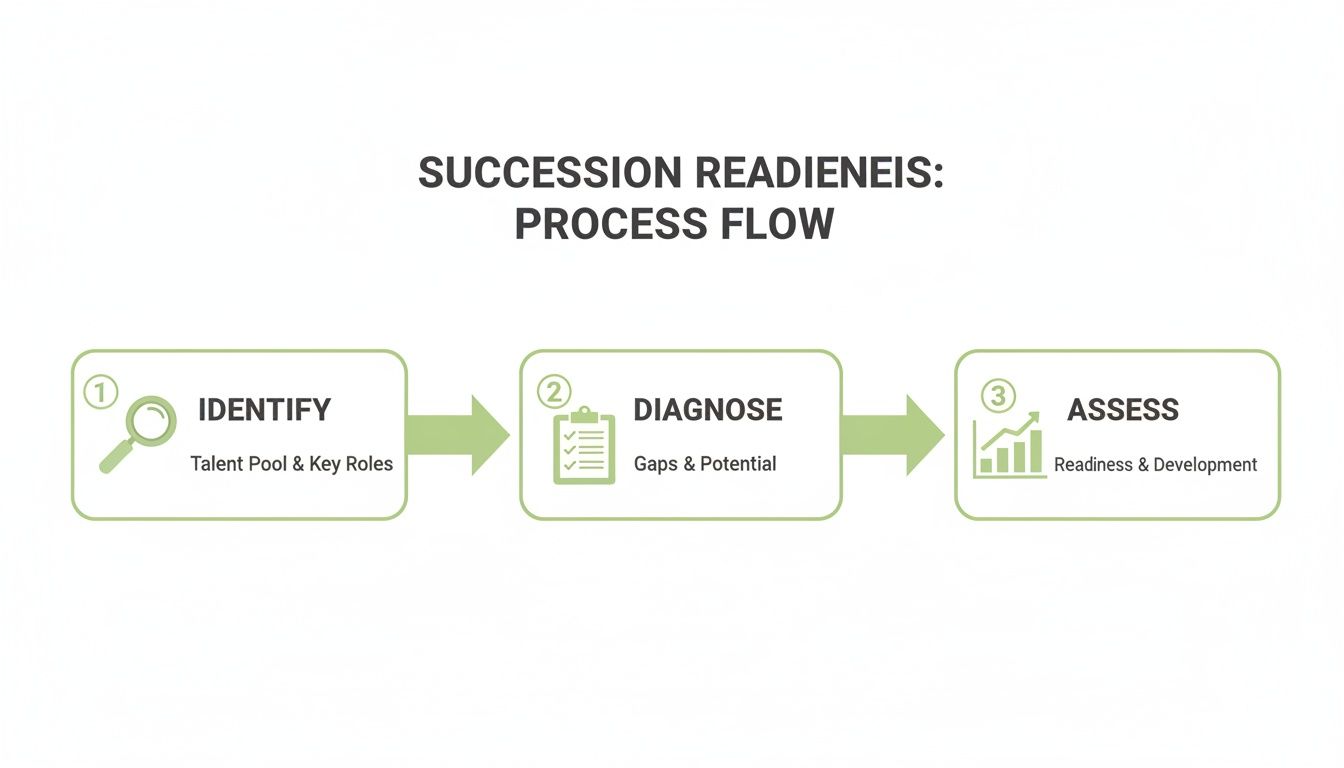
Once you've looked in the mirror, look out at the organization. A proper assessment means going beyond performance reviews to identify the actual competencies needed for the future. The data shows most companies are unprepared. Only 26% of CEOs and board members say succession planning is treated as a top priority. This is alarming when 43% of executives report over half their leadership team turned over in the past year.
To get an unbiased view, many organizations bring in outside help, like C-suite advisory services, for a comprehensive audit. You can start by mapping the critical roles, not just the people. Which positions are essential to your strategic goals over the next five years?
Once you have the roles, define the competencies needed to excel in them—not today, but in the future. The biggest mistake is looking for a clone. Instead, ask:
What new skills will this role demand in two years? Five years?
What leadership style will best serve the team of the future?
Who in the organization shows early signs of talent in these areas?
This objective assessment helps you spot high-potential people hiding in plain sight, setting the stage for a plan built on data and foresight, not familiarity.
The RAMS™ Reframe - Building Your Leadership Pipeline
Once you’ve uncovered the patterns making you indispensable, the real work begins. It’s time to stop diagnosing and start building. A solid leadership pipeline isn’t about finding a single carbon copy; it’s about creating an ecosystem of talent that keeps the organization resilient. This is where we apply the RAMS™ Method—a framework engineered for high-performers to create leadership pipelines that last.
Results: Defining The What
The first pillar is Results. This is about ruthless objectivity. We move beyond gut feelings about who “seems like a leader” and pin down the clear, measurable outcomes the role demands.
It starts with one question: What does winning actually look like in this role, and how would we prove it?
Define Future-Focused KPIs: Don't just recycle the current performance plan. What metrics will define success three years from now? This might be innovation rates or talent retention in specialized departments.
Establish Non-Negotiable Outcomes: What are the 3-5 things that absolutely must get done for the business to win? These become the foundation of every development plan.
Create an Objective Scorecard: Build a simple scorecard to rate potential successors against these outcomes. This is your defense against unconscious bias.
Attitude: Cultivating The How
Next is Attitude. Technical skills get leaders in the door, but their mindset—their how—determines if they can navigate a crisis or inspire a team. This is where we intentionally build resilience, adaptability, and a growth mindset.
You don't hope for the right attitude; you forge it.
An organization's ability to thrive through change is a direct reflection of the resilience of its leaders. A pipeline full of technically skilled but brittle leaders is a pipeline destined to fail.
Here's how to start building that resilience:
Assign Stretch Projects: Give high-potentials assignments deliberately outside their comfort zone. The goal is to build their "adversity muscle" in a safe space.
Coach Through Setbacks: When a project hits a wall, treat it as a coaching moment. The conversation isn't about blame, but about what was learned.
Model Vulnerability: Share your own war stories—the projects that went sideways and what you learned. This shows that real leadership is about growth, not infallibility.
Mastery: Closing The Gaps
Mastery is the targeted development phase. With a clear picture of the Results needed and the Attitude required, you can build personalized development plans to close specific skill gaps.
This is worlds away from generic training programs. For rising leaders, it's crucial to focus on practical skills like building executive presence and strategic communication. A true Mastery plan mixes:
Formal Learning: Pinpoint specific courses or certifications to fill knowledge gaps.
Experiential Learning: Use rotational assignments in different parts of the business to build perspective.
Mentorship and Coaching: Pair them with a seasoned senior leader for unfiltered guidance and a confidential sounding board.
Systems: Creating The Flywheel
Finally, Systems ties it all together. This is where you build repeatable processes for identifying talent and mentoring rising stars. It’s what turns your succession plan from a one-off project into a self-sustaining flywheel of talent development.
The old ways were broken—reactive, secretive, and biased. We can do better.
Comparing Traditional Succession Tactics To The RAMS™ Method

The difference is stark. Moving to a systems-based approach de-risks your organization's future. Key systems to implement include:
Quarterly Talent Reviews: Make it a non-negotiable rhythm to discuss high-potential talent and check progress.
Formal Sponsorship Programs: Go beyond mentorship. Task senior leaders with actively advocating for their protégés.
A Centralized Talent Profile: Use a simple system to track skills, goals, and readiness scores across the organization.
You can learn more about how the complete framework operates by exploring the RAMS Method in detail. By putting it into practice, you stop worrying about who will replace you and start building a legacy.
The Return - Navigating the Transition to Sovereignty
The strategic work comes down to this: the handover. This is where careful planning meets human dynamics. A misstep here can unravel everything. Get it right, and your successor is empowered to lead from day one, ensuring the stability you've built.

Architecting a Structured Handover Period
A vague transition timeline breeds anxiety. Counter this with a clear, phased 90-day structure:
Phase 1: Shadowing (First 30 Days): Your successor is a sponge. They attend key meetings to absorb the unwritten rules, but without direct authority.
Phase 2: Shared Responsibility (Next 30 Days): You co-pilot critical projects together. This is for real-time coaching and a warm handover of key stakeholder relationships.
Phase 3: Full Empowerment (Final 30 Days): Your successor takes the lead. You slide into a purely advisory role—available, but no longer in the driver's seat.
This prevents the outgoing leader from lingering and gives the successor space to establish their authority. It's a scaled-up application of the principles in our guide on how to delegate effectively.
Mastering Crucial Communication
Uncertainty is a morale killer. A transparent communication strategy is your best tool.
The Internal Team: Be direct. Explain the timeline and the strategic thinking. Frame it as the company's evolution.
Key Clients and Partners: The outgoing leader must make personal introductions to transfer trust and goodwill.
The Broader Market: Get the board on the same page. A unified message to investors reinforces stability.
Leadership changes are happening faster than ever. S&P 500 CEO succession announcements are projected to hit an annual rate of 13%, up from the usual 10%. More telling, external CEO hires have climbed from 18% to 33% year over year, showing a massive shift in how organizations navigate these changes. You can get more insights from The Conference Board.
Measuring Success: The Return to Yourself
The handover isn't the finish line. A truly successful succession is validated by the sustained growth of the company long after you’ve stepped away. Success is measured in the silence—the absence of emergency calls only you can handle.
Your focus must pivot from control to continuity. Track higher-level indicators:
Team Engagement & Retention: Are your A-players still with the company six or twelve months post-transition? High retention proves the new leader has earned their trust.
Rate of Innovation: Is the team still pushing boundaries? A steady pace shows the new leadership fosters psychological safety for risk-taking.
Client & Stakeholder Confidence: Watch client retention. Stability here signals a seamless transfer of crucial external relationships.
This phase demands a profound personal shift. Your identity must evolve from operator to mentor. This is the pathway to nervous-system sovereignty—a state where your worth is no longer chained to your operational control. It’s the deep knowing that you have built something strong enough to stand on its own. It is the freedom that comes from defining your leadership legacy not by your presence, but by its endurance.
This is the real return on your investment. It’s not just a secure future for the organization—it’s a sovereign future for yourself.
Common Questions About Leadership Succession Planning
Even the most thoughtful framework invites questions. Let's tackle some of the most common ones that arise when leaders get serious about building a legacy that lasts.
How Early Should We Start Planning for Succession?
The short answer? Yesterday. The best time was when your current leader took the role. The second-best time is now. Effective succession planning is a continuous process woven into your company's fabric. Part of any leader's job is to be growing the talent around them from day one.
Waiting until a leader announces their departure is like trying to build an ark after the flood has already started. True readiness is cultivated over years, not weeks.
When talent development is an ongoing system, it stops being a high-pressure "event" and becomes just part of how you do business well.
What Is the Biggest Mistake in Succession Planning?
The most common trap is trying to find a clone of the current leader. It’s a profound failure of foresight. Your organization is preparing for the future, not the past. The right question isn't, "Who can do what Jane did?" but rather, "What skills, perspectives, and temperament will our company need to win in the market of tomorrow, and who has the potential to grow into that leader?" A successful plan prepares for the future; it doesn't replicate the past.
How Can We Ensure Our Plan Is Diverse and Inclusive?
A diverse leadership pipeline will not happen by accident. It requires deliberate, systematic effort.
Go Beyond Mentorship to Sponsorship: Mentors give advice. Sponsors give opportunities. Implement formal sponsorship programs where senior leaders are explicitly tasked with advocating for high-potential women and individuals from underrepresented groups.
De-Bias Your Talent Reviews: Use objective scorecards based on future-focused competencies. Scrutinize the language in performance reviews to root out coded biases ("she's aggressive" vs. "he's assertive").
Broaden Your Definition of 'Potential': Your next great leader might not look or act like your last one. Challenge traditional markers of leadership and look for quiet influencers and brilliant collaborators.
What Is the Board's Role Versus the CEO's Role?
The roles are distinct but must be deeply interconnected.
The Board's Role is Governance: The board is the steward of the company's long-term health. They own the process of identifying, selecting, and supporting the next CEO.
The CEO's Role is Development: The CEO is the chief talent officer. Their responsibility is to build a robust leadership pipeline throughout the entire organization, ensuring the board has a wealth of strong internal candidates to consider for the top job.
At Baz Porter, we help accomplished women move from being indispensable operators to sovereign architects of their legacy. If you're ready to build a succession plan that secures your company's future while freeing you to embrace your own, it may be time for a different kind of conversation. Explore how we can help.
Where to go next
If any of this reads like your own reflection, the Silent Collapse Diagnostic™ is a quiet place to start. It is a private space to see what is really running underneath the work. And if you want the deeper why beneath it all, read the Sovereign Manifesto.