Unlock Sovereign Impact: Leadership Legacy Quotes
Legacy Is a Verdict, Not a Wishlist. The accolades line your office wall. The title is on your door. You have built an undeniable record of success. Yet there is a quiet, persistent dread. A sense that the structure you built survives only through your constant depletion.
That is Silent Collapse™.
You search for leadership legacy quotes because something in you knows output is no longer enough. But most quote lists fail you. They hand you inspiration when you need diagnosis. They give sentiment when you need structure. I use these quotes differently. I use them to expose where authority has become performance, where service has become self-erasure, and where legacy has become ego management.
Legacy is not what you hope people say later. It is what your current operating system is already producing in others.
If your influence depends on exhaustion, your legacy is fragile. If your team grows only when you intervene, your legacy is stalled. If you want practical context beyond quotes, review these strategies for growing influence.
Table of Contents
2. The greatest leader is not necessarily the one who does the greatest things
3. Leadership is not about being in charge Its about taking care of those in your charge
4. Legacy is not leaving something for people Its leaving something in people
5. Your legacy is determined not by what you get but by what you give
6. The most important legacy you leave is the difference you make in peoples lives
7. A leader should inspire people to have confidence in their leader
8. The true measure of a leader is not the number of people who serve you
9. A leaders legacy is not what they achieved but what they inspired others to achieve
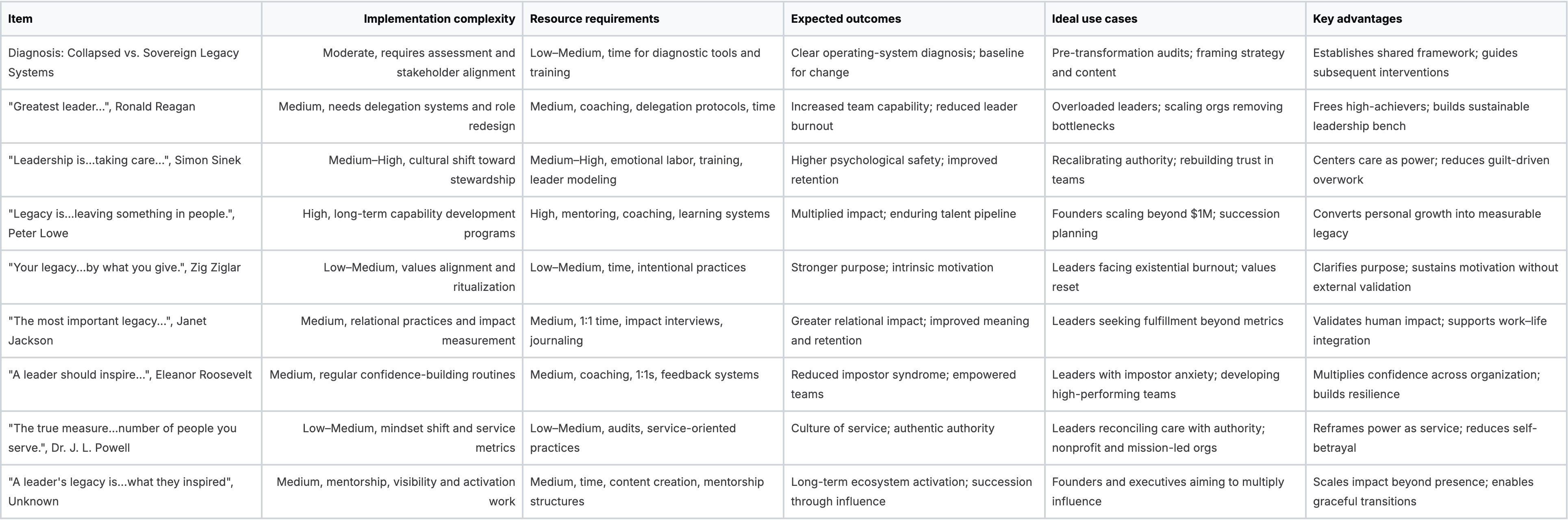
Collapsed vs. Sovereign Legacy: 9-Quote Leadership Comparison
Key takeaways
Leadership legacy quotes work best as diagnostic tools, not mood boosters.
Silent Collapse™ turns legacy into overwork, control, and identity erosion.
The RAMS Framework™ reveals whether your legacy is built on output or on transfer.
Sovereign Leadership™ creates capable people, regulated systems, and durable authority.
The definitive answer on leadership legacy quotes
Leadership legacy quotes matter when they expose how you lead, not when they briefly motivate you. The right leadership legacy quotes reveal whether you're building dependency around yourself or capacity inside other people.
A real legacy is visible now. It appears in how your team thinks, decides, steadies itself, and grows when you are not present.
The hidden pattern behind quote-seeking
You open a notes app at 11:40 p.m. You search for a leadership quote that sounds steady, generous, and wise. You are not searching for language. You are searching for relief.
That pattern matters.
Leaders in Silent Collapse™ collect quotes when their inner system is fraying. The signs are plain. Over-responsibility. Emotional numbness. Irritability. Private contempt. You keep performing competence while your judgment gets tighter, harsher, and more defensive.
Under strain, the mind defaults to control. It repeats old moves because familiar pressure feels safer than honest re-evaluation. That is why quote-seeking can become diagnostic. The quote is rarely the solution. Your reaction to it is the signal.
Quotes don't fix collapse. They reveal it.
Use them that way. A legacy quote should expose whether you are building Sovereign Leadership™ or feeding dependency. If a quote gives you a brief emotional lift but changes nothing in how authority, trust, and decision-making move through your team, you are consuming reassurance, not building legacy.
This is also why the pattern overlaps with transformational leadership in practice. Real transformation changes the internal condition of the leader and the behavioral standard of the team. It does not stop at inspiration.
I use legacy quotes as a RAMS™ screen. Results. Attitude. Mastery. Systems.
A strong quote should trigger hard questions. Are your results driven by fear of losing relevance? Is your attitude regulated or reactive? Do you develop mastery in others or protect your status by staying indispensable? Do your systems reduce pressure, or route every meaningful decision back through your nervous system?
Quote-seeking becomes a problem when it replaces diagnosis. It becomes useful when it exposes the exact form of your collapse.
1. Diagnosis collapsed vs sovereign legacy systems

Monday, 8:12 a.m. The team is waiting. Slack is full. Three decisions are blocked because nobody wants to move without you. You call that leadership. It is collapse.
A legacy system has two forms. Collapsed systems centralize authority, emotional stability, and judgment inside one overloaded leader. Sovereign systems distribute all three through clear standards, trained judgment, and repeatable decision paths.
This distinction matters because leadership legacy quotes are not motivational wallpaper. They are diagnostic tools. Your reaction to them shows whether you are building a system that can outlast your mood, your presence, and your control. That is the ultimate test of legacy and leadership in practice.
Collapsed leaders usually present well. They are responsive, involved, informed, and admired for carrying too much. Internally, the pattern is harsher. They do not trust delay. They do not trust silence. They do not trust other people's judgment unless it mirrors their own. The team learns this fast and adjusts around it.
Sovereign leaders create a different condition. Authority stays clear under pressure. Decisions keep moving without ritual escalation. People grow stronger because the system requires maturity instead of dependence.
Use RAMS Framework™ to name the condition
Start with a cold read of the system.
Results: You pursue outcomes to regulate identity and prove value.
Attitude: Your baseline is vigilance. Rest feels unsafe. Delegation feels risky.
Mastery: You keep the hard judgment calls because competence has become part of your self-protection.
Systems: Work flows back to you at the exact point where trust should have been designed.
Now compare that with a sovereign pattern.
Results: Performance follows mission and standards.
Attitude: Pressure does not decide your tone.
Mastery: You build judgment in other people and let them use it.
Systems: The team can act, decide, and recover without waiting for your nervous system to settle.
Long-running research on adult development has repeatedly shown that the quality of a person's close relationships strongly shapes long-term wellbeing. That matters here because legacy is relational before it is reputational. If your leadership leaves people more cautious, more dependent, and less able to think clearly without you, the legacy is already degraded.
Use quotes accordingly. Do not ask whether a quote feels inspiring. Ask whether it exposes control, dependency, resentment, overfunctioning, or underbuilt systems. That is how you use language to diagnose Silent Collapse™ and move toward Sovereign Leadership™.
If you want to identify your current pattern, Take the Silent Collapse Diagnostic.
2. The greatest leader is not necessarily the one who does the greatest things

“The greatest leader is not necessarily the one who does the greatest things. He is the one that gets the people to do the greatest things.” This quote cuts straight into the hero pattern.
If your team performs best only when you enter the room, your legacy is weak. You are producing output. You are not producing leaders. That is the distinction.
I've seen founders build respected companies and still create internal dependency everywhere. Every decision routes back to them. Every problem waits for their mood, their judgment, their bandwidth. They call it high standards. It is often unprocessed control.
Use the quote against your calendar
Run a calendar audit for the last two weeks. Mark every meeting, decision, or task that only you were “qualified” to handle. Then ask a brutal question. Is that true, or have you trained the system to depend on you?
Operational rule: If the team needs your presence for normal function, the system is underbuilt.
Use these actions:
Strip out rescue work: Identify recurring tasks you keep reclaiming.
Transfer decision rights: Give one team member final say on a live process.
Name the standard: Write what good looks like, then stop hovering.
Review development: Ask who is more capable this month because of your leadership.
For a deeper systems lens on authority and delegation, study scaling impact by creating systems that empower teams and free your time. If you want a broader definition of leadership inside organizations, this overview of what is organizational leadership is useful context.
3. Leadership is not about being in charge Its about taking care of those in your charge

A leader walks into a 1:1 already irritated. The team member notices in seconds, edits what they say, and leaves with less clarity than they had before. That is not pressure management. That is Silent Collapse™ running the room.
“Leadership is not about being in charge. It's about taking care of those in your charge.” Read this quote as a diagnostic tool. It exposes whether your leadership creates stability, growth, and trust, or fear, dependence, and emotional guesswork.
Collapsed leaders confuse care with two behaviors. They either protect people from every discomfort or use authority to extract output without regard for cost. Both come from the same internal problem. The leader is dysregulated, image-protective, and unwilling to face the effect they have on other people.
The RAMS™ test is simple here. Can your team rely on your presence without bracing for your volatility? If not, your legacy system is already compromised.
Care shows up in the nervous system of the team
People under sound leadership do not spend energy reading the room. They bring risk earlier. They recover from mistakes faster. They know correction will be clear, not personal. That is what care looks like in practice.
Relationship quality matters because people do their best thinking in conditions of steadiness and respect. The long-running Harvard Study of Adult Development reached a blunt conclusion. Close relationships shape wellbeing more than status or achievement. In leadership, the translation is obvious. Relational quality is structural, not soft.
Use this quote with discipline:
Run developmental 1:1s every month: Discuss decision quality, conflict handling, and growth edges.
Ask pressure questions: What is creating drag right now? What are you avoiding telling me?
Stop rescuing: Help people think through the problem, then keep ownership with them.
Make standards explicit: Care without standards creates confusion. Standards without care create fear.
Audit your emotional leakage: If your stress becomes the team's weather, address that first.
Read what is servant leadership style if you need a cleaner distinction between service and self-erasure.
People can tell whether your care builds capacity or secures control.
4. Legacy is not leaving something for people Its leaving something in people

A leader in Silent Collapse™ hoards judgment. They stay needed by keeping the underlying logic in their own head. The team gets answers, not understanding. That is not legacy. It is control dressed up as excellence.
“Legacy is not leaving something for people. It's leaving something in people.” Read it as a diagnostic tool. Ask a hard question. Are people around you becoming more capable, or more dependent on your presence?
The RAMS™ lens matters. A collapsed leader may produce results while failing the transfer test. They assign work, review work, and fix work, but they do not build range, agency, maturity, or self-trust in others. A Sovereign leader installs thinking patterns that remain after they leave the room.
The difference shows up in daily behavior. You can hear it in the way a team member explains a decision. You can see it in whether standards hold when the leader is absent. If your people freeze without you, your legacy system is weak.
Use the quote with discipline:
Explain your reasoning in real time: Show how you weigh tradeoffs, risk, timing, and standards.
Teach principles, not just preferences: Separate what is required from what is merely your style.
Turn mistakes into pattern recognition: Name the lesson so the person can apply it again without you.
Measure capability transfer: Ask what each person now does independently that once required your intervention.
Stop rewarding escalation as loyalty: Constant dependence is not commitment. It is underdevelopment.
Teaching often feels inefficient to leaders whose identity is fused with output. That is part of the collapse. You prove worth by doing, rescuing, and staying central. Legacy requires the opposite move. You slow down long enough to build someone else's internal architecture.
That is how something gets left in people.
If you need a stronger frame for growth through development, review what is transformational leadership.
5. Your legacy is determined not by what you get but by what you give
“Your legacy is determined not by what you get, but by what you give.” This quote exposes motive. It asks whether leadership is still a form of acquisition for you.
Many successful leaders keep collecting. More influence. More recognition. More control. More proof. They don't notice that the appetite itself has become the problem. The external record grows while the internal state empties.
Giving interrupts that loop. Not performative giving. Not image management. Real contribution. Time. Access. Mentorship. Protection. Clarity. Opportunity.
Giving exposes motive
Ask what your leadership currently distributes. Pressure or stability. Fear or courage. Confusion or clarity. Dependence or confidence.
Martin Luther King Jr. framed leadership through service when he asked, “Life's most persistent and urgent question is, ‘What are you doing for others?’” That principle appears in discussion of his August 28, 1963 speech to 250,000 people at the Lincoln Memorial in this article on his leadership legacy. That question still cuts cleanly through ego.
Use the quote with precision:
Define what you give best: Perspective, access, standards, naming truth.
Schedule contribution deliberately: Mentoring doesn't happen by accident.
Audit self-promotion: Notice where visibility has replaced service.
Build giving into operations: Teach, sponsor, and open doors as part of the role.
For a direct reflection on contribution and authority, read legacy and leadership.
6. The most important legacy you leave is the difference you make in peoples lives
A leader can post record numbers and still leave damage behind.
That is the problem this quote exposes. “The most important legacy you leave is the difference you make in people's lives.” It forces a harder audit than performance dashboards do. Silent Collapse™ often hides inside visible success. The leader looks effective. The team grows more cautious, less honest, and more dependent.
The quote works as a diagnostic tool. Ask a direct question. What changes in people after prolonged contact with your leadership? More steadiness or more anxiety. Better judgment or constant approval-seeking. Cleaner ownership or learned helplessness.
That is legacy.
The issue is not whether people liked working for you. The issue is whether your presence strengthened their capacity. Sovereign Leadership™ leaves people clearer, calmer, and more internally organized. Collapsed leadership leaves residue. Confusion. Hypervigilance. Self-doubt. Polished metrics do not cancel that out.
Measure human residue
If you want a serious review, stop treating relational impact as a vague moral extra. Put it inside your operating system. The RAMS™ Framework makes that practical. Review your Results pillar through human outcomes, not only commercial ones. Review your Attitude pillar by examining the emotional climate you create under pressure.
Use the quote with discipline:
Track human change: Write down where your leadership increased someone's judgment, courage, or range.
Ask one blunt question: “Who became stronger under my leadership this quarter?”
Audit the residue you leave: After hard meetings, do people leave with clarity or contraction?
Review patterns, not compliments: Look for repeated gains in confidence, ownership, and truth-telling.
If your team delivers and still shrinks around you, your legacy system is collapsed.
If people become more capable because you led them, your legacy is working.
7. A leader should inspire people to have confidence in their leader
“A leader should inspire people to have confidence in their leader; a great leader inspires people to have confidence in themselves.” Eleanor Roosevelt named the difference between charisma and legacy.
If people trust you but doubt themselves, your leadership remains centralized. That often feels good to the insecure leader. You become the source. You become the reassurance. You become the answer they seek before taking action.
That pattern also feeds Silent Collapse™. You can't carry authority for everyone forever. At some point your team's dependence becomes your prison.
Confidence transfer is legacy
Confidence transfer is teachable. It doesn't come from praise alone. It comes from delegated judgment, visible trust, and clean feedback.
Build confidence before you build compliance.
Use Roosevelt's quote this way:
Affirm competence specifically: Name what the person did well and why it worked.
Return questions: Ask what they would decide before giving your view.
Increase decision range: Let them own slightly more risk than feels comfortable.
Share your thinking process: Show how conclusions are made, not just announced.
The Attitude pillar of the RAMS Framework™ plays an important role. If your internal voice says, “If I'm not the smartest one here, I lose authority,” then you will undermine other people's confidence. Your team will feel that contraction, even if you never say it aloud.
8. The true measure of a leader is not the number of people who serve you
A collapsed leader collects service upward. A sovereign leader directs service outward. That is the diagnostic value of this quote.
“The true measure of a leader is not the number of people who serve you, but the number of people you serve.” Read it as a systems test. If your team exists to protect your ego, manage your moods, and keep your status intact, your legacy is already degrading. Silent Collapse™ often hides inside praise, access, and constant accommodation.
Service, in this context, means stewardship. It means using authority to make work clearer, safer, and more effective for other people. It does not mean permanent availability. It does not mean emotional overexposure. It does not mean becoming the human shock absorber for every problem in the room.
Service is a structure, not a performance
Leaders in collapse usually misread service as self-erasure. They say yes too fast. They absorb too much. They confuse exhaustion with virtue. Then resentment starts, standards slip, and care turns theatrical.
Sovereign Leadership™ works differently. It serves through design. Clear priorities. Clean roles. Consequences that hold. Support that is real, but contained. The point is not to look generous. The point is to build an environment where people can perform without unnecessary friction.
This quote fits the Responsibility and Stewardship pillars of the RAMS Framework™. Responsibility asks, “What am I accountable for?” Stewardship asks, “What am I building in people and systems that will outlast my presence?” If you cannot answer those two questions clearly, your service will turn into overfunctioning.
Use the quote as a diagnostic prompt:
Define your service mandate: Name the outcomes and people you are responsible to strengthen.
Audit upward service: Identify where your team is spending energy managing you instead of serving the mission.
Remove one recurring obstacle: Fix a bottleneck, decision delay, or ambiguity that keeps draining capacity.
Set access rules: Availability needs standards, response windows, and boundaries.
Track resentment: Resentment signals misused service, weak structure, or hidden self-betrayal.
The leader who serves through structure earns trust. The leader who serves through depletion breeds dependency, confusion, and private anger. That is not moral leadership. That is a slow internal failure.
9. A leaders legacy is not what they achieved but what they inspired others to achieve
“A leader's legacy is not what they achieved, but what they inspired others to achieve.” The attribution on this one varies, but the principle is sound.
This quote is the ripple-effect test. Your legacy is not confined to your direct work. It extends through the work other people attempt because your leadership expanded their sense of possibility.
That is why inspiration, used correctly, is not fluff. It is ignition. But it must be backed by structure, standards, and example or it turns into performance.
Map the ripple effect
Map your influence in rings. Start with direct reports. Then peers. Then clients. Then the people they influence because of what they learned under your leadership.
One current leadership trend points in this direction. A Q1 2026 Harvard Business Review analysis, described in this summary of emerging AI and legacy trends, says 37% of senior women leaders use AI tools for legacy amplification. I'm not citing that as established present-day fact beyond the summary provided. I'm naming the underlying idea. Legacy can be engineered through systems that extend influence beyond the founder's direct presence.
Practical moves matter more than abstraction.
Create a legacy map: Name who you are deliberately developing.
Document your teachable ideas: Turn private wisdom into repeatable language.
Watch second-order impact: Track who your people go on to influence.
Build systems for transmission: Meetings, reviews, writing, mentorship, standards.
Collapsed vs. Sovereign Legacy: 9-Quote Leadership Comparison
The return your legacy is your nervous system
These leadership legacy quotes are not affirmations. They are scalpels. Use them to dissect your motives, your defaults, and your operational weaknesses. If a quote irritates you, pay attention. It is often touching the exact pattern you've been defending.
The shift from collapsed leadership to Sovereign Leadership™ is not mainly strategic. It is biological. A dysregulated system reaches for control, speed, certainty, and over-functioning. A regulated system can think, delegate, teach, and serve without disappearing into everyone else's needs.
That is why so many accomplished leaders feel empty after getting what they wanted. The structure outside improved. The structure inside did not. Silent Collapse™ remains hidden until success removes the excuses. Then a critical question arrives. Why do I feel nothing when I have everything I worked for?
I treat quotes as diagnostic prompts inside the RAMS Framework™.
Results: What am I producing in people, not just on paper?
Attitude: What fear still drives my leadership behavior?
Mastery: What capability am I transferring this quarter?
Systems: What continues without me because I built it well?
The nervous system you lead from becomes the culture other people work inside.
An anonymized client once came to me with strong revenue, a respected title, and total emotional numbness. The team deferred to them on everything. They were praised constantly. They were also exhausted and privately angry. We didn't start with motivation. We started with diagnosis. We rebuilt authority through cleaner standards, delegated judgment, and nervous-system regulation. The visible result was not louder leadership. It was calmer leadership. The team became more decisive. The leader became less central. That is the point.
Legacy is a present-tense architecture. It is visible in how people function around you today. If your current system requires overwork to preserve authority, your legacy is already leaking. If your leadership leaves people clearer, stronger, and more self-trusting, your legacy is already alive.
Read more in the Sovereign Leadership Resource Hub.
FAQ
Why do leadership legacy quotes feel hollow to me
Because most are used as inspiration instead of diagnosis. If you're in Silent Collapse™, your system doesn't need more mood. It needs truth. A useful quote names the pattern you keep protecting.
How do I know if my legacy is built on control
Check what happens when you step back. If decisions stall, confidence drops, and people wait for rescue, you built dependence. Legacy built on control looks impressive and functions poorly.
Can leadership legacy quotes actually change behavior
Yes, if they are embedded in a real operating system. Reflection alone is weak. Reflection tied to the RAMS Framework™ becomes behavioral. The quote surfaces the issue. The framework changes the pattern.
What is the first sign of Silent Collapse™
Emotional flatness is common. So is compulsive over-responsibility. You keep producing, but meaning drains out. You become efficient and internally absent.
How should I use quotes with my team
Use one quote as a weekly diagnostic prompt. Ask what current behavior it exposes. Then assign one observable change. Keep it practical. Keep it behavioral.
Author
British military veteran. Two-time international bestselling author. Founder, The Prestige Architect™. Host, Rise From The Ashes podcast, C-Suite Network. Boulder, Colorado.
Schema
{
  "@context": "https://schema.org",
  "@graph": [
    {
      "@type": "Article",
      "headline": "Unlock Sovereign Impact: Leadership Legacy Quotes",
      "description": "Leadership legacy quotes as diagnostic tools for Silent Collapse™ and the shift to Sovereign Leadership™.",
      "author": {
        "@id": "https://bazporter.com#author"
      },
      "publisher": {
        "@type": "Organization",
        "name": "Baz Porter LLC™"
      },
      "mainEntityOfPage": "https://bazporter.com",
      "inLanguage": "en"
    },
    {
      "@type": "FAQPage",
      "mainEntity": [
        {
          "@type": "Question",
          "name": "Why do leadership legacy quotes feel hollow to me",
          "acceptedAnswer": {
            "@type": "Answer",
            "text": "Because most are used as inspiration instead of diagnosis. If you’re in Silent Collapse™, your system doesn’t need more mood. It needs truth. A useful quote names the pattern you keep protecting."
          }
        },
        {
          "@type": "Question",
          "name": "How do I know if my legacy is built on control",
          "acceptedAnswer": {
            "@type": "Answer",
            "text": "Check what happens when you step back. If decisions stall, confidence drops, and people wait for rescue, you built dependence. Legacy built on control looks impressive and functions poorly."
          }
        },
        {
          "@type": "Question",
          "name": "Can leadership legacy quotes actually change behavior",
          "acceptedAnswer": {
            "@type": "Answer",
            "text": "Yes, if they are embedded in a real operating system. Reflection alone is weak. Reflection tied to the RAMS Framework™ becomes behavioral. The quote surfaces the issue. The framework changes the pattern."
          }
        },
        {
          "@type": "Question",
          "name": "What is the first sign of Silent Collapse™",
          "acceptedAnswer": {
            "@type": "Answer",
            "text": "Emotional flatness is common. So is compulsive over-responsibility. You keep producing, but meaning drains out. You become efficient and internally absent."
          }
        },
        {
          "@type": "Question",
          "name": "How should I use quotes with my team",
          "acceptedAnswer": {
            "@type": "Answer",
            "text": "Use one quote as a weekly diagnostic prompt. Ask what current behavior it exposes. Then assign one observable change. Keep it practical. Keep it behavioral."
          }
        }
      ]
    },
    {
      "@type": "Person",
      "@id": "https://bazporter.com#author",
      "name": "Baz Porter",
      "jobTitle": "Leadership Architect, Founder of The Prestige Architect™",
      "alumniOf": {
        "@type": "Organization",
        "name": "British Military"
      },
      "knowsAbout": [
        "Silent Collapse",
        "Sovereign Leadership",
        "Executive Burnout",
        "RAMS Framework",
        "Nervous System Recovery"
      ],
      "sameAs": [
        "https://www.linkedin.com/in/bazporter",
        "https://bazporter.com",
        "https://substack.com/@bazporter",
        "https://www.risefromtheashespodcast.com"
      ],
      "url": "https://bazporter.com"
    }
  ]
}
If this exposed more than it comforted, good. That means you're close to the core issue. Baz Porter works with high-achieving executives and founders who have built visible success while privately slipping into Silent Collapse™. When you're ready to stop performing authority and rebuild it through Sovereign Leadership™, Apply to Work With Baz.