Leadership Coaching Rates: The Real Cost of Your Collapse
Leadership coaching rates at the top end are not casual spend. For C-suite work, rates typically range from $200 to $3,000 per hour, with a median of $717 per hour in 2026, while six-month programs cost $5,000 to $15,000 and intensive CEO-level packages can exceed $30,000. If you're already paying through exhaustion, distorted decision-making, and private breakdown, that invoice is intervention, not indulgence.
You open the spreadsheet. The numbers are clean.
Revenue is real. Compensation is strong. The title still carries weight. From the outside, your life looks like proof that the system worked.
Inside, nothing lands.
You tell yourself you're tired. I don't buy that. Tiredness resolves. A weekend helps. Sleep touches it. What I see in women at this level is different. They hit targets and feel absent while doing it. They keep functioning, but the self inside the function has gone dim.
That is Silent Collapse™.
It has a distinct symptom profile. You keep producing while your internal life goes offline. You become excellent at performing capacity you no longer possess. You stop asking whether this is sustainable and start asking how long you can hide it.
The most dangerous part is this. You can still look powerful while the structure is failing.
Table of Contents
The Silent Cost of Your Success
I know the woman staring at the screen. She isn't confused about money. She's confused by the emptiness sitting beside it.

She built the thing. She carries the team. She signs the approval. She absorbs the pressure before it reaches anyone else. Then she goes home and feels nothing that resembles relief.
That isn't ingratitude. It isn't weakness. It isn't a motivation problem.
It's a fracture between visible success and internal capacity.
You may hear your own thoughts in this. If I slow down, everything falls apart. Or this one. I have everything I wanted. Why do I feel nothing? That is not drama. That is diagnostic material.
The symptom most women miss
The first symptom is often emotional flatness.
Not collapse on the floor. Not a public breakdown. Flatness. Food tastes dull. Wins don't register. Rest feels foreign. You keep moving because motion is the only state that doesn't force contact with what's underneath.
Success can mask dysfunction for a long time. It cannot repair it.
I was formed in the British military. I learned early that performance under pressure can hide damage for longer than often realized. In leadership, that delay is costly. You can command a room and still be structurally compromised.
Why this matters before we talk rates
If you misname the condition, you'll buy the wrong solution.
A woman in Silent Collapse™ often thinks she needs better time management, a short holiday, or more discipline. She does not. She needs to stop treating systemic breakdown like a scheduling issue.
Leadership coaching rates only make sense once you admit what you're paying now. You're paying in numbness. You're paying in reaction speed replacing clear thought. You're paying in a life that looks intact and feels vacant.
The Price of Intervention A Breakdown of Leadership Coaching Rates
Leadership coaching rates are wide because the work is wide. For C-suite leaders, rates typically range from $200 to $3,000 per hour, with a median of $717 per hour in 2026. Six-month programs cost $5,000 to $15,000, and intensive CEO-level packages can exceed $30,000, according to Arden Coaching's breakdown of executive coaching costs.
High-end coaching is not cheap because the problem isn't simple. The closer the work gets to identity, authority, and decision pressure, the less useful bargain pricing becomes.
Leadership coaching rates should be read as intervention pricing. You're not buying information. You're paying to correct a pattern that keeps draining value.
Premium engagements fit leaders carrying premium consequences. If your decisions shape people, profit, and pace, the support around those decisions cannot be casual.
The wrong question is "What does coaching cost?" The right one is "What is this collapse already costing me?"
What the market actually charges
The market does not price all coaching the same because not all coaching does the same job.
If you want general development, broad support, or manager-level progression, the structure may look very different. For leaders evaluating more operational support at an earlier stage, this guide on executive coaching for managers is a useful contrast. It helps clarify why rates rise as the stakes, complexity, and confidentiality rise.
At the top end, you're paying for four things:
Depth of diagnosis. Surface advice won't touch a leader whose identity is fused with output.
Quality of containment. Senior women need a room where performance can stop for a minute without penalty.
Strategic precision. The work must affect judgment, delegation, authority, and energy allocation.
Proximity to consequence. A poor decision at your level ripples further.
What these rates really mean
Most women read an invoice emotionally. I read it diagnostically.
A lower rate can be appropriate for lighter work. A higher rate often reflects intensity, access, specialization, and the level of reconstruction required. If the structure is failing, the intervention must match the severity of failure.
I've seen women spend more avoiding the core issue than they would've spent addressing it. They buy efficiency systems, short-term relief, and fragmented support. None of it touches the engine.
If you're also sorting through local options, my view on leadership coaches near me will help you separate proximity from actual fit.
Why Your P&L Is a Poor Measure of Your Collapse
A healthy profit line does not prove a healthy leader.

I use one metaphor here because it fits. Your leadership can look like a glass tower with polished exterior walls while the foundation is taking water. The city still sees a skyline. The engineer sees a structural threat.
That is Silent Collapse™.
Your numbers can stay strong while you deteriorate
Companies already understand coaching as a strategic asset. The individual leader often doesn't. The 2025 ICF Global Coaching Study reported that the global coaching industry generated $5.34 billion in 2025 revenue, up 17% from 2023, and that over 50% of clients are now employer-sponsored.
Coaching has moved into leadership and talent strategy. The market is treating it like infrastructure, not a perk.
That matters because your P&L rewards output. It does not measure the internal mechanism producing that output. Revenue can rise while judgment degrades. Promotions can continue while your emotional range narrows. You can be praised for stamina when what you're really displaying is overadaptation.
I wrote more directly about this in Revenue Is Lying, because many women still use external proof to deny internal failure.
The nervous system learns the wrong lesson
A leader under chronic strain often trains herself into a dangerous reflex. She links slowing down with threat.
That means rest feels unsafe. Delegation feels reckless. Space feels irresponsible. She doesn't choose overfunctioning anymore. She inhabits it.
If your body interprets pause as danger, you'll keep calling collapse ambition.
This is why standard performance advice misses the mark. It assumes the leader has free access to calm, reflection, and choice. Silent Collapse™ removes that access first. What remains is a highly competent woman who can still execute while privately losing range, softness, and discernment.
Your business numbers cannot diagnose that. They can only hide it longer.
The RAMS Diagnosis How Collapsed Leadership Bleeds Value
I don't use leadership coaching rates as a shopping category. I use them as a mirror. The question isn't whether coaching is expensive. The question is where your collapsed state is already leaking value.
A major gap remains here. CNPC's overview of coaching program models notes that no sources break down costs or returns specifically for high-achieving women aged 40 to 55 experiencing burnout, even though 80% of companies invest in coaching to increase retention by up to 22%. That gap matters because women in Silent Collapse™ often fund the damage personally before anyone budgets for the repair.

Reach becomes surveillance
In collapse, visibility turns hostile.
The more visible you become, the less permission you feel to recover. Every meeting becomes a stage. Every decision becomes proof. Every quiet moment gets interpreted as slippage.
You aren't leading reach anymore. Reach is managing you.
Acquire becomes compulsion
Women continue to add wins to avoid facing depletion.
A new target. A bigger client. Another expansion. Another strategic move. Acquisition starts to function like pain relief. You chase what confirms your competence while your private life drains out behind the deal flow.
Monetize becomes leakage
Collapsed leaders often monetize through overextension. The business still earns, but the method is brutal. Margin gets eaten by indecision, rework, poor boundaries, delayed conversations, and the hidden cost of being the emotional shock absorber for everyone else.
You're still valuable. You're just extracting that value in the most expensive way possible.
Scale becomes fragility
Scale without internal authority is not scale. It's amplified instability.
When the founder, executive, or rainmaker is the nervous system of the whole operation, growth increases exposure. More people depend on a structure that still collapses inward when pressure rises.
Here is the diagnostic in plain terms.
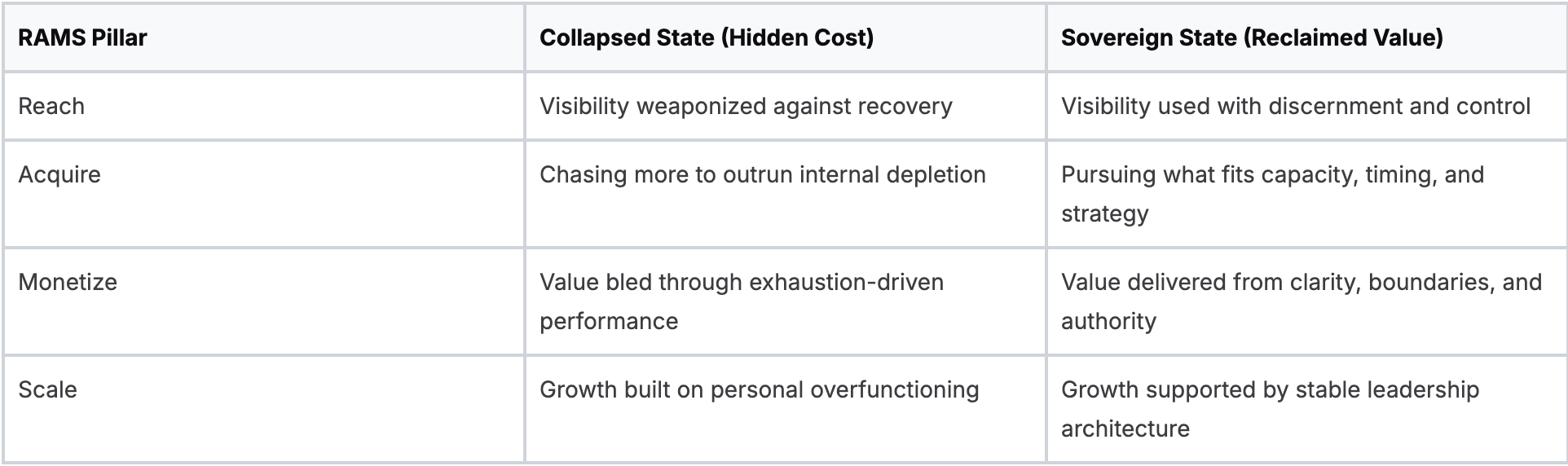
I break the full framework down in the RAMS Method explainer.
Clinical read: the hidden cost isn't just burnout. It's distorted leadership behavior that starts looking normal because it keeps producing.
If you're comparing leadership coaching rates, compare them against these leak points. Compare them against the cost of being indispensable in a way that is eating you alive. Compare them against the value trapped inside a leader who can no longer access herself without stopping the machine.
Calculating the ROI of Sovereign Leadership
You approve a budget, hit the number, and still end the quarter more depleted, more reactive, and less able to think clearly than the one before it. That is not a performance problem. It is a leadership system billing your body for business continuity.

ROI starts there.
If you only measure coaching against revenue gained, you will underprice the intervention. Sovereign Leadership fixes a more expensive problem. It stops the pattern where a female executive subsidizes growth with overfunctioning, hypervigilance, and self-erasure. The invoice for coaching is visible. The cost of Silent Collapse is usually buried inside delays, team dependence, decision fatigue, and a leader who cannot come off alert without guilt.
Calculate return with clinical honesty:
Identify the strain point. Where are you compensating with force instead of authority?
Quantify the business effect. Track slowed decisions, retention risk, unnecessary founder involvement, inconsistent delegation, and revenue that depends on your depletion.
Price the current pattern. Add the cost of churn, missed opportunities, avoidable hires, stalled strategy, and the hours you spend regulating dysfunction that should never have reached you.
Measure the post-intervention shift. Faster decisions, cleaner ownership, lower emotional volatility, stronger team autonomy, and capacity that no longer collapses under visibility or growth.
This is the math I trust. It examines what your P&L misses.
For some leaders, operational relief belongs in the equation too. If you are sorting structural support from clinical intervention, this article on hiring an executive assistant can help clarify the difference. An assistant can reduce load. An assistant cannot rebuild internal authority.
The strongest return shows up in places finance rarely labels correctly:
Decisions made without spiraling
Delegation that holds after pressure rises
Fewer bottlenecks caused by your availability
Clearer boundaries around capacity
A nervous system that stops treating rest as threat
That is financial return because it changes how value moves through the business. It also changes what the business stops extracting from you.
I explain that financial model in more detail in this guide to executive coaching ROI for leadership performance and capacity recovery.
You are not buying motivation. You are correcting a leadership condition that has been expensive for longer than the invoice will be.
Beyond the Invoice The Non-Negotiable Return
Some women still ask the wrong final question. They ask whether they can afford intervention.
The better question is whether they can afford to remain structurally split.
Large organizations already answer that clearly. Coherent Market Insights reports that enterprises with more than 10,000 employees invest an average of $16.1M annually into leadership development and coaching, within a global market expected to reach $174.53B by 2026. Serious systems invest in leadership because unstable leadership is expensive.
This is about ending the pattern
At the individual level, the same logic applies.
You can start with lower-cost formats. Group coaching can create traction. A focused program can create movement. Those are valid entry points. They are not always substitutes for deep reconstruction when the pattern is embedded in identity, authority, and nervous-system response.
If executive burnout is already showing up in your leadership, I wrote more about that pattern in executive burnout coaching.
The indispensable return is sovereignty. You lead without disappearing. You decide without flooding. You stop using your own body as the hidden subsidy for business performance.
That is not luxury. That is leadership.
Frequently Asked Questions on Coaching Investment
How do I justify this to a board or CFO
Don't sell it as self-care. Sell it as risk correction.
Frame the investment around decision quality, leadership stability, retention, and execution under pressure. If your current pattern creates bottlenecks, role confusion, or slow strategic movement, say that directly. Senior stakeholders understand the cost of impaired leadership when you speak in operational terms.
Ask for budget the same way you'd ask for any intervention protecting performance, continuity, and judgment.
Is this usually paid from a professional development budget
Often, yes. In many companies, coaching sits inside leadership development, talent, or executive performance support.
If you're employer-sponsored, position the request around business outcomes. Keep it concrete. Name what improves when the leader's internal capacity matches her external responsibility. Avoid vague language about fulfillment. Use the language of leadership effectiveness.
How is this different from therapy
Therapy and leadership coaching do different jobs.
Therapy may address mental health, trauma, or personal healing in a clinical setting. Leadership coaching addresses how a leader functions inside responsibility, power, pressure, and organizational consequence. In women with Silent Collapse™, the distinction matters because the presenting issue is often not public dysfunction. It is high-functioning distortion.
What if I don't need premium one-to-one support yet
Then don't force it.
Start where your truth is. If you need structure, perspective, and traction, a lower-intensity format may be enough for now. But don't use a smaller investment to avoid naming a larger problem. Entry-level support helps when the pattern is early. It becomes insufficient when collapse is entrenched.
Why do I feel empty even though I am successful
Because success and self-contact are not the same thing.
You can accumulate proof and still lose access to your own interior life. When achievement becomes the mechanism that keeps your identity intact, every win has less emotional effect. You stop feeling nourished by what once drove you.
Why does slowing down feel dangerous
Because your system learned to equate motion with safety.
That pattern forms when responsibility, pressure, and identity stay fused for too long. You don't avoid rest because you're weak. You avoid it because pause threatens the structure you've built to survive.
If your results confirm what you already suspect, the next step is an application, not a sales call. I do not work with everyone. I work with women ready to stop managing their collapse and start ending it. Start with the Silent Collapse Diagnostic, explore the Sovereign Leadership Resource Hub, or Apply to Work With Baz.
Author bio: British military veteran. Two-time international bestselling author. Founder, The Prestige Architect™. Host, Rise From The Ashes podcast on the C-Suite Network.