
How Executive Coaching ROI Rewires Your Bottom Line
You’ve hit a wall. The relentless drive that built your career now just leads to exhaustion. You're a high-performance engine running on the wrong fuel, powerful, but sputtering. This isn’t burnout; it's a silent collapse, the quiet moment when the monumental effort you pour in no longer matches the impact you make. You’re starting to wonder, “If I stop performing, will I just disappear?” This feeling of stagnation isn't just in your head; it’s a hidden tax on your company's P&L.
Key Takeaways
ROI is a Hard Metric: Executive coaching delivers a tangible financial return, with studies showing an average ROI of 5 to 7 times the initial investment, primarily through improved productivity, talent retention, and strategic effectiveness.
The Neuroscience of Leadership: High-pressure leadership triggers a cortisol-fueled "fight-or-flight" state, crippling strategic thought. Coaching rewires these neural pathways, enabling calm, decisive action under pressure, which is the biological root of improved business outcomes.
Measure Both Financials & Behaviors: A complete ROI picture tracks quantitative KPIs (revenue, retention costs) and qualitative KPIs (360-feedback, team engagement). Behavioral shifts are the leading indicators of future financial gains.
The RAMS Method™ Maximizes Returns: A systematic approach like the RAMS Method™ (Results, Attitude, Mastery, Systems) connects internal leadership shifts directly to external business results, ensuring a sustainable, scalable impact far beyond temporary behavioral fixes.
Executive coaching ROI isn't a soft, feel-good metric; it's a direct reflection of your leadership's impact on organizational health and profitability. While many studies cite a financial return of 5 to 7 times the initial investment, the real value lies in rewiring leadership from a state of reactive burnout to a powerful engine for growth and innovation.
The Hidden Pattern: The Real Cost of a Dysregulated Leader
You've done everything right. You climbed the ladder, shattered expectations, and built a career on relentless drive. And yet, you've hit a leadership plateau. The very strategies that once guaranteed your success now only lead to exhaustion.
This is the silent collapse.

This plateau isn't a personal failure. It’s the predictable consequence of outgrowing an old leadership model. The same drive that propelled you forward is now creating a hidden friction that quietly erodes your company's bottom line and your own well-being. Think of it like a powerful sports car trying to win a race with the handbrake secretly engaged. The engine roars, but the car fights itself, wasting energy and burning out.
The Hidden Friction Eroding Your Impact
That handbrake is a dysregulated nervous system. Constant pressure floods your brain with cortisol, effectively shutting down the prefrontal cortex, the part you need for strategic thinking, empathy, and complex problem-solving. A leader stuck in fight-or-flight is just reacting, not leading. This internal state creates measurable drags on performance. The shocking truth about productivity is that this internal friction is a direct tax on output and innovation.
The costs of this stagnation multiply fast:
Top talent leaves: High performers disengage and look for opportunities elsewhere, kicking off expensive recruitment cycles.
Innovation stalls: When a leader runs on empty, the first casualties are creative risk-taking and psychological safety.
Opportunities are missed: Without strategic clarity, your organization reacts to the market instead of leading it.
Your internal state translates directly to external business results. A leader operating from burnout quietly squanders the organization's potential.
Companies try patching these issues with innovative workplace wellness program ideas, but if the root cause at the leadership level isn't addressed, these efforts are just a band-aid. Tackling this stagnation isn't an expense; it’s a critical investment. This is the first step to unlocking a significant executive coaching ROI.
The RAMS Reframe: A Practical Framework for Maximizing Coaching Impact
To truly grasp the impact of executive coaching, you need a clear, practical framework. This isn't just about spreadsheets; it's about capturing both the hard financial gains (quantitative metrics) and the critical behavioral shifts (qualitative metrics) that drive those gains. You need both to build a compelling business case.
The process is straightforward: the investment fuels specific actions, which create measurable, organization-wide impact.
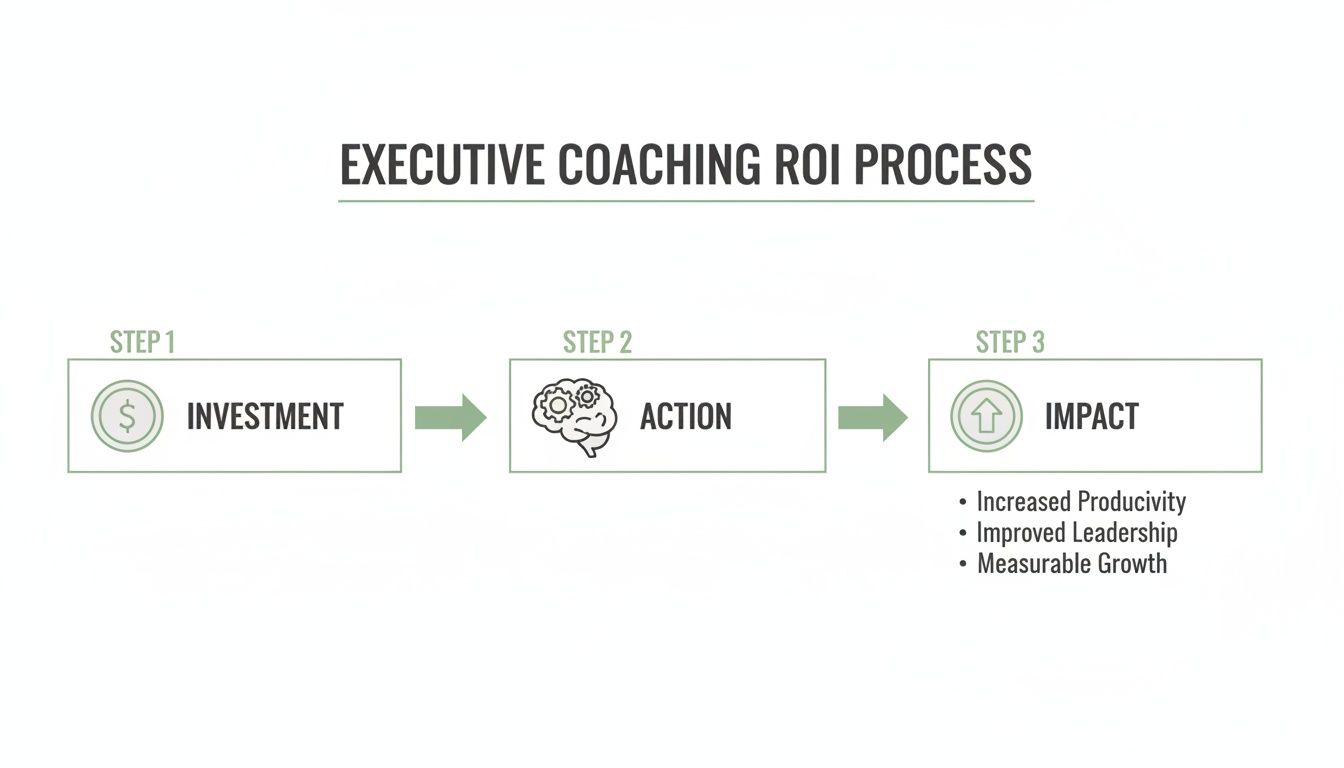
This visual draws a straight line from the coaching investment, through the leader’s new behaviors, all the way to the final business impact.
Tracking the Tangible Returns
Quantitative metrics are the proof points that make a CFO listen. They are the most direct way to show a financial return. The key is to establish a clear baseline for these numbers before coaching begins.
Key items to track:
Revenue Growth: Can you connect improved strategic clarity to hitting specific sales targets or growing market share?
Operational Efficiency: Look for improvements in project completion times or reductions in cost-per-unit. A coached leader eliminates bottlenecks.
Employee Retention: Calculate the real cost of turnover for key people. A landmark study by MetrixGlobal pinned a 788% ROI on executive coaching, with reduced turnover being a primary driver.
Assessing the Intangible Drivers
Qualitative metrics are often brushed off as "soft" skills, but this is a huge mistake. These behavioral changes are the leading indicators of future financial wins. The untold power of executive coaching is that this internal mastery is the root cause of all external results.
How to measure these essential outcomes:
360-Degree Feedback: Conduct assessments before and after the coaching. Anonymous feedback provides objective data on real behavioral change.
Team Engagement Scores: Use your existing pulse surveys to track morale and psychological safety. Research consistently shows a 32% improvement in team engagement when a leader is coached.
Observed Behavioral Changes: Work with the coach to identify 3-5 specific, observable behaviors the leader needs to adopt, then track their frequency.
Quantitative vs. Qualitative ROI Metrics

When you blend these two approaches, you get a complete picture of your coaching ROI. Our client success stories show how leaders turn these frameworks into profound, measurable results.

The Proven Financial Impact of Executive Coaching
The data is overwhelmingly clear, executive coaching consistently generates a financial impact that dwarfs its cost. Multiple studies show executive coaching routinely delivers multiples of the initial investment, commonly reporting a 3× to 8× ROI range.
The International Coaching Federation (ICF) has summarized studies showing a median organizational ROI of nearly 7:1. You can dig into a deeper analysis of these organizational investment findings on ExecutiveCoachCollege.com.
A landmark study by MetrixGlobal reported a staggering 788% ROI from executive coaching, driven primarily by huge jumps in productivity and significant reductions in costly employee turnover.
These figures help set realistic expectations. A strong financial return isn't just possible, it's probable.
How The RAMS Method Maximizes Your Coaching ROI
Any decent coach might get a positive ROI. But you aren't looking for decent. A game-changing return requires a complete system built to turn internal shifts into hard, external results. The RAMS Method is an architectural framework for leadership. It doesn’t just patch symptoms; it rewires the very foundation of how you lead.
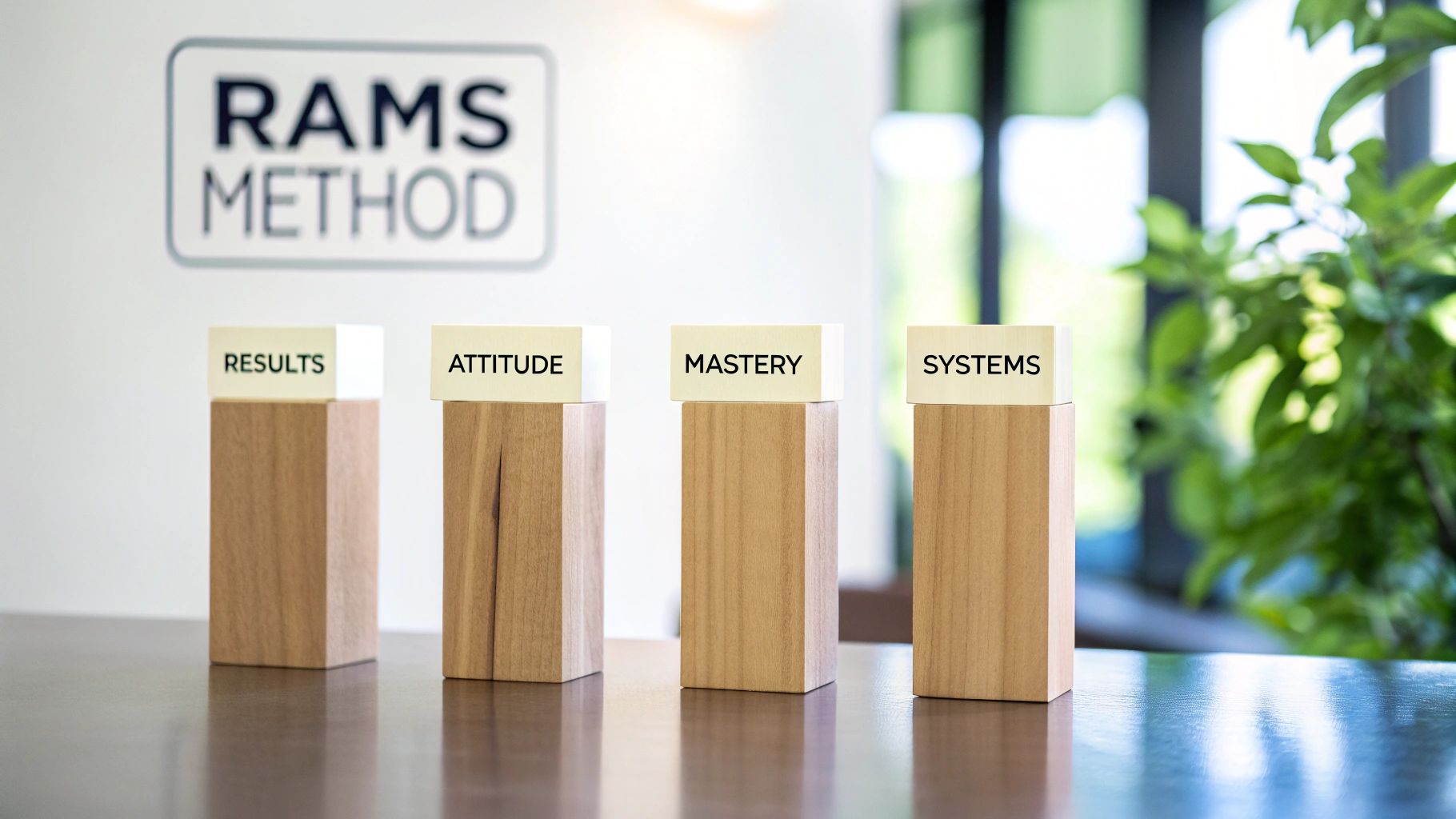
This method ensures the executive coaching ROI is a sustainable engine for growth through four pillars:
Results: We anchor the entire journey in tangible business objectives from day one. Before we touch mindset, we answer: "What specific, measurable outcome defines a win?"
Attitude: We identify the deep-seated beliefs and internal narratives, like perfectionism and hyper-vigilance, that sabotage performance and systematically replace them with an attitude rooted in sovereignty and strategic calm.
Mastery: This is nervous-system sovereignty. We move past intellectual theories into the biological reality of leading under pressure, giving you somatic tools to regulate your internal state in real-time. This physiological control is the ultimate competitive advantage.
Systems: We build replicable processes and communication frameworks that embed your newfound effectiveness into the team's DNA. These scalable systems that empower teams create leverage and lasting impact.
Together, these pillars create a powerful compounding effect. You can get the full picture in our deep dive on the RAMS Method, a revolutionary leadership framework explained. For more, explore these strategies to maximize executive coaching ROI and foster growth.
The Return: Building Your Undeniable Business Case
To get budget and buy-in, you need a data-backed proposal that speaks the language of the C-suite: strategic advantage. The real expense isn't the coaching fee; it's the hidden drag of stagnant leadership.
Crafting Your Proposal: A 5-Step Structure
Follow this structure to make your case impossible to ignore:
The Problem/Opportunity: Lead with a specific, high-cost business challenge. Quantify it. "Our top-tier talent attrition is at 18%, costing us an estimated $750,000 a year."
Proposed Solution: Briefly explain why coaching is the sharpest tool for this job. "By coaching our senior leaders, we will directly target the root cause of this costly attrition."
Key Objectives & Metrics: List 3-5 clear, measurable goals. Mix quantitative ("reduce attrition by 5%") with qualitative ("improve leadership scores on 360-feedback by 15%").
Projected ROI Calculation: Show them the money. "A 5% drop in attrition saves $208,000. Against a $50,000 investment, this projects an ROI of over 300% in the first year."
Measurement & Reporting Plan: Outline how you'll track progress and report back. This proves you’re managing an investment, not just spending a budget.
Industry reports find that around 86% of companies that calculate coaching ROI at least get their initial investment back. Many report returns exceeding 500%. You can dig into more of these powerful coaching statistics on Luisazhou.com.
Your Questions About Coaching ROI, Answered
What Is a Realistic ROI to Expect from Executive Coaching?
The industry data consistently points to a financial ROI in the 5x to 7x range. However, if coaching is aimed at a high-stakes moment, like landing a crucial funding round or preventing a key team from quitting—the return can be exponentially higher. The secret is defining that target outcome with absolute clarity.
How Long Does It Take to See a Return on Investment?
Short-Term Behavioral Wins (30-90 Days): Qualitative shifts happen fast. You’ll see improved communication, confidence, and team morale within the first few months.
Long-Term Financial Impact (6-18 Months): The hard-dollar ROI takes longer as behavioral shifts become ingrained habits that create systemic change.
How Do You Isolate Coaching as the Cause of ROI?
We build an airtight case by triangulating data:
Establish a Baseline: We capture KPI data before a single session.
Use 360-Degree Feedback: Pre- and post-coaching assessments provide direct evidence of behavioral change.
Correlate the Data: We track the leader's progress alongside their team's performance metrics. When a leader’s 360-feedback score jumps at the same time their division’s project delivery times improve, the correlation is impossible to ignore.
This isn't about simply managing burnout. It's about returning to yourself, the calm, decisive, and sovereign leader you were meant to be. That return is the ultimate ROI.
Ready to stop guessing and start building a measurable, data-backed case for your own leadership growth?