
The High Achiever's Curse: Why Feelings of Inadequacy at Work Are a Trap
The feeling hits you in the gut. You’re sitting in a meeting, staring at your laptop, and a cold wave of dread washes over you. Any minute now, they're going to realize I'm a fraud. I don't belong here. You just landed a huge win, but instead of relief, you feel the crushing weight of the next expectation. If you stop performing, even for a second, you’ll disappear.
This isn't a motivational issue; it's a nervous system response. It’s the silent collapse happening inside high-achieving leaders who are trapped on a performance hamster wheel, where every success just raises the bar and cranks up the pressure.
Key Takeaways
It’s Not a Character Flaw, It’s Biology: Feelings of inadequacy are often a physiological response from a nervous system stuck in a chronic state of fight-or-flight, not a sign of personal weakness.
The Performance Trap is Real: This cycle, fueled by stress hormones like cortisol and adrenaline, conditions your brain to dismiss success and constantly scan for the next threat, making it impossible to feel accomplished.
You Are Not Alone (This is Systemic): The pressure you feel is part of a global crisis of professional burnout. Recognizing this shifts the focus from self-blame ("What's wrong with me?") to systemic awareness ("What's wrong with the culture?").
The RAMS Method is the Way Out: A practical framework focusing on Results, Attitude, Mastery, and Systems can help you reclaim your confidence by rewiring your nervous system from the ground up.
Feelings of inadequacy at work are a physiological symptom of a dysregulated nervous system trapped in a state I call the 'Performance Trap.' This chronic fight-or-flight response, driven by relentless pressure, makes it biologically impossible to internalize success, leading to a cycle of self-doubt and burnout.
The Hidden Pattern – Your Nervous System on Overdrive
That relentless internal battle—the voice whispering you’re faking it—isn’t just in your head. It’s a survival response, a deeply wired pattern that high achievers are especially prone to. Research from institutions like the American Psychological Association highlights how those who set impossibly high standards are most susceptible to this phenomenon.
Imagine your nervous system is a high-performance engine. It was designed for short, powerful bursts to escape danger. But modern work culture has you redlining that engine 24/7. Every deadline, critical email, and high-stakes project is processed not as a challenge, but as a saber-toothed tiger.
Your body, unable to tell the difference, floods your system with cortisol and adrenaline.

This neurochemical state is the real engine behind the feelings of inadequacy at work. Your body is telling you that you are in perpetual danger, so your mind concludes you must be failing. The internal dialogue sounds something like this:
"My last win was a fluke. There's no way I can pull that off again."
"If I stop performing, I'll become irrelevant. I'll disappear."
"I have to keep proving myself, or they'll finally see I'm faking it."
This constant, grinding pressure to prove your worth is utterly exhausting. The internal belief that you're not good enough becomes a self-fulfilling prophecy, draining your energy and chipping away at your confidence from the inside out.
The physical toll is real. You feel profoundly exhausted, yet that relentless drive keeps you pushing. Finding peace in the midst of chaos starts when you recognize that these feelings are signals—not truths. This isn't about finding another productivity hack. It's about finally understanding the deep connection between your mind, your body, and your professional life.
The RAMS Reframe – Reclaiming Your Professional Confidence
Insight is liberating, but it isn’t enough. To truly break free from the Performance Trap, you need a practical, embodied framework that gets you out of your head and into action. This is where you shift from understanding the problem to actively dismantling it from the nervous system up.
The RAMS Method is a systematic approach I developed with leaders to do exactly that. It fundamentally rewires your relationship with results, your internal attitude, your approach to mastery, and the very systems that govern your professional life.

1. Results: Redefining Your Definition of Success
First, we tackle the high-achiever’s addiction to external validation. When your self-worth is hitched to the next promotion or glowing review, you hand over control of your confidence to others. We reframe this not as a personal failing, but as a shared, systemic experience.
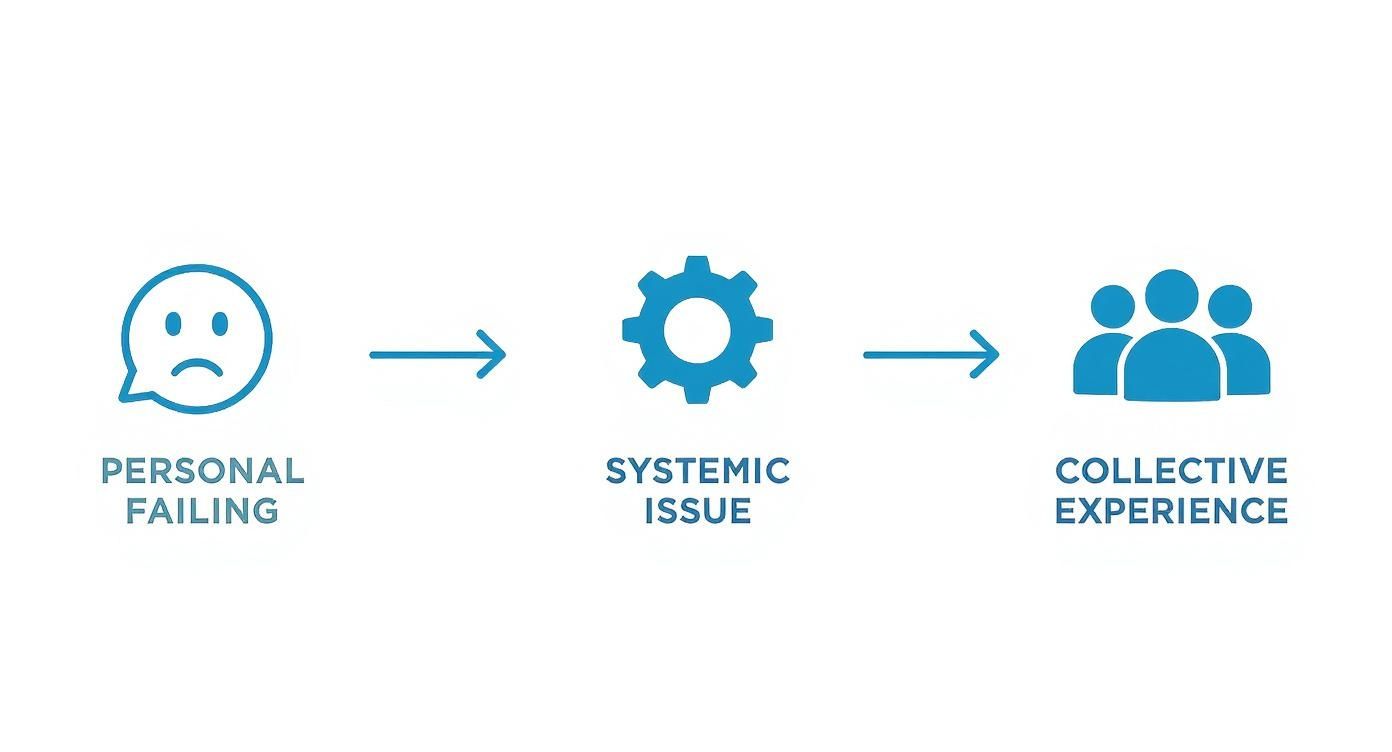
The work here is to shift your focus from outcomes you can't control to internal metrics you absolutely can. This pivot moves you from seeking approval to sovereign self-assessment.
Old Metric (External)New Metric (Internal)"Did everyone love my presentation?""Did I communicate my ideas with integrity?""Did I get the promotion?""Did I show up with presence today?""Am I meeting their expectations?""Am I honoring my own process?"
2. Attitude: Shifting From Critic to Witness
Next, we disarm that harsh internal critic. The Attitude component of RAMS is about cultivating a compassionate self-witness. This isn't fluffy affirmation; it's learning to observe your internal state without judgment.
The goal is to notice the feeling of inadequacy arise without becoming it. You learn to say, "I am experiencing a feeling of inadequacy," rather than, "I am inadequate." This small linguistic shift creates profound internal space.
This practice quiets the amygdala's alarm bells, allowing your prefrontal cortex—the rational part of your brain—to come back online. For many, external guidance from a trusted mentor can powerfully accelerate this shift.
3. Mastery: Building Competence From Calm Presence
True Mastery is never born from frantic, fear-driven effort. It’s cultivated from a place of calm presence. When your nervous system is regulated, your capacity for learning, creativity, and deep work expands dramatically.
You no longer feel the desperate need to prove you are good enough; you simply become more effective because your energy isn't being burned up by internal battles. If this resonates, exploring how to recover from burnout by addressing the nervous system first is a critical step. Our guide on overcoming burnout at work also offers actionable steps.
4. Systems: Creating Structures for Regulation
Finally, Systems. Individual effort cannot win against a flawed environment. This pillar is about designing your workday to protect your nervous system, not just your productivity metrics.
These are non-negotiable boundaries and routines:
Time Blocking: Carve out sacred blocks for deep work to prevent draining context-switching.
Boundary Scripts: Have clear, pre-prepared ways to say "no" to requests that compromise your well-being.
Recovery Rituals: Schedule short, intentional breaks to down-regulate. A five-minute walk or stepping away from screens makes a world of difference.
By implementing the RAMS framework, you create an ecosystem where confidence becomes the natural byproduct of your actions. You can explore our complete guide explaining the RAMS Method, Baz Porter's leadership framework. While you're at it, you may want to look into strategies to reduce employee burnout.
The Return – From Inadequacy to Sovereignty
The path out of the Performance Trap isn't about adding more strategies. It’s a process of subtraction—dismantling the ingrained patterns and knee-jerk nervous system responses that fuel your feelings of inadequacy at work.
This entire process is about returning to yourself.
The end goal is what I call nervous system sovereignty. This is the highest form of professional freedom. It’s the state where your sense of worth is an internal anchor, a calm center you operate from no matter what chaos swirls around you. It’s when you finally lead with confidence that is embodied, not performed.
Reclaiming Your Inner Authority
Real confidence is not a positive thought. It's the grounded feeling of knowing your own capabilities, even when facing uncertainty. This shift is a necessity. A staggering 79% of employees report experiencing work-related stress, according to The American Institute of Stress. This is a massive red flag that the old ways of working are failing us.
The most powerful leaders are not those who never feel doubt. They are the ones who have learned to regulate their internal state in the face of it. They lead from embodied confidence, not a desperate need for approval.
Your Invitation to Return
This path is a dedicated practice of reclaiming your inner authority. It's about building a foundation of self-trust so solid that no difficult project, piece of critical feedback, or toxic environment can shake you.
This isn't a sales pitch. It's an invitation to take the next logical step. It's a chance to go deeper, understand the unique patterns holding you back, and start the tangible work of reclaiming your sovereignty.
This is your permission to stop chasing worthiness and finally start embodying it.
Frequently Asked Questions
Why do I feel inadequate at work even when I'm succeeding?
The feeling usually isn't about your competence. It's your nervous system on overdrive. When you live in a state of constant threat, your brain reads every task as high-stakes, so no win ever feels like enough. The pattern is physiological, not a personal failing.
Is feeling inadequate the same as imposter syndrome?
They overlap, but this runs deeper. Imposter syndrome names the thought. The inadequacy underneath is a body state, a chronic sense of not-enough that persists no matter what you achieve. You address it by regulating the nervous system first, then reframing the story.
How do I quiet the harsh inner critic?
You shift from critic to witness. Instead of fighting the critical voice or believing it, you notice it with distance, naming the thought without merging with it. That small gap is where grounded confidence starts to return.
Can I rebuild confidence without more pressure?
Yes. Real confidence is built from calm, not force. When you create structures that keep your system regulated, competence compounds quietly, and success starts to feel like enough. It is a return to steadiness, not another push.
Where to go next
If any of this reads like your own reflection, the Silent Collapse Diagnostic™ is a quiet place to start — a private, sixty-minute conversation, not a self-assessment. And if you want the deeper why beneath the work, read the Sovereign Manifesto.