
Feeling Worthless at Work: Why High-Achievers Crash & How to Recover
That feeling of worthlessness at work? It’s a silent collapse. It’s the profound, painful disconnect between the success everyone else sees and the fraud you feel like inside. The promotions, the praise, the corner office... none of it quiets the relentless inner voice that whispers, “If I stop performing, I’ll disappear.” You’ve built a life that looks perfect on paper, but you’re crumbling under the weight of it.
Key Takeaways
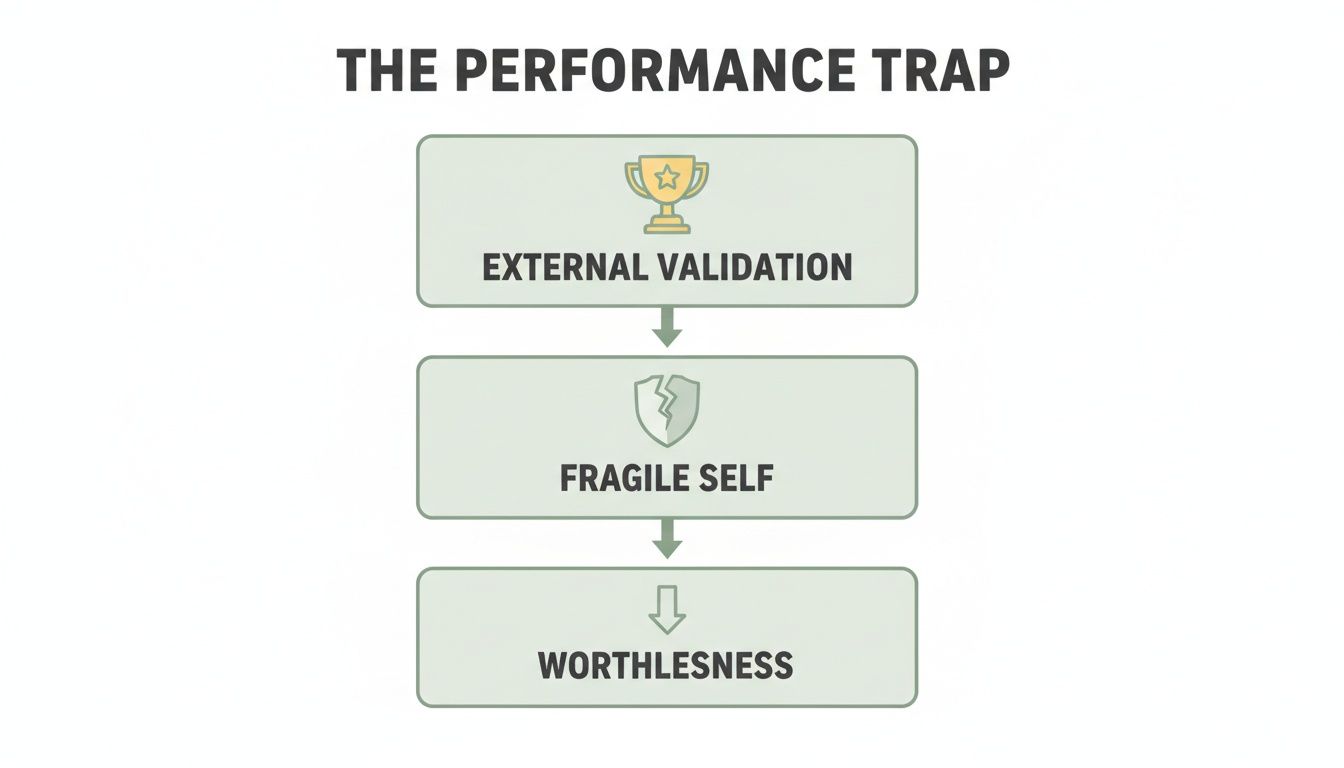
The Performance Trap: Feeling worthless often stems from a nervous system conditioned to equate your productivity with your right to exist. External validation becomes your only measure of self-worth, making any perceived failure feel like an existential threat.
Neuroscience, Not Weakness: This feeling isn't a character flaw. It's a physiological response driven by chronic stress, which impairs the part of your brain responsible for rational self-assessment, leaving your inner critic in charge.
The RAMS Framework: Reclaiming your value requires a new operating system. The RAMS Method (Results Reimagined, Attitude of Sovereignty, Mastery from Within, Systems for Sustainability) offers a structured path to rebuild worth from the inside out, independent of external praise.
Nervous-System Sovereignty: The ultimate goal is not to achieve more, but to return to yourself. This means building an unshakeable internal state where your value is a given, not something that rises and falls with your daily performance.
The Ache of Accomplishment When Success Feels Hollow
You did everything you were supposed to. You climbed the ladder, secured the title, and earned the respect of your colleagues. Your career is a masterpiece of strategic moves and relentless effort.
But behind closed doors, or in the silence of your commute home, there's a hollow ache. It’s the nagging dread that whispers, no matter what I achieve, it will never be enough to finally prove I'm valuable. This is the high-achiever’s paradox: a life packed with accomplishments that feel profoundly empty.
This isn't a rare phenomenon; it's a silent epidemic among the most successful leaders. So many find themselves feeling empty despite your accomplishments, fighting an internal void that no amount of external success can fill.

This guide isn't about chasing another accolade to numb the feeling. It's about dismantling the root cause of this hollowness and reclaiming the solid, unshakeable self-worth that is your birthright.
Feeling worthless at work stems from a nervous system conditioned to equate productivity with safety and external validation with self-worth. This makes any perceived failure feel like a direct threat to your core identity.
Understanding the hidden cost of success is the first, crucial step toward genuine fulfillment. We will explore exactly why you feel this way and map a clear path back to yourself. As you work through these steps, a tool like a Cognitive Therapy Thought Record can be powerful for catching and challenging automatic negative thoughts. For a deeper dive, see our guide on reclaiming self-worth without guilt.
The Hidden Pattern—Why High-Achievers Feel Worthless
To dismantle the feeling of worthlessness at work, you must first understand its architecture. This isn't about a single bad day or a missed deadline. It’s a slow, quiet erosion of your self-worth, driven by a toxic combination of your internal wiring and external workplace pressures.
High-achievers, more than anyone, build their identity on a foundation of performance. Your sense of self becomes fused with what you produce. This is what I call the Performance Trap. When your value as a human is tied directly to external validation—praise, promotions, hitting metrics—that value becomes dangerously fragile. It’s like building a skyscraper on a fault line.
The Neuroscience of the Performance Trap
Your brain’s primary directive is survival. It is constantly scanning for threats. For a high-performer, the threat isn’t a predator; it’s social and professional annihilation. That voice whispering, "If I stop performing, they'll see I'm incompetent," isn't just a stray thought. It’s a physiological alarm.
This triggers a chronic stress response, flooding your system with cortisol. According to studies on the neurobiology of stress, prolonged high cortisol levels impair the prefrontal cortex—the part of your brain handling emotional regulation and rational thought. The result? You literally lose the ability to see your own value clearly. You get stuck in a reactive state where your inner critic runs the show.
You begin defining your worth by your last win or latest mistake, ignoring a lifetime of evidence to the contrary. Understanding the roots of these powerful feelings of inadequacy at work is the non-negotiable first step to dismantling them.
When the System Is the Problem
Your internal state is only half the story. The work environment itself is often a powerful catalyst. Toxic cultures, constantly shifting expectations, and a lack of authentic feedback create fertile ground for self-doubt to flourish.
This is a systemic problem. A 2023 Work in America Survey by the American Psychological Association found that 77% of workers reported work-related stress, and a significant 18% reported feelings of ineffectiveness—a direct echo of worthlessness.
This is the 'glass cliff' phenomenon in action. Women are often promoted into high-risk leadership roles during times of crisis, where the chances of failure are higher. When things inevitably go wrong, the system implicitly blames the individual, reinforcing a devastating and completely unearned sense of worthlessness.
This combination of an internal Performance Trap and a flawed external system creates a perfect storm. It is designed to convince you that your exhaustion, anxiety, and feelings of failure are your fault alone. It isolates you, making it harder to see the truth: your worth was never tied to your job title in the first place. You can see the full scope of these workplace well-being findings to understand just how widespread this is.
The RAMS Reframe—A Framework to Reclaim Your Value
Insight without action is just another source of stress. Knowing you’re in the Performance Trap is one thing; getting out is another.
To dismantle this cycle, you need a new operating system. You need a way to rebuild your sense of value from the inside out, completely independent of external praise.
This is why I created the RAMS framework. It’s a systematic approach to shift you from a mindset driven by exhaustion to one of embodied leadership. This isn't about adding more to your plate; it’s about fundamentally changing your relationship with your work, your worth, and yourself.
Results Reimagined
The first pillar, Results, isn’t about chasing more KPIs. It’s about redefining what a “result” means to you. Instead of measuring success by applause or promotions, you measure it by impact and alignment. Are your daily efforts aligned with your core values? Are you creating an impact that you recognize as meaningful? This moves the goalposts from the chaotic external world to a stable foundation within you.
Attitude of Sovereignty
The second pillar, Attitude, targets your inner critic. Feeling worthless at work is fueled by a relentless voice of self-judgment. This pillar is about cultivating an attitude of unshakeable self-sovereignty. This isn't about empty affirmations. It's developing the capacity to observe critical thoughts without becoming them. You learn to separate your identity from your performance, creating a buffer that protects your worth.
Mastery from Within
The third pillar is Mastery. Many high-achievers outsource the validation of their expertise. Within RAMS, Mastery is reclaiming complete ownership of your skills and experience. It’s the deep, embodied knowing of the unique value only you can bring. This is the source of quiet, unshakeable confidence that no one can take from you.
Systems for Sustainability
Finally, Systems provides the practical architecture to support this new way of operating. It’s about building personal and professional ecosystems that nourish you instead of draining you. This includes actionable strategies for setting powerful boundaries, managing your energy, and curating your environment to support your well-being.
Mindset Shift: From Exhaustion to Embodied Leadership

By implementing these four pillars, you stop patching cracks in a broken foundation. You build an entirely new one—solid, authentic, and truly your own.
To go deeper, explore the principles behind the RAMS Method leadership framework. This isn't a quick fix; it's a permanent upgrade to your internal operating system.
Putting the RAMS Method Into Practice
Knowing the RAMS framework is one thing. Living it is where the real change happens. This isn't about adding more tasks. It's about swapping old, draining habits for new practices that reclaim your energy and cement your sense of worth.

These exercises are direct and immediately useful. They give you the scaffolding to break the cycle of feeling worthless at work and start building a career on the unshakable foundation of your own sovereignty.
Dismantle Your Internal Narratives
That feeling of worthlessness is a story you've been telling yourself on a loop. This prompt helps you catch that story and tear it apart.
Step 1 Identify the Trigger: What just happened? Pinpoint the specific event. (e.g., "I got vague feedback on a project brief.")
Step 2 Capture the Narrative: What was the immediate thought? Write down the exact words. (e.g., "See? You can’t get anything right. You are not cut out for this.")
Step 3 Challenge with Evidence: Find three cold, hard facts from your career that prove the narrative is false. (e.g., "1. I delivered the Q3 launch that beat projections. 2. My last review praised my strategic thinking. 3. My team trusts me.")
Step 4 Reframe the Story: Write a new, accurate statement. (e.g., "The feedback was unclear; that is not a reflection of my capability. I am a highly competent leader.")
Doing this consistently retrains your brain to seek objective truth instead of defaulting to old, destructive stories.
Set Firm Boundaries with Clear Scripts
Setting boundaries is a non-negotiable part of the Systems pillar. Use these scripts as a starting point.
When you need to decline a non-urgent request:
"Thank you for thinking of me. My focus is currently on [Your Core Priority] to ensure it gets the attention it deserves. I won't be able to take this on right now."
When you're asked to work outside established hours:
"I can address that first thing tomorrow morning. I am offline for the evening to recharge."
These scripts are not apologies. They are clear, firm statements that your time and focus are valuable resources—and you control them. This is a critical move away from the people-pleasing that fuels worthlessness. Mastering these applications is a cornerstone of the work we do inside the RAMS Accelerator program, where leaders turn these concepts into daily habits.
The Return to Nervous-System Sovereignty
The journey out of feeling worthless at work isn’t about fixing an imaginary flaw. It’s a fundamental shift toward creating a sustainable, embodied way of leading where your value is no longer up for debate.
This is the final act: achieving nervous-system sovereignty. It's an unshakeable internal state where your worth is a given, not something that rises and falls with performance reviews.
This work is urgent. The pressure cooker environment for high-performing women is a crisis. Workplace stress leads to a staggering $1 trillion in lost productivity annually from depression and anxiety. These aren't just statistics; they represent millions of brilliant leaders whose intrinsic value is being eroded by broken systems. You can dig deeper into these critical workplace mental health statistics to understand the full picture.
The Return to Yourself
Lasting success isn’t built on a foundation of promotions. It’s built on an internal one. It’s the quiet confidence that comes from knowing your value exists independent of your last win.
You stop leading from a place of needing to prove yourself and start leading from a place of already knowing yourself.
Your legacy won’t be defined by the metrics you hit, but by the sovereignty you embodied. It’s about building a career where your well-being is the non-negotiable asset you protect most fiercely, because it is the source of your greatest impact.
This guide has given you the map. The journey requires you to take the first step. It starts with a simple, powerful decision: you are ready to stop outsourcing your worth and start building it from within.
This is your invitation to return to yourself.
If you’re ready to trade exhaustion for embodiment and build a leadership legacy that feels as good on the inside as it looks on the outside, the next step is clear. Take our free diagnostic to pinpoint exactly where your energy is leaking and discover how the RAMS method can give you a structured path back to a fulfilling, powerful career. This isn't just another strategy; it's the way back to your intrinsic worth.
Your Questions, Answered
Navigating your way out of feeling worthless at work is a journey. Here are answers to common questions.
How Long Does It Take to Stop Feeling Worthless?
There's no magic timeline. Initial shifts—like quieting the inner critic—can appear within a few weeks of consistently using frameworks like RAMS. Lasting change, where your self-worth feels solid, comes from rewiring neural pathways over several months. The key isn't speed; it's consistency.
Can My Job Itself Be the Problem?
Absolutely. While our internal stories play a massive role, a toxic work environment is like pouring gasoline on the fire. A culture that lacks psychological safety, celebrates over-functioning, or gives inconsistent feedback will grind down even the most resilient person. If you’ve been doing the inner work but still feel drained, the problem might not be you—it could be the system.
What if I Feel Guilty for Setting Boundaries?
Guilt is a universal response when you first start drawing lines, especially if you're conditioned to equate your value with being available. Think of that guilt as a signal: it means you're challenging an old pattern. Acknowledge the feeling without letting it drive your actions. A boundary isn't a rejection of others; it’s a profound act of self-respect.
Reclaiming your value isn’t a journey you have to walk alone. At Baz Porter, we provide the expert guidance and structured support high-achieving women need to move from exhaustion to embodied leadership. To discover your personalized path forward, take the first step.