Feeling Useless at Work? Why High-Achievers Are Silently Collapsing
Feeling useless at work, especially when you’re a high-achiever, is almost never about a lack of capability. It’s a symptom. A distress signal from your nervous system indicating a deep misalignment between what you’re contributing and your own internal sense of value. It’s born from systemic pressures, a growing disconnect from what truly matters, and the sheer exhaustion of keeping up an impossible pace without meaningful recognition. The internal dialogue is relentless: "If I stop performing, I'll disappear."
Key Takeaways
It's Not a Personal Failure, It's a Pattern: The feeling of uselessness is driven by predictable patterns like Silent Burnout, Value Misalignment, Role Mismatch, and Imposter Dynamics, not a sudden lack of competence.
The Recognition Gap is Real: Your sense of futility is often fueled by the "Recognition Gap"—the chasm between the immense value you deliver and the acknowledgment you receive, which slowly erodes your sense of impact.
Actionable Framework for Recovery: You can reclaim your efficacy using a structured approach like the RAMS Method (Results, Attitude, Mastery, Systems), which shifts you from exhaustion-driven performance to embodied leadership.
First Steps to Sovereignty: Immediate, small actions like a "Sovereignty Audit" and strategic delegation can create the energetic space needed to begin your recovery and regain control over your professional reality.
The High-Achiever's Paradox Of Feeling Useless
You have the title. You have the track record. You lead teams, drive revenue, and make the big decisions. From the outside, you’re the definition of success. And yet, inside, a silent collapse is underway. A persistent, nagging voice whispers, "Is this it? Does any of this even matter?"
This is the high-achiever's paradox: a deeply isolating reality where your external accomplishments feel hollow and your sense of impact has evaporated. You are not imagining it. That feeling of being an imposter in your own successful life is a powerful signal that your professional operating system is fundamentally and critically misaligned.

When Success Feels Like A Trap
This isn't just a bad week. It's a chronic sense of futility that grows in lockstep with your responsibilities. High-achieving women are uniquely susceptible, thanks to a potent mix of internal drive and external pressures.
You’ve been conditioned to equate your worth with your output, pushing relentlessly toward the next goal. But when that forward momentum is the only thing validating your existence, stopping feels like disappearing entirely.
This cycle is amplified by systemic issues. Research shows women experience burnout at significantly higher rates, with 46% of women reporting burnout compared to just 37% of men. This gap widens in leadership roles. You can dig deeper into the factors driving these workplace burnout statistics on cariloop.com. The result is a profound disconnect: you’re performing at an elite level but feeling completely empty and ineffective.
The most dangerous part of feeling useless isn’t the lack of motivation; it’s the quiet erosion of your identity. You start to believe the feeling is the truth.
This internal conflict often manifests in subtle but damaging ways. You might feel like you're the only one, but these patterns are common among women at the top of their game.
Four Hidden Drivers Of Feeling Useless
This feeling doesn't come out of nowhere. It's the result of one or more of these four drivers working quietly in the background. Seeing them is the first step to reclaiming your efficacy.
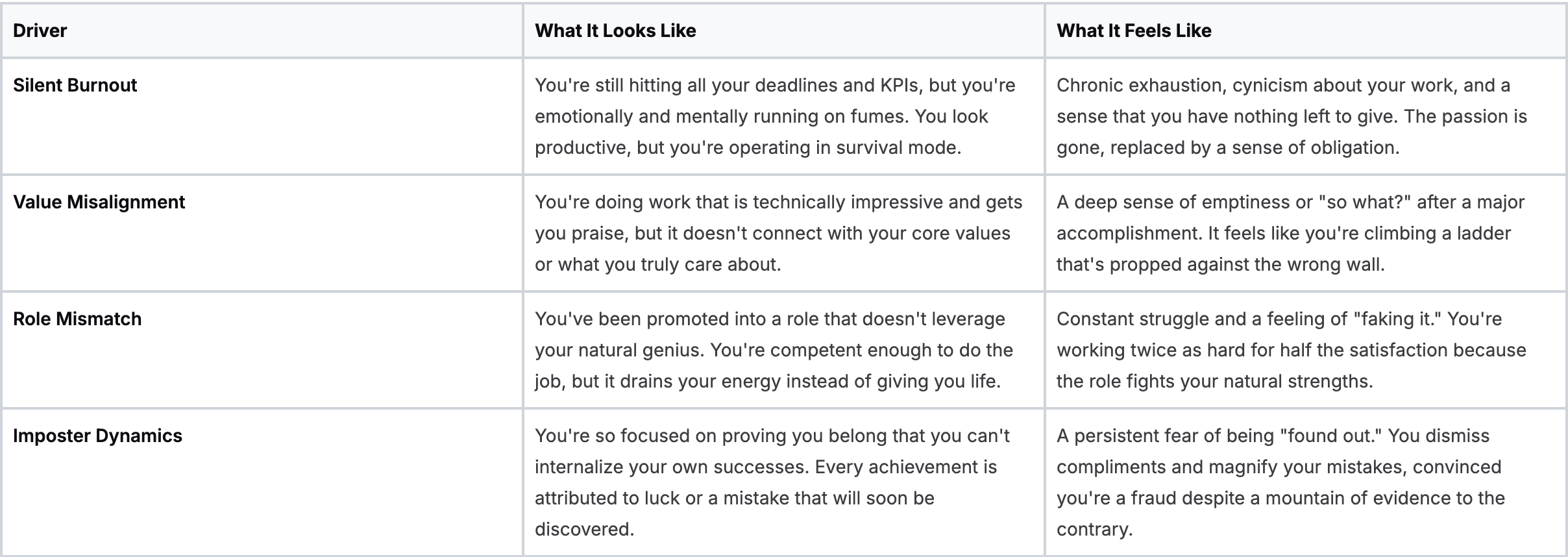
Once you can name the driver, you can stop blaming yourself. It's not a personal failure; it's a systemic problem that needs a strategic solution.
Key Signs You're Experiencing This Paradox
Recognizing the specific pattern is the first step toward breaking it. Beyond the drivers above, this internal conflict often shows up in these behaviors:
Productivity Dysphoria: You’re checking off tasks and meeting deadlines, but you feel zero satisfaction or sense of accomplishment. Your to-do list becomes a source of dread, not achievement.
Emotional Distancing: You find it incredibly difficult to connect with your team or the mission of your work. The passion you once had has been replaced by a flat sense of obligation.
Hyper-Fixation on Minor Flaws: You magnify tiny mistakes into career-ending evidence of your incompetence, completely overlooking your major successes.
Inability to "Turn Off": Even when you aren’t working, your mind is racing, trying to solve problems or mentally rehearse how to prove your worth. You're left perpetually exhausted.
The Neuroscience of Futility: Why Your Best Efforts Feel Empty
That feeling of spinning your wheels but going nowhere? It isn't just in your head. It’s a physiological reality. Feeling useless at work is the predictable endpoint of sustained, high-level performance inside systems that reward unsustainable output.
You're running on what I call the ‘Invisible Treadmill.’ You’re sprinting, putting in a superhuman effort, and maybe even breaking personal records. But when you finally look up, you realize the scenery hasn't changed. The feeling of being behind is still there. The finish line just keeps getting pushed further away.
This is more than just a metaphor. It’s what happens when chronic stress starts to rewire your brain’s reward circuits. The dopamine hit you used to get from a big win starts to shrink. It takes more and more effort to get less and less satisfaction until, eventually, even your most significant accomplishments feel completely hollow.

The Productivity Paradox
When you feel your effectiveness dipping, your instinct is to work harder. You double down, convinced that just a few more hours or a little more grind will fix it.
This is the Productivity Paradox—a vicious cycle where pushing harder only camouflages your declining impact and speeds up your journey straight into burnout.
It’s a nasty, counterintuitive trap. You think you're solving the problem, but you're actually just feeding the beast. This is usually when a terrifying internal dialogue starts to take over: "If I stop performing, I'll disappear." That fear isn't just psychological; it's a deeply wired nervous system response to what feels like a genuine threat to your identity, your value, and your very survival.
The data paints a grim picture. A recent study found that 63% of employees experiencing burnout report being less productive over the last year. This shatters the myth that pushing through exhaustion leads to better outcomes. You can see more on the burnout and productivity connection from Infinite Potential.
From Exhaustion-Driven To Embodied
The Invisible Treadmill runs on an outdated model of leadership—one built on sheer force of will and relentless, grinding output. This exhaustion-driven performance isn't just unsustainable; it's the direct cause of feeling useless.
The alternative isn’t to work less, but to lead differently—from a place of embodied power. This demands a fundamental shift in how you operate, a dynamic I explore in my guide to Success Dysregulation.
Your feeling of uselessness is not a judgment on your capability. It is a distress signal from your nervous system, begging you to stop sourcing your worth from a system that is designed to deplete you.
Making this shift requires moving from a state of constant, frantic reaction to one of conscious, sovereign action. The table below breaks down what this shift looks like in the real world.
Exhaustion-Driven Performance Vs Embodied Leadership
Take a look at these two columns. Which one feels more like your current reality? Recognizing yourself in the "Exhaustion-Driven" column is the first, most powerful step you can take.
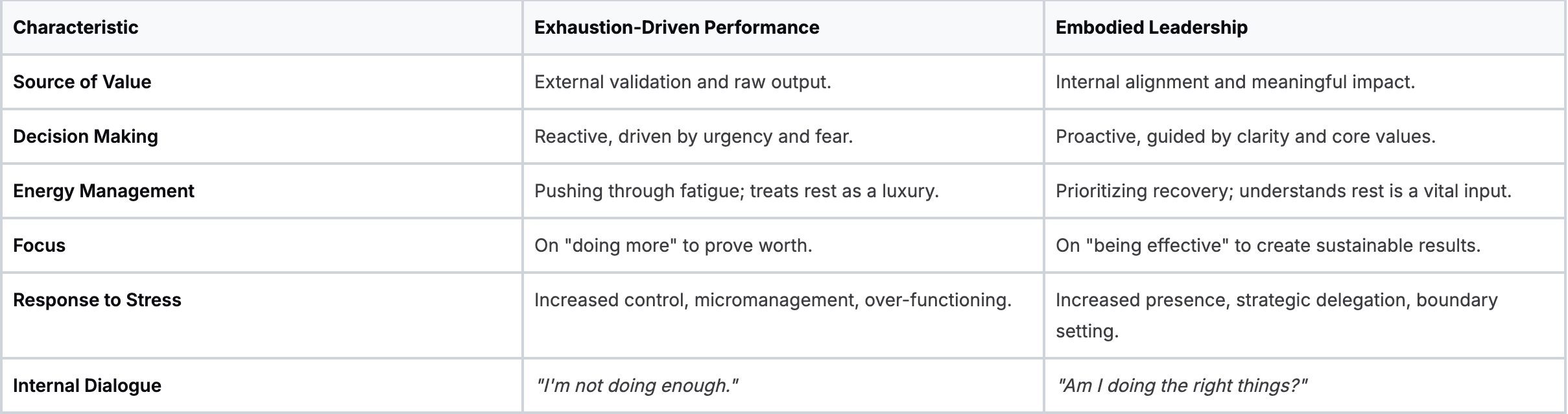
Seeing yourself in that first column is a confirmation, not an indictment. It proves that the problem isn't your effort or your talent. The problem is the operating system you're running. To reclaim your sense of efficacy, you have to change the framework itself.
How The Recognition Gap Fuels A Sense of Futility
This isn't just about missing a "thank you." For so many high-achieving women, that creeping feeling of uselessness is tied directly to a systemic problem: the Recognition Gap.
Think of it as the chasm between the immense value you consistently deliver and the meaningful acknowledgment you actually receive.
When your best work disappears into a void, you're left running on internal validation. But over time, that well runs dry. You start questioning your impact and whether any of it really matters. This isn't just a feeling; it’s the slow, calculated erosion of your professional worth.
This disconnect is rampant. One Deloitte report on workplace well-being found that a staggering 48% of Gen Z and 47% of millennials feel their contributions aren't adequately recognized or rewarded. This systemic failure to see and value effort is a breeding ground for futility.
The Subtle Ways The Gap Shows Up
The Recognition Gap isn’t always an obvious slight. It’s often a death-by-a-thousand-cuts scenario. Does any of this sound familiar?
The Echo Chamber Idea: You share a well-researched idea, and it’s met with crickets. Ten minutes later, a male colleague rephrases the exact same point, and suddenly, it's brilliant.
The "Office Housework" Trap: You’re the default for taking notes, organizing offsites, or mentoring junior staff—critical tasks that are rarely tied to promotions.
The Vague Performance Review: Your feedback is heavy on subjective critiques ("You could be warmer") but light on acknowledging your actual, data-backed achievements.
The Unseen "Extra Mile": You stay up all night to salvage a project, and the success is absorbed as a "team win," with no specific mention of your pivotal role.
Each one sends a quiet but clear message: Your contributions are expected, not valued.
From External Validation To Internal Depletion
As a high-achiever, you’re powered by a formidable internal engine. But that engine was never meant to run in a vacuum. It needs fuel—the external feedback that confirms you're making a difference.
When that feedback loop is broken, the internal dialogue turns corrosive: “Did that project even matter? If I just stopped, would anyone notice?”
The Recognition Gap forces you into a dangerous cycle of over-functioning. You work harder and harder, chasing a validation that never arrives, until all you’re left with is exhaustion and a profound sense of being invisible.
This is exactly where futility takes root. It’s not that you've stopped achieving; it’s that the system you're in has stopped reflecting your achievements back to you. Eventually, you stop believing in them yourself. Being seen is a critical part of professional respect, a dynamic we explore further in our guide on how to gain respect at work.
RAMS Reframe: A Proven Framework For Reclaiming Your Impact
Recognizing the patterns is the diagnosis. Now for the treatment. Shifting from total depletion to embodied impact demands a new operating system.
This isn't about adding more to your plate. It's about fundamentally changing the plate itself.
The RAMS Method is a structured framework I developed for high-achievers to reclaim their efficacy. It provides a concrete path back to your power through four pillars: Results, Attitude, Mastery, and Systems.
1. Redefine Your Results
The first move is to dismantle the old, exhausting definition of "success." When you're feeling useless, it's often because your internal metrics are broken. You’re measuring activity, not impact. You’re tracking hours logged instead of fulfillment gained.
Redefining your results means shifting your focus from raw output to meaningful outcomes. This isn't about lowering your standards; it's about raising them to include your own well-being in the equation.
Start by asking a different set of questions:
Instead of "How much did I get done today?" ask, "What was the most meaningful thing I accomplished?"
Instead of "Am I proving my worth?" ask, "Am I leveraging my unique genius?"
Instead of "What’s next on the to-do list?" ask, "What action today will create the most value tomorrow?"
This re-calibration short-circuits the ‘Invisible Treadmill.’ It forces you to connect your effort to what truly matters, which is the ultimate antidote to futility.
2. Shift Your Attitude Toward Sovereignty
Your internal dialogue is the most powerful force shaping your professional reality. For many high-achievers, this voice is a relentless critic. This creates a state of chronic nervous system activation, making it impossible to lead from a place of clarity.
Shifting your attitude is about moving from self-criticism to nervous system sovereignty. It’s the practice of treating your feelings not as failures to be suppressed, but as critical data.
When you feel useless, your nervous system is sending a clear signal that your current approach is unsustainable. Ignoring it is like ignoring the engine light on your car. You can for a while, but eventually, you'll break down.
A sovereign attitude means you take radical ownership of your internal state. You learn to recognize the physical sensations of burnout—the clenched jaw, the shallow breathing—and respond with intention instead of just reacting.
3. Reconnect With Your Mastery
Feeling useless is often a symptom of being disconnected from your core strengths. You’ve likely been promoted into roles that require you to manage and firefight—tasks that don't light you up. You spend so much time shoring up weaknesses that you forget what it feels like to operate in your zone of genius.
Reconnecting with your mastery is a deliberate process of identifying the skills that make you feel alive and effective.
To get started, conduct a simple Mastery Audit:
List "Flow State" Activities: Write down every task from your career that made you lose track of time.
Identify Core Skills: Look at the list and pull out the underlying skills. Is it strategic problem-solving? Mentoring talent? Synthesizing complex data?
Map to Your Current Role: How much of your current week is spent using these skills? If it’s less than 20%, you’ve found a primary source of your futility.
Create a Small Win: Identify one small way you can bring one of these skills into your work this week.
This audit gives you a data-driven look at the gap between your natural talents and your daily responsibilities. Closing that gap is essential. For a deeper dive, learn more about the RAMS Method and its revolutionary coaching model.
4. Build Sustainable Systems
Your habits, boundaries, and routines are the systems that either support your performance or drive you straight into the ground. No amount of positive thinking can overcome a system designed for burnout.
Building sustainable systems is about redesigning your work life to protect your energy and focus.

These systems aren't about working less; they are about working smarter. They create the structure to channel your energy toward high-impact activities. For those whose professional lives are impacted by conditions like ADHD, finding resources on thriving with ADHD in the workplace can be a crucial part of building these personalized systems.
This infographic plainly shows how a lack of supportive systems, particularly around recognition, leads directly to a sense of futility.

The flow is simple: when your contribution goes unacknowledged, it creates a gap. That gap is where demotivation and burnout fester. The RAMS framework helps you build the systems to finally close it.
The Return: Your First Steps Toward Professional Sovereignty
Feeling useless isn't a personal failing you need to "fix." It’s an intelligent signal from your nervous system, screaming that the way you've been operating is no longer sustainable.
The goal isn't to muscle through it. It's to finally listen. These first steps are about taking back the ground beneath your feet and moving from a place of embodied power, not sheer depletion. You can start today.

Conduct A Sovereignty Audit
Before you can chart a new course, you need an honest map. This isn't about judgment; it's about data. Grab a notebook, set aside 15 minutes, and get brutally honest.
Energy In vs. Energy Out: What are the top 3 activities at work that consistently drain you? Now, what are the top 3 that give you energy? Look at the ratio. Is your week a net deposit or a net withdrawal?
The "Should" vs. The "Want": Pull up your calendar. How much of it is filled with things you feel you should do versus things you genuinely want to do?
Impact Reality Check: If you could only do one thing this week to feel genuinely impactful, what would it be? Is that thing even on your to-do list?
Boundary Integrity: When was the last time you said a clean "no" to a request without a long-winded apology or a pang of guilt?
This quick audit gives you a tangible snapshot of your current alignment. The point isn’t to fix it all at once. It’s to see the pattern.
Create Energetic Space Instantly
Feeling useless is almost always amplified by feeling overwhelmed. The most direct counter-move is to create breathing room. You can do this right now by delegating one, low-stakes task.
I know. High-achievers resist this because it feels like a loss of control. Reframe it immediately: delegation is the active creation of focus. You are trading a low-value task for high-value mental real estate.
The internal monologue of depletion says, "It’s faster if I just do it myself." The voice of sovereignty asks, "Is this the absolute best use of my energy right now?"
Find one task that meets these criteria:
It does not require your unique genius.
Someone else on your team is capable of handling it.
The consequences of it being done to a "good enough" standard are minimal.
Got one? Good. Now use this direct, unapologetic script to hand it off.
The One-Minute Delegation Script:
"Hi [Name], I'm shifting my focus to [Project X] and need to protect my capacity. Could you please take the lead on [the low-impact task]? The main goal here is to [state the desired outcome]. I trust your judgment, but let me know if you have any immediate questions."
This single action does more than just clear an item off your list. It sends a powerful signal—to yourself and your team—that your focus is a valuable resource. This is a foundational skill for sustainable leadership. If you need more scripts, our guide on how to set boundaries at work is a great next step.
Your journey back from feeling useless is a series of small, intentional steps that reclaim your agency. It starts right here, with one sovereign choice.
Burning Questions About Career Burnout
Feeling useless at work is a disorienting experience. It tends to kick up a storm of questions that can make you second-guess your career, your competence, and your entire future. Let's tackle some of the most common questions.
How can I feel useful again if my role hasn't changed?
Feeling useless almost never comes from a change in your job description; it’s an internal landslide. The solution has to start from the inside.
Feeling useful again in the same role means you must redefine your personal scorecard for "impact."
Stop measuring your value by the sheer volume of tasks you muscle through. Instead, start tracking your contributions to things like team morale, strategic clarity, or client relationships. Actively hunt for small projects that tap into your core strengths—even tiny ones—to re-engage the part of your brain that finds fulfillment in work. Your role might be fixed, but where you point your focus within that role is entirely up to you.
Is feeling useless a sign I should quit my job?
Not always. It's a powerful flare in the sky signaling that something needs to change. Before you draft that resignation letter, you need to distinguish between a role problem and a system problem.
A role problem means your work is fundamentally out of sync with your skills and values. A system problem means you like the work, but the company culture—insane expectations, zero recognition, a toxic environment—is crushing you.
Quitting a job to escape a feeling of uselessness without first diagnosing the root cause is like moving houses to fix a leaky faucet. You often take the problem with you.
If it's a role problem, a new job might be the answer. But if it’s a system problem, you might first try implementing new boundaries. Our guide on overcoming burnout at work has frameworks to help you make this crucial distinction.
How long does it take to recover from executive burnout?
Recovery isn't a straight line with a finish date. It's a gradual, messy return to feeling like you're in the driver's seat of your own nervous system.
For high-achievers, the timeline often depends less on stopping the work and more on changing how the work gets done. I’ve seen leaders report a significant shift in just a few weeks simply by implementing new systems and boundaries.
For deeper burnout, it can take several months to fully recalibrate. The key is to focus on small, consistent actions rather than waiting for a single moment of "recovery." For those grappling with intense futility, exploring professional guidance and effective burnout and stress treatment options can be a crucial next step.
At Baz Porter, we guide high-achieving women from the brink of exhaustion back to embodied leadership. If you're ready to stop feeling useless and start leading from a place of renewed power and purpose, your return to yourself begins here.
Explore how the RAMS Method can restore your professional sovereignty