8 Empowering Feeling Inadequate Quotes for Leaders in 2026
You've built the career, secured the title, and exceeded every benchmark. From the outside, you are the definition of success. But internally, a quiet narrative runs on a loop: 'If I stop performing, I'll disappear. I'm not enough.' This feeling, a persistent, draining sense of inadequacy, is the silent collapse many high-achieving women experience at the peak of their careers. It's the exhaustion of performing perfection, the fear of being discovered as a fraud, and the isolation of believing you're the only one.
Key Takeaways
Inadequacy is a Symptom: Feelings of inadequacy are not a personal flaw but a signal from your nervous system indicating a misalignment between your actions and your core identity.
Reframe Your Internal Narrative: You can dismantle feelings of inadequacy by consciously reframing common triggers like imposter syndrome, perfectionism, and comparison as data points for growth.
Experience is Expertise: Your lived experience, especially through challenges and non-traditional paths, is not a liability but a unique and valuable form of expertise that others lack.
Action Creates Sovereignty: Moving beyond inadequacy requires small, consistent actions—like strategic delegation, setting personal benchmarks, and documenting your wins—that reclaim your internal authority.
This article isn't about generic inspiration; it is a strategic toolkit designed for leaders. We will go beyond just reading feeling inadequate quotes and instead use them as data points to dismantle the underlying patterns that create this feeling. Feeling inadequate is a symptom of a dysregulated system, often a nervous system conditioned for high-alert performance. These quotes and the frameworks provided offer a direct path to recalibrate that system and return to a state of sovereign leadership.
Inside, you will find a curated collection of powerful insights, each paired with a reflection tailored to the specific pressures faced by women in leadership. More importantly, each quote is linked to a concrete action or journaling prompt. This gives you a practical method to translate abstract concepts into real-world leadership practice. This is where you stop managing the symptom and start dismantling the system that fuels it.
1. "You Are Not Behind" - Reframing the Timeline Myth
The quiet, persistent whisper that you should be further along is a common torment for high-achieving women. This internalized pressure creates a phantom timeline, a made-up schedule against which you measure your own progress, often finding yourself wanting. This is one of the most insidious ways inadequacy takes root, turning your own journey into a source of anxiety rather than accomplishment. The simple phrase, "You are not behind," acts as a direct counter-narrative to this destructive myth. It validates your unique path, recognizing that true leadership isn't about speed; it's about depth, wisdom, and readiness.

The Power of Your Unique Pace
This quote is particularly resonant for women who feel they are "late bloomers" in their careers. Consider the C-suite executive who spent 15 years as a specialist before ascending to leadership, or the founder who launched her company at 45. Their paths weren't delayed; they were preparatory. That extended time in the trenches built a foundation of expertise and resilience that a faster track could never provide. Their accomplishments are not "late" but perfectly timed, arriving when they were most equipped to handle them. This is a powerful reframe when dealing with the feeling inadequate quotes our own inner critic throws at us.
Your timeline isn't a deviation from the norm; it's the specific, tailored curriculum your leadership required. Every perceived delay was a lesson in disguise.
Action & Implementation: The Sovereignty Timeline
When the feeling of being "behind" surfaces, it’s a signal to reclaim ownership of your story. Instead of comparing your chapter five to someone else's chapter twenty, document your own narrative.
Create Your Sovereignty Timeline: Open a document and map out your significant personal and professional milestones. For each one, write a single sentence about what it taught you or how it prepared you for your current role. Notice how seemingly unrelated experiences built critical leadership skills.
Journaling Prompt: The next time inadequacy around timing arises, ask yourself with fierce honesty: "Whose schedule am I trying to meet, and why have I given them that power?" Then, answer this: "What unique advantage has my specific timing given me that others who followed a more 'traditional' path might lack?"
2. "Your Imposter Syndrome Is Evidence of Your Growth" - Reframing Inadequacy as Development
The feeling of being a fraud, despite a resume stacked with accomplishments, is a heavy burden for many successful women. This sense that you don't belong in the very rooms you've earned your way into is not a sign of failure; it’s a signal you are expanding beyond your comfort zone. This reframe, rooted in research on high-achieving women, shifts impostor syndrome from a personal flaw to a predictable side effect of professional growth. It acknowledges that the discomfort of not knowing everything is a prerequisite for learning and leading at a higher level.

The Power of Your Unique Pace
This perspective is critical for women navigating significant career leaps, like the tech leader promoted to VP or the entrepreneur scaling her first company. That feeling of inadequacy isn't proof you're an impostor; it's evidence you're in a new arena. Your brain is encountering novel challenges that require new skills, and this creates a temporary, uncomfortable gap between your current expertise and your new responsibilities. Neuroscience shows that this state of learning activates threat-detection pathways, making you feel vulnerable. Recognizing this biological reality is the first step in managing these powerful feeling inadequate quotes that echo in your mind.
Discomfort is the price of admission for growth. The feeling that you don't belong is often the first sign that you're about to become more than you were.
Action & Implementation: The Growth vs. Fraud Journal
When impostor feelings surface, your task is to treat them as data, not as a verdict. Use these moments as an opportunity to diagnose your growth edge instead of internalizing a false narrative of fraudulence. If you find your self-doubt is hindering your ability to produce work, exploring strategies to overcome writer's block and unlock creativity can provide practical tools for moving forward.
Create a Growth vs. Fraud Journal: Track when feelings of inadequacy arise. For each instance, ask: Does this feeling point to a genuine, solvable skill gap (growth) or a vague, unprovable sense of unworthiness (fraud)?
Journaling Prompt: The next time you feel like an impostor, force specificity. Instead of asking, "Am I worthy of this role?" ask, "What is one specific skill my predecessor had that I am currently developing?" Then, identify one capability you bring to the role that is entirely new. For a deeper dive into this topic, you can learn more about overcoming impostor syndrome at work and find additional tactics.
3. "You Don't Have to Be Perfect to Be Worthy" - Releasing the Excellence Trap
For many high-achieving women, perfectionism isn't just a high standard; it's a shield. The belief that any mistake or flaw will confirm external (or internal) doubts about your competence drives an exhausting pursuit of flawlessness. This quote directly challenges the false equation that ties your worthiness to your perfection. It dismantles the very foundation of the burnout cycles that trap so many female leaders, making it a key component for sustainable leadership.

The Power of "Good Enough"
This idea is critical for women who feel they must over-prepare to be seen as legitimate. Consider the female entrepreneur who delays a product launch, endlessly tweaking it to be "perfect," while a male counterpart releases a minimum viable product and iterates based on market feedback. Or the C-suite executive who spends hours perfecting a presentation, only to see her male peers speak effectively off-the-cuff. The truth is that "perfect" is often the enemy of progress. These examples highlight how perfectionism becomes a performance tax paid disproportionately by women. Embracing imperfection is not about lowering your standards; it's about strategically allocating your energy. If the idea of worthiness feels elusive, it can be helpful to delve deeper and understand the roots of low self-worth.
Your worth is not a performance review. It's your inherent state, existing independently of any single task, project, or outcome.
Action & Implementation: Strategic Imperfection
When you feel the pull of perfectionism, it's a chance to question the return on your investment of energy and time. Instead of automatically defaulting to a flawless standard, introduce strategic imperfection. This is a core practice in overcoming the perfectionism that holds many high-achieving women back.
Track Your Perfectionism Costs: For one week, log the extra time you spend on a task to make it "perfect" versus "good enough." Note the anxiety generated. Was the outcome significantly better, or did you just burn valuable resources?
Journaling Prompt: The next time the urge for flawlessness arises, ask yourself: "Who truly benefits from my perfectionism, and who pays the cost?" Then, identify one thing you already do "imperfectly" that is still highly valued by your team or organization. This is your evidence that worthiness and perfection are not linked.
4. "Your Experience Is Expertise" - Validating the Knowledge You Already Possess
Imposter syndrome often attacks our most valuable asset: our experience. For high-achieving women, there's a powerful tendency to discount hard-won, practical knowledge while overvaluing external credentials or others' formal qualifications. You might have navigated a dozen complex product launches, yet feel less qualified than a colleague with a new certification. This is a critical error in self-assessment. The quote, "Your experience is expertise," serves as a potent reminder that the knowledge embedded in your lived history is not just valid, it is your greatest competitive advantage.
The Power of Embodied Knowledge
This concept is vital for women transitioning between roles or industries, where inadequacy can feel overwhelming. Consider a female healthcare leader moving from clinical practice to hospital administration. Her years of patient-facing work are not irrelevant; they are the bedrock of her new role, providing an essential perspective on operational decisions that someone with only a business background will never have. Similarly, a woman in tech moving from individual contributor to manager isn't leaving her technical skills behind. That deep expertise is the context that will make her an effective, empathetic leader for her team. These are just a few examples of how feeling inadequate quotes can help reframe our thinking.
Your past isn't something to overcome; it's a library of case studies, a database of proven strategies, and the foundation of your authority. Your experience is your expertise.
Action & Implementation: The Expertise Inventory
When you feel your knowledge is being questioned, especially by your own inner critic, it’s time to take stock of your intellectual and practical assets. Use this exercise to make your implicit knowledge explicit.
Create Your Expertise Inventory: Document three significant challenges you've successfully navigated. For each one, detail the specific skills you used and the core principle you learned. A female founder entering a board role, for instance, might list "navigating a cash flow crisis," which translates to the board-level expertise of "advanced risk management and financial resilience."
Journaling Prompt: The next time you think, "I don't have the right experience for this," ask yourself: "What existing knowledge from my past can I apply to this new context?" Reframe "I don't know how to do X" to "My experience with A, B, and C gives me a solid framework for learning X."
5. "Asking for Help Is a Sign of Strength, Not Weakness" - Restructuring Inadequacy as Isolation
For high-achieving women, the impulse to do everything alone is often mistaken for capability. In reality, it's a direct symptom of inadequacy, a fear that needing support will expose a perceived flaw. This belief turns challenges into solitary burdens, paving the way for the exact burnout and isolation that stalls brilliant careers. The quote, "Asking for help is a sign of strength," directly confronts this, reframing the act of seeking support from a confession of failure into a demonstration of strategic leadership.

The Power of Strategic Delegation
This concept is about reclaiming cognitive real estate. Consider the female founder who hires a fractional COO not because she can't manage operations, but because her energy is better spent on fundraising and product innovation. Or the healthcare leader who builds an administrative support team, freeing herself from paperwork to focus on patient outcomes and staff mentorship. They aren't admitting weakness; they are making a calculated investment in their own high-value output. This reframe is a potent antidote when reviewing the list of feeling inadequate quotes that your inner critic has on repeat.
Asking for help is not an admission of your limits. It's a declaration of your priorities and a strategic allocation of your most valuable asset: your focus.
Action & Implementation: The Support Inventory
When the pressure to handle it all builds, it's a cue to identify where you're compensating for a lack of resources. True leadership involves building a structure that supports your objectives, not becoming the entire structure yourself.
Create Your Support Inventory: Identify one critical area where you are overextended. Rephrase the need from "I need help with X" to a strategic objective: "Optimizing X requires specialist support." This could be delegating project management, hiring a coach, or outsourcing financial modeling. For a deeper look into building these structures, explore this guide on support for leaders.
Journaling Prompt: Ask yourself, "What would I achieve if the energy I spend managing X was suddenly free?" Let that answer fuel your decision. Then, practice modeling this for your team by saying, "I'm bringing in support for X so I can fully concentrate my efforts on Y." This frames help-seeking as a powerful leadership move.
6. "Comparison Is the Thief of Adequacy" - Breaking the Benchmarking Trap
For accomplished women, feelings of inadequacy are often manufactured, not innate. They are a byproduct of a system that relentlessly pushes comparison. This is especially damaging in leadership, where the benchmarks for success have historically been set by male career trajectories or are now warped by the curated perfection of social media. The phrase, "Comparison is the thief of adequacy," serves as a potent cognitive stopgap, interrupting the cycle before it can erode your sense of achievement. It is a reminder that what feels like personal failure is often just a mismatched yardstick.
The Power of Your Unique Pace
This idea is critical for women who feel their objective success is somehow 'not enough'. Consider the female tech founder comparing her company's scaling to a male-led unicorn that had vastly different access to venture capital. Or the executive who feels behind, measuring her path against a male predecessor who never had to navigate the same systemic barriers or career interruptions. These are not apples-to-apples comparisons; they are designed to make you feel deficient. This is one of the most common reasons high-achievers search for feeling inadequate quotes; the feeling is externally imposed, not internally generated.
Your adequacy isn't determined by how you measure up against another's highlight reel. It is defined by your impact, your integrity, and your alignment with your own values.
Action & Implementation: The Personal Benchmark Audit
When the urge to compare arises, it's a signal to disconnect from external metrics and reconnect with your own definition of success. The goal is to build immunity to the comparison trap by establishing benchmarks that are authentic to you.
Audit Your Comparison Sources: For one week, keep a log. Every time you feel a pang of inadequacy, note the trigger. Was it an article, a LinkedIn post, a peer's announcement? At the end of the week, review the list and ask: "Is this a fair and relevant benchmark for my specific journey, resources, and goals?"
Journaling Prompt: The next time you find yourself benchmarking against someone else, stop and ask: "What unseen advantages, resources, or different life circumstances might they have had?" Then, write down three things you have accomplished that you are genuinely proud of, independent of any external validation or comparison.
7. "Your Value Isn't Determined by Your Productivity" - Reclaiming Worth Beyond Performance
For many high-achieving women, a dangerous equation governs their self-worth: value equals output. This belief system ties your intrinsic worth directly to your latest accomplishment, report, or project outcome. It creates a fragile sense of adequacy where any pause, whether a vacation, parental leave, or a simple sick day, feels like a direct threat to your identity. The quote, "Your value isn't determined by your productivity," is a powerful intervention. It challenges the core of this performance-based worth and offers a path to sustainable leadership built on being, not just doing.
The Power of Inherent Worth
This concept is particularly challenging for leaders who feel their value evaporates without active projects. Consider the female C-suite executive on a sabbatical who feels aimless and worthless, or the founder who cannot truly unplug on vacation because her self-concept is fused with the company's daily operations. Their struggle isn't a lack of discipline; it's an identity crisis rooted in a false metric. The truth is, your wisdom, perspective, character, and ability to hold space for your team are assets that exist independently of your to-do list. Embracing this is a critical step for leaders who are tired of performing for their worth.
Your leadership isn't measured by the volume of your work but by the quality of your presence. This presence is renewed in rest, not depleted by it.
Action & Implementation: The Worth Inventory
When you feel inadequate because you aren't "doing enough," it's time to redefine your value proposition. Use these steps to disconnect your worth from your work output, a key defense against burnout and one of the most important lessons derived from feeling inadequate quotes.
Create Your Worth Inventory: List 10-15 things that make you valuable that have nothing to do with a task list. Examples include: your integrity, your ability to listen, your unique perspective shaped by experience, your loyalty to your team, or your calming presence in a crisis. Review this list during low-productivity periods.
Journaling Prompt: Ask yourself: "If I could never accomplish another professional goal from this day forward, what value would I still bring to my family, my community, and myself?" Then, answer this: "What lie am I believing when I feel my worth shrink during periods of rest or non-achievement?"
8. "Your Unique Perspective Is Your Competitive Advantage" - Converting Difference Into Distinction
For many women in male-dominated fields, the feeling of being different can be a constant source of inadequacy. Your collaborative style, patient-centered focus, or values-driven approach can feel 'soft' or out of place against more aggressive, growth-at-all-costs models. This quote directly confronts that feeling, reframing what you perceive as a liability into your most potent asset. It suggests that your legitimacy as a leader doesn't come from mirroring the dominant culture; it comes from introducing a perspective that completes it.
The Power of Your Unique Pace
This idea is particularly crucial for women whose contributions are initially misunderstood or undervalued. A female finance leader whose collaborative risk assessments felt slow compared to her peers' aggressive strategies might later be credited with saving the firm from a market downturn. A woman in tech whose focus on user experience was dismissed as 'fluffy' may be the very reason the product achieves market dominance. Her 'difference' wasn't a flaw; it was a strategic foresight others lacked. These are not just inspiring stories; they are common examples of how a different viewpoint becomes a critical advantage, turning one of the most painful feeling inadequate quotes into a source of power.
Your difference is not a deficit to be overcome. It is the distinct frequency you bring to the system, capable of revealing opportunities and risks others are tuned out to.
Action & Implementation: The Advantage Audit
Instead of trying to "fix" your unique approach to fit in, the goal is to document its effectiveness and build a case for its value. This practice moves you from defending your style to demonstrating its superiority.
Create Your Advantage Audit: Identify 3-5 ways your professional approach differs from the dominant model in your industry. For each difference, document a specific instance where it led to a positive outcome (e.g., better client retention, reduced team turnover, an avoided crisis).
Journaling Prompt: Ask yourself, "If I stopped trying to translate my approach into language others understand and simply let the results speak for themselves, what would that look like?" Then, consider this: "What is one professional decision I can make this week that is fully aligned with my unique style, even if it feels counter-cultural?" This is a key step in cultivating the confidence that underpins authentic leadership.
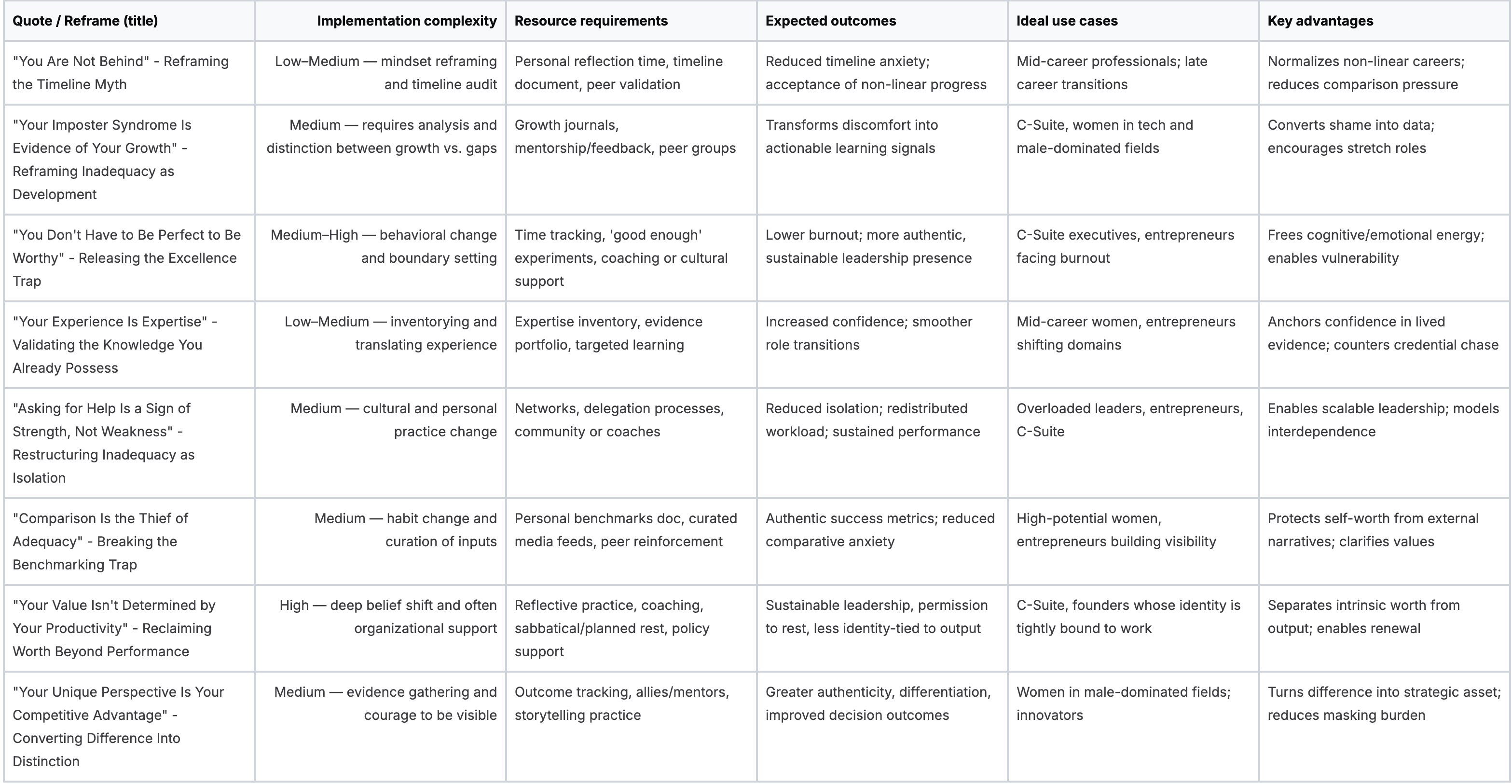
8-Quote Comparison: Reframing Inadequacy
Beyond Quotes: Your Return to Sovereign Leadership
The quotes we've explored are more than just comforting words; they are precise diagnostic tools. Each one illuminates a specific fracture point in your leadership foundation, a place where external expectations have overridden your internal authority. From reframing imposter syndrome as a sign of your own rapid development to dismantling the illusion that perfection equals worth, these insights serve a single purpose: to guide you back to yourself. The persistent, nagging feeling of inadequacy is not a sign of your personal failure. It is a critical signal from your nervous system, an alert that you are operating out of alignment with your core self.
This collection of feeling inadequate quotes acts as a mirror, reflecting the specific ways you may have internalized external pressures and benchmarks. The goal is not simply to collect and admire these reflections, but to use them as a starting point for tangible, systemic change in your leadership approach.
From Insight to Action: Reclaiming Your Authority
Recognizing the patterns of inadequacy is the first step. The true work lies in dismantling them and building something stronger in their place. This is not about adding more stress or another item to your already overflowing to-do list. It is about a fundamental return to a state of sovereign leadership, grounded in your intrinsic value, not your relentless performance. The key takeaways from this journey include:
Your Internal Narrative is Malleable: The stories you tell yourself about your worth, your timeline, and your capabilities are not fixed. You have the power to consciously rewrite them, replacing comparison with self-validation and the demand for perfection with an appreciation for growth.
Inadequacy is a Symptom, Not a Disease: The feeling is a surface-level indicator of a deeper misalignment between your actions and your core identity. By addressing the root cause, such as a dysregulated nervous system or a leadership style built on external validation, the symptom naturally dissipates.
Action Creates Sovereignty: True confidence isn't found in a quote; it's forged in the small, consistent actions you take to honor your own needs, expertise, and perspective. Asking for help, setting a boundary, or trusting your unique experience are the practical applications of these insights.
You have now seen the map. You have identified the territories where you've cede your power. The final, most important step is to begin the journey back home, to the leader you were before the world told you who you were supposed to be. It's time to move beyond managing the feeling of inadequacy and start building a leadership presence where it simply cannot survive.
Feeling inadequate is a pattern, not a permanent state. The Baz Porter methodology provides a system to break that pattern at the nervous-system level, restoring your innate authority. If you are ready to stop managing inadequacy and start leading with unshakeable self-sovereignty, learn more at Baz Porter.