Feeling Inadequate at Work? How to Rewire Your Mind for Confidence
The meeting ends, and the silent critique begins. “Did I say the right thing? Am I adding any real value here? They all see I’m out of my depth.” It’s a familiar internal monologue, the gnawing feeling that you are one mistake away from being completely exposed as a fraud.
You've hit every target, earned every promotion, and secured your seat at the table. Yet, the voice in your head tells a story of quiet panic, of the relentless, exhausting pressure to prove you belong.
This isn't a character flaw. It’s a predictable biological response to sustained, high-pressure environments. That feeling of being "not enough" is your nervous system caught in a survival loop, a pattern that keeps you striving but never arriving.
Key Takeaways
Before we dive deeper, here are the essential shifts this article will guide you through:
Understand the Root Cause: Discover the neuroscience behind the "Performer's Trap"—why your brain interprets professional pressure as a survival threat and locks you in a cycle of self-doubt.
Implement the RAMS Framework: Learn a tangible system (Results, Attitude, Mastery, Systems) to dismantle inadequacy and build sovereignty from the inside out, shifting from external validation to internal command.
Master Nervous System Regulation: Acquire practical, body-based tools like Box Breathing and Grounding to immediately calm anxiety and regain control in high-stakes moments.
Why Do I Feel So Inadequate at Work?
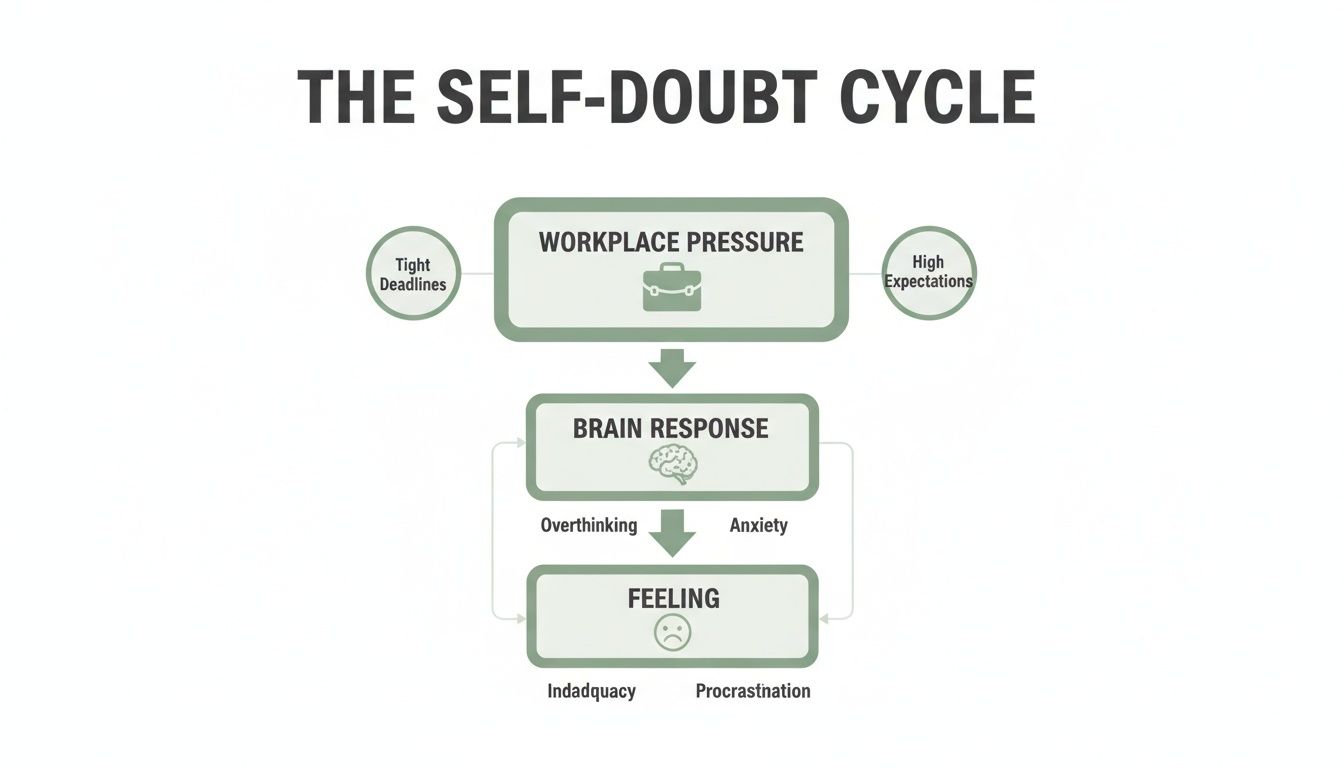
That constant feeling of inadequacy isn't a personal failure; it's a deeply ingrained biological response. Your nervous system is a survival machine, hardwired to detect threats. In a high-stakes professional environment, this ancient system misinterprets pressure, a tight deadline, critical feedback, a new project, as a genuine danger, triggering a primal fear of being cast out of the tribe.
The Hidden Pattern – Your Biology on High Alert
The silent collapse for high achievers often begins with a paradox. Your resume is a highlight reel of accomplishments, but your internal reality is a storm of self-doubt. You meticulously prepare for every meeting, double-check every email, and work longer hours than anyone else. Why? Because you’re driven by a gnawing fear that your last success was just a fluke.
This isn't a fleeting moment of insecurity; it's a chronic state of high alert. The script playing on a loop in your head is unforgiving: “If I stop performing, I will disappear.” This cycle, which I call the "Performer's Trap," is an invisible cage where each success only raises the stakes and deepens the anxiety. This is a systemic issue, not an individual failing; studies from sources like the American Institute of Stress show that overwhelming job pressure is a leading cause of workplace stress, feeding directly into these feelings.

This gnawing feeling is more than just imposter syndrome. It’s the hidden cost of success for many high-achievers, a pattern that keeps you striving but never actually arriving. You can learn more about how to stop feeling 'never enough' and reclaim your energy in our detailed guide.
The Amygdala: Your Brain's Smoke Detector
Deep in your brain, the amygdala acts as a hyper-vigilant smoke detector. When it perceives a threat, like sharp feedback or the weight of a high-stakes project, it hits the panic button, flooding your system with stress hormones like cortisol. This is your fight-or-flight response, a brilliant system for escaping physical danger, but in an office, it manifests as:
Vicious Self-Criticism: Your brain frantically scans for your own weaknesses to "fix" them before you’re exposed.
Anxious Over-Preparation: You work insane hours, trying to control every variable.
Crippling Fear of Failure: The amygdala sees failure not as a learning opportunity, but as a direct threat to your safety and place in the tribe.
When you’re constantly under pressure, your amygdala becomes overactive, keeping your nervous system stuck in a permanent state of high alert. This chronic stress is the biological fuel that feeds the feeling of inadequacy.
How Your Nervous System Learns Inadequacy
Your nervous system is a learning machine. When you repeatedly experience a cycle of intense performance followed by brief relief (or criticism), your brain learns a distorted lesson: "The only way to be safe is to be flawless."
This conditioning forges a deep-seated belief that your value isn’t inherent. It’s something you must earn, day after day, through the grind of external validation. You get hooked on approval because, on a biological level, it feels like survival itself.
This pattern is a fast track to burnout. Trying to "think your way out" of this deeply ingrained physiological state with simple affirmations will fail because you can't reason with a nervous system in survival mode. The solution isn't to try harder; it's to regulate this primal response. Getting a handle on this cycle is non-negotiable, and we cover more strategies for how to recover from burnout in our detailed guide.
Understanding these biological roots allows you to shift from self-blame to grounded awareness. Your feelings aren't a sign that you're broken. They are a logical response to an unsustainable way of working.
The RAMS Reframe - Reclaiming Your Professional Sovereignty
Knowing why you feel inadequate is one thing. Reclaiming your power is another. To move from the nagging feeling of not being good enough to genuine confidence, you need a new operating system, one that doesn't run on the volatile fuel of external validation.
This is where you stop managing symptoms and start re-architecting your professional life using the RAMS framework, a structured approach designed to build internal sovereignty.
Introducing The RAMS Framework
The RAMS framework, Results, Attitude, Mastery, and Systems, is your blueprint for dismantling the inadequacy trap. It’s a practical method for shifting from a reactive, threat-based mindset to a proactive, grounded state of leadership.
Pillar 1: Results Reimagined
In the inadequacy trap, "results" are about external validation, promotions, praise, public recognition. This turns your career into a high-stakes performance where your self-worth is always on the line.
The RAMS reframe shifts the definition of Results from external praise to internal alignment and meaningful impact.
Define Your Own Scorecard: You define what a "win" looks like, separate from KPIs set by others.
Focus on Impact, Not Applause: Shift your attention from how your work is perceived to the tangible value it creates.
Celebrate the Process: Acknowledge the effort and learning, not just the final outcome. This decouples your sense of accomplishment from unpredictable external feedback.
Pillar 2: Attitude as Regulation
Your attitude isn't about forcing a smile. It's about the baseline state of your nervous system. When you're stuck in inadequacy, your default "Attitude" is high alert.
The RAMS reframe focuses on actively regulating your physiological state to cultivate a grounded Attitude.
This means learning tangible techniques to shift out of a threat-based mindset. You cannot think your way out of a feeling you've embodied. You must learn to regulate your body first. To really get a handle on this, focusing on tangible improvements in your daily output is key. Explore powerful strategies to improve work performance that can help you regain control and boost your productivity.
Pillar 3: Mastery of Self
Traditional "Mastery" focuses on job skills. This external focus can feed inadequacy because there's always more to learn.
The RAMS reframe expands Mastery to include the most critical skillset of all: mastering your own internal state.
This is the art of self-regulation. It is recognizing the internal script of self-doubt and choosing not to engage with it. It’s the ability to feel the surge of adrenaline before a big presentation and consciously bring your heart rate down.
Self-mastery involves:
Interoception: Developing awareness of your internal bodily signals.
Emotional Differentiation: Learning to distinguish between productive concern and debilitating anxiety.
Boundary Setting: Mastering the ability to say "no," a core tenet of our work in Leadership Sovereignty Mastery.
This internal mastery is the true source of unshakable confidence. When you know you can manage your internal state, external pressures lose their power.
Pillar 4: Systems for Sustainability
Feeling inadequate is often a result of unsustainable work habits. Relying on sheer willpower is a guaranteed recipe for burnout.
The RAMS reframe emphasizes creating personal and professional Systems that foster sustainable performance.
These systems act as scaffolding, supporting you so you don't have to rely on a finite supply of willpower. Examples include:
A "Shutdown" Ritual: A clear routine to mark the end of the workday, signaling to your brain that it's time to rest.
Scheduled "Deep Work" Blocks: Time-blocking to protect your focus from endless distractions.
A Personal "Board of Directors": A trusted circle of mentors and peers for support and guidance.
The Inadequacy Trap vs. The RAMS Reframe
This table highlights the fundamental shift from the old, stress-inducing approach to the sovereign leadership principles of the RAMS framework.

Adopting the RAMS framework is a conscious choice to stop playing a game that thrives on your self-doubt. It is the practical path to reclaiming your professional sovereignty.
The Return - Practical Tools for Building Real Confidence

The RAMS framework is the map, but change happens in the moment. You need simple, powerful tools to manage your nervous system when anxiety strikes. These are not just "relaxation" exercises; they are nervous system regulation tools. Each time you use them, you are actively rewiring your brain's response to stress.
The Five-Minute Reset with Box Breathing
When you feel that tightness in your chest, that’s your nervous system signaling a threat. Box breathing is a technique used by elite performers to restore calm. It works by influencing the vagus nerve, which helps regulate your heart rate and shift you out of fight-or-flight.
Inhale for four seconds through your nose.
Hold for four seconds.
Exhale for four seconds through your mouth.
Hold for four seconds.
Repeat this cycle for 3-5 minutes. The steady rhythm breaks the chaotic loop of anxious thoughts.
The Grounding Body Scan
Feeling inadequate at work often feels disconnected. A body scan pulls you out of your head and into the present moment.
Sit with your feet flat on the floor.
Bring awareness to your feet: Notice the solid pressure against the floor.
Slowly move upward: Systematically bring your attention to your ankles, calves, knees, and so on. Just observe any sensations without judgment.
Continue through your torso, arms, and head.
This practice takes just a few minutes but powerfully reminds your brain that you are physically present and safe. It's a foundational skill for understanding how to be assertive at work, as true assertiveness comes from a place of grounded confidence.
The Deconstruction Journaling Prompt
Vague, generalized self-criticism fuels inadequacy. This prompt deconstructs those feelings, robbing them of their power. The next time you feel "not good enough," answer these three questions honestly:
What is the exact thought? (e.g., "I will fail this project and everyone will see I'm incompetent.")
What is the objective evidence FOR this thought? (Stick to cold, hard facts.)
What is the objective evidence AGAINST this thought? (List your past successes, relevant skills, and available resources.)
This shifts you from emotional overwhelm to rational analysis, proving that your feelings are not always facts.
The Path Back to Your Authentic Self
The way out of the inadequacy trap isn’t about piling on another achievement. It’s about subtraction, stripping away the conditioning that taught you your value is something you must earn through exhausting performance.
The goal isn't to become a flawless version of yourself. It’s about coming home to the authentic self that’s been buried under the pressure.
True, lasting confidence is an internal state, a felt sense of being grounded and centered in your own body, in command of your nervous system. It’s the quiet power that comes from knowing you are enough, right now.
From Proving to Embodying
This is the shift the RAMS framework is designed to create. It’s a process to guide you away from proving your worth and toward embodying your value. When you make this shift, the constant feeling of being inadequate at work finally loses its power.
This return to self is the most profound act of leadership you can undertake. It is the shift from a career built on fragile validation to a legacy built on authentic, embodied presence.
Your Next Step Toward Sovereignty
You’ve seen the patterns, you understand the science, and you have a framework. But insight without action is just an interesting idea. Moving from the inadequacy trap to authentic leadership requires deliberate practice.
If this has resonated with your experience, your next step isn’t another solo effort. It’s about getting a clear map for your path. This isn't a sales pitch; it's an invitation to return to yourself. It's time to stop navigating this complex internal landscape alone.
Book a diagnostic call today, and let’s map your personalized path back to the powerful, effective leader you already are.
Your Questions About Workplace Inadequacy, Answered
When you're wrestling with feelings of not being good enough at work, questions are bound to come up. Let's tackle some of the most common ones head-on to bring some clarity to what you're experiencing and light the path forward.
Is This Just Imposter Syndrome?
While they're related, they aren’t the same. Imposter syndrome is the specific fear of being exposed as a fraud, despite evidence of your success. Feeling inadequate at work is a broader umbrella that includes imposter syndrome but also covers feelings of not being skilled enough, prepared enough, or simply enough, even without the distinct "fear of being found out." If that specific fraud-like feeling is hitting home, we have a guide dedicated to helping you navigate imposter syndrome at work in our dedicated guide.
How Do I Know if It’s Me or a Toxic Job?
It's almost always a dance between the two. Your internal wiring and external environment can lock into a feedback loop. A good way to untangle it: Do these feelings follow you from job to job? If so, the roots are likely in your nervous system patterns. However, a toxic workplace with unclear expectations, relentless criticism, or zero support will pour gasoline on that fire. The RAMS framework builds the resilience to see what’s yours, what’s theirs, and how to navigate any professional setting.
How Long Until I Start to Feel a Real Difference?
You can feel immediate relief. In a high-stress moment, a technique like box breathing can calm your nervous system in minutes, giving you a real-time sense of control.
But building lasting change is a deeper process. Most leaders I work with feel a significant shift in their baseline stress and confidence within a few weeks of consistent practice. The profound, unshakable changes tend to lock in over several months of dedicated work.
This is a path of creating sustainable shifts, not hunting for quick fixes. As you go, you might find it helpful to explore further insights on workplace well-being from other trusted experts. Every step you take builds a new foundation of lasting self-trust.
Where to go next
If any of this reads like your own reflection, the Silent Collapse Diagnostic™ is a quiet place to start. And if you want the deeper why beneath the work, read the Sovereign Manifesto.