
The Executive Coach Service for High-Achieving Women
An executive coach service for high-achieving women in collapse isn't a perk. It's a clinical intervention for leadership breakdown. The market itself shows the category's weight: global executive coaching was valued at $103.6 billion in 2025 and is projected to reach $161.1 billion by 2030, with reported average returns of 5 to 7 times the investment when done well.
You still hit the targets.
You still lead the room.
You still know how to sound certain when your body is sending a different message.
No one sees the lag after the meeting.
No one sees the blank stare in the car.
No one hears the private sentence repeating in your head.
If I slow down, everything falls apart.
This crucial insight often goes unnoticed. You are not merely tired. You are not badly organised. You are not failing because you need another planner, another retreat, or another polished leadership slogan. You are functioning at a high level while your internal command system is failing in plain sight.
I know this pattern. I was trained in systems where hesitation had a cost. My British military formation taught me to read breakdown early. In women at the top, the breakdown rarely looks dramatic. It looks efficient. It looks composed. It looks expensive. It looks praised.
That is why a real executive coach service matters. Not for optics. For diagnosis.
Table of Contents
What an Executive Coach Service Diagnoses
You Have Everything. Why Do You Feel Nothing? An Executive Coach Service Can Diagnose Why.
You built the career.
You earned the authority.
You became the one everyone depends on.
And now your wins land flat.
You finish the quarter and feel nothing. You hit the number and feel nothing. You walk into your house still carrying the meeting in your chest. You are performing competence while privately negotiating with depletion.
I see this in women who are praised for resilience. They are not resilient. They are over-adapted. They have learned to stay useful long after the self has gone offline. If that sounds familiar, read executive dysregulation in leaders.
Silent Collapse hides behind performance: Outward success can mask internal breakdown for years.
A true executive coach service diagnoses function: It does more than sharpen communication or confidence.
Generic burnout language is often too blunt: It misses identity fracture, self-betrayal, and nervous system overload.
Recovery starts with precision: If the diagnosis is wrong, the protocol will fail.
An executive coach service should identify whether you're facing a skill gap, a role transition problem, or a deeper operating-system failure. For high-achieving women in Silent Collapse™, the purpose is not surface performance enhancement. The purpose is to rebuild the leader's core operating system so she can move from collapse to Sovereign Leadership™ without self-betrayal.
Practical rule: If the service can't tell the difference between exhaustion and identity collapse, it isn't diagnostic. It's decorative.
What it must assess
Most women I speak to have already tried to solve this with efficiency. Better scheduling. Better boundaries. Better language in meetings. None of that touches the breach if the breach is internal command failure.
A real diagnostic lens examines:
Decision integrity
Are you making decisions from clarity, or from fear of fallout?Energy truth
Are you tired, or are you leading from sustained internal override?Identity coherence
Does your public authority match your private reality?Relational cost
Are the people around you receiving your leadership, or your depletion?
That is the difference between coaching as convenience and coaching as intervention.
The Unseen Diagnosis Behind Your Success
Most coaching language stops at burnout. I don't.
Burnout describes exhaustion. It doesn't fully explain why a woman can remain highly productive while feeling detached from her own life. It doesn't explain why praise starts to feel like static. It doesn't explain why a leader can still execute while internally disappearing.
That condition is Silent Collapse™.

I use the term because the standard language is too soft. Silent Collapse is what happens when external structure keeps running after internal structure has fractured. The woman is still visible. The title is still intact. The calendar is still full. But the command center is no longer governing cleanly.
Read that again. She is not weak. She is split.
The hidden pattern
The best metaphor I have for this is a building with a perfect facade and compromised load-bearing walls.
From the street, it looks premium. Inside, the stress lines are spreading. Staff don't always see it. Boards don't always see it. Family often doesn't see it until the woman either goes numb, turns volatile, or disappears into constant work because stillness exposes the damage.
This is why generic advice fails. It treats the facade. It does not inspect the structure.
The public material in executive coaching still leaves this underdeveloped. One source notes that the Silent Collapse paradox in high-achieving women executives remains largely unaddressed, while a separate framework on transition identifies a 40% failure rate in newly promoted vice presidents due to psychological complexity. Even that misses the cumulative identity breakdown in women aged 40 to 55 whose success masks internal fracture, as outlined in this analysis of the peer-to-leader paradox and the unmet identity gap.
The Silent Collapse paradox in high-achieving women executives remains largely unaddressed in mainstream executive coaching content.
That gap matters. If the field doesn't name the condition, the client keeps misreading the symptoms. She assumes she needs more stamina. In truth, she needs a different command model.
Why women misread this condition
High-achieving women are often rewarded for anticipatory control. They read the room early. They absorb complexity early. They over-function early. The skill gets promoted. The cost gets buried.
By mid-career, the same adaptation can become a trap. She can no longer tell the difference between responsibility and self-erasure. She can no longer tell whether her discipline is serving the mission or consuming the self.
I've watched women describe this as "brain fog," "just stress," or "a bad season." Sometimes there are overlapping factors that intensify the picture. For some women, attentional strain has been present for years but never recognised. If that possibility is relevant, this clinical overview on ADD in high-achieving women adds useful context.
The key point is simple. Silent Collapse is not laziness, fragility, or poor mindset. It is a leadership condition with biological, relational, and identity consequences.
If that lands hard, read success dysregulation in executive women.
Why standard coaching misses it
Conventional coaching often asks better questions. Fair enough. But better questions alone don't rebuild authority when the authority has become performative.
I was trained to identify failure points before they become visible disasters. In military terms, Silent Collapse is not a morale problem. It is degraded command under sustained pressure with no true reset. The leader still issues orders. The system still moves. But accuracy falls, trust thins, and the cost of one more quarter gets steeper.
When a woman says, "I have everything I wanted. Why do I feel nothing?" I don't hear ingratitude. I hear a system in override.
That is the unseen diagnosis behind her success.
The RAMS Method A Clinical Framework for Sovereignty
Most women in Silent Collapse don't need more reflection. They need a protocol.
That is why I use the RAMS Framework™. My military formation taught me to distrust vague improvement. If a condition is real, the response must be structured. RAMS gives that structure. It names how success itself gets weaponised against the woman, then rebuilds leadership so power no longer requires self-betrayal.
The standard in strong coaching is not endless conversation. It is disciplined execution. In elite coaching, the 70/30 rule means 70% client-driven action and 30% coach-facilitated dialogue, and programmes that pair structure, defined outcomes, self-ratings, and business signals show an 85% success rate in aligning personal transformation with organisational metrics, according to this executive coaching framework analysis.

That matters because women in collapse often consume insight and call it progress. It isn't. Progress changes behaviour, workload design, decision quality, and personal truth.
An anonymised example. A founder came to me after years of growth, recognition, and private depletion. She wasn't disorganised. She was over-commanding every part of the business because control had become her emotional stabiliser. The company looked healthy. She did not. We didn't start with confidence. We started with command failure.
You can read the formal breakdown of the RAMS Method framework.
Comparison of States
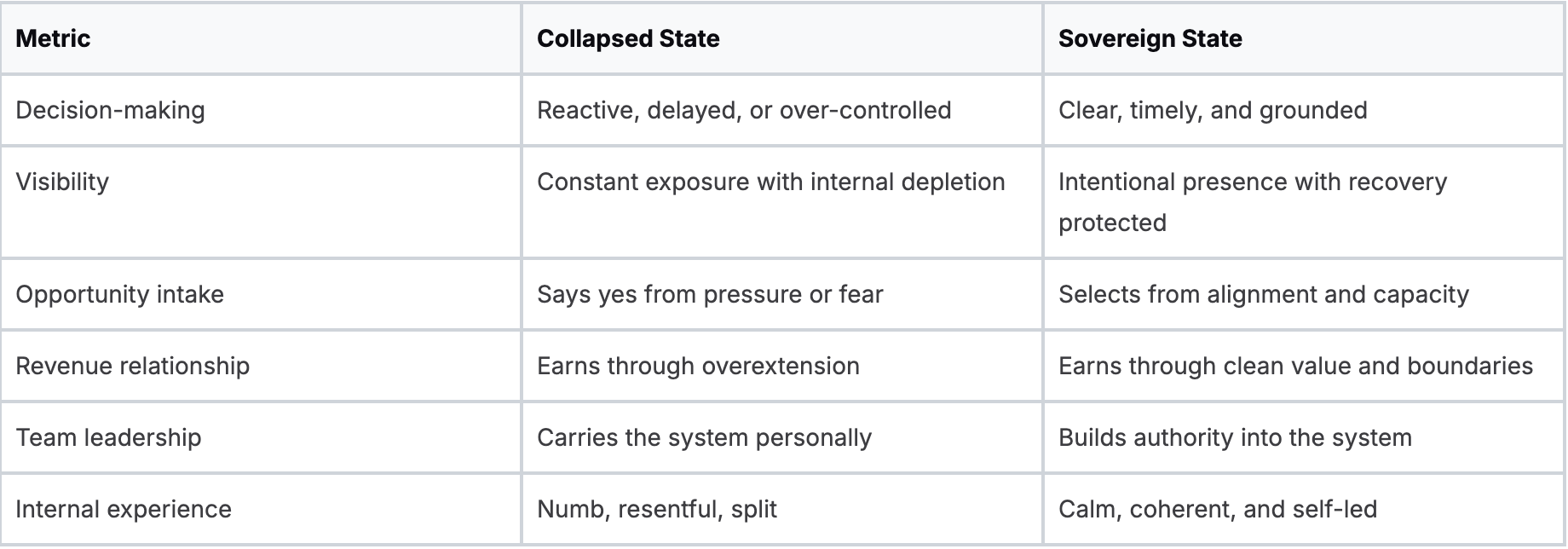
Reach
In collapse, Reach becomes overexposure.
The woman stays visible because visibility has become proof of relevance. She keeps speaking, posting, leading, replying, rescuing, attending, smoothing, and carrying. She calls it responsibility. Often it's fear. If she steps back, she fears the whole structure will expose itself.
That is not influence. That is survival through presence.
I tell clients this plainly. Visibility can be weaponised against recovery. The more everyone can reach you, the less access you have to yourself.
How Reach collapses a leader
She becomes the emotional regulator for the room
Everyone borrows her steadiness. No one notices its cost.She mistakes responsiveness for leadership
Fast replies feel competent. They also shred concentration.She confuses constant access with value
Her presence becomes expected, not strategic.
The founder I mentioned earlier was in every critical thread. Every escalation route ended with her. Her business had scale in theory and dependence in practice.
The sovereign version of Reach is different. Presence becomes intentional. Access is governed. Influence is directed, not leaked.
Rebuilding Reach
Audit where your presence is performative
List the meetings, channels, and decisions where you appear to prevent anxiety, not to create value.Separate signal from availability Leadership signal is what your presence means. Availability is access. They are not the same.
Design protected absence
If your team cannot function without your constant touch, you don't have reach. You have dependency.
A sovereign leader isn't hard to reach because she is aloof. She is hard to interrupt because her command has architecture.
By the end of this phase, clients often notice a hard truth. They weren't leading through reach. They were anaesthetising fear through constant relevance.
Acquire
In collapse, Acquire becomes compulsive intake.
She acquires more business, more responsibility, more clients, more hires, more complexity, more praise, more proofs. She keeps taking in because stopping would force contact with the emptiness underneath.
High performers become dangerous to themselves. They can convert distress into output so efficiently that no one intervenes.
The woman I worked with kept saying yes to opportunities she no longer respected. Every one of them looked sensible from the outside. None of them reduced internal friction. Her life had become a series of externally valid but internally corrosive acquisitions.
What she chases that deepens collapse
More opportunities than her system can metabolise
More recognition to outrun internal doubt
More commitments that preserve image
More control disguised as standards
There is no dignity in endless intake. There is only accumulation.
The sovereign version of Acquire is selective. A woman in this state doesn't ask, "Can I do this?" She asks, "What does this cost my command?"
Rebuilding Acquire
Define the true objective
Not the polite objective. The true one. Relief, status, protection, approval, revenue, escape.Refuse misaligned acquisition
If the opportunity expands pressure while shrinking authority, it is contamination.Set acquisition criteria before emotion hits
Decide in advance what qualifies. In collapse, unstructured decision-making gets hijacked by urgency.Measure after-effect, not just upside
The question is not whether the opportunity is impressive. The question is what version of you it requires.
I often say this to women who are overbuilt and underfed. Acquisition without sovereignty is just elegant self-abandonment.
The founder began declining work that looked prestigious but demanded distorted access. Revenue did not disappear. Distortion did.
Monetize
In such circumstances, many women tell themselves the suffering is justified.
In collapse, Monetize becomes extraction. She turns capability into revenue through over-functioning, perfection, and emotional labour that never makes it onto the invoice. She earns, but she bleeds value while doing it.
This is common in both executives and founders. The executive absorbs unpriced relational burden. The founder overdelivers to maintain certainty. Both call it professionalism. Both pay in nervous system debt.
Signs Monetize has been corrupted
Your best work depends on pressure
You underprice the cost of your access
You carry relational labour no one names
Your performance rises while your inner life collapses
Many coaching engagements falter. They help the woman cope with the extraction instead of ending it.
The sovereign version of Monetize restores clean exchange. Value is created without requiring collapse as the fuel source.
Rebuilding Monetize
Identify where exhaustion props up your economics
Which parts of your role or model still depend on heroic effort?Price access, not only output
If people are buying your judgment, your calm, your speed, or your containment, that is part of the value.Remove invisible labour from default mode
Stop assuming you must absorb confusion to prove leadership.Tie delivery to sustainable standards
If your current standard can only be maintained by internal damage, it is not a standard. It is a leak.
This is one place where an executive coach service should be brutally practical. Contracts should define a small number of outcomes, track self-ratings, and connect personal change to real business signals. If it stays abstract, the old patterns survive under new language.
One factual option in this category is Baz Porter, whose work applies Silent Collapse™ and the RAMS Framework™ to high-achieving women rebuilding authority after burnout.
Revenue earned through self-betrayal always looks stronger on paper than it feels in the body.
The founder's shift here was stark. She stopped compensating for weak systems with personal overdelivery. The business became less dramatic. Her authority became more credible.
Scale
In collapse, Scale is usually fantasy built on a broken base.
The woman says she wants freedom. Often she has built expansion on personal vigilance, so every growth move increases fragility. More staff means more oversight. More clients means more leakage. More visibility means more pressure to remain impossible.
That isn't scale. It's multiplication of strain.
What false scale looks like
The team grows, but all important decisions still bottleneck through her
Revenue expands, but recovery time disappears
Authority increases, but self-trust decreases
The system looks larger, but the woman feels smaller inside it
The sovereign version of Scale is systematised authority. The business, function, or team can extend because the leader is no longer acting as the missing process.
Rebuilding Scale
Stop scaling compensations
If you're still compensating for unclear roles, weak standards, or emotional dependence, growth will magnify those failures.Build authority into the structure
Decision rights, escalation paths, communication standards, and role ownership must exist outside your mood and availability.Protect the leader's signal
The more senior you become, the more your timing, focus, and judgment matter. Scale requires guarding them.Use recovery as strategy
A depleted leader may still function. She cannot govern cleanly for long.
The founder eventually reached the point most women fear. She became less central to daily motion. Nothing fell apart. In truth, the drama around her had been hiding how much unnecessary dependency she had trained into the system.
That is what Sovereign Leadership™ makes possible. Not softness. Not withdrawal. Command without collapse.
If what you've read feels uncomfortably precise, take the Silent Collapse Diagnostic. The Silent Collapse Diagnostic will name exactly where you are in the collapse cycle. It takes five minutes.
The Expected Return Nervous System Sovereignty
The return is not motivation.
Motivation is unstable. It rises with validation and drops with pressure. Women in Silent Collapse usually have no shortage of discipline anyway. The problem isn't willingness. The problem is that the body no longer trusts the life it has built.
I define return as Nervous System Sovereignty. That means your internal state is no longer being governed by urgency, over-responsibility, or concealed fear. You can hold authority without bracing. You can make decisions without splitting yourself in two.

In executive coaching, the business case and the human case finally meet. The executive coaching market was valued at $103.6 billion in 2025 and is projected to reach $161.1 billion by 2030, with average reported returns of 5 to 7 times the investment. Some reports cite up to 788% ROI when retention effects are included, according to this executive coaching market overview.
Those numbers matter, but not for the reason generally believed. They matter because they prove this category persists where value is visible. Organisations don't keep paying for interventions that produce no material effect. But for the woman in collapse, the first material effect is often internal. Her thinking clears. Her reactivity drops. Her need to over-control weakens.
What this return actually looks like
It looks ordinary from the outside.
She doesn't need to announce transformation. She stops leaking power through tension. Her calendar changes. Her decision speed changes. Her tolerance for misaligned work changes. Her team feels less of her pressure and more of her leadership.
I tell women this often. The point isn't to feel better all the time. The point is to become governable by truth again.
If you're trying to understand that state more fully, read nervous system regulation for leaders.
What doesn't count as return
A temporary high after a retreat doesn't count.
A stronger script in meetings doesn't count if you're still collapsing at home.
A cleaner morning routine doesn't count if your authority still depends on over-functioning.
The end state is not inspiration. It is internal command.
In military environments, composure is not cosmetic. It is operational. I bring the same lens here. If a leader cannot access calm authority under load, the system around her absorbs the distortion. Team friction rises. Decision quality slips. Personal life becomes recovery collateral.
Nervous System Sovereignty reverses that. You lead from grounded authority. You stop managing collapse and start ending the conditions that produce it.
Selecting a Coach A Clinical Decision Not a Chemistry Call
Most women choose a coach the way people choose a dinner guest. They look for chemistry. That is too weak for this condition.
This should be a clinical decision. Can the practitioner diagnose the difference between a performance gap and identity collapse? Many models use structured frameworks and assessments, including systems that map 20 behavioral dimensions, but those tools often identify symptoms rather than the root cause of identity fracture in high-achievers, as noted in this executive coaching guide on assessment-led models.
If you want a useful contrast in support style, this page on expert coaching guidance for adults shows how specificity matters when the underlying condition is easily misunderstood.
Use these criteria:
The coach names your condition precisely
The protocol goes beyond insight
The work includes structure, not just conversation
The coach can handle power, ambiguity, and resistance without flinching
For women evaluating this category, I’ve written more on coaches for women in executive recovery.
Questions on the Collapse and Recovery Cycle

Why do I feel empty even though I am successful?
Because success and self-connection are not the same thing. Existing executive coaching literature still shows a gap in gender-specific analysis of burnout and identity collapse, especially for women aged 40 to 55, with no specialised recovery framework beyond generic advice in much of the available material, as outlined in this review of the leadership gap.
Is it possible to recover my drive without burning out again?
Yes, but only if drive stops being fed by fear, proof, and over-responsibility. Recovery does not mean becoming less ambitious. It means ambition no longer requires self-betrayal.
Why don't standard wellness or coaching methods work for me?
Because many of them target relief, not command. If the method doesn't diagnose Silent Collapse™ specifically, it may soothe symptoms while leaving the operating failure intact.
If your results confirm what you already suspect, the next step is an application, not a sales call. I don't work with everyone. I work with women ready to stop managing their collapse and start ending it. Apply to Work With Baz
Author bio: British military veteran. Two-time international bestselling author. Founder, The Prestige Architect™. Host, Rise From The Ashes podcast on the C-Suite Network.