Executive Coach in the Tech Industry: End Silent Collapse
An executive coach in the tech industry is not a generic advisor. She needs a specialist who can diagnose leadership breakdown under pressure and rebuild how she leads, decides, and recovers. That matters in a market where executive coaching shows an average 5 to 7 times return on investment, and one landmark study quantified 788% ROI through gains in productivity, retention, and leadership effectiveness.
You are still performing. That’s the problem.
Your calendar is full. Your numbers hold. Your team still sees a composed operator. But your interior world is thinning out. You finish the quarter and feel nothing. You win and feel relief, not satisfaction. You tell yourself you’re tired. I’ll say it cleanly. Tired is not the diagnosis.
An executive coach in the tech industry should be trained to spot collapse long before your title, compensation, or board deck show it. For a senior female leader, that means rebuilding leadership as a system. Not polishing confidence. Not handing you another productivity ritual.
Silent Collapse™ is not ordinary burnout. It’s what happens when performance stays high while identity, recovery, and internal safety erode.
Generic coaching is too soft for tech pressure. You need a coach who understands high-stakes decision cycles, velocity, scrutiny, and the female cost of surviving inside them.
ROI matters, but it isn’t the first metric. The first metric is whether you can think clearly under pressure without betraying yourself.
The ultimate objective is Sovereign Leadership™. Calm authority. Clean decisions. No dependence on exhaustion to produce results.
Table of Contents
The Silent Collapse of the High-Performing Woman in Tech

You wake up tired after sleeping. You dread minor decisions. You resent people you once mentored with care. You want silence, but you keep saying yes.
That isn’t laziness. It isn’t fragility. It isn’t poor time management.
It’s Silent Collapse™.
What it looks like from the inside
You think, “If I slow down, everything falls apart.”
You think, “I have everything I wanted. Why do I feel nothing?”
You think, “I can carry this one more quarter.”
Then another quarter passes. The title stays. The applause stays. You disappear a little more.
This is common among women who learned to survive by being precise, useful, and indispensable. Tech rewards that pattern until it starts eating the person carrying it. The same traits that built your authority become the machinery of self-erasure.
Burnout in women leaders isn’t only about workload. It often carries identity pressure, role compression, and the strain of staying credible in rooms that still read authority through a male lens.
A McKinsey Women in the Workplace report found that women leaders are 1.5 times more likely than men to report burnout, and 40% of senior women cite identity-related pressure as a barrier to sustained performance.
Why ordinary language misses the problem
“Burnout” is too broad. It sounds like rest fixes it.
Sometimes rest helps the body. It doesn’t always restore the self.
Silent Collapse™ is different. Your output may still look excellent. Your team may still praise your calm. But your nervous system is no longer operating from safety. It’s running from threat, image maintenance, and consequence. You don’t feel driven. You feel trapped.
That’s why the usual advice lands flat. Delegate more. Take a day off. Go offline. None of that reaches the wound if your leadership identity has fused with over-functioning.
I’ve written elsewhere about executive dysregulation in high-pressure leadership. The point is simple. If your body reads leadership as danger, success won’t soothe you. It will corner you.
Why Tech-Specific Coaching is Non-Negotiable

Tech leadership is a high-stakes tightrope. You don’t get applauded for stepping off to recover. You get measured while crossing.
That’s why a generic coach often misses the mark. Tech compresses time. It normalizes volatility. It rewards constant cognitive switching. For women, it adds one more tax. You are expected to stay sharp, strategic, composed, collaborative, and never visibly overloaded.
The nervous system problem beneath the performance problem
When a leader stays under unresolved pressure, the body starts prioritizing survival over discernment. You can still function. You can still present. But your choices narrow. You become reactive in polished language.
That is the hidden pattern behind Silent Collapse™.
An executive coach in the tech industry should understand that your issue is not just workload. It’s the repeated pairing of authority with threat. Every earnings call, product pivot, board demand, staffing issue, and public visibility hit teaches the body one lesson. Stay alert or lose control.
Clinical reality: once hypervigilance becomes your default, rest feels unsafe and stillness feels irresponsible.
That’s why women in male-dominated environments often confuse activation with competence. If they aren’t braced, they think they’re slipping.
I’ve seen this repeatedly in women leading inside hard-charging cultures. I unpack part of that pattern in women in male-dominated industries.
Why the market is moving toward specialization
The broader industry sees the gap. The global executive coaching market is projected to reach $27 billion by 2032, with growth driven in part by tech’s demand for evidence-based support during C-suite transitions and disruption.
That growth doesn’t impress me on its own. What matters is why it’s happening. Leaders in tech can no longer afford coaching that stays at the level of personality, inspiration, or vague accountability. The pressure is too specific. The cost of internal collapse is too high.
What specialized coaching actually means
A real specialist in this field should be able to do three things:
Detect collapse under high performance before your role, revenue line, or reputation break.
Separate signal from stress so your decisions stop coming from physiological threat.
Rebuild leadership structure so authority no longer depends on self-abandonment.
If a coach can’t work at that level, she may still be useful. She just isn’t built for this fight.
How to Evaluate and Hire Your Executive Coach
Don’t hire a cheerleader. Hire an operator.
If you’re looking for an executive coach in the tech industry, treat the search like executive recruitment. You are not buying encouragement. You are selecting someone who can diagnose complex pressure patterns, challenge self-deception, and restore clean authority.
What matters and what doesn’t
Credentials matter. Lived leadership matters more.
A polished website is noise. So is borrowed language about purpose and fulfillment if the coach cannot explain what happens when a high-achieving woman starts performing through physiological strain. I’d rather see disciplined methodology, pattern recognition, and proof of real work under pressure.
The economics support taking this seriously. The average ROI for executive coaching is 5 to 7 times the initial investment, mainly through stronger productivity, retention, and team effectiveness.
Screen for this: can the coach describe how your behavior changes under stress, not just how your mindset should sound when it’s calm?
I’ve outlined some of the traps in hiring coaches for women. Most women don’t need more affirmation. They need sharper diagnosis.
The questions I’d tell you to ask
Use these in the first conversation.
What do you think I’m not seeing about my current pattern?
Listen for precision. If the answer stays generic, move on.How do you work with leaders who still perform well while privately deteriorating?
Silent Collapse™ often hides behind competence. They should know that.What is your method when stress distorts judgment?
If they can’t address nervous-system strain, they’re treating symptoms.What counts as success beyond business results?
You want clarity, steadiness, boundaries, and cleaner decision-making.What kind of client should not hire you?
Serious practitioners know their limits.
The signs to walk away
They over-focus on inspiration. Motivation spikes don’t rebuild leadership structure.
They mirror you too softly. If they won’t confront you, they can’t help you.
They sell certainty without method. Real work has a system.
They ignore context. Tech pressure and female leadership dynamics are not side notes.
A strong coach should leave you feeling accurately read, not flattered.
The RAMS Framework A System for Sovereign Leadership

I don’t use motivation to rebuild leaders. I use structure.
My proprietary system is the RAMS Framework™. Reach. Acquire. Monetize. Scale. The common interpretation of these words is business growth. I use them differently. I use them to expose where collapse lives inside your leadership pattern and how Sovereign Leadership™ replaces it.
A landmark Metrix Global study on executive coaching ROI quantified 788% ROI through gains in productivity, reduced turnover, and stronger leadership outcomes. That number matters because disciplined intervention changes results. Not by magic. By changing how leaders operate.
Reach under collapse versus authority
In collapse, visibility becomes a weapon against recovery. You stay reachable, available, and responsive because being seen as reliable has fused with being safe.
In sovereignty, reach becomes intentional presence.
Collapsed Reach means you overexpose yourself to demands. Every ping gets access to your nervous system.
Sovereign Reach means you decide where your leadership is required.
The shift is not hiding. It’s ending unnecessary access.
When everyone can reach you, no one is receiving your best leadership. They are consuming your fragments.
Acquire under collapse versus discernment
In collapse, you acquire more to prove stability. More meetings. More responsibility. More visibility. More strategic ownership.
That looks impressive. It also deepens dependency.
Ask what you are still chasing for identity insurance.
Strip out roles you keep only to avoid disappointing people.
Acquire only what aligns with your actual mandate.
Some leaders need simple planning tools to support this transition. If you need a clean structure for mapping capacity, these professional development plan templates can help you organize decisions without adding noise.
Monetize under collapse versus clean value
In collapse, you bleed value through over-functioning. You work harder than needed to maintain outcomes that should be produced by systems, boundaries, and stronger delegation.
In sovereignty, value stops leaking.
You stop pricing your leadership through personal depletion.
You stop rewarding chaos with your best energy.
You focus your effort where judgment, not just labor, creates value.
An executive coach in the tech industry earns her seat. She should be able to see where your exhaustion is subsidizing weak structures.
Scale under collapse versus Sovereign Leadership
Collapse scales dysfunction. If your current leadership depends on constant override, more growth only multiplies the strain.
Sovereign Leadership™ scales authority without self-betrayal.
Build decision hygiene.
Reduce unnecessary exposure.
Train your team to carry weight without emotional leakage from you.
Expand only what your nervous system can lead cleanly.
For a deeper explanation of the mechanics, I’ve broken down the RAMS Method by Baz Porter in more detail.
Leadership State Comparison Collapse versus Sovereignty
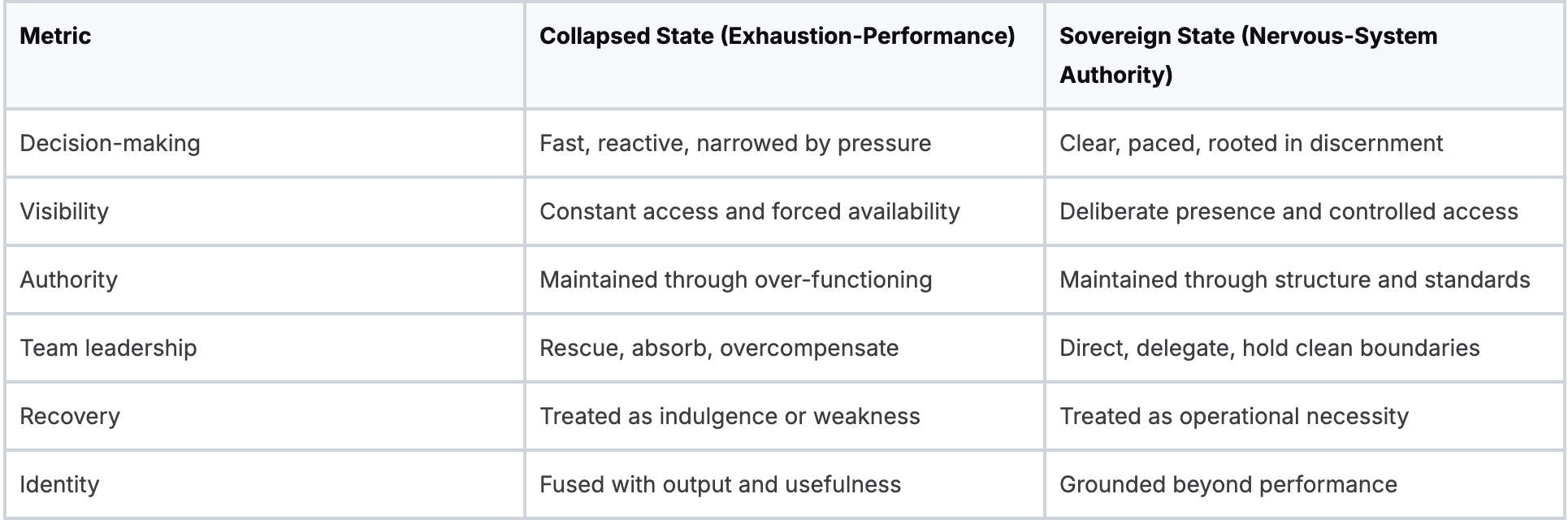
The first move isn’t guessing where you are. It’s naming it accurately.
The Silent Collapse Diagnostic will name exactly where you are in the collapse cycle. It takes five minutes.
Case Example From Collapse to Sovereignty

A client came to me after a major growth stretch in tech. Senior role. Strong compensation. Public credibility. Private erosion.
She said she wasn’t burned out. She said she was “just flat.” That word matters. High performers often sanitize collapse before they admit it.
What collapse looked like in practice
Her team relied on her for emotional containment and final judgment. She reviewed too much. She stayed reachable late. She accepted responsibilities that didn’t belong to her because she didn’t trust the downstream standard.
Outwardly, this looked like excellence.
Internally, she had lost access to herself. She couldn’t feel clean desire. Only duty. Even praise irritated her because it bound her tighter to the role that was draining her.
She did not need more resilience language. She needed her leadership pattern interrupted.
What changed
We worked through RAMS Framework™ as a structural reset.
Under Reach, she reduced access points and stopped treating immediate response as proof of commitment.
Under Acquire, she named which responsibilities she was holding for identity, not necessity. Several went.
Under Monetize, she identified where her personal depletion was covering weak team agreements. We rebuilt those agreements.
Under Scale, she stopped acting as the nervous system for the whole function.
I was trained in environments where pressure strips away fiction. That military formation still shapes how I work. Clean diagnosis first. No sentimentality. No performance theatre.
One option leaders consider in this kind of work is structured executive coaching through Baz Porter, where the focus stays on Silent Collapse™, Sovereign Leadership™, and the RAMS Framework™ for high-achieving women.
What changed most wasn’t mood. It was command. She stopped leading from bracing. Her decisions got quieter. Her presence got stronger. People around her felt less drama and more certainty.
That is what sovereignty looks like in real life.
The Return to Nervous-System Sovereignty
Motivation is unstable. Sovereignty is not.
The end state is not feeling up all the time. It is not constant peace. It is not a polished personal brand that hides chronic strain. The return is biological. Your body no longer treats leadership as a threat event.
That changes everything.
What sovereignty actually gives back
You recover without guilt. You make decisions without flooding. You stop confusing urgency with importance. You no longer need overwork to trust your own authority.
This is why I care less about surface confidence and more about regulation. If the body is still trapped in vigilance, confidence becomes costume.
If you want language for that deeper layer, this CEO's Guide to Biological Recovery is a useful read. It points toward the same truth. Recovery is not indulgence. It is operational.
I’ve also written directly about nervous system regulation for leaders, because many executives still try to solve a biological problem with calendar tactics.
Sovereign Leadership™ begins when your authority no longer depends on self-abandonment.
That is the core work of an executive coach in the tech industry. Not to help you cope better with collapse. To end the cycle that keeps creating it.
Frequently Asked Questions
Why do I feel empty even though I am successful
Because success can keep functioning after self-trust has started to erode. Silent Collapse™ often hides behind achievement. The outside still works. The inside goes numb.
Do I need an executive coach or just time off
If rest helps briefly but you return to the same braced pattern, time off isn’t the full answer. You likely need deeper leadership reconstruction, not just recovery time.
What should an executive coach in the tech industry actually help me change
She should help you change how you lead under pressure. That includes boundaries, decision quality, recovery, authority, and the link between identity and over-functioning.
If your results confirm what you already suspect, the next step is an application, not a sales call. I do not work with everyone. I work with women ready to stop managing their collapse and start ending it. Apply to Work With Baz
British military veteran. Two-time international bestselling author. Founder, The Prestige Architect™. Host, Rise From The Ashes podcast on the C-Suite Network.