Break Free From 'Doing What It Takes'
Doing what it takes has an operational ceiling. When leadership rebuilding follows an iterative system, success can reach up to 70%, compared with 13% to 50% for rigid approaches, and disciplined execution can raise success from 25% to over 65% when the work is managed like a real rebuild instead of a panic response. You already know this in your body. More effort isn’t saving you now. It’s finishing the collapse.
You woke up tired again, but tired isn’t the word.
You’re still performing. Still leading. Still carrying the room. People still call you capable, sharp, trusted, indispensable. Then the meeting ends, the win lands, the numbers move, and you feel nothing. Or worse, dread.
That’s the part almost nobody names.
You thought the finish line would bring relief. It brought exposure. Every new milestone now demands a larger piece of you. You don’t feel proud. You feel hunted by your own standard.
This is the private script running underneath your public life. If I slow down, everything falls apart. If I say I’m done, they’ll see I’m not who they think I am. If I stop producing, what remains?
You’re not lazy. You’re not weak. You’re not confused.
You’re over-adapted to pressure. Your system learned to survive by overriding itself. Now the override is permanent.
That’s why rest doesn’t work. Time off doesn’t touch it. A long weekend doesn’t reach the layer where the fracture lives. You don’t have a calendar problem. You have a leadership model built on self-abandonment.
I’ve seen this pattern enough to call it by its right name. But before I diagnose it, you need to see it clearly in yourself. If this lands hard, read the hidden cost of success for high-achieving women. It names the private tax of looking powerful while coming apart.
Doing what it takes stops working when the strategy that built success starts consuming the leader running it.
Silent Collapse™ hides behind performance. You can look stable, profitable, and respected while your internal system fails.
More discipline alone won’t solve this. A broken operating model only becomes more efficient at harming you.
The sustainable answer is a rebuild from an embodied, sovereign state, not from panic, guilt, or force.
Doing what it takes is not leadership when it becomes a permanent survival strategy. It’s a last-resort protocol that has outlived its mission. The only sustainable path forward is a systematic rebuild of your leadership model from a sovereign state, not through more effort.
Table of Contents
Introduction The Cost of Doing What It Takes
Victoria doesn’t look burned out.
She looks expensive. Controlled. Proven. Her calendar is full. Her team still leans on her. Her clients still trust her. Revenue may be fine. Reputation may be intact. None of that changes what happens when the room goes quiet.
She stares at the next target and feels resentment instead of ambition.
She finishes the launch and wants to disappear.
She gets praise and feels exposed.
That’s the cost of doing what it takes when the tactic becomes your identity. You stop leading from choice. You lead from compulsion. The outside world sees endurance. Your body reads emergency.
I’ve worked with women at this stage. They rarely say, “I’m collapsing.” They say, “I’m just tired.” Then they list the evidence that they’re still functioning, as if function disproves damage.
It doesn’t.
High performers can carry severe internal failure for a long time. In fact, performance often hides it. That’s why this phase is so dangerous. You can still execute while your self-trust, authority, and nervous system degrade in the background.
You can be too successful to get caught early.
The woman in Silent Collapse™ doesn’t need more inspiration. She needs an accurate diagnosis. She needs to stop mistaking over-functioning for strength.
The Diagnosis From High Achievement to Silent Collapse
The move from high achievement to internal breakdown is not random. It follows a pattern. Once you see it, you can’t unsee it.
The pattern beneath the performance
Your nervous system was built to detect threat and organize response. That capacity serves you well in short bursts. It becomes destructive when leadership itself is built on constant override.
In plain terms, you trained yourself to perform under strain. Then you kept going long after the strain became your normal.
The result is Silent Collapse™. External success masks internal breakdown. Your decisions get sharper in public and less trustworthy in private. You can still present authority while losing contact with yourself.

A useful metaphor is this. Your leadership system has been running on an override protocol for so long that the protocol itself became the threat. What once helped you survive pressure now strips precision, trust, and meaning from everything you do.
A 2023 McKinsey study found 42% of women leaders reported burnout vs. 35% of men, with mid-career women 1.5x more likely to experience identity collapse after peak achievement, yet only 15% of leadership resources offer gender-specific, systematic transitions from exhaustion to authoritative clarity. women leaders and burnout findings
That gap matters. Most women in this state are handed soft language and generic self-care. That misses the failure entirely.
If your system is already dysregulated, deeper clinical support may be necessary alongside leadership reconstruction. That’s where resources like reVIBE Mental Health's burnout care can help address the mental health layer without pretending the leadership layer will fix itself.
Why high performers miss the warning signs
Women like Victoria don’t ignore the signs because they’re unaware. They ignore them because the signs have become familiar.
The body tightens before every important conversation. Sleep gets lighter. Joy flattens. Irritation rises. Decisions become more forceful and less clean. She notices all of it. Then she translates it into duty.
I’m just in a demanding season.
That sentence has buried more collapse than most crises ever did.
High-achieving women are often rewarded for early threat detection, quick response, and self-suppression under pressure. Those traits build careers. They also create a dangerous blind spot. The system starts reading stillness as risk and intensity as safety.
That is why slowing down can feel intolerable. It isn’t because rest is wrong. It’s because your body has linked non-performance with danger.
Clinical rule: If relief makes you anxious, the issue is no longer workload alone. It’s conditioning.
I’ve written about this deeper layer before in executive dysregulation. The pattern is not moral. It is operational. That distinction matters because shame blocks rebuilds.
The clinical label matters
Naming the pattern changes the response.
If you call it stress, you’ll manage symptoms. If you call it fatigue, you’ll seek recovery. If you call it Silent Collapse™, you’ll understand that the leader herself is being consumed by the strategy she used to win.
That’s the diagnosis.
Not burnout as a vague complaint. Not tiredness as a passing phase. A system failure hidden by competence.
Once that’s clear, the work changes. You stop asking how to keep enduring. You start rebuilding the operating system.
The RAMS Reframe A Systematic Path to Sovereign Leadership
A woman can run a company, carry a family, hold a team together, and still be operating from a body that has not felt safe in years.
That is the failure point.
I do not treat this as mindset work. I treat it as system rebuild. Women who read slowing down as weakness do not need softer language. They need a command structure that rebuilds leadership from the nervous system up. That is what RAMS Framework™ does. Reach. Acquire. Monetize. Scale.
It is military-derived, structured for real pressure, and built to hold under changing conditions. Rigid recovery plans break the first time the calendar fills, a client escalates, or a child gets sick. A living system has to adjust without throwing the leader back into overdrive. Research on adaptive project methods supports that approach, as shown in these Agile success benchmarks.
You do not need inspiration. You need a method.
Reach stops being a survival reflex
In collapse, reach gets distorted. You stay available to prevent backlash. You stay visible to prevent irrelevance. You answer fast, overexplain, and keep your hand in every thread because your body reads distance as danger.
That is not influence. That is threat management.
Reach in RAMS Framework™ means deliberate access. You decide where your presence creates command and where it only feeds compulsion.
Use this sequence:
Audit every open access point.
Meetings. Messages. Slack channels. Approvals. Personal check-ins. Emotional cleanup. If people can pull on you at will, your leadership has no perimeter.Separate strategic visibility from fear-based exposure.
Some rooms require your presence. Others only soothe your anxiety about being left out.Close the routes that bypass discernment.
Default access trains everyone around you to treat your nervous system like public infrastructure.Rebuild presence through decision, not guilt.
Show up where authority is required. Exit where your availability is being used as sedation for a weak system.
Access without control turns capable women into containment units for everyone else’s instability.
Acquire restores internal command
Collapsed leaders often acquire symbols instead of resources. More validation. More credentials. More praise. More reasons to believe they deserve the role they already earned.
That strategy keeps the wound open.
Acquire means reclaiming what stabilizes authority from the inside. Time. Quiet. Clean counsel. Honest reflection. Conditions that let the body stop bracing long enough for sound judgment to return. If you want a broader look at the structure, read the RAMS Method leadership framework.
Work this step in order:
Stop collecting proof of worth.
Every new piece of proof loses value if your system still believes you are one mistake away from losing safety.Acquire regulated counsel.
Choose advisors who stay steady around power, urgency, and emotion. You need accuracy, not admiration.Install simple feedback loops.
Track clarity, decision quality, resentment, and recovery. Keep it plain. You are looking for pattern, not performance art.Build capacity before taking on more.
Expansion without internal stability turns achievement into another extraction cycle.
Many high-performing women resist this because it feels slow. Good. That friction exposes the conditioning. If calm feels irresponsible, your body has been trained to trust strain more than stability.
For support at the body level, some women also explore effective remedies for anxiety. Use them as support, not as a substitute for rebuilding command.
Monetize stops the hidden bleed
Exhausted leaders leak value in ways revenue does not immediately expose. They over-deliver. They rescue too early. They absorb poor planning from others. They make expensive decisions from fatigue, then call it dedication.
The invoice gets paid. The body pays too.
Monetize means restoring a clean exchange between value and authority. Your leadership stops subsidizing the entire system with overfunctioning.
Use this rebuild protocol:
Find where depletion is lowering your standard.
Look for rushed approvals, underpriced judgment, excessive accessibility, and work you keep because teaching someone else feels slower.Identify emotional subsidies.
Many women in collapse are funding performance with invisible labor. They stabilize moods, absorb tension, and carry relational fallout that should never have landed on them.Reset decision conditions.
Stop making important calls from a flooded state. Delay what can wait until your thinking is clean.Stop using sacrifice as evidence of value.
The body is not a payment method.
Here is the distinction that matters.
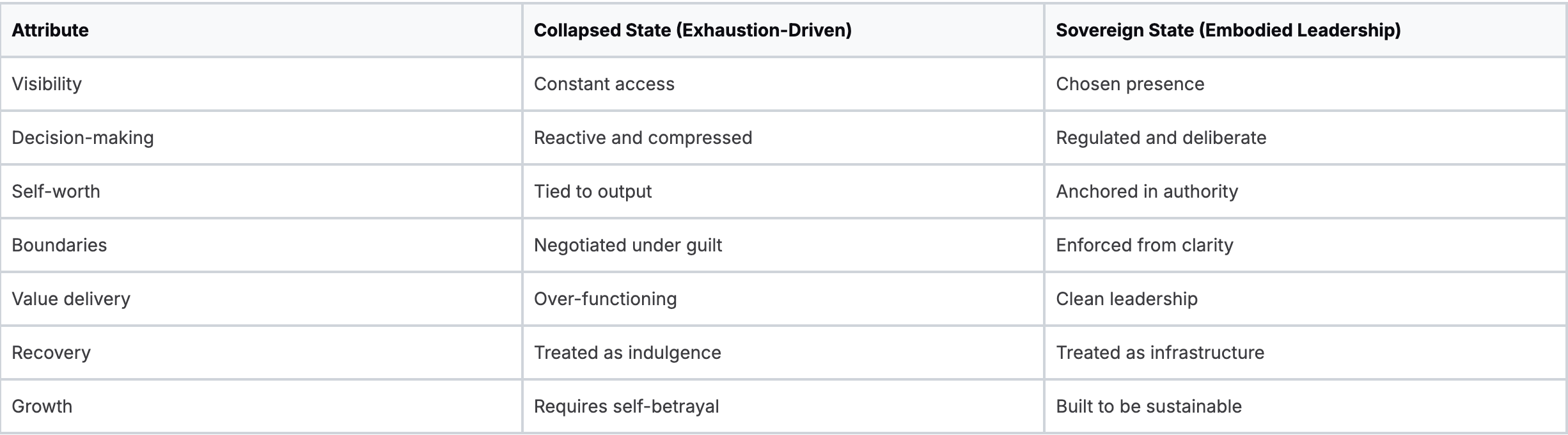
Scale stops costing your identity
Women in Silent Collapse™ usually do not fear more responsibility. They fear the price they know growth has extracted before.
They are right to fear it.
If your current model of doing what it takes depends on suppression, speed, and override, then scale multiplies damage. Scale in Sovereign Leadership™ means increasing impact without increasing self-abandonment.
Follow these requirements:
Scale only what stays stable under pressure.
If a process collapses under normal stress, it is not ready for growth.Protect the conditions that produce your best judgment.
Sleep, thinking time, recovery windows, and strategic solitude are operating requirements, not rewards.Remove yourself from repetitive strain.
You should not be the first responder for every emotional, operational, or relational tremor inside the organization.Use short rebuild cycles.
Review the system weekly. Correct early. Do not wait for a visible breakdown.Include identity in the scale plan.
If success keeps requiring self-erasure, the model is defective.
I have seen this pattern too many times to dress it up. A woman looks strong in public, profitable on paper, and privately fantasizes about disappearing. The answer is not more resilience theater. The answer is a disciplined rebuild of access, capacity, value, and scale.
That is the RAMS reframe. It does not ask you to become less ambitious. It requires you to stop feeding ambition with your nervous system.
The Return Daily Practices for Nervous System Sovereignty
The rebuild fails if it stays conceptual.
You need daily disciplines. Not wellness rituals. Disciplines. In the military, you do not wait until equipment fails to inspect it. You maintain it because failure under pressure is too expensive. Your nervous system deserves the same standard.

Disciplined project management in personal transformation raises success from 25% to over 65%, and key failure points include premature termination of efforts at 10% to 30%. Those results improve when the work uses military-derived structure and clear metrics, as shown in this review of project management and transformation success.
Command your inputs
A dysregulated leader cannot afford random inputs.
Your first discipline is strategic disengagement.
Create non-stimulus windows daily.
No phone. No news. No messaging. No passive consumption. Give your system periods where it is not being recruited into reaction.Stop starting the day with demand.
If the first voice you hear is the market, the team, or the inbox, you’ve surrendered command before breakfast.Reduce false urgency.
Most leaders in collapse mistake immediacy for importance. They train the body to stay activated all day.
If anxiety remains high, supportive resources can help you explore effective remedies for anxiety as part of a broader regulation strategy. Use them as support, not as a substitute for rebuilding the operating model.
Protecting your state is not avoidance. It is command discipline.
Make decisions from regulation
Your second discipline is decision hygiene.
Too many women make major calls while activated, then spend days cleaning up the residue. Stop that.
Use this rule set:
Do not make identity-loaded decisions in a flooded state.
That includes quitting, hiring, firing, confronting, apologizing, or overcommitting.Name your state before the decision.
Tight chest. Fast speech. Impatience. Numbness. If you cannot name your state, you cannot trust your urgency.Use a delay when the body is loud.
Not avoidance. Delay. Return when the system is quiet enough to distinguish fear from fact.Record patterns.
If the same decision type always destabilizes you, that is diagnostic data.
I’ve detailed more of this discipline in nervous system regulation for leaders. Regulation is not softness. It is the condition required for clean force.
Maintain the system daily
Your third discipline is embodied discharge.
Stress that is never discharged becomes personality. That is one reason women in collapse start describing themselves as irritable, detached, or flat. They think it is character drift. Often it is unresolved activation.
Use a short daily maintenance cycle:
Morning check-in: Name your physical state before you touch the day.
Midday interruption: Stop for a brief body scan and release visible tension in jaw, shoulders, chest, and hands.
Post-demand reset: After a hard meeting or conflict, do not go straight into the next demand. Walk. Breathe. Let the activation complete.
Evening closure: End the workday on purpose. Do not carry open loops into the night as proof of commitment.
This is what “doing what it takes” should mean now. Not running harder. Maintaining the leader so the leadership remains trustworthy.
Common Pitfalls That Reinforce Collapse
Most women do not fail this rebuild because they lack intelligence. They fail because they keep applying collapse logic to recovery work.

The smart woman’s favorite escape route
The first trap is intellectualization.
You read about the pattern. You understand the framework. You can explain your trauma responses, leadership distortions, and attachment to over-functioning in fluent language. None of that means your system has changed.
Insight without embodiment becomes another hiding place.
The second trap is relapse into familiar usefulness. Pressure rises. Someone needs you. A deadline tightens. You revert to the old identity because it still gets applause.
That return can happen fast. It often hides behind words like responsibility, standards, and excellence.
AI pressure is a new accelerant
A newer trap is technological overexposure. Leaders are now expected to adapt, respond, integrate, learn, and stay current at a pace that can fracture already stressed systems.
A projected 2026 Deloitte report states that 67% of female executives report AI-induced exhaustion, up 22% from 2025, and that leaders using structured, veteran-inspired methods reduce related impostor syndrome by 40%. The gap in useful guidance remains severe, according to this report on AI-induced exhaustion in female executives.
AI pressure flatters the same women already at risk. The competent one. The quick one. The one who can absorb change and still perform. That pressure makes collapse look modern and necessary.
The countermeasure
Use hard boundaries before stress rises.
Define your must-haves early: Protect sleep, thinking time, and recovery blocks before demand tries to steal them.
Refuse identity inflation: You do not need to become the symbol of flawless adaptation.
Limit unnecessary access: Use healthy boundaries at work as an operating requirement, not a personality preference.
Expect resistance: The old self will call this laziness. Ignore it.
The old operating system will always try to recruit you back with urgency.
Conclusion Stop Managing Collapse Start Ending It
Doing what it takes was useful once. It got you through. It built things. It earned trust.
Now it is breaking the leader required to hold the life it created.
You have a choice. Keep managing symptoms inside a failing leadership model, or rebuild the model itself. Sovereign Leadership™ is not a reward for endurance. It is the condition you protect so your authority stops costing you your identity.
Frequently Asked Questions
Why do I feel empty even though I am successful?
Because success and self-possession are not the same thing. You can achieve at a high level while abandoning your own internal signals. When that goes on long enough, achievement stops feeling like fulfillment and starts feeling like extraction.
Is doing what it takes always unhealthy?
No. In short bursts, it can be necessary. The problem starts when emergency effort becomes your permanent way of leading. A temporary survival tactic is useful. A permanent one becomes destructive.
Why does slowing down make me anxious?
Because your system may have learned to associate stillness with danger. If your identity formed around performance, rest can feel like exposure. That does not mean rest is wrong. It means your system needs retraining.
Can’t I solve this with better time management?
Not if the root issue is collapse. Better scheduling can reduce friction, but it cannot repair a leadership identity built on override. If the operating model is damaged, efficiency only helps you break faster.
What does Sovereign Leadership™ actually feel like?
It feels quieter. Decisions become cleaner. Boundaries stop feeling cruel. Presence stops feeling performative. You no longer need constant output to prove you should be in the room.
If your results confirm what you already suspect, the next step is an application, not a sales call. I do not work with everyone. I work with women ready to stop managing their collapse and start ending it. Start with the Silent Collapse Diagnostic, review the Sovereign Leadership Resource Hub, or Apply to Work With Baz.
Author bio: British military veteran. Two-time international bestselling author. Founder, The Prestige Architect™. Host, Rise From The Ashes podcast on the C-Suite Network.