The Leader's Guide to Decision Making Under Pressure
You're staring at the problem. The stakes are high. Your team is looking to you. But your mind is a blank slate. The crisp, decisive clarity you normally command has vanished, replaced by a thick fog of adrenaline and doubt. This isn't just stress; it's a physiological hijacking. If I mess this up, it’s all on me. The internal monologue begins, and suddenly, you're frozen. This is the moment leaders dread—the Silent Collapse.
Key Takeaways
The Silent Collapse: High-pressure moments trigger a predictable biological hijacking of your brain. Your prefrontal cortex (executive function) is overridden by your amygdala (threat detection), leading to decision paralysis. This is a physiological event, not a personal failing.
The RAMS™ Framework: To regain control, you need a pre-installed protocol. The RAMS™ (Results, Attitude, Mastery, Systems) framework is a four-part system designed to calm your nervous system and bring your executive brain back online for clear, strategic decision-making.
Tactics for Embodiment: Practical drills like pre-mortem analysis, mental rehearsal, and rapid reset techniques (e.g., box breathing) are crucial for building the neurological muscle memory needed to stay grounded in real-world high-stakes situations.
From Management to Sovereignty: The ultimate goal isn't just to manage pressure but to cultivate nervous system sovereignty. This means building such deep internal regulation that external chaos no longer dictates your ability to think and lead with clarity.
The High-Stakes Moment When Clarity Vanishes
It happens in a flash. One minute, you're in the zone, confidently steering a critical project or navigating a tense negotiation. The next, something shifts—a sudden market downturn, a key team member's surprise resignation, an ambush question in the boardroom—and a jolt runs through your entire system. The clear path forward is suddenly gone, replaced by a thick fog of uncertainty.

This is the "Silent Collapse," a gut-wrenching experience all too familiar to high-achieving women. This isn't about competence; it's a physiological hijacking. Your chest gets tight, your thoughts start to spiral, and the sharp instincts you normally rely on completely evaporate.
The Internal Monologue of Paralysis
The inner critic is always the first to speak, and it’s rarely kind. "Why am I freezing? I should know the answer. If I stop performing, I'll disappear. If I mess this up, everything I've worked for is on the line." This wave of self-doubt cranks up the pressure, making clear-headed decision making under pressure feel utterly impossible.
Effective decision making under pressure isn't about ignoring stress; it's about interrupting your body's primal reaction long enough to let your executive brain get back online. You must rapidly size up the situation, see the viable paths forward, and act with conviction, often with far less information than you'd like.
This phenomenon is often the result of sustained high performance, where your nervous system is already running on high alert. You might recognize the physical signs:
Feeling detached, like you're watching yourself from outside your body.
An intense urge to either do something—anything—impulsively or just completely shut down.
The inability to process information that seemed straightforward only moments ago.
This paralysis is not a personal failing. It’s a predictable biological response to what your brain perceives as a major threat, where survival instincts override executive function. Simply acknowledging that this is a normal reaction is the first step to regaining control.
This experience of executive dysregulation is a massive signal that your old ways of managing stress just aren't cutting it anymore for the level of demand you're facing.
Learning to recognize these mental and physical cues isn't about beating yourself up. It's about gathering data. Every time you freeze, you're getting a crucial insight into your nervous system's triggers and its breaking points. Understanding this pattern is the key to shifting from being a victim of the chaos to intentionally navigating right through it. The objective isn't to get rid of pressure—it's to build a personal system that lets you thrive in it.
The Neuroscience Behind Decision Paralysis
That feeling of being frozen under pressure? It's not a character flaw. It’s a biological script that’s been hardwired into our species for millennia. To get a handle on it, you first have to understand what's actually happening inside your head when the stakes get high. This isn’t a personal failure; it’s a predictable hijacking of your brain’s most sophisticated systems.
Think of your brain as the advanced cockpit of a high-performance jet. Your prefrontal cortex (PFC) is the seasoned pilot—the part responsible for rational thought, long-term planning, and making nuanced calls. But there’s another system in that cockpit: the amygdala, an ancient, hyper-vigilant security alarm. Its only job is to scan for threats and hit the big red eject button.
When you’re hit with intense pressure—a hostile question in a board meeting, a sudden market crash, an unexpected crisis—the amygdala doesn’t see a business problem. It sees a saber-toothed tiger. It rips the controls straight from the pilot's hands, flooding your system with stress hormones like cortisol and adrenaline.
The Corporate Cockpit Hijacking
I call this the 'Corporate Cockpit Hijacking.' In a split second, your calm, logical PFC gets shoved to the back of the plane. The amygdala is now flying, and its flight plan is brutally simple: fight, flee, or freeze. For anyone needing to make a clear-headed decision, this neurological takeover has immediate and debilitating consequences.
Cognitive Tunneling: Your focus narrows to a pinprick. You can only see the immediate threat, completely losing sight of other options, data points, or potential solutions. It's like trying to land a plane with the cockpit windows blacked out except for one tiny slit.
Memory Impairment: Your brain temporarily locks the door to your own library of experience. The very expertise and knowledge you rely on are suddenly offline because your brain is prioritizing raw survival instincts over thoughtful analysis.
Reversion to Flawed Habits: With the PFC offline, your brain defaults to its most deeply ingrained, automatic behaviors. These are often outdated coping mechanisms or reactive patterns that are completely wrong for the complex challenge you're actually facing.
This hijacking is the root of decision paralysis. You feel stuck because, neurologically, you are. Your executive functions have been temporarily disabled by a system designed to save you from a lion, not to solve a Q3 budget shortfall.
The Real Cost of Unmanaged Stress
This biological process has profound, real-world consequences, especially for leaders. Work-related stress doesn't just make you tired; it actively sabotages your cognitive performance. A 2023 report from The American Institute of Stress found that 83% of US workers suffer from work-related stress, directly impacting their decision-making capacity.
For women in leadership, these pressures are often compounded. The struggle for a seat at the table is real, as 48% of female leaders now report lack of involvement in key decisions as a significant source of stress—a sharp increase from 39% in 2019, according to research by LeanIn.Org.
Understanding this neurological pattern is the first step toward regaining control. It reframes the challenge from, "What's wrong with me?" to, "What's happening in my brain, and how do I intervene?" The solution isn't to fight your biology but to learn to work with it. You can learn to soothe the amygdala and get your PFC—the expert pilot—back to the controls. For more on this, you can explore the fundamentals of your own nervous system architecture and how it dictates your leadership capacity.
By mastering your internal state, you ensure you're the one flying the plane, especially when the turbulence hits.
Introducing The RAMS™ Framework For Clarity In Chaos
Knowing how your brain short-circuits under pressure is one thing. Actually doing something about it is another. When the stakes are high and your rational mind goes offline, you can't just "will" yourself to be smarter or more decisive. You need a protocol—a pre-installed operating system that works with your biology, not against it.
This is exactly why I developed the proprietary RAMS™ Framework. Forget flimsy mindset hacks. This is a robust, integrated system built for leaders who operate in the pressure cooker and need to make clear, grounded decisions when chaos is breaking down the door.
RAMS™ is an acronym for Results, Attitude, Mastery, and Systems. Each element is engineered to directly counteract a specific part of the amygdala hijack, building a powerful buffer between you and the fight-or-flight response. It’s your pathway back to your most resourceful, intelligent self.
The process of losing control happens fast. One minute your prefrontal cortex is in charge, and the next, your amygdala has slammed the emergency brake.
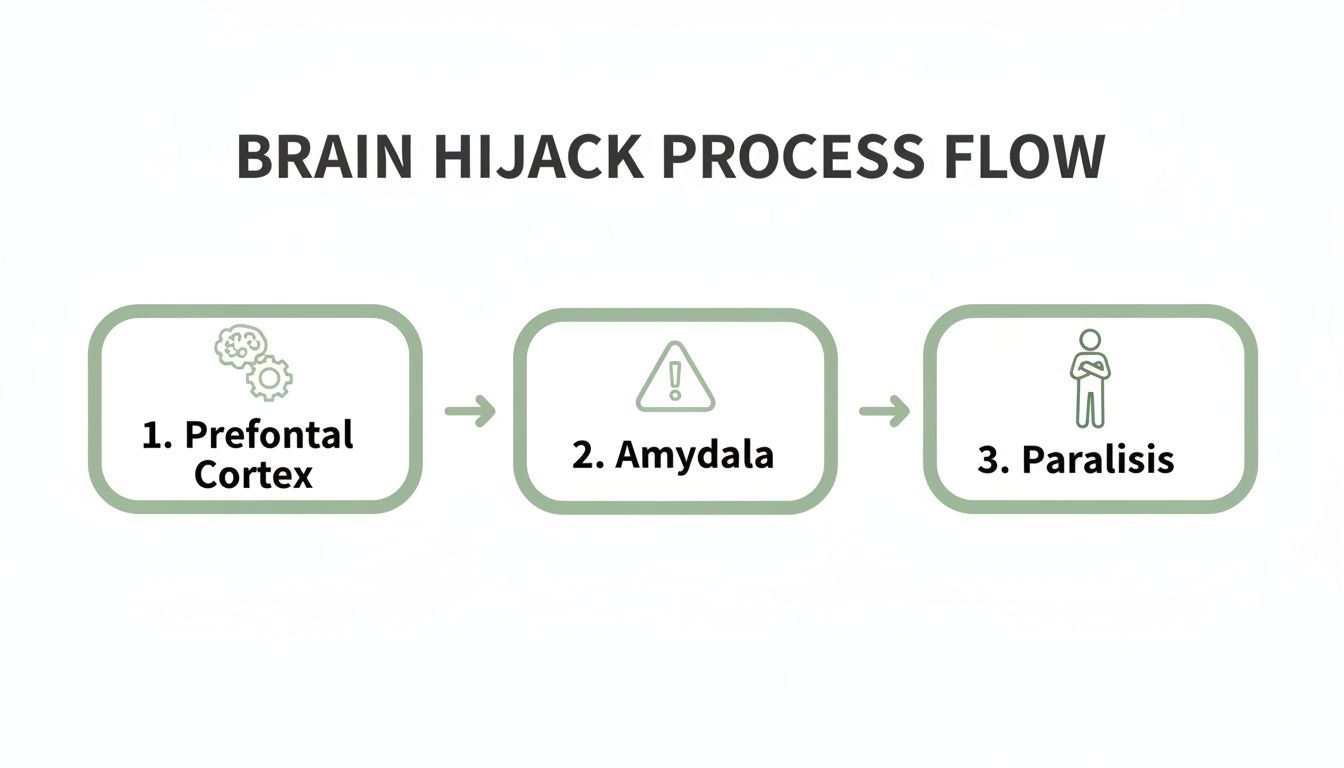
This graphic shows just how slippery that slope is. It's a quick slide from rational thought to total paralysis—the exact stall-out the RAMS™ Framework is designed to prevent.
Deconstructing The RAMS™ Method
Let's pull apart the four pillars. Each one shores up your ability to stay clear-headed when you’d normally be overwhelmed.
R - Results: This is about ruthless clarity. When you're under the gun, your brain gets tangled in the weeds of "how." By starting with a crystal-clear, measurable result, you give yourself an anchor. It cuts through the noise and provides a single, tangible target, bypassing the paralysis that comes from staring at a thousand different options.
A - Attitude: Your internal state is everything. This pillar is about intentionally regulating your physiology and emotional state before you act. It's about using specific practices to calm your nervous system, reframing a perceived threat into a manageable challenge, and cultivating a state of focused calm. A regulated attitude keeps your amygdala from screaming fire, which keeps your executive brain online.
M - Mastery: Crisis has a nasty habit of triggering crippling self-doubt. This pillar is about reconnecting with your deep well of experience, skills, and past wins—fast. It’s a rapid mental inventory of your proven capabilities, reminding your brain that you’ve navigated tough situations before and have the chops to do it again. It rebuilds confidence in real-time.
S - Systems: This is your secret weapon against decision paralysis. Systems are the protocols, checklists, and frameworks you build before a crisis ever hits. When your brain is hijacked, you don’t have to invent a solution from scratch; you just run the play you’ve already designed and trusted. This pulls the cognitive load off a compromised brain and puts it onto a reliable process.
Reactive Decision-Making vs. The RAMS™ Framework
The contrast between a reactive, stress-driven decision and one guided by the RAMS™ Framework is stark. One is a panicked gamble; the other is a strategic move from a place of grounded authority. This table breaks down the shift you can expect to make.

This isn't just a theoretical shift; it's a trainable, neurological upgrade. While intense pressure consistently degrades decision-making quality, having a structured framework is the key to building resilience and performing when it counts.
Putting The Framework Into Practice
You don't start implementing RAMS™ in the middle of a five-alarm fire. The real work happens beforehand, preparing your mind and your environment for the inevitable high-pressure moments.
The Power Of Pre-Built Systems
The "Systems" component is your greatest ally against the amygdala hijack. Think of Captain "Sully" Sullenberger landing that plane on the Hudson. He didn't invent a new procedure at 3,000 feet; he executed checklists and protocols ingrained through thousands of hours of training. He defaulted to his system.
You can build similar emergency protocols for your own world:
A Crisis Comms Checklist: A pre-approved template detailing who to contact, what to say, and in what order when things go sideways.
A Financial "Circuit Breaker": A set of predetermined actions to take if revenue drops by X% or a major client pulls out.
A Problem Triage Framework: A simple model to instantly categorize issues as Urgent/Important, Delegate, or Defer, so you're not making it up as you go.
These kinds of protocols exist in many fields. For example, looking at how other industries use financial risk management frameworks can offer powerful, cross-disciplinary ideas for managing uncertainty.
RAMS™ isn't about getting rid of pressure. It's about building a structure strong enough to hold you steady inside it, making sure your wisest, most experienced self stays in the driver's seat.
This framework is what allows you to go from being a passenger in a hijacked cockpit to being the calm pilot who knows exactly which levers to pull. It’s the key to finding peace in the midst of chaos, not by running from the storm, but by mastering your response to it. When you embed Results, Attitude, Mastery, and Systems into your leadership DNA, you build a reliable path back to clarity, no matter how intense things get.
Actionable Tactics To Fortify Your Decision-Making
Theory gives you the map, but tactics are what get you through the terrain. Knowing the RAMS™ Framework is one thing; embodying it when the pressure is on is another beast entirely. It’s all about building the mental and physiological muscle memory needed to stay grounded when a storm hits. These aren't just abstract ideas; they are concrete drills for high-stakes environments.

This is about crafting your own personal toolkit for clarity. It’s about having a set of reliable moves you can deploy in a heartbeat to interrupt an amygdala hijack and bring your executive brain back online.
Pre-Mortem Analysis: Seeing Failure Before It Happens
One of the most potent ways to improve decision making under pressure is to de-pressurize decisions before they ever become critical. Enter the pre-mortem, a strategic exercise in imagining failure. It flips optimistic planning on its head, forcing a controlled, forward-looking post-mortem before you've even started.
Here's how it works. Imagine you're about to launch a major initiative. You gather your key players and set the scene: "It's six months from now, and this launch has been an unmitigated disaster. What went wrong?" This simple reframe makes it safe to voice dissent and flag potential landmines without coming off as negative or disloyal.
This technique is incredibly effective for a few reasons:
It kills optimism bias: It forces a brutally honest look at threats that are often glossed over in the initial excitement of a new project.
It builds psychological safety: Team members can raise concerns as hypothetical problems, not as direct criticisms of the plan or its leaders.
It creates a risk mitigation plan: The output is a list of potential failures you can now proactively solve for, turning unknown threats into known variables.
Mental Rehearsal Techniques
Elite athletes don't just train their bodies; they train their minds. They mentally rehearse a perfect performance thousands of times, visualizing every move until it's second nature. This same technique is a game-changer for leaders facing high-pressure situations, whether it's a hostile boardroom or a critical negotiation.
Visualization isn't just wishful thinking—it's a neurological tool. When you vividly imagine an experience, your brain lights up many of the same neural pathways it would during the actual event.
By repeatedly running a mental simulation of a high-stakes scenario, you are effectively creating a memory of a future event. This pre-exposure desensitizes your nervous system to the stress of the situation, so when it actually happens, it feels familiar and manageable rather than threatening.
Before a tough presentation, for example, spend ten minutes visualizing the entire thing. See the room, the faces in the audience, and feel the solid confidence in your posture. Hear yourself nailing your points with clarity. Most importantly, visualize yourself handling a tough question with grace and authority. This kind of proactive preparation builds serious resilience, a core component of training for the unknown.
Rapid Reset Drills
Sometimes, despite all your preparation, you get blindsided. In these moments, you need a circuit breaker for the fight-or-flight response. You need a rapid intervention to calm your nervous system, not to eliminate the stress, but to create just enough space to think clearly.
The Box Breathing Drill: This is a profoundly simple technique used by Navy SEALs to stay calm under fire. It works.
Inhale slowly through your nose for a count of four.
Hold your breath for a count of four.
Exhale slowly through your mouth for a count of four.
Hold your breath for a count of four.
Repeat this cycle three to five times. The slow, rhythmic pattern sends a direct signal to your vagus nerve, telling your body it's safe to stand down from high alert.
The pressure on leaders is immense and only getting worse. In high-stakes roles, stress from mounting workloads dramatically impairs decision-making. Studies show a 32% decline in both decision-making and productivity among stressed leaders. This is especially true for women executives navigating industries where 79% of UK employees face regular work stress—a staggering 20% rise since 2018. When you add in workplace politics, which 37% of people cite as a major stressor, the emotional drain can seriously cloud judgment.
These tactics aren't about adding more to your already full plate. They're about upgrading your internal operating system to be more resilient. They are the practical application of the RAMS™ method—creating Systems (like a pre-mortem or reset drills) that support a regulated Attitude and reinforce your Mastery. Ultimately, this lets you focus on the Results that matter, confident in your ability to handle whatever turbulence comes your way. A key part of this is learning to balance logic with intuition, a dynamic we explore in our guide to navigating decisions between your head vs heart.
Building Long-Term Resilience And Sovereignty
Tactics are for the moment; sovereignty is for a lifetime.
Making a single good decision under fire is a skill. Consistently embodying clarity, no matter the external chaos, is a state of being. This is the ultimate goal—shifting from a leader who merely manages pressure to one who commands her internal state so completely that pressure becomes irrelevant.
This isn’t about adding more armor or learning to brace for impact. It's about cultivating such a deep sense of internal regulation that external volatility no longer hijacks your nervous system. It's about building a leadership style that is sustainable, authentic, and unshakable because it originates from a place of grounded presence.
Crafting Systems For Recovery And Reflection
True resilience isn't built in the heat of the moment. It's forged in the quiet spaces in between.
High-stakes decision-making is neurologically expensive. It drains your cognitive and emotional resources. Without deliberate systems for recovery, you're guaranteed to enter your next crisis already depleted.
These systems are your non-negotiable infrastructure for long-term clarity. They aren't luxuries; they are essential maintenance for a high-performance brain.
Scheduled "Thinking Time": This is not empty space on your calendar; it's a strategic asset. Block out time with the same ferocity you would a board meeting, dedicated solely to reflection, strategic thinking, and creative wandering. This is where you connect the dots you’re too busy to see during the week.
Robust Delegation Frameworks: Far too many leaders become bottlenecks because they haven’t built systems of trust. A clear delegation framework—defining not just the task but the desired outcome and level of authority—frees up your mental bandwidth to focus on the high-level decisions only you can make.
A Trusted Inner Circle: Sovereignty is not isolation. It requires a small, trusted council—mentors, peers, or coaches who can offer perspective without judgment. This is your personal board of directors, providing the psychological safety needed to process tough decisions and challenge your own biases.
From Managing Pressure To Embodying Presence
The core shift is moving from reaction to intention. A leader who simply manages pressure is always in a defensive posture, waiting for the next threat. A leader who embodies presence operates from a state of inner calm, allowing her to respond to challenges with creativity and wisdom rather than fear.
This transition is the essence of nervous-system sovereignty. It’s the understanding that your greatest strategic advantage is a well-regulated internal state. When your physiology is calm, your mind has access to its full range of capabilities—logic, intuition, and experience.
This state isn’t achieved by accident. It is the direct result of consistent practice in self-regulation, boundary setting, and intentional recovery.
The journey toward embodied sovereignty is about returning to your most powerful, authentic self. It’s the final step in moving beyond simply making good decisions under pressure to becoming the leader who can create clarity in any storm.
Putting It All Into Practice
Knowing the theory is one thing, but applying it when the pressure is on is a different beast entirely. Here are answers to the questions that come up most often when leaders start putting these principles into action.
How Can I Distinguish Between Intuition And Fear?
This is the critical distinction, and it’s a felt sense, not a thought. Fear is a constrictor. It feels frantic, loud, and usually spins a catastrophic story in your head. It’s the voice screaming for an impulsive reaction just to make the discomfort stop.
Intuition, on the other hand, is expansive. It’s a quiet, clear knowing that comes from a grounded place, even when the message itself is urgent.
To tell them apart, drop out of your head and into your body. Fear usually shows up as a tight chest, a knot in your stomach, or shallow breathing. Intuition feels centered, often in your gut—a calm certainty underneath the noise.
What Is The First Step When Decision Paralysis Sets In?
Stop trying to make a decision. That's the first mistake. Your brain is offline, and forcing it is like trying to rev an engine that's flooded.
Your absolute first move is to break the physiological hijack. Use a reset drill like box breathing: Inhale for four counts, hold for four, exhale for four, and hold for four. Do it just three times.
That simple act tells your nervous system the immediate threat is gone. It creates just enough cognitive space to shift from a panicked, reactive state into a responsive one. Only after you’ve regulated your body can you even begin to look at the situation with any real clarity.
How Does The RAMS™ Method Apply To Team Decisions?
The RAMS™ framework is brilliant for teams because it creates a shared language and a clear protocol, pulling everyone out of their individual panic loops. It scales beautifully.
Results: The team gets crystal clear on the single most important outcome. This immediately aligns everyone and stops people from solving different problems.
Attitude: As the leader, you model a regulated state. Your calm literally calms the collective nervous system, creating the psychological safety needed for clear thinking.
Mastery: You run a quick inventory of the team’s collective skills and past wins. This isn't cheerleading; it's a rapid reminder of shared competence that builds confidence right when it's needed most.
Systems: The team defaults to a pre-agreed protocol—a pre-mortem, a specific communication checklist, whatever you've rehearsed. This keeps the process structured even when chaos is swirling.
How Long Does It Take To See Improvement?
You will feel a difference the very first time you use a reset drill. A single, conscious breath can create the space to prevent one bad, reactive decision. That's an immediate win.
But building true nervous-system sovereignty—the ability to remain centered no matter what—is a practice. It’s not a hack. Consistent application builds new neural pathways for resilience over time.
Most leaders I work with report a significant shift in their baseline calm and clarity within 30-60 days of dedicated practice. True mastery, though, is a lifelong commitment.
True sovereignty isn't about managing pressure; it's about building a system that makes you unshakeable within it. If you're ready to move from reacting to chaos to commanding it, the journey starts with understanding your own leadership architecture. At Baz Porter, we guide you through that process.