Master Your Choices: 8 Decision Making Questions and Answers
You make a thousand decisions a day. Most are tactical. Some are strategic. A few are corrosive. They look harmless. They arrive as polite compromises, strategic concessions, and responsible yeses.
Then the bill comes due.
You accept the meeting that drains you. You take the client that violates your standards. You approve the timeline your body already knows is false. You call it leadership. Your nervous system calls it threat. That gap is where Silent Collapse™ starts.
Outwardly, you still look high-functioning. Privately, your decisions are no longer clean. They are acts of self-abandonment dressed as professionalism. This is why so much generic advice on decision making questions and answers misses the point. It teaches you how to defend a choice after the fact. It does not teach you how to catch the betrayal before it hardens into identity.
If this pattern has already started, the cost won't stay abstract. It will hit clarity, authority, health, and the quality of every room you lead. If the emotional toll underneath your choices feels familiar, even adjacent support like Vernon depression therapy can help name what high performers often hide.
Table of Contents
1. The STOP Decision Framework
When you're flooded, speed becomes a liability. The STOP framework cuts that reflex.
Use it in live situations. A board meeting. An investor call. A tense Slack thread. A high-status request that lands with pressure attached.

Interrupt the reflex
STOP means Stop, Think, Observe, Proceed.
Stop means you do not answer on contact. Think means you identify the actual decision. Observe means you check the pressure source. Is it urgency, guilt, ego, or optics? Proceed means you choose the next action from authority, not adrenaline.
A founder under investor pressure can say, “I need to review timeline assumptions before I commit.” A senior executive can decline a high-profile initiative that would deepen depletion. A leader in a meeting can refuse the automatic hand-raise that keeps the overfunctioning cycle alive.
Use STOP first in low-stakes moments. Decline the nonessential coffee chat. Delay the instant email reply. Push a meeting answer by an hour. Repetition builds access under pressure.
If you need a deeper lens on acute pressure, read Baz's piece on decision making under pressure.
Practical rule: If your body is tight, your answer is not ready.
2. The Values-Clarity Question
Some decisions are not hard. They are unacceptable. You only call them hard because the external reward is large.
Ask one question. Will this decision require me to betray myself or my core values?
Name the betrayal plainly
That question strips polish off the choice. A role with prestige and chronic overreach may violate presence, health, or honesty. A dream investor may demand cultural concessions you already know you'll regret. A perfectionistic standard may not even be yours. It may be inherited theater.
This is why broad advice fails. Generic decision making questions and answers often focus on justification after the choice. They ignore the internal rupture before it.
Use a short written audit:
Core value at stake: Name the principle in plain language.
Visible reward: Name the title, revenue, access, or approval attached.
Hidden cost: Name the part of you that must go silent to secure it.
A leader offered a major promotion can write, “Reward is status. Cost is chronic unavailability and compliance with a leadership style that isn't mine.” That sentence alone can end weeks of confusion.
For a values-based lens on professional standards, see what professional values actually require.
The best answer is not always “be decisive,” but “build a decision system that protects agency.”
3. The RAMS Decision Matrix
You say yes to a move that looks smart on paper. Revenue rises. Status rises. Your body starts paying for it first.
That is the pattern. High-achieving leaders keep scoring decisions by one metric and calling it strategy. Usually that metric is Results. That is how Silent Collapse™ hides inside success.
My RAMS Framework™ forces a full decision audit. Every major choice gets tested through Results, Attitude, Mastery, and Systems.

Use all four lenses
Results measures what the decision produces in concrete terms. Attitude measures the inner state it trains. Mastery measures the capability it builds or erodes. Systems measures whether your team, calendar, and nervous system can carry the load without distortion.
This is a required filter for strategic choices. It cuts through the self-betrayal pattern that makes strong leaders choose visible gain over internal stability.
A founder reviewing a lucrative expansion can spot the failure fast. Results look strong. Attitude shifts toward vigilance and irritability. Mastery flatlines because the work adds scale but no real growth. Systems start buckling because the team structure cannot absorb the complexity. That is not a good decision. It is a polished form of collapse.
Structured decision processes work because they force evaluation before commitment. RAMS applies that same discipline to leadership decisions. It stops emotional accounting fraud. It exposes false wins early.
Use these four questions every time:
Results: What does this produce in reality?
Attitude: What inner operating state does this reinforce?
Mastery: What competence does this sharpen or weaken?
Systems: What will this load, strain, or destabilize?
Write the answers. Do not keep them in your head. Internal noise distorts judgment, especially under chronic stress. If burnout language from sport helps you recognize the same physiology in leadership, read Salus Natural Medicine's athlete burnout guide.
For the full architecture, read the RAMS Method explained.
4. The Identity Alignment Question
Not every choice is about efficiency. Some are about authorship.
Ask this. Does this decision reinforce the leader I'm becoming, or the pattern I'm leaving behind?
Choose the self you are building
A leader who is exiting overfunctioning cannot keep saying yes to every rescue request. A founder claiming cleaner authority cannot keep softening direct feedback to avoid discomfort. A senior operator rebuilding trust with self cannot keep calling perfectionism “standards.”
This question is behavioral. It catches relapse.
Write two lists. One for the identity you're building. One for the pattern you're exiting. Keep the language specific. Grounded. Direct. Example: “Becoming a leader who speaks clearly and decides cleanly.” “Leaving the pattern of earning safety through overdelivery.”
Then use it in real time. If the decision rewards your old survival pattern, reject it or redesign it.
If you need support defining that next professional self with precision, start with professional identity development.
You don't need more confidence. You need fewer decisions that contradict your stated identity.
5. The Stakeholder Impact Matrix
People-pleasing survives by hiding the full cost. The Stakeholder Impact Matrix removes the camouflage.
Map the effect of one decision across every party touched by it. Not just the loudest one.

Map the real cost
Start with these groups:
Self: Energy, clarity, integrity, recovery.
Team: Standards, accountability, confusion, trust.
Family or home life: Presence, availability, emotional residue.
Organization or clients: Quality, sustainability, delivery risk.
Future self: Capacity, reputation, optionality.
A vice president agrees to repeated late-night escalations to support one underperforming direct report. That looks generous. The matrix exposes the truth. Self loses recovery. Family absorbs the residue. Team learns weak boundaries. The direct report avoids growth. The organization keeps a distorted system alive.
Decision quality improves when evaluation is structured and relevant. The UK Statistics Authority found that people are more willing to use statistics when they feel directly relevant to their circumstances, transparent, clear, and credible, as described in its report on statistics in personal decision making. The same logic applies here. If your decision process ignores who bears the cost, it isn't credible.
6. The Capacity vs. Opportunity Filter
A good opportunity is not the same as a right opportunity. Burned-out high achievers confuse these every week.
Capacity is not weakness. It is a hard operating constraint.
Capacity is a hard constraint
Use one sentence first. Do I have the capacity to carry this without distorting existing commitments?
That filter catches the subtle form of self-betrayal. You are not saying yes to nonsense. You are saying yes to things that are real, valuable, and badly timed. That still breaks trust with self.
A founder can defer a partnership until systems are ready. An executive can decline a board seat during a business transformation. A leader can redirect a stretch assignment to someone with actual available bandwidth.
Use a short review:
Current commitments: List what you're already responsible for.
Complexity load: Name what requires judgment, not just hours.
Recovery cost: Name what this new commitment will steal.
Deferral option: Decide whether this is no, not now, or redesign.
Decision fatigue gets worse when you keep forcing choice from depletion. Practical decision frameworks recommend asking what information you need, what biases might distort you, what a trusted adviser would say, how the decision might fail, and why you might revise it. They also note that people often fail because they don't generate enough viable options, with one expert summary recommending at least five acceptable options before choosing in this piece on everyday decisions.
That matters when your brain says there are only two options. Accept it or lose it. Usually, there are more.
If burnout language outside business helps you recognize the same pattern in performance culture, see Salus Natural Medicine's athlete burnout guide.
7. The Values-Authority Alignment Check
A lot of executives sound decisive. They are not decisive. They are compliant with prestige.
Ask this. Does this decision come from my authority, or from someone else's expectation of who I should be?
Authority without performance
False authority feels performative. It borrows tone, posture, and urgency from people you think you must resemble. Authentic authority is quieter. It doesn't need theater.
An executive may reject the expected aggressive leadership persona because it violates how they lead well. A founder may stop copying a growth-at-all-costs model that contradicts sustainability and truth. A senior leader may realize they have competence but not consent. They have been playing a role with no inner authorization.
This is one of the biggest failures in common decision making questions and answers. They ask what you did. They rarely ask whose script you were following when you did it.
Test authority with three prompts:
Borrowed voice: Whose approval am I trying to secure?
Embodied signal: Does this feel grounded or performative?
Clean ownership: Would I still choose this without the audience?
If the answer depends on applause, the authority is false.
8. The Integration Decision Framework
Compartmentalization is often praised as maturity. In practice, it can become self-erasure.
If a decision requires you to split your professional self from your actual self, the cost will surface somewhere else.
Stop splitting yourself in two
Use this question. Does this decision support integration, or does it require me to compartmentalize myself to survive it?
A role that “tolerates” your values but doesn't respect them is not a clean fit. A company culture that rewards output while punishing humanity forces fragmentation. A leader who edits humor, truth, tenderness, or standards to look executive enough will eventually feel hollow in rooms they worked hard to enter.
Question design matters here. Improvado recommends a five-step process of Define, Collect, Clean, Analyze, Visualize, and highlights SMART question design. Pragmatic Institute also distinguishes descriptive, diagnostic, predictive, and prescriptive questions in this guide to getting data answers. That distinction matters in leadership. “How am I doing?” is too vague. “Which current commitments force me into compartmentalization?” is decision-grade.
A strong integration decision doesn't chase image. It reduces internal splitting.
For a more strategic process lens, read strategic decision making process.
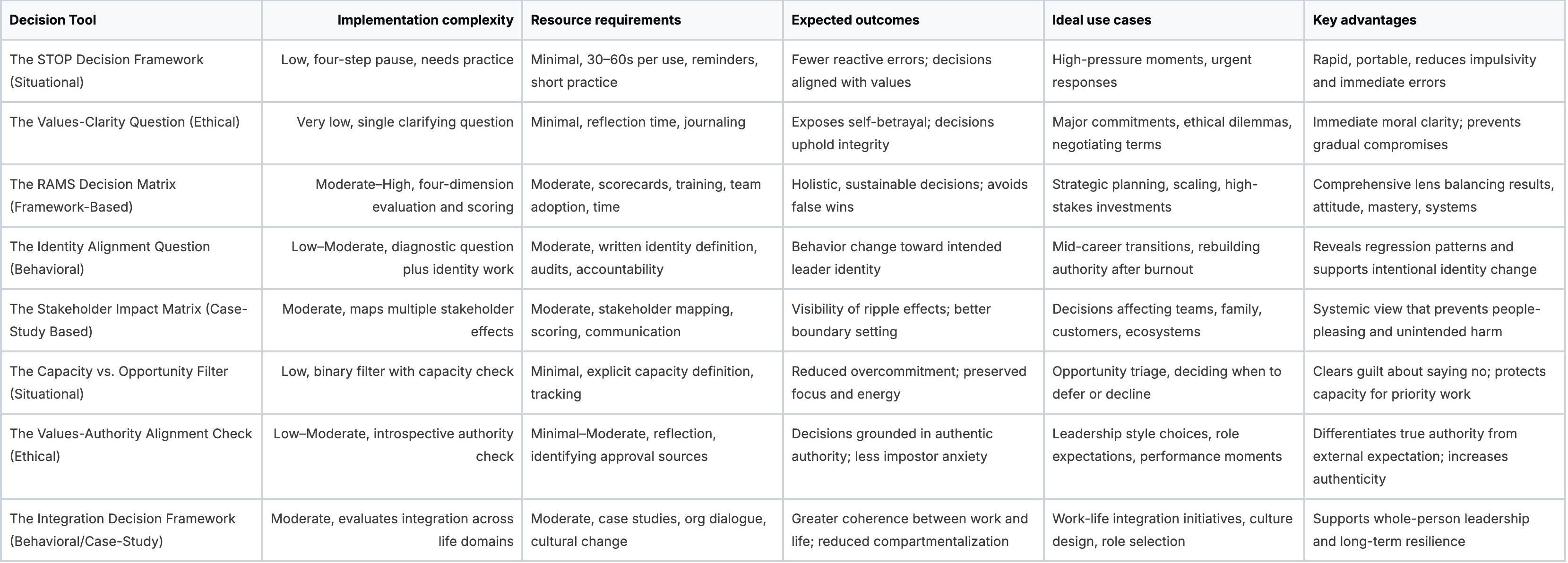
8-Method Decision Q&A Comparison
The Return: A System for Sovereign Decisions
These frameworks are not motivational quotes. They are clinical instruments. Their job is to rebuild your decision apparatus from the nervous system up.
Silent Collapse™ is not just exhaustion. It is repeated self-betrayal under professional lighting. You keep selecting what preserves image and destabilizes self. Then you wonder why the achievements feel numb.
Sovereign Leadership™ is the correction. Not as branding. As operating reality. You make fewer decisions from urgency. You stop confusing reactivity with strength. You stop calling collapse discipline.
The RAMS Framework™ is essential here.
Results without Attitude creates external success with internal corrosion. Attitude without Mastery becomes self-soothing without edge. Mastery without Systems leads to heroic effort and structural fragility. Systems without Results becomes elegant avoidance. You need all four.
Structured evaluation improves the quality and credibility of decisions when it includes gathering information, analyzing alternatives, considering risk, consulting others, and following through after the decision.
That principle also appears in competency-based interviewing guidance summarized by Clevry. Strong answers show process, evidence, alternatives, risk, and outcomes, not vague instinct, as outlined in this decision-making interview guide. I care about that because your life works the same way. If you can't explain your decisions cleanly, you're likely living inside unexamined pressure.
The return is not inspiration. It is nervous-system sovereignty. It is the ability to remain with truth long enough to choose it. It is the end of overcommitting, overexplaining, and performing certainty while your body signals no.
This work is rigorous. It asks for subtraction before expansion. It asks you to notice where you have confused loyalty with self-erasure. It asks you to stop feeding identity with outcomes that your physiology cannot sustain.
If business strategy is part of your recovery, even adjacent founder perspectives like discover Payal Saurabh Lal's strategies can sharpen how you think about cleaner choices.
Read this again if needed. Then apply it. Decision making questions and answers only matter if they change your next decision. Not your next notebook entry. Your next real yes. Your next real no.
British military veteran. Two-time international bestselling author. Founder, The Prestige Architect™. Host, Rise From The Ashes podcast, C-Suite Network. Boulder, Colorado.
FAQ
What are the best decision making questions and answers for leaders under pressure?
Start with questions that force structure. What is the actual decision? What evidence is relevant? What options exist? What risk follows each path? What outcome will show the decision worked? Under pressure, use STOP first, then move to RAMS Framework™ if the decision carries strategic weight.
Why do high achievers make bad decisions when they know better?
Because knowledge doesn't override depletion. Decision fatigue narrows options, rewards relief, and increases self-betrayal. High achievers often keep deciding from urgency, image, and overfunctioning patterns instead of authority.
How do I know if a decision is self-betrayal?
Ask whether the choice requires you to violate a core value, perform a false identity, or ignore clear capacity limits. If the reward is external and the internal cost is silence, resentment, or fragmentation, it's self-betrayal.
What's the difference between a good opportunity and a right opportunity?
A good opportunity has visible upside. A right opportunity also fits your current systems, values, and capacity. If it weakens what you already claim to protect, it isn't right.
How should I answer decision-making interview questions?
Use a structured process. Define the situation clearly. Name the decision. Explain what information you gathered, what alternatives you evaluated, what risk you considered, and what happened after implementation. Strong answers are specific and outcome-oriented, not abstract.
What if I can't trust my instincts right now?
Then stop treating instinct as the only instrument. Build a process. Use STOP for immediate decisions. Use the Values-Clarity Question for ethical choices. Use RAMS Framework™ for strategic decisions. Systems restore trust when intuition has been contaminated by stress.
If Silent Collapse™ is already shaping your decisions, don't collect more insight and call it progress. Get a real diagnosis, then build the correction. Start with Take the Silent Collapse Diagnostic, explore the Sovereign Leadership Resource Hub, and when you're done pretending this will fix itself, Apply to Work With Baz.