Constant State of Flux: Stop Silent Collapse™ with RAMS™
You're still performing. The calendar is full. The revenue exists. The title sounds strong. Privately, you feel thin, mechanical, and strangely absent from your own life.
Your mind keeps issuing one command. Keep moving or everything collapses.
That isn't ambition. It isn't resilience. In a constant state of flux, high performers often confuse adaptation with leadership. They keep absorbing change, rewriting priorities, and carrying instability in their own body until the system starts to fail. That condition has a name in my work. Silent Collapse™.
Table of Contents
The Anatomy of Collapse in a Constant State of Flux
At 6:12 a.m., you are already solving problems that should not belong to you. A team conflict is brewing, a priority changed overnight, and someone at home needs a decision before you finish coffee. You respond fast, stay composed, and keep the machine running. Your body still records the day as threat exposure.
A constant state of flux is not a flattering description of modern leadership. It is a clinical pattern of overload inside the human operating system. Repeated change forces the nervous system into continuous recalibration, then strips identity down to pure function. You stop leading from grounded judgment and start leading from compensation.
Key takeaways
Flux is a physiological burden: Persistent change density keeps leaders in adaptation mode, even when the calendar looks manageable.
Silent Collapse™ hides inside competence: Performance can stay high while recovery capacity, emotional range, and self-definition degrade.
The core symptom is hollow control: You still execute, but every variable feels heavier and every pause feels unsafe.
Recovery requires structure: Repeated instability is a systems problem. Systems end it.
Here is the mechanism. Constant flux erodes role clarity first. Then it degrades recovery. Then it distorts identity. After enough cycles, a leader no longer knows whether they are choosing, reacting, or merely containing fallout. That is not resilience. That is a command system running redline without maintenance.
The private thoughts give it away. “If I stop, everything falls apart.” “I built this life. Why do I feel nothing.” Those are not motivation problems. They are signs of nervous system dysregulation fused with identity erosion.
Instability at home amplifies the same pattern. If your personal life carries unresolved contingency risk, use an essential emergency care plan to reduce preventable disruption before it reaches executive bandwidth. Leaders who ignore domestic instability do not protect focus. They import noise into every decision cycle.
Recognition before repair
Workload is only part of the failure. Collapse also comes from persistent change density. Reorganizations, shifting priorities, political ambiguity, and blurred authority lines keep the body in chronic adaptation even when output remains high. That is why polished organizations still produce depleted leaders.
The same architecture shows up across roles. The labels differ. The mechanism does not. If you recognize this pattern in a caregiving or family context, my analysis of working mother burnout maps the same breakdown through a different operational load.
A business buzzword turned this condition into something normal. It is not normal. It is a predictable failure sequence. If you stay in flux long enough, the nervous system treats volatility as baseline and the self starts disappearing behind performance.
The Hidden Pattern Behind Perpetual Chaos
Why flux feels personal
Monday starts with a clear plan. By noon, priorities have shifted, authority is blurred, and the people above you want speed without committing to a direction. You compensate. You absorb the ambiguity, translate contradictions, and keep execution moving. By evening, the work is still standing, but your internal command function is degraded.
That is the hidden pattern. Constant flux stops being a business condition and becomes a physiological one.
When volatility persists, the nervous system stops classifying uncertainty as a passing disruption. It recodes instability as normal. The body prepares for interruption before interruption arrives. That state changes behavior long before performance numbers fall.

The shift is easy to miss because it often looks like diligence. You monitor more. You explain more. You rehearse contingencies. You tighten control around details that should never need this much personal energy. The organization calls you reliable. Your body is paying the invoice.
A leader in chronic uncertainty often isn't failing at strategy. They're compensating for unstable inputs with personal overcontrol.
The mechanism is straightforward. Environmental change outpaces decision cycles. Ambiguity rises. Perceived control drops. Cognitive strain follows. The leader starts feeling less steady and less decisive, even when skill has not changed. The system has outrun the command loop.
The identity erosion nobody names
This pattern does more than exhaust attention. It deforms identity.
If you spend enough time acting as the shock absorber for unstable conditions, you stop relating to yourself as a person with judgment and limits. You relate to yourself as a function. You become the one who absorbs pressure, closes gaps, and keeps others calm. That adaptation looks useful from the outside. Internally, it strips the self down to utility.
That is why perpetual chaos feels personal. The threat is no longer limited to deadlines or shifting plans. The threat reaches self-trust. You start asking whether you are slipping, losing capacity, or becoming weak. The underlying failure sits upstream. A dysregulated system has trained you to confuse overfunctioning with leadership.
This is also why high performers stay trapped longer. Achievement conceals deterioration. The external rewards keep arriving, so the internal breakdown gets mislabeled as success. That pattern is part of what makes success-driven nervous system dysregulation so dangerous.
The redline problem
A high-performance engine works under load. Run it at redline long enough and heat replaces precision.
Leaders in chronic flux live in the human version of that condition. Every unclear expectation demands interpretation. Every shifting priority consumes working memory. Every delayed call from above transfers processing load downward. The leader who remains functional becomes the unofficial regulator for everyone else's instability.
That arrangement always extracts a cost. Reaction time gets worse. Patience narrows. Discernment gets replaced by urgency. Relationships become more transactional because there is no spare capacity for reflection or repair. The leader may still look composed, but composition is no longer the same as regulation.
Operational rule: If your environment changes faster than your decision architecture, your body becomes the shock absorber. That is unmanaged system strain.
The RAMS Framework A System for Sovereignty
It is 6:12 a.m. You check your phone before your feet hit the floor. Three priority changes. One confused request marked urgent. One decision someone avoided making, now sitting in your lap. If that pattern feels normal, you do not have a productivity issue. You have a system failure, and your body has been drafted to absorb it.
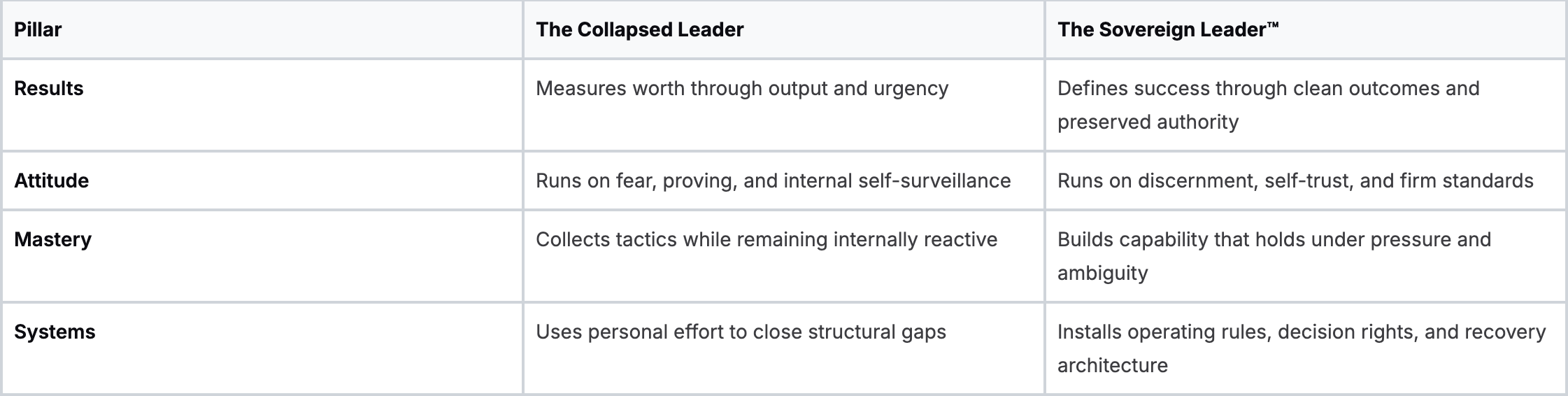
That is what the RAMS Framework™ addresses. Results. Attitude. Mastery. Systems.
Treating a constant state of flux like a business trend misses the true diagnosis. Chronic instability trains the nervous system into vigilance and strips identity down to usefulness. RAMS gives you a way to reverse both. It replaces coping with structure. It restores authority at the level that matters most: your decisions, your physiology, and your sense of self.
Leadership Operating System Collapsed vs. Sovereign
Results
In a collapsed state, results stop being feedback and become identity. You stop asking whether the work is sound. You ask whether your output still proves you deserve your role. That shift is expensive. It makes every delay feel personal, every setback feel diagnostic, and every quiet period feel dangerous.
This is how identity erosion hides inside achievement. You still perform. You still deliver. But your inner scoreboard is no longer measuring outcomes. It is measuring worth.
A sovereign approach starts with separation.
Separate output from self-respect. Measure decision quality, execution quality, and strategic coherence. Do not use productivity to decide whether you have earned recovery.
Cut false urgency. Speed is useful when timing matters. In every other case, speed is a stress response wearing professional clothing.
Track stable indicators. In volatile conditions, consistency matters more than emotional noise. Watch what remains true across changing demands.
Practical rule: If a result requires self-erasure, the result is corrupted.
The collapsed leader asks, “How do I keep proving I still have it?” The sovereign leader decides what counts, then refuses to bleed identity into the scorecard.
Attitude
Attitude is your internal command climate. It determines what your system normalizes under pressure.
In collapse, that climate turns coercive. The language sounds disciplined. The mechanism is self-abandonment.
Common forms are easy to spot:
Conditional permission: “I can stop after I clear this.”
Catastrophic responsibility: “If I release control, everything falls apart.”
Identity compliance: “Usefulness keeps me safe.”
Emotional minimization: “This is manageable. Keep going.”
None of those patterns build resilience. They train submission to dysregulation.
Sovereign attitude starts with three hard corrections. Name recurring drain as a structural fault, not a personal weakness. Stop giving volatile people unrestricted access to your time and attention. Stop relabeling fear as excellence. Hypervigilance is not rigor. Constant availability is not maturity. Self-surveillance is not leadership.
Many high performers stall here because the old posture still earns praise. That does not make it sound. It means the environment rewards self-sacrifice until the person providing it breaks.
For a more detailed explanation of the method, read the RAMS Method breakdown on why traditional coaching fails under collapse conditions.
Mastery
Mastery is not the number of frameworks you can quote under stress. Mastery is what remains available when stress rises.
A leader with mastery can still think clearly inside ambiguity. She does not lose judgment because conditions changed. She does not become easier to manipulate because other people are disorganized. She does not trade authority for approval.
That requires three layers.
Technical competence
You still need the basics. Clear communication. Prioritization. Delegation. Execution. Weak fundamentals create avoidable chaos.
But technical skill does not protect a dysregulated operator for long. Once the nervous system is overstimulated, cognition narrows. Good training gets overridden by threat response.
Emotional command
This is behavioral control under activation. You notice the tightening chest, the urge to answer instantly, the compulsion to rescue, the spike of panic disguised as efficiency. Then you interrupt it.
That interruption matters. Without it, the body writes the policy.
Identity integrity
This is the deepest layer. Identity integrity means you remain continuous while conditions change. You do not become a different person in every room. You do not shapeshift to secure approval. You do not hand the environment authority over who you are.
Leaders who hold up under flux are not the fastest adapters. They are the least internally fragmented.
Systems
Systems decide whether recovery holds or collapses on contact with reality. Without systems, insight becomes theater.
Flux is continuous movement. In leadership, that means conditions shift faster than static plans can handle. Annual intentions and vague ownership fail in that environment. You need faster feedback loops, clear decision rights, and recovery built into the operating model.
Start with decision rights.
Install decision rights
Ambiguity spreads when ownership is blurry. Clarify who decides, who advises, and who executes.
Define the final call. State where your authority begins and where it stops.
Limit opinion drag. Extra input often lowers clarity instead of improving it.
Refuse inherited load. If unresolved decisions keep defaulting to you, the structure is broken.
Use rolling planning windows
Long-range plans break under unstable conditions because assumptions expire quickly. Shorter planning windows let you review signals, adjust priorities, and reduce lag between reality and response.
Use 30-day and 90-day reviews. Keep them tight. Review active priorities, decision bottlenecks, energy drains, and role confusion. As noted earlier, unstable conditions require tighter loops.
Build recovery protocols
Recovery is not a reward. It is maintenance for judgment.
Most executives wait until they are depleted, then call the crash burnout. The better move is to install recovery before decline starts. Protect thinking time. Set communication boundaries. Create transition points between roles. Give your body repeated proof that the threat cycle will end.
A functional Systems reset includes:
Boundary architecture
Define response windows, meeting filters, escalation paths, and off-hours rules.Signal review cadence
Review changes on a schedule. Constant monitoring keeps the system in threat mode.Personal operating rules
Decide in advance what you will not do under pressure. No reactive commitments. No same-day approval of misaligned requests. No rescuing capable adults from predictable consequences.Environmental pruning
Remove avoidable complexity. Fewer channels. Fewer open loops. Fewer simultaneous priorities.
By the time a leader says, “I need a break,” the deeper problem is usually architectural. Rest helps. Structure prevents relapse.
If this section hit a nerve, act on it. Take the Silent Collapse Diagnostic. Then use the Sovereign Leadership Resource Hub to begin rebuilding authority at the level of identity, nervous system regulation, and operating structure.
The Return to Sovereign Leadership
Recovery starts when you stop treating endurance as a virtue. The return is not emotional. It is architectural.

What changed for Victoria
A recent client, anonymized here as Victoria, arrived with the usual profile. High authority. Strong results. Flat affect. She wasn't failing publicly. She was disappearing privately.
Her pattern was precise. She absorbed ambiguity for everyone else. She translated unclear expectations, closed decision gaps, and remained constantly reachable. The business praised her stability. Her body paid the invoice.
We didn't start with inspiration. We started with removal. She stopped same-day accommodation of non-critical requests. She cut two recurring meetings with no decision value. She installed a weekly decision review. She defined where her role ended. Within weeks, the noise floor dropped. Within the next phase, her thinking sharpened because her system was no longer processing avoidable chaos.
That's the point of embodied sovereignty. Authority has to exist in the body, not just the org chart.
The 30 and 90 day protocol
Use this as a command sequence, not a wish list.
First 30 days
Stabilize demand: Pause non-essential initiatives. Reduce moving parts before you optimize anything.
Define boundaries: Set response windows, meeting criteria, and escalation thresholds.
Map role leakage: List every responsibility you carry that was never formally assigned.
Install review rhythm: Use a weekly planning and signal review instead of constant reactive scanning.
Stop proving you can carry chaos. Start proving you can govern it.
By 90 days
Rebuild energy allocation: Match your best cognitive hours to high-impact work.
Clarify decision structure: Document who decides, who advises, and who executes.
Remove identity distortion: Stop using urgency to validate value.
Protect continuity: Create repeatable personal and operational systems that hold when pressure rises.
This is the return. Not to the old self. To the governed self.
If you're done performing stability while privately collapsing, Apply to Work With Baz.
Frequently Asked Questions
Why do I feel empty after hitting goals in a constant state of flux
Because your nervous system doesn't register achievement if it never exits threat processing. You can reach the milestone and still feel nothing. The body is still waiting for the next disruption. That isn't ingratitude. It's unresolved activation.
Is a constant state of flux always bad for leaders
No. Temporary flux is normal. Prolonged flux without clear decision rights, boundaries, and recovery systems is the problem. Short bursts can sharpen performance. Chronic exposure erodes judgment, identity, and self-trust.
Why do I hesitate more when I'm experienced
Experience doesn't protect you from ambiguity overload. In unstable conditions, signals are easier to misread and consequences feel harder to predict. Hesitation often rises because your system is trying to reduce error under threat. The answer is cleaner structure, not more self-criticism.
If I set boundaries, won't I become irrelevant
No. You become clearer. Collapsed leaders confuse availability with value. Sovereign leaders define access, preserve cognitive quality, and improve decision integrity. Relevance built on self-abandonment is unstable by design.
How do I know if this is Silent Collapse™ and not ordinary stress
Ordinary stress passes when the demand passes. Silent Collapse™ persists even when performance remains high. The common signs are emotional flatness, hidden resentment, decision fatigue, identity drift, and the constant belief that you can't stop without consequences. If you need a clean reference point, review the guidance in the Baz Porter FAQ.
What should I read next if this article describes me
Start with Read The Manifesto. It names the standard. Then use the diagnostic and decide whether your current life is being governed by design or by drift.
Author
Baz Porter is a British military veteran. Two-time international bestselling author. Founder, The Prestige Architect™. Host, Rise From The Ashes podcast, C-Suite Network. Boulder, Colorado.
If this article described your private reality with uncomfortable accuracy, that's the point. Baz Porter works with high-achieving leaders who have built visible success and lost internal authority in the process. Read The Manifesto, review the Sovereign Leadership Resource Hub, then Apply to Work With Baz.