How to Come Home to Yourself
You do not feel like yourself anymore. You feel like the person who runs your life, not the one living it. On paper it all works. The title. The money. The family photo. Inside there is a flat, quiet nothing.
This is Silent Collapse™. It is a successful life that feels like almost nothing inside. The way out is not a new you. It is a way back to the self you already have. That way back is how you come home to yourself.
You do not need to become someone. You need to return. If that lands, read the manifesto before anything else.
What this page covers
What it means to come home to yourself
The hidden pattern that keeps you gone
The RAMS™ return, pillar by pillar
One leader's standing practice
The architecture of your return
Questions people ask
Key takeaways
Coming home to yourself is a practice, not a mood.
You did not lose yourself. You set yourself aside to build the life.
The return is a structure you run on purpose, every week.
Rest restores the body. A standing practice restores the self.
The move is return, never becoming someone new.
What it means to come home to yourself
To come home to yourself is to return the parts of you that you set aside to build your life. It is not a feeling you wait for. It is a practice you run. You name the self that went quiet. You give it time on the calendar. You protect that time like a client meeting.
Do it once and you feel relief. Do it every week and it becomes a return operating system. That system is what holds the change. Silent Collapse™ is the name for the numb, empty state you are leaving. Sovereign Leadership™ is the ground you are walking back to.
Most leaders treat this as a rest problem. It is not. Rest restores the body. It does not restore meaning. That is why a long weekend leaves you rested and still hollow. Coming home is a presence problem. Presence is built, not bought.
The word home matters. You are not going somewhere new. You are going back to something that is still yours. It got quiet, not gone. A practice is how you turn the volume back up.
The hidden pattern that keeps you gone
There is a name for feeling flat where feeling should be. The sociologist Corey Keyes called it languishing, the absence of well-being rather than the presence of illness. You are not ill. You are not well. You are in the grey in between.
Here is the pattern. You built a life. To build it, you left parts of yourself behind. The part that rested. The part that felt. The part that wanted things for no reason. That leaving kept the machine running. More on the root of it in self-abandonment.
The trouble is that the leaving never ends on its own. Each busy week asks you to abandon a little more. So the self drifts further out. The distance feels normal because it came on slow.
This is why you cannot think your way home. You have to build your way home. Willpower fails here because the problem is not effort. The problem is structure. A loop this old does not break. It gets re-architected.
The RAMS™ return, pillar by pillar
The way back is not more effort. It is a different structure. RAMS™ is the framework I use with leaders in Silent Collapse. It reads across five pillars: Results, Attitude, Authenticity, Mastery, and Systems. Systems is where the return is won or lost, because a self you visit once drifts again by Friday.
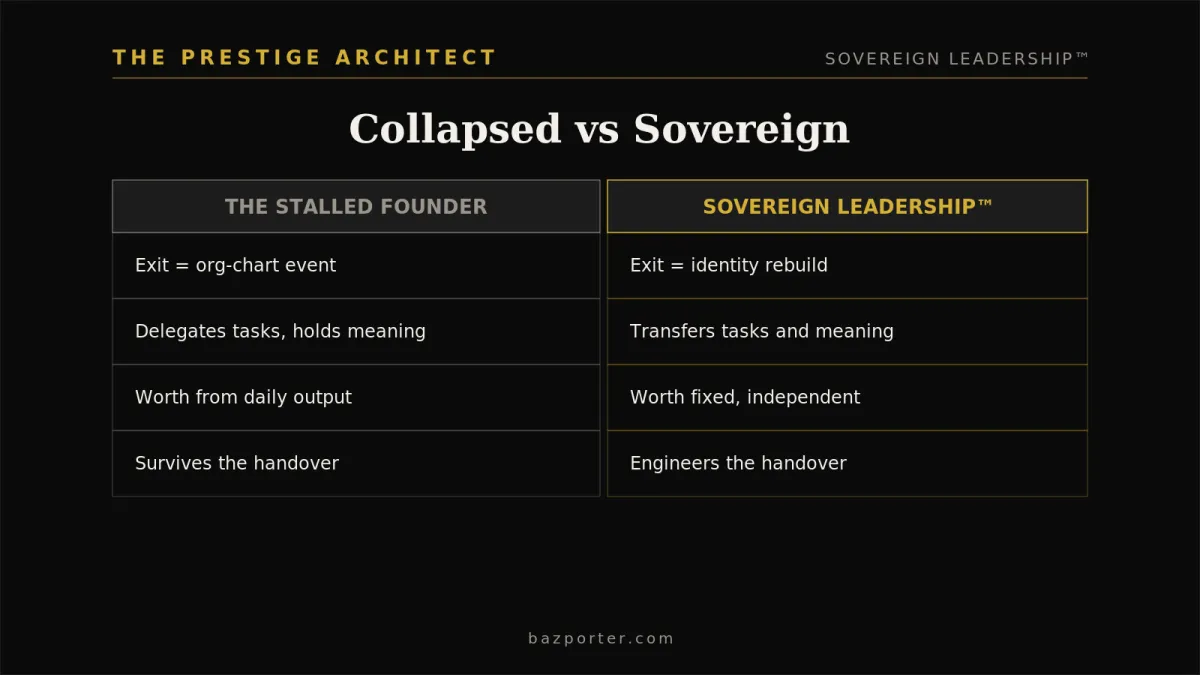
Here is the contrast between the collapsed pattern and the sovereign one:
Results: Collapsed measures output. Sovereign measures whether the output means anything to you.
Attitude: Collapsed pushes through the numbness. Sovereign reads the numbness as a signal.
Authenticity: Collapsed performs the role. Sovereign returns to the self under the role.
Mastery: Collapsed masters the work. Sovereign masters the inner life the work rests on.
Systems: Collapsed builds a life that runs without you. Sovereign builds a week you are present inside.
Read the Systems line again. That is the heart of coming home. A return you feel once is a mood. A return you schedule is a system. Only the system holds.
Research on motivation backs this. The psychologists Edward Deci and Richard Ryan showed that people come alive through autonomy, competence, and connection, not through output alone. A weekly return practice feeds all three on purpose. That is why it works when rest does not.
The numbness is not a flaw to fix. It is a signal that the self has been outvoted for too long.
If the stillness keeps showing you the emptiness, that is the door, not the danger. Start with the Silent Collapse Diagnostic™. It names where you actually are in one honest hour.
One leader's standing practice
A leader I counsel had every marker of a life that works. Two decades of wins. A strong balance sheet. A family that loves them. They came to me with one line. "I do not know who I am when I am not working."
Weekends were the worst. The quiet felt like a threat. They had filled every gap with work to keep the quiet away. We did not add rest. We built a return practice.
One morning hour a week with no purpose but presence. One relationship tended for its own sake. One want followed for no return. Small. Fixed. Protected on the calendar like any meeting that matters.
The first month felt like nothing. That is normal. By the third month the self was back in the room. The wins stayed. The numbness went. Not because the schedule got lighter. Because they came home to it, on a schedule. This is the same ground as finding your way back, made repeatable.
The architecture of your return
The return is not a mood. It is a structure you build on purpose. Here is the shape of it.
First, name the state out loud. Say it plainly: I left myself to build this. Naming ends the shame loop. Second, return one abandoned part of yourself to the week, and protect it like a client meeting. Start with one real moment. Third, add a second the following week. Then a third.
Fourth, review it weekly. The drift is quiet and patient. Your review has to be louder. Ask one question each week: was I present in the life I built, or only running it? The answer sets the next week.
None of this asks you to burn down the life you built. The life is not the problem. Your absence from it is. The work is to move back in, and to keep moving back in.
You do not have to do it alone, and you do not have to guess. Apply for the Silent Collapse Diagnostic™. In one hour we map where the self went and where the return begins. If you want the philosophy first, the manifesto holds it.
Questions people ask
What does it mean to come home to yourself?
It means returning the parts of you that you set aside to build your life. It is a practice, not a single event. You name the self that went quiet, give it time each week, and protect that time. Silent Collapse™ is the state you leave. Return is the move.
How do I come home to myself when I feel nothing?
Start small and start on the calendar. Name the numbness out loud. Return one set-aside part of yourself to your week and protect it like a meeting. Feeling follows action here, not the other way round.
Why do I feel like a stranger to myself?
Because you spent years performing a role and little time as the self under it. The role grew loud. The self went quiet. The distance feels like a stranger. It is not gone. It has been waiting.
Is coming home to yourself the same as self-care?
No. Self-care often restores the body so you can produce more. Coming home restores the self so the producing means something. One refuels the machine. The other brings the person back.
How long does it take to feel like yourself again?
Expect the first weeks to feel like nothing. The return is built, not felt at first. Most leaders notice a shift within a few months of a protected weekly practice. Consistency matters more than intensity.
About the author
Baz Porter® is the founder of Baz Porter LLC® and the architect of Sovereign Leadership Architecture™. He guides high-achieving leaders from Silent Collapse™ to Sovereign Leadership™: power without collapse, success without self-betrayal. He is an international bestselling author and the host of the Rise From The Ashes podcast on the C-Suite Network. Begin with the manifesto or the Silent Collapse Diagnostic™.