How to Find Your Way Back to Yourself
How to Find Your Way Back to Yourself
You catch your reflection and a stranger looks back. The clothes are yours. The title is yours. The face is not. If you want to find your way back to yourself, start here: what you feel is not a character flaw. It is Silent Collapse™, the quiet state where the life works and the person who built it has gone missing. This is the state I counsel people out of every week. You do not need to become someone else. You need to come back. Read the manifesto and you will see the shape of the return before we name a single step.
On this page
The short answer: how to find your way back to yourself
You find your way back to yourself by naming the self you abandoned to build the life, then choosing one true thing at a time until the stranger in the mirror becomes you again. The feeling of being lost is not weakness. It is a signal. It means you outran your own center. Baz Porter® calls this state Silent Collapse™, and the way out is a return, not a rebuild of a newer, shinier mask. Return means walking back toward what was real before the performance took over. It is slow, it is plain, and it works.
Key takeaways
Feeling like a stranger to yourself is a recognized psychological state, not a moral failure.
The gap you feel is the distance between who you are and who you perform.
You do not close that gap by achieving more. You close it by returning.
The return runs on small, true choices, repeated daily.
The Silent Collapse Diagnostic™ shows you exactly where you left yourself behind.
The hidden pattern under feeling lost
Here is what almost no one tells you. The stranger in the mirror is not new. You created that stranger on purpose, one adjustment at a time. You softened a real opinion to keep the peace. You took the safe role. You performed the calm leader while something inside went quiet. Each choice made sense alone. Together they built a person who is not you.
Psychology has a name for the ache this creates. Self-discrepancy theory shows that when your actual self drifts from your ideal self, the result is a specific kind of dejection, a flat and hollow low, not sharp pain (Higgins, 1987, Psychological Review). That flatness is the tax on living as someone you are not. It does not shout. It just drains the color out of a good life.
There is a second pattern, and it is the door out. We do not hold our identity as a fixed fact. We hold it as a story we tell about ourselves. Research on narrative identity shows that people rebuild a coherent self by re-authoring that story, by claiming the chapters they buried and writing what comes next (McAdams, 2001, Review of General Psychology). You are not lost. You lost the thread of your own story. The return is picking it back up.
The five-pillar map back to yourself
I counsel leaders through the return using RAMS™: Results, Attitude, Authenticity, Mastery, Systems. It turns a vague longing into a route you can walk. Here is the map.
Results
Stop measuring your life by output alone. Output built the stranger. Ask a harder question. What did this week give back to you? A result that costs you yourself is a loss wearing a win. Sovereign Leadership™ counts the person, not just the scoreboard.
Attitude
Drop the belief that feeling lost means you failed. It means you noticed. Noticing is the first honest act of the return. The leaders who come home are not the ones who feel nothing. They are the ones who stopped pretending the numbness was normal.
Authenticity
This is the center of the work. Authenticity is not a personality. It is the daily practice of matching your outside to your inside. Say the true sentence in the meeting. Wear the real reaction on your face. Each small act of matching shrinks the gap that self-discrepancy opened. The stranger fades as the real person speaks.
Mastery
You are already skilled at reading a room, holding pressure, carrying weight. Turn that mastery inward. Read your own room. Notice when you go quiet, when you shrink, when you perform. The same attention that runs your work will run your return, once you aim it at yourself.
Systems
Feelings fade. Systems hold. Build one small structure that returns you to yourself on the ordinary days. A morning question. A weekly hour alone. A standing check on one true thing. The return is not a single brave decision. It is a system that keeps the door open.
Collapsed versus Sovereign
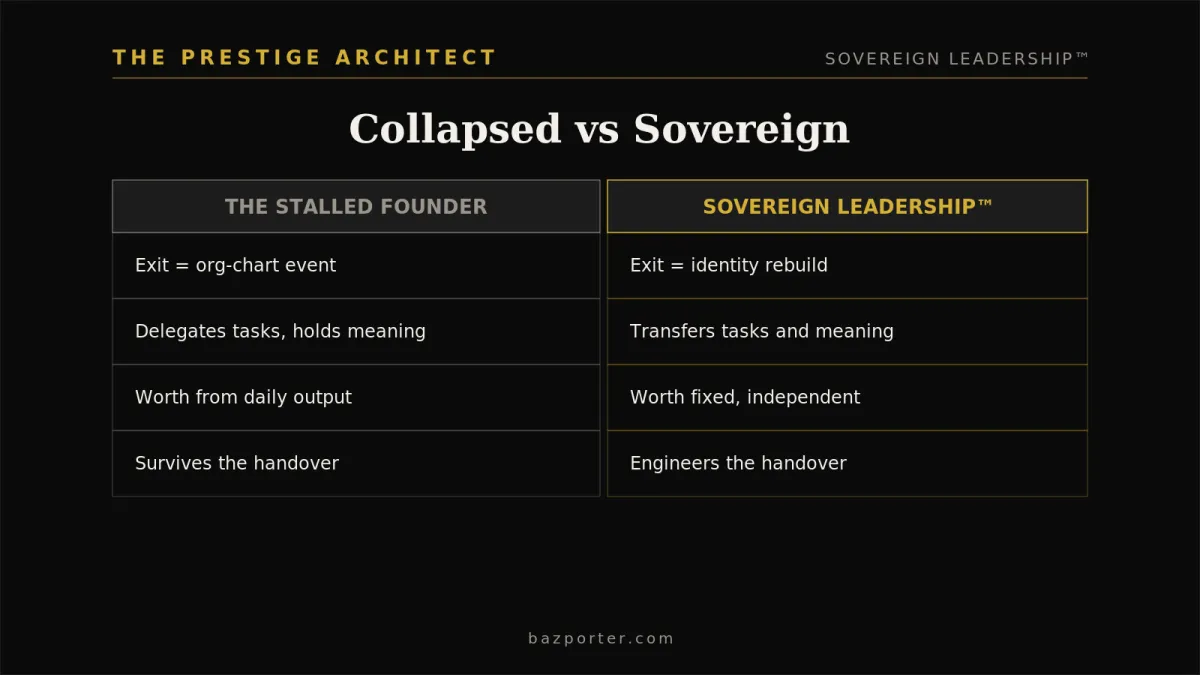
Two people live inside the same successful life. One is collapsed. One is sovereign. The difference is not the resume.
The collapsed self:
Performs the person everyone expects and calls it maturity.
Feels the gap and files it under tiredness.
Waits for the feeling to pass on its own.
Adds one more achievement to quiet the ache.
The sovereign self:
Names the self left behind and stops abandoning it.
Reads the flatness as a signal, not a verdict.
Chooses one true thing today, then again tomorrow.
Rebuilds from the inside, where the return actually starts.
You do not need to become someone new. You need to come home to who you already are.
If you cannot yet see where you left yourself, that is the point of the first step. The Silent Collapse Diagnostic™ maps the exact places you traded yourself for the life. You cannot return from a place you have not named.
One leader's return
A managing director sat across from me and said it plainly. On paper it all worked. Inside there was a flat, quiet nothing. She had won the roles she chased at thirty. She did not know the person who held them at forty-eight. She kept waiting to feel like herself again. It never came.
We did not add anything. We subtracted the performance. She named three places she had gone silent: with her board, with her partner, with her own body. She chose one true sentence a day. Small, plain, honest. Nothing dramatic. Within weeks the color started to return, not from a new win, but from the old self walking back into the room. She had not lost herself. She had left, and no one told her she could come back.
The architecture of your return
Feeling lost inside a working life is common. Staying lost is a choice, once you know there is a way back. The return is not a mood you wait for. It has an architecture. It has a first stone.
The first stone is naming the gap with precision. Not "I feel off." The exact place, the exact trade, the exact self you set down. That is the work of the Silent Collapse Diagnostic™. It is a clear-eyed read of where you left yourself, and the first designed step of the return. Apply for the diagnostic, and we begin building the road home, one true stone at a time.
Questions people ask
Why do I feel like a stranger to myself?
Because you slowly became someone you perform instead of someone you are. The distance between your real self and your presented self creates a flat, hollow feeling that psychologists call self-discrepancy. It is not a sign you are unwell. It is a sign you drifted from your own center, one reasonable choice at a time.
Can you actually find your way back to yourself?
Yes. Identity is not fixed. It is a story you can re-author. People rebuild a coherent sense of self by reclaiming the parts they buried and choosing what comes next. The return is real, it is repeatable, and it starts with naming what you set down rather than chasing something new.
How long does it take to feel like myself again?
The first shift is faster than most people expect, often within a few weeks of honest, daily practice. The full return is longer, because you are undoing years of quiet performance. What changes early is the direction. You stop drifting away from yourself and start moving back, and that alone lifts the flatness.
Is feeling lost the same as burnout?
No. Burnout is depletion from overload. Feeling like a stranger to yourself is Silent Collapse™, a loss of self inside a life that still functions. You can be rested and still feel hollow. Rest fixes tiredness. Only the return fixes the missing person in the mirror.
Where do I start if I feel lost inside a successful life?
Start by naming the gap with precision, not by adding another goal. The Silent Collapse Diagnostic™ shows you the exact places you traded yourself for the life you built. From there, the return runs on small true choices held by a simple system, and Baz Porter® walks the road with you.
About the author
Baz Porter® is The Prestige Architect™ and the founder of Baz Porter LLC. He counsels accomplished leaders out of Silent Collapse™ and into Sovereign Leadership™ using the RAMS™ framework: Results, Attitude, Authenticity, Mastery, Systems. His work is the architecture of the return, guiding people back to the self they set down to build the life.