Changing Careers at 35: The High-Achiever's Roadmap to Sovereignty
You’ve done everything right. The degree, the promotions, the six-figure salary—you built the exact career you were supposed to want. So why do you wake up most mornings with a quiet dread, a nagging feeling that your peak performance is just a mask for a deep, unshakable sense of misalignment?
The success that once fueled you now feels like a cage.
Key Takeaways
Your Discomfort is Biological, Not a Failure: The feeling of being trapped by "golden handcuffs" is a real nervous system response to a career that no longer aligns with your core self. Understanding this is the first step to overriding it.
The RAMS Framework is Your Operating System: A successful career pivot at 35 requires a structured approach. The RAMS method (Results, Attitude, Mastery, Systems) provides the military-grade clarity needed to move from fear to command.
You're Not Starting Over, You're Starting from Experience: Your decade of wisdom is your greatest asset. The key is to strategically reframe your skills and overhaul your personal brand for the career you want, not the one you had.
Sovereignty is the Real Goal: This transition is about more than a new job title. It's about reclaiming ownership of your professional life so your career becomes an expression of you, not something that happens to you.
The Problem with Golden Handcuffs

This experience is the paradox of the high-achiever, and it often hits its peak right around 35. You're trapped by what we call the “Golden Handcuffs”—a title, salary, and lifestyle so comfortable that walking away feels completely irresponsible, maybe even impossible.
The internal dialogue is relentless: "I should be grateful for this," or "Starting over now would be career suicide."
Changing careers at 35 isn't a retreat; it's a strategic redeployment of your wisdom and experience. It is about moving from a path defined by external validation to one built on internal alignment and professional sovereignty.
This conflict isn't just in your head; it’s a physiological reality. Your nervous system, conditioned for years to equate this specific path with safety and success, now registers the thought of change as a genuine threat. The result? A state of chronic, low-grade stress that drains your energy and stifles your creativity.
A Disconnect You Cannot Ignore
With each passing quarter, that dissonance gets louder. You're executing flawlessly on projects that leave you feeling utterly hollow. This disconnect between your external achievements and your internal reality becomes a heavy burden to carry.
You’re being celebrated for work that no longer reflects who you are, or more importantly, who you’re becoming.
This feeling isn’t a sign of failure. It's a critical signal from your body that your current trajectory is unsustainable—an invitation to realign your professional life with your core self before burnout makes the decision for you.
You've built a life that looks perfect on paper, but if you're being honest, it feels more like a cage than a kingdom. You’re not alone. In fact, understanding that you have built the life you wanted, but it now feels like a cage is the first real step toward finding the exit.
The question is no longer if you need a change, but how you can execute one with wisdom and courage.
Your Definitive Guide to a Successful Career Change
Let's cut right to the chase. Changing careers at 35 isn't a retreat; it's a strategic move to reclaim ownership of your life's work. This isn't about hitting the reset button and starting from zero. It's about wielding the decade of wisdom you've earned to forge a career that resonates with the woman you are today, not the person you were at 22.
This guide is your roadmap. No fluff, no generic advice. Just actionable strategy.
Your Path Forward
Here's exactly what this article will arm you with:
Anchor Your Next Move in Your Core Values: We'll go deeper than job descriptions to unearth the non-negotiable values that must be the bedrock of your next chapter. This is where lasting fulfillment comes from.
Map Your Hidden Assets (aka Transferable Skills): You’ll learn how to translate your hard-won experience into the language of your target industry, making your past wins undeniable proof of your future value.
Build Your Financial Runway: We’ll lay out the practical steps to create the financial stability that allows you to make moves from a place of power and confidence, not scarcity and fear.
Master the RAMS Framework: You'll get a full breakdown of the Results, Attitude, Mastery, and Systems (RAMS) method, a proven structure to command your entire transition with military-grade clarity and purpose.
Consider this your executive briefing for the journey ahead. It all starts with a raw, honest assessment of where you are now and a crystal-clear definition of where you're going. As you plan your next steps, understanding why access courses are ideal for career changers in their 30s, 40s, and beyond can light up a clear educational path for targeted upskilling.
Your experience isn’t a liability; it's your single greatest asset. It’s time to deploy it to build a career that doesn't just look good on a resume but feels right in your bones. Now, let’s get ready to confront the internal resistance you're bound to face.
Why Your Brain Fights a Mid-Career Change
You feel it in your gut. That deep, restless pull toward something more. It’s a palpable desire for change. But the second you think about doing something real, like actually updating your LinkedIn or researching a new industry, a powerful, invisible force slams on the brakes.
This isn’t a lack of willpower. It’s your brain’s survival programming kicking into high gear. Your brain, the most sophisticated protective machine ever built, is actively working against your dream of a career change at 35. Understanding why it does this is the first step to overriding its outdated, fear-based software.
The Habituation Loop: Your Brain's Complacency Trap
Think about it. For more than a decade, your brain has been rewarded for doing a specific job. Every promotion, every successful project, every pay rise, they all triggered a little hit of dopamine, the chemical messenger of motivation and reward. This carved a deep, powerful groove in your brain: Do this job = Get reward = Feel safe and successful.
But after years on repeat, that reward system gets tired. Your brain habituates. The same wins that once felt thrilling barely move the needle now. This is the Habituation Loop. Your brain’s reward centers have gone quiet, leaving you with that hollow, empty feeling of being unmotivated at work even when, on paper, you're crushing it.
That internal void you’re feeling? It’s not you being ungrateful. It’s a biological signal that your current environment no longer offers the novelty and challenge your brain needs to grow. It’s a sign you’ve outgrown the cage.
This neurological state is precisely why you can feel both bored out of your mind and terrified of change at the same time. One part of your brain craves new stimulation, while its ancient, deep-seated survival instinct clings desperately to the proven, familiar path. It’s an exhausting internal tug-of-war.
Identity Foreclosure: When "What You Do" Becomes "Who You Are"
The second major obstacle is a powerful psychological trap known as identity foreclosure. This is especially potent for high-achievers. Your career stopped being just what you do a long time ago; it’s a core piece of who you are. "I'm a Senior Marketing Director." "I'm a Partner at the firm."
When you anchor your identity so tightly to a professional title, the idea of letting it go feels less like a career pivot and more like a complete annihilation of self.
Social Validation: Your title is a convenient shortcut. It instantly signals your status, competence, and value to the world.
Internal Certainty: It gives you a clearly defined box to put yourself in. It tells you where you fit and what your purpose is.
Predictability and Control: In a chaotic world, your professional identity offers a predictable future, a known quantity.
Losing that title means stepping into an identity vacuum. Who are you without it? Your brain interprets this terrifying ambiguity as a direct threat to your survival, triggering a primal fear response that makes staying put—even in a soul-crushing role, feel like the only sane choice.
This resistance is a normal, protective mechanism. But at 35, you have the wisdom to see it for what it is: an outdated defense system that is now holding you back from a more authentic, aligned life. While the average age for a career shift is 39, the mid-thirties are a critical inflection point. Data shows that workers between 35 and 44 make fewer job changes than their younger peers, hinting at a period of stagnation that often precedes a major pivot. This very friction is what ignites the search for new opportunities.
Ultimately, understanding the roots of your internal resistance, the neurochemical loops and the identity entanglement, is what gives you the power to separate from it. You can observe the fear without letting it drive the car. You can recognize it not as a stop sign, but as a signal that you’re finally moving in the right direction: toward growth, sovereignty, and a career that actually fits the incredible person you’ve become.
Using the RAMS Framework for Your Career Transition
That knot in your stomach? The one that tightens every time you think about making a change? It’s completely predictable. Your brain is running on old survival software, code that equates leaving the familiar with immediate danger.
But you can't override that deep-seated resistance with motivational quotes and vague inspiration. You need a system. A framework built for high-achievers like you who demand clarity, precision, and a concrete plan of attack. That's exactly why I built the RAMS framework.
RAMS stands for Results, Attitude, Mastery, and Systems. It’s not just another acronym to memorize; it's an operating system. It's how you architect a career pivot with the same strategic rigor you'd bring to a multi-million dollar project, moving you from a place of reactive fear into a position of proactive command.
Results: Defining Your New North Star
First up is Results, and this forces a hard look at what "success" actually means to you now, not the version you adopted a decade ago. For most of your career, success was likely defined by the outside world: the promotion, the salary bump, the corner office. That’s the old game.
The RAMS approach starts by defining your desired outcome through a completely different lens, your own.
How do you want to feel when you shut your laptop at 6 PM? Energized? Creative? Like you actually made a difference?
What specific impact do you want your work to have? Is it about mentoring the next generation? Solving a gnarly industry problem? Building something tangible with your own hands?
What kind of life is this career meant to support? Are you craving more flexibility for your family? The autonomy to do deep, uninterrupted work?
This isn't about daydreaming. It's about forging a concrete, emotionally-charged vision for your future. This new definition of "Results" becomes your North Star, the unwavering guidepost you'll rely on when the inevitable doubts and old habits try to drag you back to what’s comfortable.
Attitude: Mastering Your Internal State
Once you know where you're going, it’s time to manage the internal chaos. This is Attitude. It's the essential inner work required to navigate the emotional minefield of a major life pivot. Let's be honest, changing careers around 35 triggers every single one of our deepest fears about security, status, and identity.
Right now, your inner dialogue is probably dominated by scarcity and fear: "What if I fail?" "What will my colleagues think?" "Am I about to throw away everything I've worked for?"
RAMS gives you the tools to consciously reframe this internal narrative. You learn to see fear not as a red light, but as a data point—proof that you're stepping into the growth zone. This is about shifting from a mindset of risk-aversion to one of calculated courage. It’s the deliberate choice to operate from a place of personal sovereignty instead of letting fear call the shots.
Mastery: Leveraging Your Genius and Filling the Gaps
Mastery is where we get brutally honest about your skillset. So many brilliant women I work with fall into the trap of believing a career change means starting over from ground zero. This is a complete fallacy. You are not starting from scratch; you are starting from a decade of hard-won, real-world experience.
The process here is twofold:
Map Your Core Genius: First, we identify your transferable skills, and I don't mean the buzzwords on your resume. Are you a master communicator who can get anyone to say yes? A systems thinker who can untangle any complex process? A natural leader who can rally a team around a mission impossible? These are the portable assets you take with you, no matter the industry.
Targeted Upskilling: Only after we've mapped your existing genius can we see the specific knowledge gaps you need to fill. This allows for precise, efficient learning—a specific certification, a weekend course, a small pilot project—instead of a long, expensive, and unnecessary educational overhaul.
This is all about positioning. You're not a newbie starting over; you're a strategic asset with a unique blend of proven experience and fresh skills that makes you far more valuable than someone fresh out of school.
Systems: Building Your Scaffolding for Success
Finally, Systems provides the practical, tangible structure to make it all happen. A dream without a plan is just a wish that will eventually die from neglect. This is where you build the logistical and emotional scaffolding to support your entire transition.
Effective systems are your safety net and your launchpad. They include:
Your Financial Runway: Calculating and building the savings you need so you can make choices from a place of power and stability, not panic.
Your Support Network: Intentionally curating a circle of mentors, sponsors, and peers who are cheering for your future self—not the well-meaning friends who keep reminding you of your old identity.
A Phased Transition Plan: Creating a clear timeline with specific milestones. This might involve a "bridge job," taking on freelance projects to test the waters, or scheduling informational interviews before you make the final leap.
These systems are your operational blueprint. They turn an overwhelming ambition into a sequence of manageable steps, ensuring you keep moving forward while minimizing the risk. Finding peace in the midst of the chaos that a career change inevitably brings is a hell of a lot easier when you have a reliable structure to lean on.
The table below starkly contrasts the old way of thinking about a career with the empowering approach of the RAMS framework.
Old Career Paradigm vs. The RAMS Reframe
This table really drives home the shift in thinking required for a successful, modern career pivot. It's about moving from an outdated, linear path to a dynamic, sovereign one.

By working through Results, Attitude, Mastery, and Systems in that order, you take the terrifying prospect of changing your career at 35 and turn it into an executable project. You stop being a passenger, white-knuckling the ride and hoping for the best. You become the architect of your own future.
Practical Steps for Executing Your Career Pivot
Theory is great, but let's be honest, action is what creates change. This is where the rubber meets the road, where your career pivot morphs from a well-researched idea into a tangible reality. It’s all about building the practical scaffolding, financial, experimental, and strategic, that lets you step into your new professional identity with confidence, not desperation.
We've covered the 'what' and 'why.' Now it's time for the actionable 'how'.
Create Your Financial Runway
A career change is an act of courage, but that courage has to be built on a foundation of stability. You simply cannot make clear, empowered decisions if you’re operating from a place of financial panic. This is why building a "financial runway" isn't just a good idea; it's non-negotiable.
This means sitting down and calculating your essential monthly expenses, then saving enough to cover them for a specific period, typically 6 to 12 months. This buffer is your freedom fund. It gives you the space to explore, upskill, or even take a lower-paying bridge job without the crushing pressure of immediate financial strain.
For women changing careers at 35, getting the finances right is absolutely critical. Data shows that over two-thirds of career changers face an income gap, with 58% taking an initial pay cut. But here’s the good news: the long-term outlook is overwhelmingly positive. A staggering 82% of people who changed careers later in life reported being extremely pleased with their new work. Think of a temporary financial adjustment as a strategic investment in your long-term fulfillment.
Use Pilot Projects and Bridge Jobs to Test the Waters
You don’t have to burn the ships and quit your job tomorrow to start your new career today. One of the smartest ways to de-risk your pivot is through low-commitment experiments.
Pilot Projects: Take on a small freelance project in your target field. This gives you a taste of the real-world work, helps you build a new portfolio, and lets you test whether your assumptions about the day-to-day are accurate.
Bridge Jobs: Look for a transitional role that incorporates elements of your desired new career while still leveraging your existing expertise. This could be a consulting gig or even a part-time position that pays the bills while you build new skills and connections.
These strategic "test drives" provide invaluable data. They’ll quickly tell you whether your interest is a passing fancy or a genuine passion, all while keeping your personal and financial risk to a minimum.
Overhaul Your Personal Brand and Positioning
Your old resume and LinkedIn profile? They’re an archive of your past, not a billboard for your future. It's time for a complete overhaul. You have to reframe your entire narrative to position yourself as a strategic leader entering a new domain, not just someone with an unrelated job history.
Your story needs to connect the dots for recruiters and hiring managers who won't do it for you. Frame your past experience through the lens of your new goals. Emphasize those powerful transferable skills you've honed over the years, project management, strategic planning, team leadership. For more in-depth advice on this, explore these strategies for creating the best resume for transitioning careers and executing a career pivot.
When your personal brand is clear and compelling, you might just find yourself in the fortunate position of juggling multiple opportunities. If that happens, our guide on how to handle multiple job offers can help you make the best possible choice.
This structured approach, visualized in the RAMS process flow, turns a daunting leap into a series of manageable, confidence-building steps.
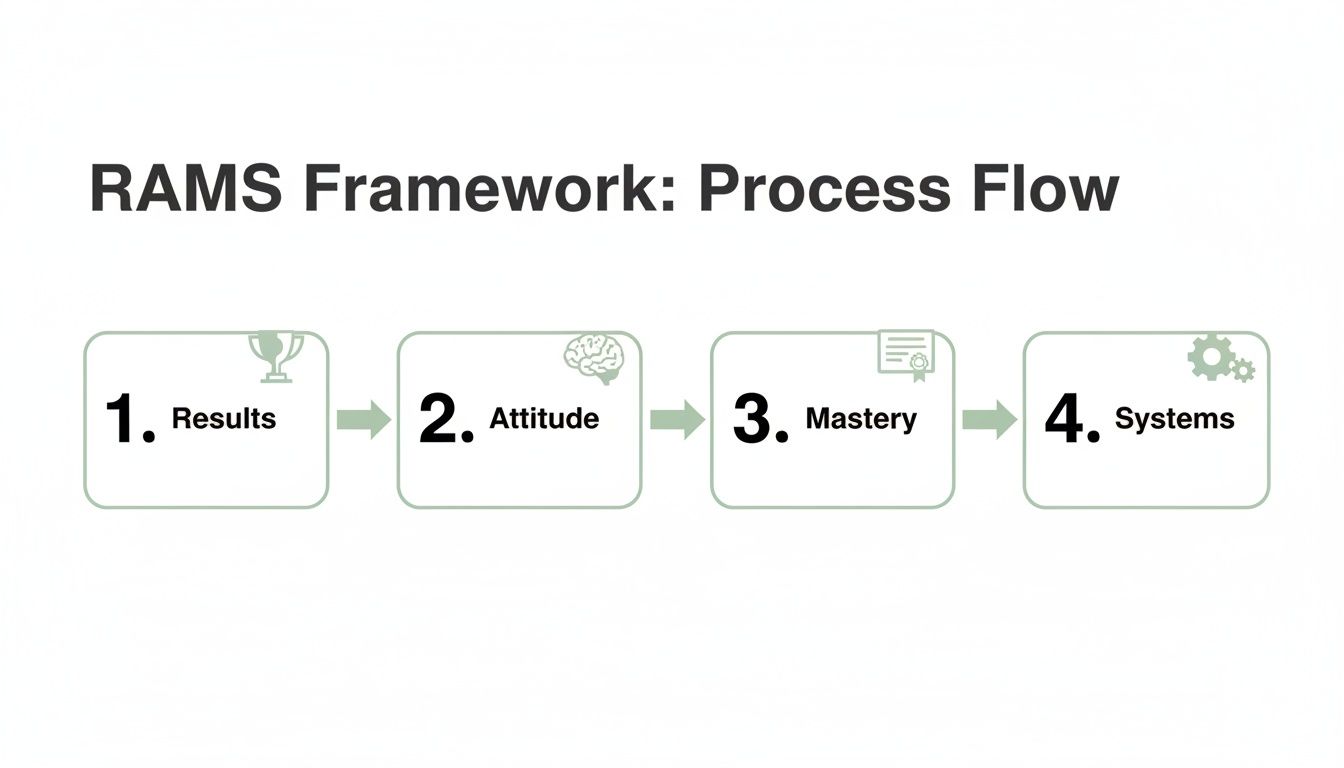
By moving sequentially through defining the Results you want, mastering your Attitude, leveraging your Mastery, and building the right Systems, you create an unstoppable momentum toward the career you were meant to have.
Reclaiming Sovereignty in Your Professional Life

Let's be honest. This whole process of changing careers at 35 isn't really about a new job title or a bigger paycheck, is it? The real endgame here is a fundamental shift in your relationship with work itself.
It’s about ditching the need for external validation and finally plugging into your own internal compass. It's the move from a career that happens to you to one that is a direct, unapologetic expression of you.
This is what I call professional sovereignty. You’re taking back your power, ensuring your work serves your well-being, and not the other way around.
A Return to Self
For years, maybe decades, your career choices were probably driven by a mix of ambition, other people’s expectations, and a very specific, culturally-approved definition of "success." That path got you here, and it was valuable. But it may have also pulled you miles away from your core self.
This career pivot is your chance to close that gap.
It’s a conscious, deliberate return to the person you are today, with all the hard-won wisdom, experience, and clarity you’ve earned. Every step you've taken so far, from mapping your skills to building a financial runway, has been an act of rebuilding trust in yourself. It's a declaration that you are the ultimate authority on your own life.
The goal isn’t to find a job you can tolerate until retirement. The goal is to build a professional life that feels so authentic, so deeply aligned with your values, that the concept of "work-life balance" becomes obsolete. It all just becomes your life.
And if you’re feeling like you’re alone on this journey, you’re not. Far from it. Current research shows that a staggering 33% of workers are actively looking for new jobs. This feeling often crystalizes in our mid-thirties when we finally have enough experience to know what's truly missing. The data is clear: making a major career shift is a normal, healthy part of a modern professional life, not a sign you failed.
Sovereignty means your career no longer defines your identity; your identity defines your career. It’s about having the guts to define success on your own terms and then building a professional world that honors that definition. This demands a huge internal shift, which is exactly why resetting your mindset is the most critical work you will do.
This isn't just a career change. It's a complete upgrade to your personal operating system, one that creates a sustainable foundation for a life of purpose, impact, and deep fulfillment.
You are not starting over. You are finally coming home.
Still Have Questions About a Mid-Career Change?
Even with the clearest roadmap, it’s completely normal to have those nagging, practical questions pop up. The ones that can stop you in your tracks if you let them. Let's tackle the big ones head-on so nothing holds you back.
How Do I Talk About This Career Change in an Interview?
Your new story isn't an escape plan; it's a strategic evolution. Resist the urge to frame this change as running away from something you hated. That’s not your narrative.
Instead, you’ll want to position this as a deliberate move, a conscious alignment of your hard-won skills with a new field where you know you can make a bigger, more meaningful impact.
Try leading with a powerful, confident narrative like this: "After a decade in [Old Field], I became an expert in [Key Skill 1] and [Key Skill 2]. I'm now intentionally bringing that strategic capability to [New Industry] because its mission to [New Mission/Value] deeply resonates with where I can add the most value."
See the difference? You’re not a rookie starting over; you’re a high-value asset making a calculated play.
Seriously, Is It Too Late for Me to Start Something New?
Let’s be crystal clear: that idea is a complete fallacy. You are not starting over. You are starting from experience.
Think about it. Your 10+ years of professional wisdom, the ability to navigate tricky office politics, lead a team through a crisis, manage a project that’s going off the rails, that’s invaluable. You can't learn that in a classroom, and it's what sets you apart.
Many forward-thinking sectors like tech, renewable energy, and healthcare consulting are actively looking for people with diverse backgrounds. They need your mature perspective and your proven knack for solving complex problems.
Your age and experience are not a liability; they are your single greatest competitive advantage. You bring a level of strategic insight and emotional regulation that younger candidates simply haven't had the time to develop. Own it.
A well-executed transition isn't an overnight jump. Realistically, you should plan for a 9-18 month timeline. That gives you breathing room for research, targeted upskilling, authentic networking, and the actual job hunt. This is a strategic redeployment of your career, not a desperate leap. When you build a solid financial runway and use a framework like RAMS, you navigate this entire period from a place of strength and sovereignty.
Are you ready to stop second-guessing and start architecting the next chapter of your career? The principles we've touched on are just the beginning. At Baz Porter, we specialize in helping high-achieving women just like you execute these kinds of transitions with absolute precision and confidence.
Discover the RAMS Method and reclaim your professional sovereignty today.