The Arrival Fallacy: Why Success Feels Hollow
You hit the number. You closed the round. You took the title everyone said would change everything. And then you sat in the quiet afterward and felt almost nothing. This is not a character flaw. It has a name. It is the arrival fallacy, and it sits at the center of what I call Silent Collapse™. The high achiever reaches the summit and finds it empty. I have watched this land in the room more times than I can count. I wrote the Sovereign Leadership manifesto for the leader living exactly this gap.
On This Page
Key Takeaways
The arrival fallacy is the belief that reaching a goal will bring lasting happiness. It rarely does.
The letdown at the summit is a signal, not a defect. It is data about how the goal was chosen.
High achievers feel it hardest. Their whole system is built to chase the next arrival.
The cure is not a bigger goal. It is a rebuilt relationship with why you climb.
The Silent Collapse Diagnostic™ maps where the gap lives in you.
What Is the Arrival Fallacy?
The arrival fallacy is a simple, brutal error. It is the belief that when you arrive, you will finally feel enough. Positive psychologist Tal Ben-Shahar named it while teaching one of the largest classes ever held at Harvard. The term describes the gap between the happiness you predict and the flatness you feel. You arrive. The feeling does not.
Here is the clinical version. You forecast that a goal will change your inner state. It changes your circumstances instead. The mind resets its baseline within days. What felt extraordinary becomes ordinary. So you set a larger goal, certain the next one will deliver. This is the loop that drives Silent Collapse™ in successful people. The outside looks like a win. The inside feels like a locked door.
The Hidden Pattern Beneath the Summit
The pattern is older than any one career. Psychologists call it hedonic adaptation. In a landmark 1978 study, researchers found that lottery winners returned close to their prior happiness within a year (Brickman, Coates, and Janoff-Bulman, Journal of Personality and Social Psychology). The high resets. The baseline holds. Ben-Shahar built on this to explain why elite performers crash after the win, a pattern documented in Psychology Today and its reporting on high achievers who feel lost after success.
There is a second layer under the first. The goal itself was often inherited. It came from a parent, a peer group, a culture that measures worth in output. You met a standard you never chose. So arrival cannot satisfy a need it was never designed to meet. The emptiness is precise. It is telling you the truth.
Why High Achievers Feel It Most
Ambition is not the problem. The engine is the problem. High achievers train one muscle above all others. They learn to defer their worth to the next result. Each win buys a short reprieve. Then the meter resets to zero. The system that made them successful is the same system that keeps them starving.
This is why the arrival fallacy hits founders and executives so hard. Their identity fused with their achievement long ago. When the achievement lands and the feeling does not, the ground moves. Many name it as numbness. Some name it as dread. A few, quietly, name it as grief. I treat all three as the same alarm.
The RAMS™ Reframe: From Collapsed to Sovereign
I do not motivate people out of this. I re-architect the system underneath it. RAMS™ runs across five pillars, at the level of the business and the nervous system.
Results. The collapsed leader measures worth by the next milestone. The sovereign leader measures worth by alignment, then lets results follow.
Attitude. The collapsed leader treats the letdown as failure. The sovereign leader reads it as intelligence and adjusts the aim.
Authenticity. The collapsed leader chases inherited goals. The sovereign leader audits every goal for whose voice set it. This pillar is the hinge.
Mastery. The collapsed leader masters the climb. The sovereign leader masters the return to self at the top.
Systems. The collapsed leader relies on willpower. The sovereign leader builds structures that hold worth steady between wins.
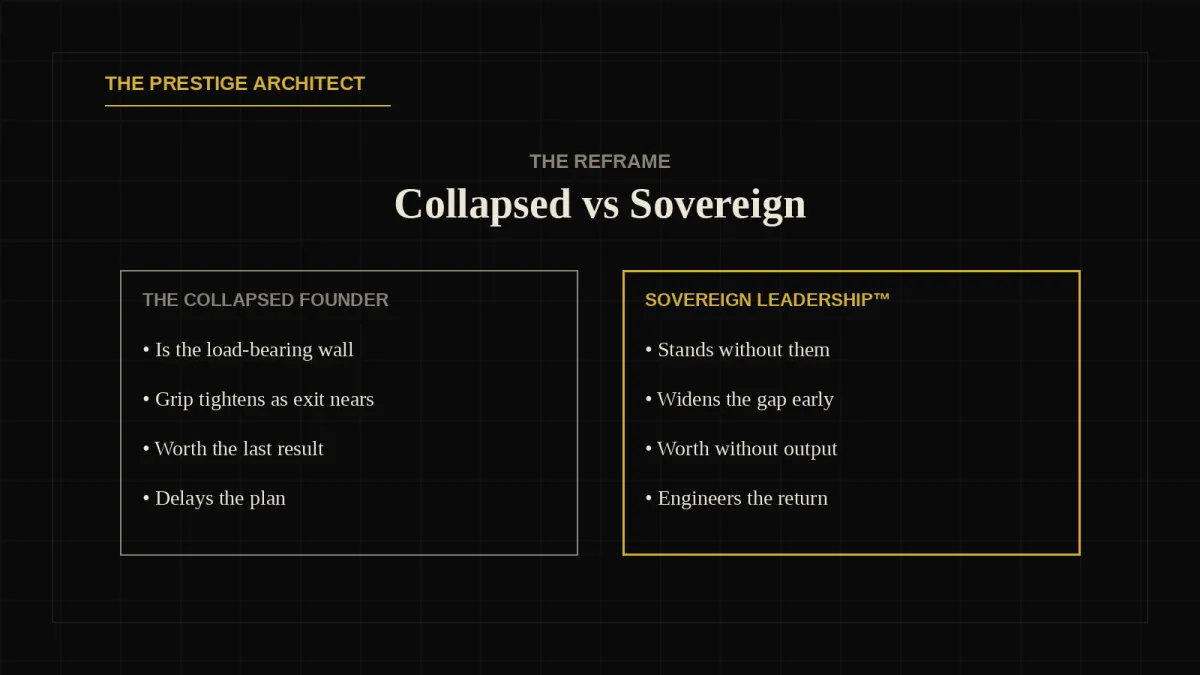
Collapsed vs Sovereign
Collapsed: the goal owns you. Sovereign: you own the goal.
Collapsed: arrival is the point. Sovereign: alignment is the point.
Collapsed: worth resets to zero after each win. Sovereign: worth holds a floor.
Collapsed: silence after success feels like a threat. Sovereign: silence becomes a room you can enter.
The arrival fallacy is not a sign you aimed too high. It is a sign you climbed a mountain someone else chose.
If any of this reads like a mirror, start where I start every client. Take the Silent Collapse Diagnostic™. It is sixty minutes, live with me. It shows you where the gap actually lives.
A Case From the Room
A founder came to me the month after her exit. Eight figures cleared. She said the words most people never say out loud. She said, "I felt more alive when I was still fighting for it." She was not ungrateful. She was disoriented. The chase had been her whole architecture. Now the chase was gone, and so was the anesthetic.
We did not set a new goal. We audited the old ones. Most of them, it turned out, belonged to her father. Once she saw that, the numbness had somewhere to go. She rebuilt her aim from the inside out. The emptiness was never the enemy. It was the map.
The Architecture of Your Return
You do not need more drive. You need a different foundation. The work is to separate your worth from your output, then rebuild the goals on ground you actually own. This is the core of The Becoming™ and the deeper containers beneath it. It is not motivation. It is architecture.
The door is the same for everyone. Take the Silent Collapse Diagnostic™. We map the gap, name the inherited goals, and design the return. You have spent years arriving. Give one hour to understanding why it never felt like enough.
Frequently Asked Questions
What is the arrival fallacy?
The arrival fallacy is the false belief that reaching a goal will produce lasting happiness. Coined by positive psychologist Tal Ben-Shahar, it describes the gap between the satisfaction you expect and the flatness you feel on arrival. The circumstances change. The inner state resets fast.
Why do I feel empty after achieving a goal?
Because the mind adapts to gains far faster than it accumulates them. Your baseline resets within days, so the win normalizes almost instantly. If the goal was also inherited rather than chosen, arrival cannot meet a need it was never built to serve. The emptiness is accurate information.
Is the arrival fallacy the same as burnout?
No. Burnout is depletion from sustained overload. The arrival fallacy is the letdown that follows a win, even when you are well rested. They can appear together, and they often do in high achievers, but they are separate patterns with separate causes.
Who coined the term arrival fallacy?
Tal Ben-Shahar, a positive psychology teacher at Harvard, named it. He observed that high performers predicted lasting happiness from their goals, then felt little once they arrived. His work built on decades of research into hedonic adaptation.
How do I stop the arrival fallacy?
You do not chase a bigger goal. You audit the goals you already hold and ask whose standard set them. Then you rebuild your sense of worth so it holds a floor between wins. The Silent Collapse Diagnostic™ is the sixty-minute starting point for that work.
About Baz Porter®
Baz Porter® is The Prestige Architect®. He guides high-achieving leaders from Silent Collapse™ to Sovereign Leadership™ through the RAMS™ architecture: power without collapse, success without self-betrayal. He is a British Army veteran, an international bestselling author, and host of the Rise From The Ashes podcast on the C-Suite Network. Related reading: successful but feel empty, success guilt, and success dysregulation.