
For High-Achieving Women
Who Are Done Being Strangers to Themselves
You've built the empire. The multi-6-figure business. The corner office everyone envies.
But here's what nobody sees...
You're dying inside The 4 AM anxiety attacks. The calendar as armor.
The terrifying question that keeps you awake...
"If I stopped performing... would I disappear?"
Finally Choose Themselves Over Their To-Do Lists
Discover Why 97% of "Successful"
Women Are Secretly Collapsing Yours Free.


Dear Beautiful Soul,
I see you.
Not just your achievements or your carefully curated LinkedIn profile.
I see the woman behind the titles, beyond the metrics, beneath the mask of "having it all together."
I see you at 3AM, when the world is quiet but your mind isn't.
When the questions you can't ask in the boardroom become too loud to ignore.
"Why does achieving everything I wanted feel like losing myself?"
"When did success start feeling this heavy?"
I know this journey intimately.
Not because I'm another coach with strategies and systems (though yes, those matter).
But because I've walked alongside women who dared to question everything they built.
Like Lorraine, who found herself in the darkest place imaginable both personally and professionally.
Today, she's not just surviving; she's reaching heights she "didn't even realize she was looking for."
Her words, not mine:
"What Baz does is life altering. He reached my heart, my soul, and allowed me to come alive again."
Or Angela, who transformed her relationship with power entirely.
She stopped pushing through exhaustion and started leading from authentic presence.
Now her team doesn't just respect her they're inspired by her whole, unfiltered truth.
Then there's Sabrina, who discovered what happens when you stop trying to fit into old leadership models.
"Baz doesn't just offer advice," she shares, "he ignites a fire within. He empowers you to unlock unprecedented potential not just in yourself, but in your entire organization."
This isn't just about executive burnout or stress management.
Those are just symptoms of a deeper truth.
This is about reclaiming your soul in the midst of success.
About remembering who you were before the world told you who to be.
About leading from a place of power that doesn't require perfection.
I've watched women step into boardrooms not with rehearsed speeches, but with unshakeable presence.
I've seen them make million-dollar decisions from a place of inner knowing, not endless analysis.
I've witnessed them build global teams while staying deeply connected to themselves.
Your success got you here.
But your truth will take you further.
You don't need another strategy.
You need permission to lead differently.
To breathe differently.
To succeed differently.
To be differently.
The transformation you're seeking isn't about adding more to your already full plate.
It's about coming home to the woman you've always been beneath the achievements.
Ready to remember who you are beyond the titles?
With deep understanding and unwavering belief in your next chapter,
Baz
P.S. The fact that you're still reading means your soul knows something your schedule hasn't admitted yet.
It's time for real change.
Not the kind that looks good on paper, but the kind that feels true in your bones.

12 week Private Mentorship Program
Strategic Identity Reset
- 6 Private 90-Minute Sessions with Baz Porter
- Comprehensive Identity & Authenticity Assessment
- Success Wound Identification & Healing Protocols
- Authentic Leadership Development Protocols
- 4-Week Post-Program Integration Period
- Custom Identity Reclamation Resources
- Stop waking up at 4 AM wondering if you matter beyond what you produce
- End the exhausting performance that's killing your soul while keeping your success
- Make decisions from your authentic self, not from fear of disappointing others
- Lead without the armor and watch people finally connect with the real you
- Create legacy impact that feeds your soul, not just your bank account
A Million Dreams Community
Where High-Achieving Women Transform Together
- Trauma-informed Guidance (weekly sessions)
- Somatic nervous system reset
- Health optimization
- Executive performance coaching
- Specialized breathwork
- Direct access to proven frameworks
- You'll sleep through the night because your body finally feels safe in your success
- You'll make decisions faster because you trust yourself more than others' opinions
- You'll stay regulated in rooms that used to dysregulate you
- You'll be present with your children without guilt eating you alive
- You'll lead from sovereignty, not survival
- You'll stop performing your life and start living it


Hi I'm Baz...

I know what it's like to look successful on the outside while falling apart on the inside.
My journey from British military veteran to rock bottom taught me the hardest truth, sometimes you have to lose everything to find yourself.
After my own dark night of the soul battling depression, facing homelessness, and questioning everything I discovered something powerful.
Real transformation isn't about pushing harder. It's about coming home to yourself.
Today, I guide high-achieving women from exhaustion to embodied leadership. Featured in Yahoo, CEO Weekly, Women Leaders Magazine, and Digital Journal, my work goes beyond traditional coaching.
Not because I have all the answers, but because I understand the questions that keep you up at 3AM.
This isn't about adding more strategies to your life. It's about remembering who you were before the world told you who to be.
Ready to come home to yourself?
TAKE YOUR FIRST STEP
Begin With Your Private Reset Ritual
Join hundreds of female executives who started their transformation here.
No pressure. No performance. Just presence.
(Start sleeping better in 5 days or less)

From Fraud to Force: How to Overcome Impostor Syndrome
You are in a high-stakes meeting, presenting the very project you bled for. And as the words leave your mouth, a cold dread washes over you. It’s not a thought, it’s a physical sensation in your gut: “They can all see you’re faking it. Any second now, they’ll find you out.” The air thickens. Your achievements feel like a costume, and you are just an amateur playing dress-up, waiting for the inevitable exposure.
This is the silent collapse. No external drama, just the quiet, internal implosion of your hard-won authority.
Key Takeaways
It's a Nervous System Problem, Not a Mindset Flaw: Lasting confidence isn't built with positive affirmations. It requires rewiring the deep, physiological stress patterns that scream, "You're a fraud."
Success Can Make It Worse: High achievement often creates a "Performance Treadmill," where each win raises the stakes and intensifies the fear of being exposed, leading directly to executive burnout.
Use the RAMS Method for a Practical Fix: You can systematically dismantle impostor patterns by focusing on Results (your evidence), Attitude (reframing the narrative), Mastery (regulating your nervous system), and Systems (building a supportive ecosystem).
Nervous System Sovereignty is the Goal: The ultimate aim is not to eliminate self-doubt forever, but to build the capacity to stay grounded and lead effectively even when those feelings arise.
The Disconnect Between Success and Self-Doubt
You’ve got the title. The awards are piling up. Your peers respect you, and your track record is undeniable. Yet, there's that nagging voice, a persistent whisper in the back of your mind: "It’s only a matter of time before they find out you don't belong here."
This jarring gap between your external reality and your internal monologue is the classic signature of impostor syndrome, especially in high-achieving women.
It’s not a personal failure; it's a conditioned pattern. The harder you work and the more you accomplish, the more intense the fear of being exposed becomes. It’s a cruel paradox, and you are far from alone in feeling this way.

A Rising Tide of Self-Doubt
This feeling is no longer a dirty little secret; it's a mainstream leadership challenge that women at the top simply can't afford to ignore. A recent study by KPMG found that 75% of executive women have experienced impostor syndrome at some point in their careers. This is a cry for help from the highest levels of leadership.
This isn’t just a fleeting trend. Google Trends data shows a steady, relentless climb in interest over the last five years.
This chart isn’t just lines on a graph; it's a visual representation of a collective exhaustion. It’s the sound of leaders who are tired of performing, tired of the mask, and desperate for a real solution.
Intellectual fixes—like being told to "just be more confident"—inevitably fall flat. Why? Because they completely ignore the dysregulation happening in your nervous system. We dive deep into this crucial distinction in our guide on the connection between success and dysregulation.
Beating this pattern for good requires more than surface-level advice. It demands a fundamental shift in how you relate to yourself, your work, and your body's response to stress.
The Hidden Pattern - Why Your Achievements Fuel Your Self-Doubt
It’s a bizarre contradiction. You land the big client, nail the promotion, or steer your team to a massive win. But instead of feeling competent, you feel more like a fraud than ever before. This isn't a flaw. It’s a feature of how a high-achiever’s brain gets wired.
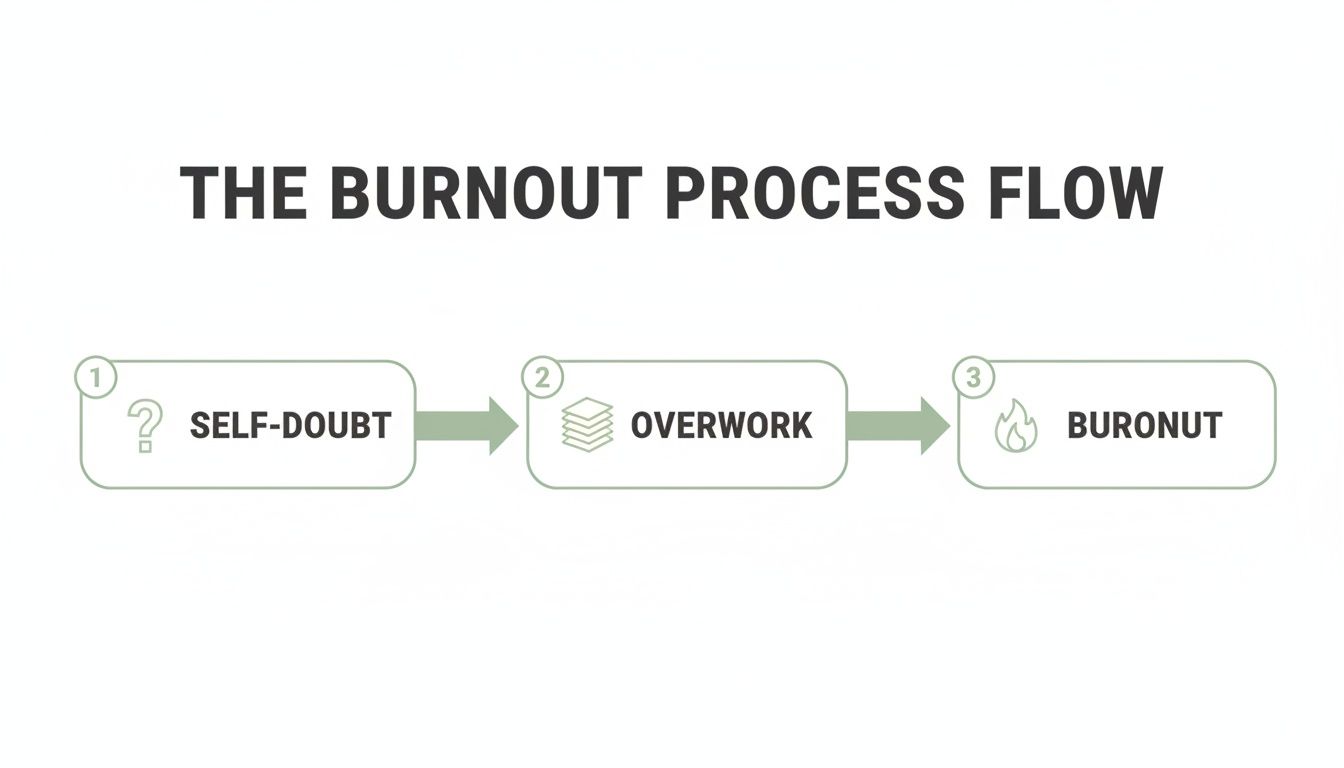
To overcome impostor syndrome, you must recognize that it is a nervous system pattern, not an intellectual problem. It’s a physiological response to pressure rooted in a deep-seated belief that your value is conditional upon your performance, which keeps you trapped in a cycle of over-functioning and burnout.
With every new success, the stakes get higher. Your brain doesn't file that win away as proof of your competence. Instead, it sees it as a new, much higher bar you now have to clear, cranking up the fear of being exposed. You're not building confidence; you're just piling on the pressure.
This exhausting loop is the Performance Treadmill. You run faster and faster, collecting achievements, but you never actually arrive at a place of genuine self-worth. You’re working for approval, not from a place of embodied capability.

From Mindset to System Wiring
To truly break free from impostor syndrome, you have to make a critical shift. Stop asking, "What’s wrong with me?" and start asking, "How is my system wired?" This isn't a simple mindset issue. It's a neurological pattern etched into your nervous system over years.
Your nervous system has learned that performance equals safety. Succeed, and you get a temporary hit of relief. But the moment the next challenge pops up, the system floods with cortisol and adrenaline, triggering that old, familiar fear: "This is it. This is the time they find me out."
Key Insight: Real, lasting confidence isn’t about convincing your brain you’re good enough. It’s about teaching your body it’s safe enough to trust your own capabilities, without needing constant proof from the outside world.
The Downward Spiral: Where Impostor Syndrome Meets Burnout
That constant feeling of being a fraud physically runs you into the ground. This is where impostor syndrome becomes dangerous, creating a direct path to executive burnout. The relentless pressure to prove you belong keeps your system flooded with stress hormones.
You over-prepare. You micromanage. You say "yes" to everything. Each action feels necessary to outrun the fear of being exposed. But it's not sustainable. It's a physiological spiral into complete exhaustion.
This isn’t new. Psychologists Pauline Clance and Suzanne Imes first described it in 1978 when they studied high-achievers who could not internalize their own accomplishments. Decades later, the pattern holds. Your nervous system gets stuck in a perpetual "fight or flight" mode. Rest becomes impossible because stillness feels like a threat—a quiet moment where you might finally be "found out."
To break this cycle, you have to manage workplace stress and burnout by tackling the impostor feelings at their root. For a deeper look at recovery, check out our guide on overcoming burnout at work.
Impostor Syndrome vs. Burnout: A Vicious Cycle
While not the same, impostor syndrome and burnout form a vicious cycle. One relentlessly fuels the other. Understanding their toxic partnership is the key to breaking free.

Seeing them side-by-side makes it clear: impostor syndrome provides the "why" (the internal fear), and burnout is the devastating "what" (the physical and emotional collapse). The persistent feelings of inadequacy at work effectively create a self-imposed glass ceiling.
ACT II: The RAMS Reframe – A Practical Framework for Lasting Confidence
If positive thinking worked, you wouldn't be here. Those approaches fail because they don’t touch the real problem: a dysregulated nervous system and ingrained behavioral patterns. To dismantle the internal architecture of self-doubt, you need a structured approach that builds genuine confidence from the ground up.
This is what the RAMS Method was designed for. It’s a practical framework for leaders to systematically tackle the cognitive, somatic, and environmental triggers that keep impostor feelings on a loop.
R is for Results: Your Evidence-Based Defense
Stop arguing with your feelings. You can’t win. Instead, become a data scientist of your own success. Impostor syndrome lives in vague, unsubstantiated fears. Your best weapon is a portfolio of cold, hard data.
This isn’t about ego. It's about building an undeniable, factual case for your capability.
Start a "Results Inventory" today. This is a living document cataloging your specific contributions and their real-world impact.
Quantify your wins: Don't just say you "managed a project." Say: "Led a cross-functional team of 8 to deliver Project X two weeks ahead of schedule, resulting in a 15% increase in departmental efficiency." Numbers don't lie.
Archive your praise: Save screenshots of emails where a client praised your work. Keep notes from performance reviews. When your inner critic whispers, "you're a fraud," pull out the receipts.
Track your growth: Note every time you master a new skill. This documents your capacity to adapt and grow—proving that success isn't a fluke.
Doing this consistently rewires your brain. You move your self-worth from the shaky ground of subjective feelings to the solid bedrock of objective fact.
A is for Attitude: Intercepting the Fraudulent Narrative
Your internal monologue is the engine that powers impostor syndrome. You must learn to intercept and reframe fraudulent thoughts the moment they appear. This is a cognitive skill that requires practice.
The goal isn't to "be positive." It's to adopt the mindset of a humble realist.
Consider this classic impostor thought: "Everyone in this meeting is so much smarter than me."
A humble realist reframes it: "There are some brilliant people in this room. This is an opportunity for me to learn and contribute my unique perspective."
The reframe isn't a delusion. It’s a more accurate, useful interpretation of reality. It acknowledges the talent in the room while affirming your own right to be there. Building this cognitive muscle is a core part of becoming more self-aware. To dig deeper, check out our guide on how to be more self-aware.
M is for Mastery: Taming Your Nervous System
This is the piece most solutions ignore. You cannot think your way out of a physiological stress response. When you feel that hot rush of anxiety—the fear of being exposed—your body is already in fight-or-flight mode.
Lasting confidence requires you to become a master of your own nervous system.
Mastering your internal state breaks the cycle before it starts. You don't need a meditation retreat; simple somatic practices are incredibly powerful.
Box Breathing: Before a high-stakes presentation, find a quiet corner. Inhale for four counts, hold for four, exhale for four, and hold for four. Repeat. This instantly brings your autonomic nervous system back into balance.
Grounding: When you feel a jolt of anxiety, press your feet firmly into the floor. Feel the stability. This sends a direct signal of safety to your brain, pulling you out of the spiral.
These are not fluffy relaxation techniques. They are essential leadership tools for maintaining composure under pressure.
S is for Systems: Building Your Confidence Ecosystem
Impostor syndrome doesn't happen in a vacuum. Your environment can either fuel the fire or douse it. You must consciously design professional and personal systems that reinforce your confidence.
This is about proactively architecting an ecosystem where your competence can thrive.
It means seeking mentors who see your brilliance. It means building a peer group for honest conversations. It means setting—and enforcing—firm boundaries that protect you from the burnout cycle. A huge part of this is developing mental toughness, a skill that fosters a deep, unshakable self-belief far beyond any single project.
The Return to Nervous System Sovereignty
Let's be clear: moving past impostor syndrome isn't about adding another skill. You're already skilled. This is about taking something away—releasing the years of conditioning and self-doubt that have kept you playing small.
This is a fundamental shift from a life spent performing for others to one where you lead from a place of deep, unshakeable self-trust.
This is about reclaiming nervous-system sovereignty. It’s the ability to feel the pressure of a high-stakes meeting without it derailing your self-worth. It’s being able to take in praise without deflecting it, and face criticism without crumbling. This is a whole new way of being.
Real leadership was never about having all the answers. It’s about cultivating a grounded presence that lets you navigate uncertainty with clarity and strength.
Sustainable Integration, Not Temporary Fixes
The RAMS framework isn’t a one-time checklist. Think of these as tools you'll keep coming back to. This journey is about sustainable integration, not a quick fix.
Every time you reframe a fraudulent thought or use a grounding technique, you cast a vote for a new way of being. You are slowly building a leadership style that is powerful because it’s real.
This process is an unraveling. You are shedding the heavy armor of perfectionism to reveal the capable, resilient leader who has been there all along. The freedom is not in becoming someone new, but in finally allowing yourself to return to who you truly are.
Your Invitation to Embodied Leadership
This journey—from feeling like a fraud to leading with genuine self-trust—is some of the most critical work you can do. It doesn't just change your career; it ripples out into every corner of your well-being.
Understanding what authentic leadership actually means is the starting point. It's a commitment to leading from internal alignment, not a scramble for external validation.
If you’re ready to architect a leadership presence free from the grip of impostor feelings, the path forward starts with a clear diagnosis of your specific patterns. The first step in returning to yourself is understanding where you are right now.
Common Questions & Straight Answers
Let's tackle a few of the questions that often come up when high-achieving women decide they're finally ready to move past impostor syndrome. These are the last-minute hesitations, the "what ifs" that can keep you stuck. It's time for some clarity.
Can You Really Get Rid Of Impostor Syndrome For Good?
Yes, but probably not in the way you're thinking. This isn't about finding a one-time "cure." It's about developing what I call nervous-system sovereignty. You learn to recognize those fraudulent feelings for what they are: physiological signals, not objective proof of your inadequacy.
With practice, the thoughts lose their grip. They might still show up as a faint whisper during a high-stakes presentation or a tough negotiation, but you'll have the tools to regulate your system in the moment. You'll know how to challenge the narrative and operate from a place of grounded confidence.
The goal isn't eradication; it's resilience.
How Is a Somatic Approach Different From Regular Therapy?
Traditional talk therapy is an incredible tool for exploring the why behind your patterns. It’s fantastic for cognitive reframing and digging into the historical roots of your beliefs. Many of my clients have found it invaluable.
A somatic approach, like the RAMS Method, focuses on the how. It directly addresses the physiological imprint of impostor syndrome—the tension, the shallow breathing, the racing heart—that gets stored in your body. We work with the nervous system's stress response, using physical and mindfulness practices to release that trapped energy. This builds your capacity to stay centered under pressure.
It’s about changing your state, not just changing your story.
This work isn't a replacement for therapy but a powerful complement. It bridges the critical gap between intellectual understanding and embodied, felt change. That's where transformation becomes sustainable.
How Does This Work In a Male-Dominated Field Where I'm Already Under a Microscope?
This is precisely where nervous-system regulation becomes your strategic advantage. In environments where you feel constantly scrutinized or underestimated, the ability to remain internally grounded is your greatest asset. It's your superpower.
When you feel that familiar jolt of self-doubt in a boardroom full of men, you can use a subtle grounding technique. Something as simple as pressing your feet firmly into the floor sends a direct signal of safety to your brain, pulling you out of a potential spiral before it even begins.
You also learn to lean heavily on your "Results Inventory"—your personal arsenal of hard data. When you're armed with objective, undeniable proof of your contributions, your confidence is no longer dependent on external validation from colleagues who may or may not be allies. You bring your own receipts.
At Baz Porter, we architect leadership that is powerful because it's authentic. If you are ready to dismantle the patterns of self-doubt and build a career defined by genuine confidence and fulfillment, let's connect. Explore how we can build your path to embodied leadership at https://bazporter.com.

Voted number #1 for Leadership by the Best of the Best 2024. Real growth for High performing women who love life & demand more.
⭐⭐⭐⭐⭐
1630 30th Street Ste A - 418
Boulder Colorado 80301
United States
Phone: +1-646-212-4807
CUSTOMER CARE
NEWS
LEGAL


© 2019 - 2026 | Baz Porter LLC. All rights reserved.
Protected by all the possible laws. If you wanna try and copy it. We are gonna come after you. Liam Neeson Style.
Terms Of Use | Privacy Policy | Disclaimer