Who Would I Be Quiz: From Burnout to Embodied Leadership
You’ve got the title. The corner office. The accolades that prove you’ve made it. On paper, you are the very definition of success. Yet, there’s a quiet, gnawing question that haunts the spaces between your achievements: “Who would I be without all of this?”
It’s the whisper that follows a 14-hour workday, the cold unease that settles in after the applause fades. You’re staring at an internal void, a growing sense that the person in the mirror is a stranger—someone forged entirely by pressure and performance. This isn't just a tough week. This is the Silent Collapse, and you're not imagining it.
Key Takeaways
The Hidden Cost: Learn why traditional personality tests reinforce your "Executive Mask," accelerating burnout by ignoring the conflict between your performed role and your true self.
The Four Archetypes: Pinpoint your specific leadership archetype—Architect, Sentinel, Visionary, or Alchemist—to understand your unique strengths, burnout triggers, and path back to sovereignty.
The RAMS Framework: Discover a proven method to translate quiz insights into action, moving from identifying the problem to fundamentally rewiring your approach to leadership and life.
The Sovereignty Reset: Gain a practical, 5-minute tool to begin regulating your nervous system, the non-negotiable first step in dismantling a high-performance identity built on exhaustion.
Who Am I Without My Success
That question isn't just a passing thought; it's a symptom of a profound and dangerous disconnect. You’ve become so damn good at playing the part of a high-achieving leader that your authentic self—the person with passions, values, and needs beyond the next quarterly report—has been systematically sidelined.
Taking a "who would i be quiz" is a tool for deep self-inquiry, designed not to categorize you, but to dismantle the high-performance persona you’ve meticulously constructed. Its purpose is to reconnect you with your core identity and answer the questions that actually matter.
This relentless drive, while creating incredible external success, always comes at a staggering personal cost: burnout, emptiness, and the disorienting feeling of being utterly lost inside a life you built. This journey of self-inquiry isn’t just happening to you. The online personality test market, valued at $7.94 billion in 2025, is projected to surge at a 12.95% CAGR through 2034. This isn't about idle curiosity; it's driven by executives and leaders desperately seeking insights beyond traditional metrics. For many, a "who would i be quiz" is becoming a critical first step away from the brink. You can explore a full analysis of this trend and its impact on leadership development in a study by Grand View Research.

A Tool for Deep Self-Inquiry
Let's be clear: a "who would i be quiz" is much more than another personality test. Think of it as a tool for deep, personal reconnaissance. It’s not designed to put you in a box, but to help you dismantle the executive persona you’ve so meticulously constructed. The real mission is to reconnect with your core identity.
This quiz is your starting point for answering the questions that actually matter:
What truly lights me up, beyond the dopamine hit of external validation?
Where have I compromised my own values for the sake of another win?
Who am I when I’m not performing for an audience?
For those wrestling with the fundamental question of 'who am I without my success,' other unconventional tools like a Clarity Tarot reading can also cut through the noise and offer profound insights.
Ultimately, getting brutally honest about your professional identity development is the non-negotiable first step. It's the only way to build a life where your success and your soul can finally coexist.
Why Traditional Personality Tests Fall Short
You’ve taken them. We all have. The Myers-Briggs, the DISC, the Hogan. They’re the bread and butter of the corporate world, tools meant to neatly box you into a category and predict how you’ll perform. But here's the uncomfortable truth: they aren't measuring you. They’re measuring the persona you’ve bled for.
These tests are exceptionally good at capturing a snapshot of your Executive Mask—that polished, high-performing identity you’ve meticulously built to survive and win in high-stakes arenas. It’s the version of you that’s always on, always resilient, always delivering. But that mask, worn long enough, starts to feel less like armor and more like a cage, suffocating the person underneath.
This isn’t just a feeling of being divided; it’s a hardwired neurological state. As explained by neuroscientists like Dr. Andrew Huberman, the constant demand to perform keeps your nervous system simmering in a low-grade "fight or flight" response. Your body can’t tell the difference between a boardroom showdown and a real-world threat, which leads to a chronic state of activation that feels like bone-deep tension and a profound sense of being disconnected from your own life.
The Problem with Static Labels
The fundamental flaw of traditional personality tests is that they deal in static, lifeless labels. They’ll tell you what you are—an "INTJ" or a "High D"—but they offer zero insight into why you operate that way or what the personal cost of that operation is.
The most significant flaw in these assessments is their failure to account for the adaptive self—the version of you molded by pressure, expectation, and the relentless pursuit of achievement. They validate the mask, not the person behind it.
A "who would i be quiz" designed for real leaders takes a completely different path. It’s not about finding a box to fit you into; it's about uncovering the core misalignments that are fueling the burnout, the emptiness, and the gnawing feeling that something is missing.
Instead of static traits, it digs into the dynamic, context-driven factors that truly define your experience:
Core Values vs. Performed Behaviors: Pinpointing the exact places where your daily actions are at war with what you truly hold sacred.
Stress Response Patterns: Mapping your automatic reactions when the pressure hits, revealing the triggers that force the Executive Mask into place.
Embodied Needs: Unearthing the non-negotiable requirements for your fulfillment that your professional persona has been trained to ignore.
Make no mistake, the personality test market is a beast. Projections show the recruitment slice alone will hit $3.5 billion by 2033, with 85% of Fortune 500 companies already using these tools for hiring and placement. Yet, a critical distinction is emerging from the noise. Women leaders report a staggering 40% higher retention when assessments are used for genuine development, not just for sorting and categorizing.
This lines up perfectly with findings that 65% of high-achieving women who engage with deeper, more meaningful behavioral assessments end up pivoting into roles that align with their core values. The outcome? A 30% reduction in feelings of disconnection. A proper quiz isn't about fitting you into a role; it’s about reclaiming yourself from the role. You can dive deeper into our guide on other powerful leadership assessment tools that make this kind of profound work possible.
The Four Leadership Archetypes of High-Achieving Women
Let's be clear: a "who would i be quiz" isn't some fluffy personality test. It’s a diagnostic tool. It’s designed to give you the raw data on your internal operating system—the deep-seated programming that hijacks your decisions when the pressure is on. This is how you stop feeling vaguely “off” and start pinpointing the exact source of the disconnect.
For the high-achieving women I work with, these hidden patterns almost always consolidate into four primary leadership archetypes. Think of them not as restrictive boxes, but as brutally honest mirrors reflecting your current state. They show you where you’re powerful, what specifically sends you into burnout, and the precise path back to leading from a place of sovereignty, not performance.
The Architect
The Architect is a true master of systems and structure. Her genius lies in her ability to construct powerful, scalable frameworks that produce clockwork results. She is meticulous, precise, and wired for order.
But her shadow is a crippling rigid perfectionism. When chaos hits—and it always does—her nervous system defaults to a state of hyper-control. This is where micromanagement takes over and delegation becomes impossible. Her burnout trigger is unforeseen failure. When a plan she so carefully built crumbles, it doesn’t just feel like a project failure; it feels like a catastrophic collapse of her identity.
The Sentinel
The Sentinel is the fierce protector of her people and the standards she upholds. Her core strength is an almost psychic intuition for team dynamics and hidden risks, combined with an unshakeable loyalty. She is driven by a deep sense of responsibility, creating an environment of profound psychological safety for her team.
This protective drive, however, can quickly sour into hyper-vigilance. Her shadow is the relentless scanning for threats, causing her to absorb and carry the emotional burden of every single person on her team. Her burnout trigger is betrayal or the perception of letting someone down, which she experiences not as a mistake, but as a deep, personal moral failing.
This hierarchy diagram illustrates how the Executive Mask often conceals the True Self and its adaptive personas.

The critical insight here is recognizing your performed role is just a layer—a mask—worn over your true identity. It is not the core of who you are.
The Visionary
The Visionary doesn't just see the future; she convinces others to help her build it. Her power comes from her infectious passion, her boundless creativity, and an uncanny ability to spot opportunity where everyone else sees a dead end. She’s fueled by the thrill of innovation and the promise of making a massive impact.
Her shadow, however, is a dangerous disconnect from operational reality. In her relentless pursuit of the next big thing, she can completely neglect the foundational work and practical details required to keep the lights on. Her burnout trigger is stagnation or boredom; to her, being stuck feels like a form of death. You can see how these deep drivers show up in other frameworks, too, by exploring the Enneagram types and their descriptions.
The Alchemist
The Alchemist doesn’t just survive in chaos; she thrives in it. She has an almost supernatural ability to transmute crisis into opportunity. Her core strengths are her remarkable adaptability, her resourcefulness, and her unnerving calm in the eye of the storm. She’s motivated by the art of turning lead into gold.
The shadow of the Alchemist is a very real addiction to crisis. She can become so defined by her role as a firefighter that she unconsciously seeks out—or even creates—chaos just to feel purposeful and alive. Her burnout trigger is, ironically, prolonged peace or stability. A lack of problems to solve can leave her feeling useless and irrelevant, often triggering a profound existential crisis.
Leadership Archetype Comparison
These archetypes are your starting point for self-reclamation. Below is a direct comparison to help you identify your own patterns.
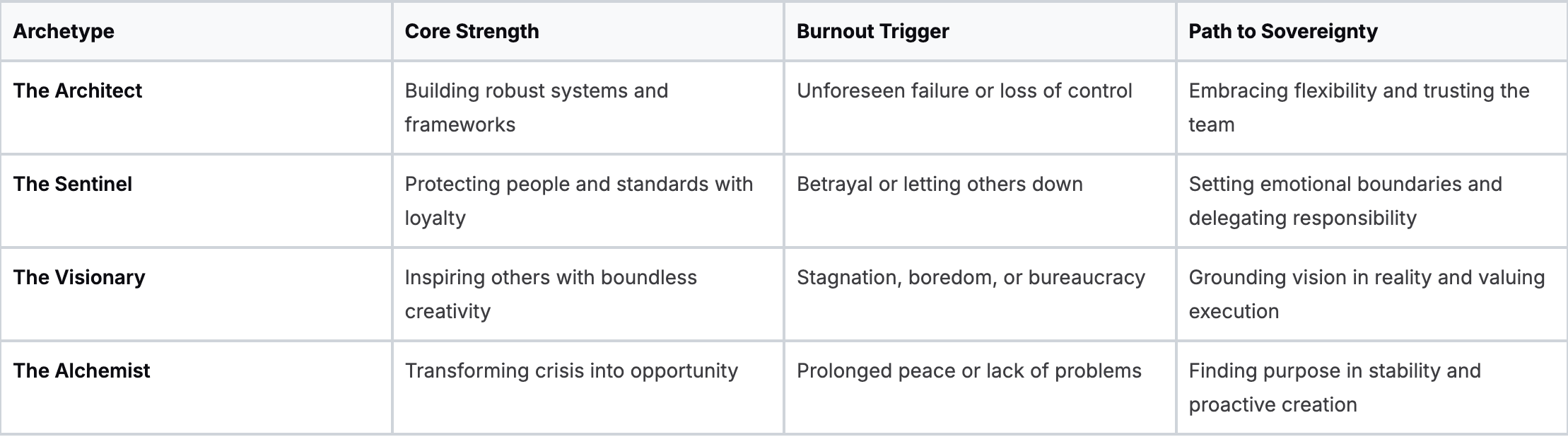
Each path to sovereignty involves dismantling the mask and integrating the shadow.
Understanding which of these archetypes is running your operating system is the first critical step toward taking back control of your own power.
How to Interpret Your Quiz Results with the RAMS Method
Getting your quiz results and seeing your archetype—whether it’s The Architect, Sentinel, Visionary, or Alchemist—is that first flash of recognition. It’s the data point that finally gives a name to the dissonance you’ve been feeling for years. But data without a plan is just noise. This is where you move from seeing the problem to actually fixing it.
This isn’t about labeling yourself or judging your archetype. It's about using it as a diagnostic map to trace the operational patterns that had you asking, "Who would I be?" in the first place. This is how you translate insight into action, using the RAMS Method to reclaim sovereignty over your nervous system and build a completely new model of leadership.
The personality assessment market is exploding, set to hit $37.7 billion by 2035. While the standard tools are used by 75% of global executives, there’s a crucial distinction: women leaders who use these tools for genuine self-development report a 35% increase in fulfillment. This is especially true in healthcare leadership, where 60% of women are now using assessments specifically to combat burnout—a core mission of the RAMS framework.
R is for Results Redefined
First, we have to tear down and rebuild your definition of "Results." Your current operating system is almost certainly programmed to chase external trophies—the next promotion, the revenue target, the public recognition. This is the exhaustion-driven model.
RAMS blows that up entirely. A true Result isn't measured by what you get, but by how you feel getting it. It's about internal alignment and energetic sustainability.
Exhaustion-Driven Result: Winning a massive contract that leaves you feeling hollowed out and depleted for a week.
RAMS-Embodied Result: Steering a project that lights you up and aligns with your deepest values, whether anyone applauds or not.
Look at your archetype. Where, exactly, are you trading your internal state for an external win?
A is for Attitude Shift
Your quiz result shows you the default "Attitude"—the mindset that hijacks you under pressure. For The Architect, it’s a desperate grab for control. For The Sentinel, it’s a spiral into hyper-vigilance. This isn’t a character flaw; it's a battle-tested survival response that has long outlived its usefulness.
The RAMS Attitude is one of sovereign choice. It’s the conscious, deliberate decision to respond from a place of regulation instead of reacting from a state of trigger-happy activation. This is where you graduate from "I have to" to "I choose to." This is where you stop performing leadership and finally start embodying it.
Your archetype's shadow side is not a life sentence. It is a set of outdated instructions that can be rewritten with intentional practice and a new operational framework.
M is for Mastery of Self
Let’s be clear: Mastery, in this context, has nothing to do with mastering a new software or professional skill. This is about achieving Mastery over your own nervous system and emotional state.
Your quiz results point directly to where you lose this internal control—the specific triggers and scenarios that throw you into fight, flight, or freeze. This is the most hands-on part of the work. Mastery means installing tangible, repeatable practices to regulate your system on demand, so you can stay centered and make clear-headed decisions even when the world around you is on fire.
For a comprehensive breakdown of this entire framework, read our detailed guide on the revolutionary RAMS method explained.
S is for Sustainable Systems
Finally, you have to architect Systems that actually support this new way of operating. Your current life, both personally and professionally, is probably a fortress built to protect your "Executive Mask." It's time for a teardown.
This means installing non-negotiable boundaries as if they were load-bearing walls. It means scheduling recovery time with the same ferocity you schedule board meetings. It means intentionally cultivating relationships that fuel you instead of drain you.
This is about designing a life where your redefined Results, sovereign Attitude, and self-Mastery are the default setting, not a luxury you hope to afford one day.
Your First Steps to Embodying Your True Self
Alright, let's get down to it. The "who would i be quiz" handed you the map. Your archetype showed you the terrain. The RAMS Method is the vehicle. Now? You get in the driver's seat.
Insight without action is just a nice-to-know piece of trivia. This is where you stop intellectualizing who you would be and start the real work of becoming her. The end game isn't just a moment of revelation—it's a full-circle return to the person you were before the world told you who to be.
This journey doesn't start with some grand, sweeping change. It begins with small, consistent acts of reclaiming your nervous-system sovereignty. It's about taking back the controls from the high-performance, autopilot programming that drove you right to the brink of burnout. You're about to build a new foundation, one anchored in your own truth, not in a desperate hunt for external validation.

A 5-Minute Practice to Reclaim Your System
Your nervous system has been conditioned for years, maybe decades, to operate on high alert. To change that deep-seated pattern, you have to introduce a new one. This isn't about finding more time in your already packed schedule; it's about reclaiming the time that is rightfully yours, one breath at a time.
The 5-Minute Sovereignty Reset:
Set a Timer: Find a quiet space—your office, your car, a locked bathroom, it doesn't matter. Set a timer for five minutes. This is non-negotiable. This time is for you.
Anchor Your Body: Sit up straight in a chair, feet flat on the floor. Feel the solid ground holding you up. Put one hand on your chest and the other on your stomach.
Physiological Sigh: Take a deep inhale through your nose. Then, without pausing, take another short sip of air in to max out your lungs. Now, let it all go with a long, slow, complete exhale through your mouth. Do this twice. This is a powerhouse technique that rapidly dumps carbon dioxide and tells your fight-or-flight system to stand down.
Box Breathing: For the rest of the time, adopt this rhythm: Inhale for a count of four. Hold for four. Exhale for four. Hold for four. Your only job is to focus on that count and the feeling of your hands rising and falling.
Notice the Shift: When the timer dings, don't jump up. Sit for another 10 seconds. Just notice. Notice the subtle drop in your shoulders. The release in your jaw. The slight slowing of the racetrack in your mind. That is the feeling of you taking back control.
This simple exercise, practiced daily, is basic training. It retrains your body to access a state of calm on command.
Journaling Prompts to Demolish and Redefine Success
That "Executive Mask" you've been wearing? It was built on a definition of success that is almost certainly no longer serving you, if it ever did. These prompts aren't feel-good exercises; they are demolition tools designed to excavate your authentic definition from beneath the rubble of "shoulds."
Be brutally honest. No one is reading this but you.
If no one knew your job title or how much you earned, what would you want them to say about how you live your life?
Describe a moment when you felt genuinely, completely alive and energized. What were you doing? Crucially, what external "success metrics" were totally absent from that picture?
What is one "should" you can let go of this week to make room for a "want"? What does that actually look like in practice? What meeting do you decline? What boundary do you set?
These questions aren't meant to be answered once and filed away. They are your new toolkit for an ongoing inquiry into what's real. To go even deeper on this, explore our guide on how to be more self-aware.
This process isn't about adding more to your already overflowing plate. It's about intentionally removing what was never yours to carry in the first place.
These first moves—regulating your nervous system and redefining your core values—are the bedrock for the deeper work of embodying your true self. The insights from the quiz were your permission slip to start digging.
The path from here is about creating a personalized roadmap. Taking our diagnostic is the logical next step to graduate from a general insight to a specific, actionable plan built around your unique archetype and goals. This is your formal invitation to come home to yourself.
Answering Your Questions
You've seen the power of this work, and it's natural to have questions. Let's tackle the ones that are likely on your mind. These aren't just FAQs; they're the critical inquiries that separate surface-level interest from a genuine commitment to transformation.
How Is This Different From Standard Corporate Tests?
Let's be blunt. Standard corporate tests are designed to make you a more efficient cog in the machine. They measure workplace behaviors and help optimize your performance for the company.
The "Who Would I Be Quiz," when used within the RAMS Method, is entirely different. It’s a diagnostic tool for you. Its sole purpose is to expose the deep, often painful, misalignment between the high-performing ‘executive mask’ you wear and the authentic, embodied self you’ve suppressed.
Instead of slotting you into a professional category, it measures the friction. It zeroes in on your core values, your specific patterns of burnout, and your automatic nervous system responses. This reveals the true personal cost of your success, giving you an honest starting point for profound change, not just another incremental tweak.
Can an Online Quiz Really Create Significant Personal Change?
An online quiz, by itself, is just a moment of insight. It’s the jolt of recognition, the flash of clarity. It’s the map that finally shows you exactly where you are standing, but it isn't the entire journey.
Lasting change happens when you take that map and use it to navigate with a proven framework.
The quiz reveals the ‘what’—the specific archetypes, disconnections, and hidden patterns keeping you stuck. A system like the RAMS Method provides the ‘how’—the concrete steps to regulate your nervous system, shift your core attitude, and build new, sustainable systems for an embodied life. The quiz is the diagnosis; the real work is the cure.
I'm Already a Successful Leader. Why Do I Need This?
This is the most critical question of all. Many of the world’s most accomplished leaders operate from a state of high-functioning burnout. Each new achievement comes at the cost of their internal life force, leading to a quiet but pervasive sense of emptiness. Their success is driven by exhaustion, not by authentic energy.
This entire process is about making a deliberate shift from that exhaustion-driven model to an embodied, sovereign style of leadership. It’s about ensuring your next decade of success is fueled by genuine fulfillment, not just grit and adrenaline. This is how you build a lasting legacy without sacrificing yourself on the altar of your own ambition.
What if I Dislike My Quiz Results?
It's crucial to see the results for what they are: data, not judgment. In fact, a strong, visceral discomfort with your results is often a powerful sign. It means you’ve just uncovered the significant and painful gap between your current reality and the woman you know you could be.
That discomfort is the catalyst. It’s the raw energy you need to fuel real change. The goal isn't to get a ‘good’ score; it's to get an honest one. Achieving that raw clarity is the single most powerful tool you have for consciously creating the leader—and the person—you truly want to become. As you begin this work, exploring a complete guide to a life purpose quiz can offer even more structure for understanding your unique path.
The quiz has given you the 'what.' Now it's time for the 'how.' The insights you've gained are the key to unlocking a new way of leading and living, but a key without a door is useless. The next step is to get your personalized roadmap for implementing the RAMS framework and moving from insight to integration. This is the return to yourself.
Take Our Free Leadership Diagnostic and Get Your Personalized Sovereignty Roadmap