How to Build a Weekly Routine That Actually Sticks
Written by Baz Porter®
You rebuild your week from zero every Monday. Ideas everywhere. Nothing lands. You start strong and never finish. This is not a discipline problem. It is a design problem, and it has a name: Silent Collapse™. That is the quiet erosion that happens when a capable person runs on raw effort with no structure holding them up. A weekly routine that sticks is the first repair. Not a tighter task list. A built rhythm your nervous system can trust. I wrote why this matters in the manifesto.
What you will find here
Key takeaways
A weekly routine that sticks is built, not willed. Structure beats willpower.
Rebuilding your week from zero is a design gap. It is not a character flaw.
A habit takes about 66 days to turn automatic. Protect the blocks until they hold.
Themed days and one weekly review end the Monday reset.
The rhythm only holds when it matches who you are, not who you perform.
How do you build a weekly routine that actually sticks?
You build a weekly routine that sticks by designing a fixed rhythm, not a longer task list. Pick three anchor blocks. Place them on the same days each week: deep work, delivery, and a weekly review. Theme your days so similar work sits together. Protect those blocks for about 66 days, the point where a habit turns automatic. The routine holds when it matches your real energy, not a borrowed template. Effort starts the week. Structure finishes it.
The hidden pattern under the weekly reset
Here is what almost no one tells you. The problem is not that you lack a routine. The problem is that you decide it fresh every day. Every small choice pulls from the same fuel. By Wednesday the tank is empty. The week falls back to reaction. Then Monday you start over, and a quiet voice says you cannot do this.
That voice is lying. The researcher Phillippa Lally and her team tracked how habits form (University College London, 2010). New behaviours took a median of 66 days to feel automatic. Not 21. Sixty-six. Most people quit near day nine and blame themselves. They were never the flaw. They stopped one structure short of the line. You can read the study in the European Journal of Social Psychology. The same pattern shows in high performers who run hot with no recovery built in, a risk Harvard Business Review has tracked for years.
So the fix is not more willpower. The fix is a rhythm that removes the daily decision. Build it once. Return to it every week.
The RAMS™ rebuild: five pillars that hold a week
RAMS™ stands for Results, Attitude, Authenticity, Mastery, and Systems. It is how Sovereign Leadership™ gets built at the nervous-system level, not just the calendar level. A weekly routine that sticks runs through all five.
Results
Name the one result the week must produce. One. Put it on the calendar before anything else. Income work and real client value go in first. Admin fills the gaps, never the core. When the week has a target, the routine has a spine.
Attitude
Stop grading yourself on a perfect week. You will miss a block. Everyone does. A routine that survives a bad Tuesday is a real routine. Return to the rhythm the next morning. Do not restart the whole system. Missing once is data, not failure.
Authenticity
Most routines fail because they belong to someone else. You copy a 5am founder and hate every minute. Build the week around your true energy. If you think best at night, guard the night. The rhythm only holds when it matches who you are, not who you perform for others.
Mastery
Protect one deep-work block that no one can touch. Same time. Same day. This is where the real work compounds. Guard it for 66 days. That is how a skill and a habit both take root. Repetition in one slot beats effort scattered across seven.
Systems
Close the week with a single review. Thirty minutes on Friday. What landed, what did not, what carries forward. Set next week from that page. You never start from zero again, because last week hands you the plan. This is the block that ends the Monday rebuild.
Here is the shift in plain terms:
Collapsed: a new plan every Monday, willpower as the engine, energy borrowed from a template, a bad day ends the whole system.
Sovereign: one rhythm you return to, structure as the engine, energy matched to who you are, a bad day is just one missed block.
Power without performance. Peace without retreat.™
If your week keeps collapsing, name why first. The Silent Collapse Diagnostic™ shows you the exact structure that is missing.
One founder's week
Maria ran a design studio alone. Smart. Driven. Rewriting her plan every Sunday night. She told me she felt like a fraud running her own company. Each Monday she opened the laptop and did not know the person in charge.
We did not add a single new task. We built three anchor blocks. Deep work Monday morning. Delivery Wednesday. A thirty-minute review each Friday. That was it.
The first two weeks felt clumsy. By week nine the rhythm held on its own. She stopped rewriting the plan, because the plan was already there. Her words: "I finally trust the person running this." The work did not change. The structure did. Her faith in herself came back with it.
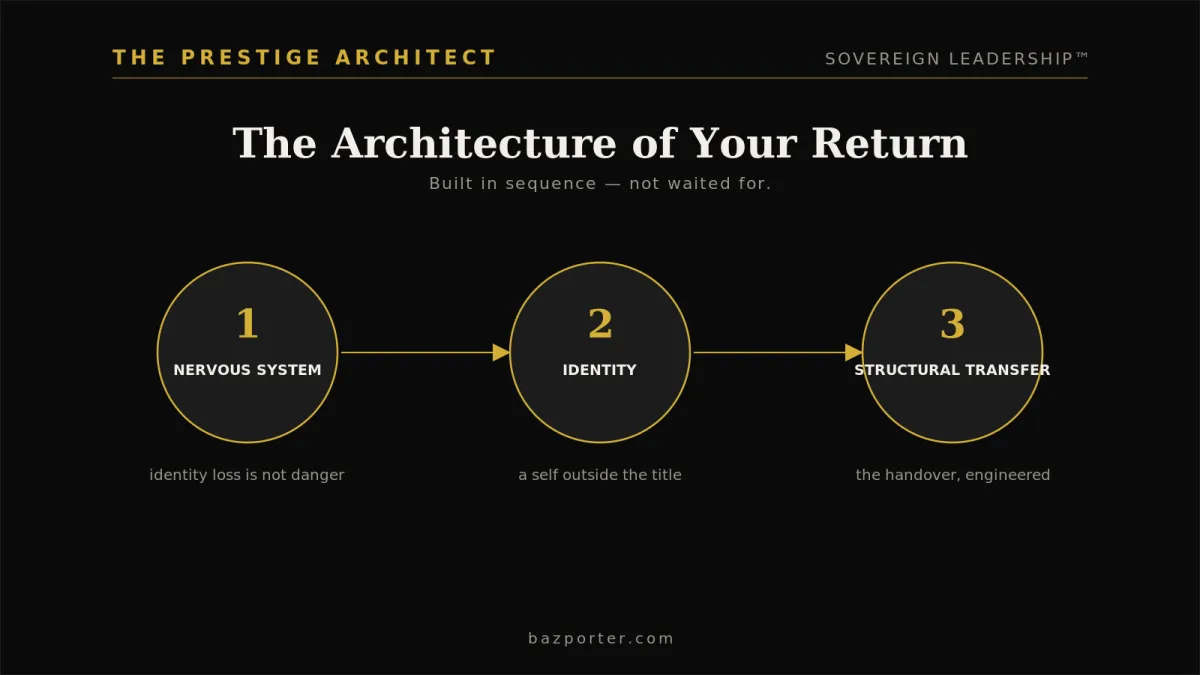
The architecture of your return
You do not need more effort. You have spent years proving your effort. You need architecture. A week that holds you up instead of one you rebuild by hand every seven days.
Start small. Three anchor blocks. One weekly review. Protect them for 66 days. Let the rhythm carry what willpower cannot. This is not about doing more. It is a return to the person who can finish.
When you are ready to build the full structure, begin with the Silent Collapse Diagnostic™. It maps the one system your week is missing, then shows you what to build first.
Questions leaders ask
Why can't I stick to a weekly routine?
Most routines fail because you decide them fresh each day. That drains your mental fuel and the week collapses by midweek. A routine that sticks removes the daily choice. You set the anchor blocks once and return to them. Structure carries what willpower cannot.
How long does it take for a routine to become automatic?
Research from University College London found a median of 66 days for a new behaviour to feel automatic. Some habits took less, some more. The lesson is simple. Protect your blocks past the point most people quit, around day nine, and let the rhythm take root.
What is the best weekly routine for a founder?
Start with three anchor blocks on fixed days: one deep-work block, one delivery block, and one weekly review. Theme your days so similar work sits together. Put income work in first. Keep it small enough to survive a hard week.
Is a weekly routine the same as a to-do list?
No. A to-do list is a pile of tasks with no home. A weekly routine gives each kind of work a fixed time and day. The list tells you what. The routine tells you when. The when is what makes the work actually happen.
How do I stop rebuilding my week from zero?
End each week with a thirty-minute review. Write what landed, what slipped, and what carries forward. Set next week from that page. You never start from zero again, because last week already handed you the plan.
About the author
Baz Porter® is the founder of Baz Porter LLC and The Prestige Architect™. He guides high-achieving leaders from Silent Collapse™ to Sovereign Leadership™. Power without performance. Peace without retreat. He does not motivate. He architects the structure a leader stands on.