The Self You Sold to Succeed
You keep circling the same quiet thought. I sold myself to get here. Not in one dramatic moment. In a thousand small ones.
You said yes when you meant no. You filed down the edge that was actually you. You learned which parts of yourself to leave at the door. And it worked. The title arrived. The money arrived. The respect arrived.
So why does it feel like a trade you would not make again?
This is Silent Collapse™. It is the felt state underneath the success. The ache is not burnout. It is self-betrayal. You built a strong life by quietly selling the person who was meant to live it. I wrote the manifesto for the leader who is only now feeling the true cost of the climb.
Written by Baz Porter®
On this page
Key takeaways
Selling yourself rarely feels like a decision. It feels like adapting.
The cost shows up late, as a stranger wearing your name.
Self-betrayal is a pattern, not a character flaw.
The move is RETURN, not reinvention.
You can come back to yourself without burning the built life down.
The short answer
It feels like you sold yourself because you did, in increments. Each compromise was small and sensible. Added up, they bought your success with your self. The self you sold is not gone. It is waiting for you to stop paying.
That last line matters. Most leaders assume the loss is permanent. It is not. A self can be unused for years and still be recoverable. The question is whether you keep signing the same contract tomorrow.
The hidden pattern
Here is what almost no one names. You did not lose yourself once. You lost yourself on a schedule.
Every room rewarded a slightly edited version of you. The edit that got the deal. The edit that kept the peace. The edit that looked promotable. Over years, the edits became the default. The default began to feel like the truth.
Research on the true self makes the price concrete. Schlegel and colleagues found that when people lose easy access to their true self-concept, their sense that life is meaningful drops with it (Schlegel et al., 2009, Journal of Personality and Social Psychology).
So the emptiness is not vague. It is a receipt. You traded the self that made the life feel like yours, and the meaning left with it. Name the trade and the fog starts to lift.
Notice the shape of it. No single compromise looks like betrayal. That is exactly why it works. A thousand reasonable edits never trip the alarm. The pattern only becomes visible from the far side, once the cost is large enough to feel. By then it reads as character, not as a choice you can reverse. It is a choice you can reverse.
The RAMS™ reframe
RAMS™ reads the leader before the strategy. Five pillars. Here is how each one looks when you have been selling yourself, and how it looks on the way back.
Results
You hit the numbers. Then the numbers stopped feeling like yours. Sovereign results are the ones you would still want if no one was watching. If a win needs an audience to feel real, it was bought with your self, not earned by it.
Attitude
You called it being adaptable. Some of it genuinely was. Some of it was quietly agreeing to disappear. The honest move is to separate the two. Flexibility serves you. Self-erasure bills you.
Authenticity
This is the pillar you mortgaged. You learned to perform fluency in a self you do not like. Self-determination research is blunt here. Acting from your own values is not a luxury. Autonomy is one of the basic needs that wellbeing is built on (Ryan and Deci, 2000, American Psychologist). Starve it long enough and the whole system reports empty.
Mastery
You mastered the role. Mastery of the role is not the same as being at home in yourself. One can hide the other for a decade. Real mastery includes knowing when the performance is running you instead of the reverse.
Systems
The selling was never only willpower. It was systemic. Your calendar, your incentives, your defaults all rewarded the edited you. That is why trying harder fails. Return is systemic too. You change what the system rewards, and the real self stops costing you to show.
Collapsed versus Sovereign
Collapsed: you ask what they want you to be. Sovereign: you ask what is true, then choose what to show.
Collapsed: every yes protects the image. Sovereign: some no protects the person.
Collapsed: success is the proof you need. Sovereign: success is a by-product you enjoy.
Collapsed: the mask feels safer than the face. Sovereign: the face becomes the asset.
The leaders I work with did not fail. They succeeded so well they lost the person who was supposed to enjoy it.
If that line lands, start where it is quiet. The Fast Future Freedom Blueprint is the free audit that names exactly what you traded and what it is costing you now.
One leader's turn
A managing director came to me calm and precise. On paper, everything worked. In private, one sentence. "I do not like who I had to become."
We did not touch the strategy first. We mapped the trades. The humor he had dropped to seem serious. The opinion he stopped voicing to stay safe. The friend he became too busy to be.
None of it was dramatic. All of it was him, sold cheap. He did not quit. He stopped paying. He let one small truth stand in a meeting and watched nothing collapse. Within a quarter, the same role held a person he recognized again.
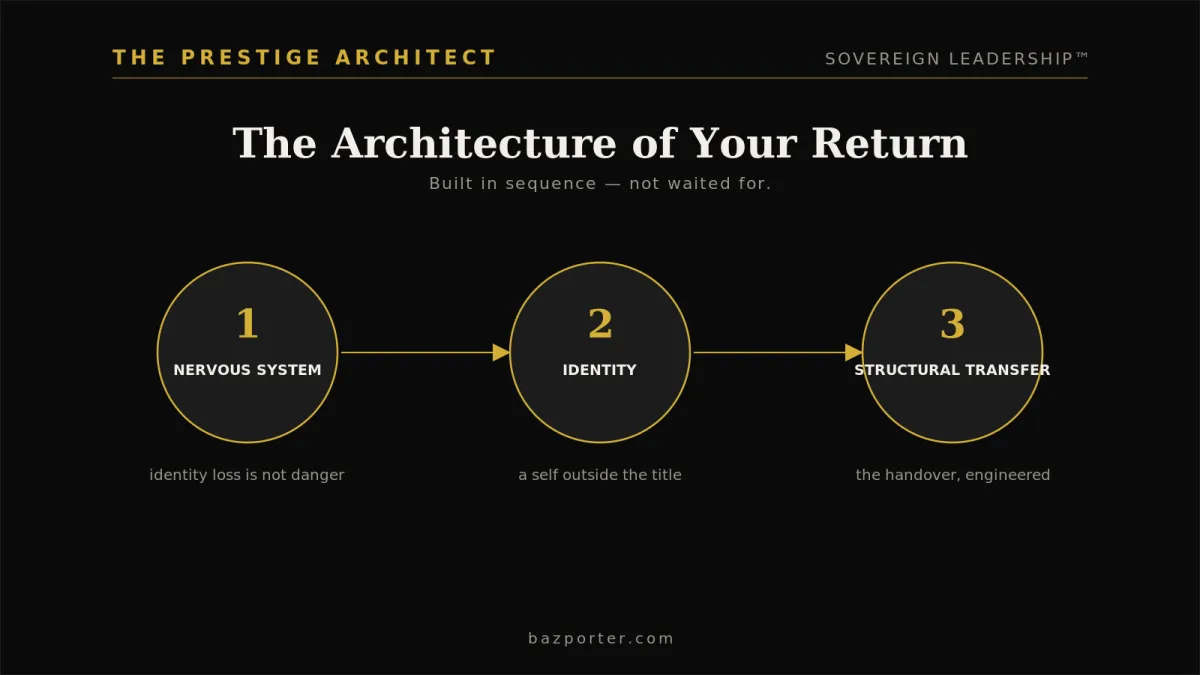
The architecture of your return
Return is not a leap. It is a build. You do not blow up the life. You buy yourself back one default at a time.
You find the first trade. You stop making it. You let the small truth stand and watch the sky hold. Then you find the next one. The nervous system learns that honesty is survivable here, and the pace picks up.
Keep the moves small on purpose. A reclaimed opinion. A protected hour. A real answer to a simple question. Each one is proof to your own nervous system that the true self is safe here. Proof compounds. The leader who felt like a stranger starts to feel like a person inside the same career.
This is the work of coming home to your real self while the title, the income, and the family stay intact. It is deliberate, not reckless. When you are ready to architect it on purpose, apply for the Fast Future Freedom Blueprint and we will map your return together.
Questions leaders ask
Is feeling like I sold myself the same as burnout?
No. Burnout is depletion from load. This is grief from betrayal. You can be fully rested and still feel you traded yourself away. A holiday does not touch it. A return does.
Does coming back to myself mean quitting my job?
Rarely. Most of the selling happened inside small daily choices, not the job itself. You reclaim the choices first. Many leaders keep the role and simply stop disappearing inside it.
Why did this feeling arrive now, after all these years?
The bill comes due when the striving slows enough for you to hear yourself. Success buys the quiet that finally lets the cost be felt. That is why it often lands squarely in your forties and fifties.
Can I really recognize myself again?
Yes. The self you sold is not deleted. It is unused. Research on the true self shows access returns when you act from your own values again. For most leaders it comes back faster than they expect.
Where do I start if everything looks fine from the outside?
Start with one honest inventory of what you have traded. Name it without flinching. The Fast Future Freedom Blueprint gives you that first clear read, and a map for the first default to reclaim.
About the author
Baz Porter® is the founder of Baz Porter LLC and the architect of RAMS™, a framework that reads the leader before the strategy. He works with accomplished leaders who are privately reckoning with the cost of the climb and want to return to their real selves without dismantling the life they built.