Succession Planning Anxiety: Why Founders Can't Let Go
You built it. Now the board wants a date for when you leave. Your chest tightens. Silent Collapse™ does not always look like exhaustion. Sometimes it looks like a founder who cannot name a successor. Everyone calls it a planning gap. It is not. It is the moment your identity and your company refuse to separate. You are not failing at succession. You are grieving a self you never agreed to bury. Most leaders read this as a process problem. It is a nervous-system problem. Before you fix the org chart, read the architecture underneath it. Read The Manifesto.
Table of Contents
Key Takeaways
The exit is an identity problem, not an org-chart problem. Founders stall on succession because the self and the company never separated.
The risk is measurable. Harvard Business Review reports founder-CEO handovers carry two to three times the failure risk of non-founder transitions.
Succession anxiety is a body signal. It is the nervous system reading a handover as a loss of self, not a calendar event.
The fix is structural. You rebuild the identity infrastructure first, then the leadership transition follows without collapse.
Succession Planning Anxiety, Defined
Succession planning anxiety is the fear that surfaces when a founder must hand control to someone else. It is not weak nerves. It is identity fusion — the self and the company have become one structure. When you try to separate them, the body responds as if you are being erased. That response is the real obstacle, not the spreadsheet.
The Hidden Pattern: Why Founders Can't Let Go
Picture the company as scaffolding built around a single body. For years it held you up. Now you are told to step out of it. Of course the ground feels gone.
This is the part advisors miss. Succession is taught as a transfer of duties. The founder hears a transfer of self. Harvard Business Review found that founder-CEO handovers fail or trigger a performance downturn at two to three times the rate of other transitions. The cause is rarely the successor. It is the founder who cannot fully leave.
Research in Psychology Today describes the mechanism plainly. When identity fuses with the company, a setback becomes a verdict on your worth. A handover becomes a small death. This is Silent Collapse™ at the moment of exit — outwardly composed, privately unraveling. The composure is the symptom, not the proof you are fine.
If this is landing, start with the architecture, not the advice. Read The Manifesto before you read another exit guide.
Identity Fusion at the Top
Identity fusion is a visceral sense of oneness with a cause. For a founder, the cause is the company. The merger built the empire. It also wires the exit to feel like amputation. Founders who separate the self from the role recover faster, decide cleaner, and hand over without sabotage. The work is not letting go of the company. The work is no longer needing it to know who you are.
The RAMS™ Reframe: Exit as Architecture
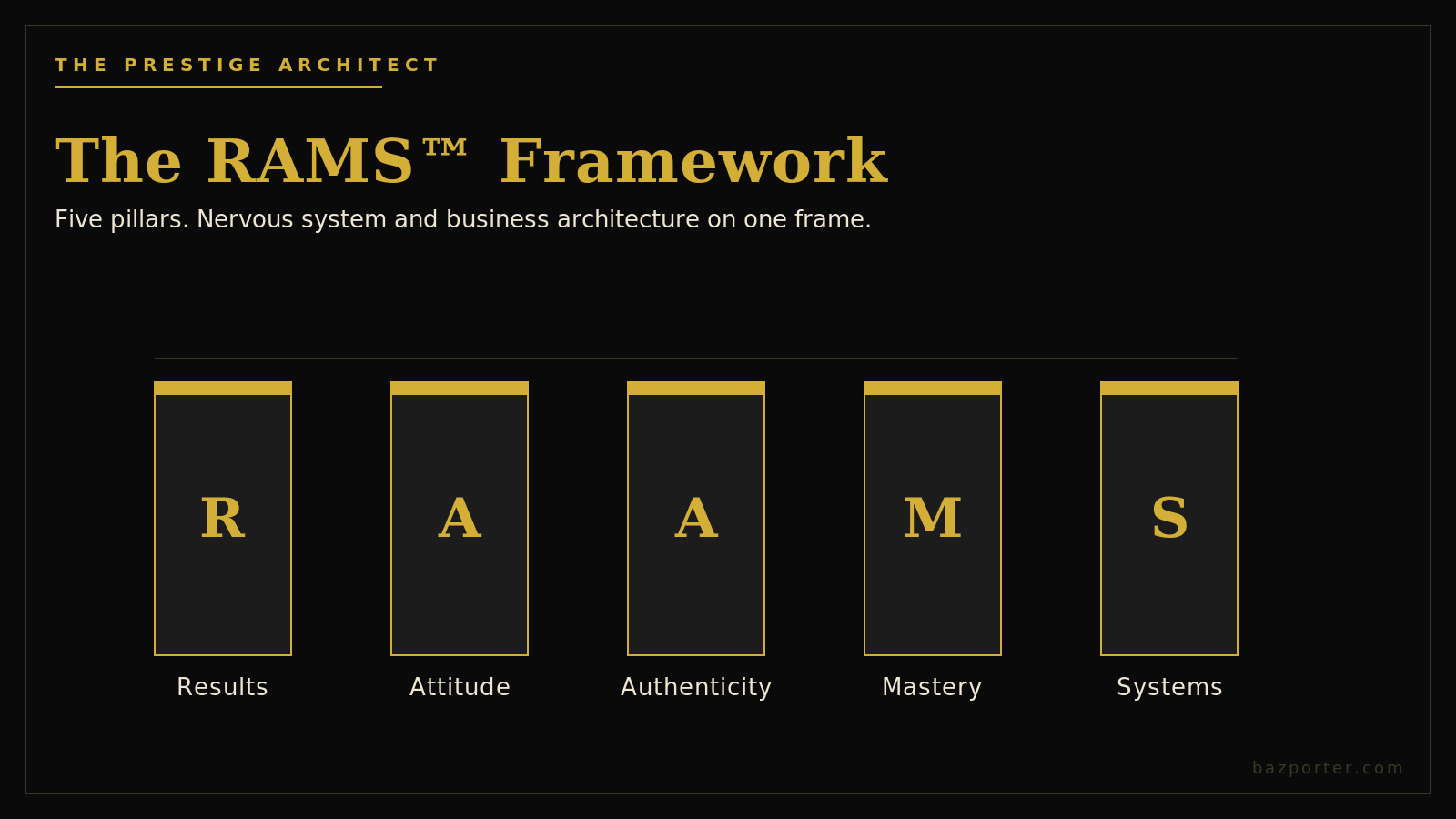
The RAMS Framework™ runs the body and the business on the same five pillars: Results, Attitude, Authenticity, Mastery, Systems. Sovereign Leadership™ applies all five to the one moment most founders avoid — the exit. Here is the rebuild, pillar by pillar.
Results: The Output–Identity Gap
You measured yourself in output for decades. Revenue. Headcount. The next round. Succession ends the scoreboard you trusted.
The trap: you read "no longer running it" as "no longer mattering."
The shift: your worth was never the output. The output was the evidence, not the source.
Operational rule: separate the result you produced from the person who produced it. One can transfer. The other never leaves you.
Attitude: Where the Collapse Lives
Attitude is the internal operating system. Succession anxiety lives here, under the calm. The founder runs a private script: "If I leave, it falls apart. If it falls apart, so do I."
The founder who cannot name a successor is not protecting the company. He is protecting himself from disappearing.
Command decision: name the script out loud. A fear you can see stops driving from the back seat.
Authenticity: The Private–Public Divide
In public you announce the transition plan. In private you rewrite the terms you set. You insert yourself into decisions you already delegated. That gap between the performed exit and the lived resistance is the engine of Silent Collapse™. Closing it is not weakness on display. It is the first honest move of the handover.
Mastery: Skill vs Sovereign Capability
You have mastered the company. That is skill. Sovereign capability is different. It is the capacity to stay whole while the thing you built changes hands.
Skill keeps you indispensable. It feels safe and quietly traps you.
Sovereign capability makes you replaceable in the role and irreplaceable as a person.
Systems: The Architecture of the Return
This is the pillar that ends the anxiety. You do not push through a handover with willpower. You build the structure that makes it safe. Clear decision rights. A tapering presence, not a sudden vanish. An identity that stands outside the title before the title is gone.
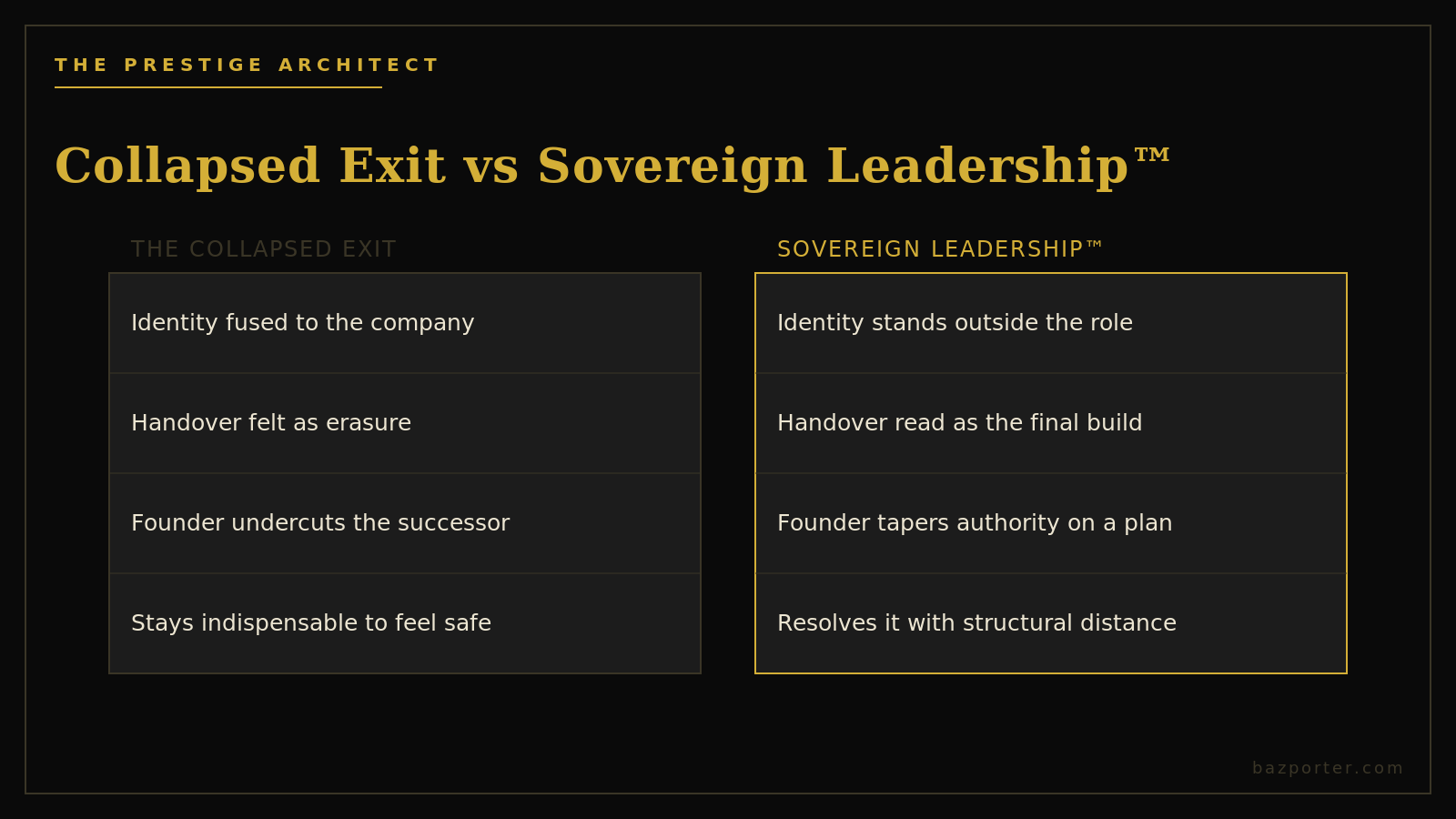
The Collapsed ExitSovereign Leadership™Identity fused to the companyIdentity stands outside the roleHandover read as personal erasureHandover read as the final buildFounder undercuts the successorFounder tapers authority on a planAnxiety managed by staying indispensableAnxiety resolved by structural distance
Collapsed Exit vs Sovereign Leadership™:
Identity fused to the company → Identity stands outside the role
Handover read as personal erasure → Handover read as the final build
Founder undercuts the successor → Founder tapers authority on a plan
Anxiety managed by staying indispensable → Anxiety resolved by structural distance
If your body tightens reading that right-hand column, that is the signal to measure it. Take the Silent Collapse Diagnostic and see where the architecture is load-bearing on you alone.
A Case Vignette: The Founder Who Stopped Interrupting
A founder I worked with had agreed to a two-year handover. Six weeks in, he was reversing his successor's calls in front of the team. He told himself he was protecting standards. He was protecting his place in the room.
We did not start with the transition plan. We started with the architecture beneath it — what his nervous system believed would happen the day no one needed him. Once that structure held, the interruptions stopped. The successor kept the authority. The founder kept himself. The exit finished early and clean. For more on this rebuild, the Sovereign Leadership Resource Hub maps the full method.
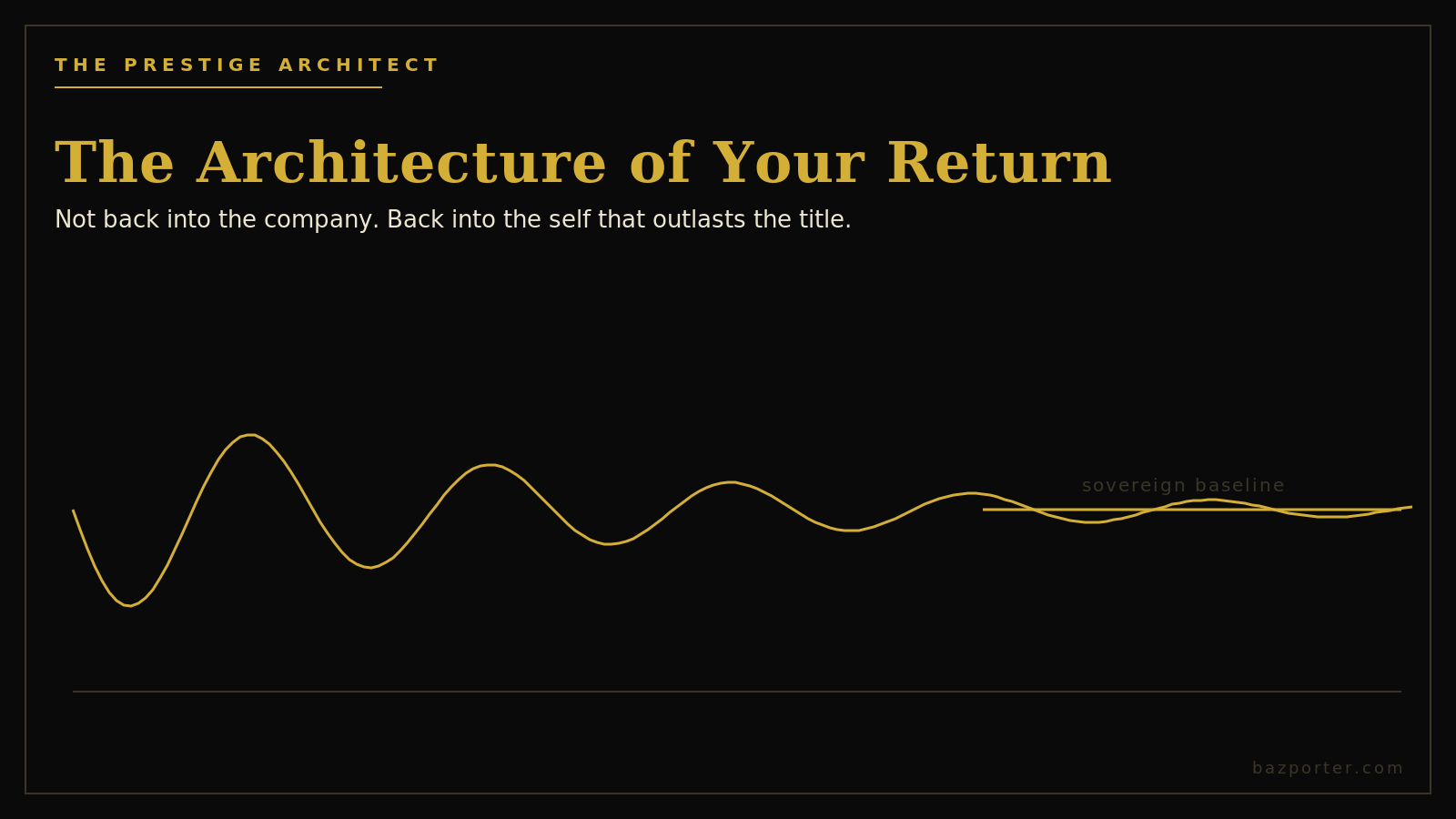
The Architecture of Your Return
The return is not back into the company. It is back into yourself — the self that existed before the title and will outlast it. This is nervous-system sovereignty, not inspiration. You regulate the body that reads exit as death. You build an identity that does not require the seat. Then the succession plan stops being a threat and becomes the last and finest thing you architect.
You do not need another exit checklist. You need the structure underneath it rebuilt. Apply to Work With Baz.
Frequently Asked Questions
Is succession planning anxiety a sign I am not ready to exit?
No. It is a sign the self and the company are fused. Readiness is not the absence of fear. It is an identity that stands on its own once the company is handed over. You build that first.
Why do founder transitions fail more than other CEO transitions?
Harvard Business Review reports founder-CEO handovers carry two to three times the failure risk. The successor is rarely the cause. The founder's continued presence and undercut authority destabilize the team. The fix is a tapering, structured exit, not a sudden one.
I have everything I built. Why does leaving it feel like loss?
Because you are not leaving a business. You are leaving a structure your identity grew into. The body reads that as erasure. That reading is Silent Collapse™, and it resolves with structural distance between you and the role.
How is this different from a normal succession plan?
A standard plan moves duties. It assumes the founder is a willing variable. This work rebuilds the founder's identity infrastructure so the plan can actually run. Architecture first. Org chart second.
British military veteran. Two-time international bestselling author. Founder, The Prestige Architect®. Host, Rise From The Ashes podcast, C-Suite Network. Boulder, Colorado.