Strategic Restraint: The Power Of The Deliberate No
Written by Baz Porter®
You are known for how much you carry. Say yes. Ship it. Absorb one more ask. Yet the steadiest leaders I counsel share a quieter skill. They know when not to act. Strategic restraint is the engineered discipline of the deliberate no. Most executives never build it. They confuse motion with leadership. Every yes feels like proof of value. So they say yes until the reserve is gone. Privately, they enter Silent Collapse™. The way out is not more effort. It is a different architecture.
Key Takeaways
Strategic restraint is the disciplined choice to not act, not launch, not commit.
It is a design decision, not a personality trait.
Every yes spends a finite reserve. Restraint protects it.
Restraint is measured in what you remove, not what you add.
The Silent Collapse Diagnostic™ shows where your yes is bleeding you.
What Strategic Restraint Actually Means
Strategic restraint is the engineered discipline of withholding action until it earns its place. It is the deliberate no. No to the initiative. No to the meeting. No to the pivot that flatters your ego. No to the yes that costs more than it returns. It is not passivity. It is not delay. It is a designed filter that lets only high value moves through. The filter runs before the request reaches your judgment. That is what makes it hold under pressure.
Leaders who build it protect three things: judgment, capacity, and conviction. Leaders who lack it drown in their own activity. They look busy. They feel behind. The problem is rarely the calendar. The problem is the absence of a rule for what never reaches it. The cost signal arrives late. It shows up as a full calendar and an empty tank. By then the leader is defending choices they never truly made.
The Hidden Pattern Behind The Overload
Here is what the research shows. Once we commit to a course, we keep feeding it. We pour in more time, more money, more meetings. Barry Staw named this escalation of commitment in 1976 (Organizational Behavior and Human Performance). We double down to justify the first yes. The failing project gets defended, not closed.
Restraint breaks the loop. It treats a sunk cost as gone, not as a debt to protect. It asks one question. Would I start this today, knowing what I know now? If the answer is no, the answer is out. The past does not get a vote. Only the future does. Michael Porter said it plainly. The essence of strategy is choosing what not to do (Harvard Business Review). Your calendar is a strategy document. Right now it may be arguing against you.
The RAMS™ Reframe
RAMS™ is my operating system for Sovereign Leadership™. It runs on five pillars: Results, Attitude, Authenticity, Mastery, and Systems. Strategic restraint lives inside each one. This is where the discipline stops being a mood and becomes a design.
Results
Results come from concentration, not volume. Ten priorities produce noise. Two produce force. Restraint is how you protect the two. When you guard your focus, output does not fall. It sharpens. A leader with two clear priorities moves faster than a team with twenty.
Attitude
The collapsed leader treats every request as urgent. The sovereign leader treats attention as scarce capital. That shift changes the whole day. You stop reacting. You start allocating. The question is no longer can I. It is should I.
Authenticity
A yes you resent is a lie you tell in public. Restraint keeps your word and your calendar honest. You lead as who you are, not as who you fear disappointing. The no you owe is also the truth you owe. People trust a leader whose yes is rare and real.
Mastery
Mastery is subtraction. The expert removes. The amateur adds. Your next level sits on the other side of what you stop doing. Skill is knowing which nine things to refuse.
Systems
Willpower cannot hold a no at scale. A system can. Build a filter that answers before you do. A rule made once protects a thousand decisions later. The best leaders decide their nos while calm, not while cornered.
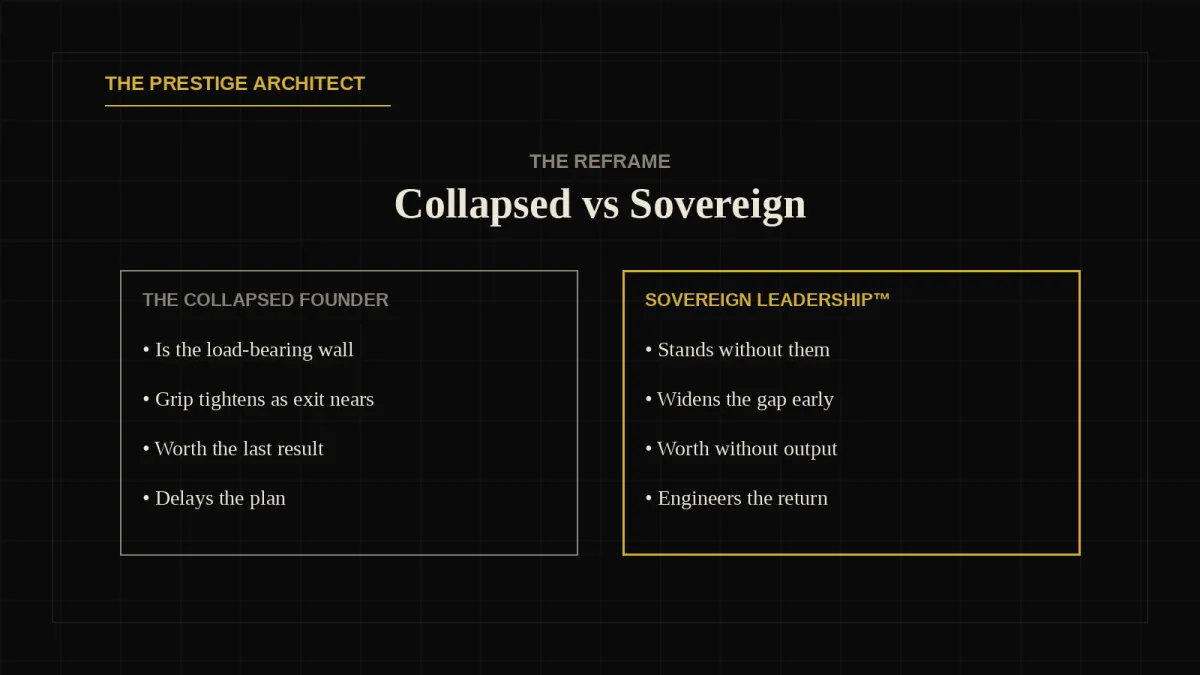
The difference between the two operating states is stark:
Collapsed: says yes to protect the relationship. Sovereign: says no to protect the result.
Collapsed: measures a day by tasks done. Sovereign: measures a day by noise removed.
Collapsed: defends the sunk cost. Sovereign: closes it and redeploys.
Collapsed: reacts to every ping. Sovereign: designs the filter once.
Collapsed: confuses motion with progress. Sovereign: guards the two moves that matter.
The strongest leaders are not the ones who do the most. They are the ones who have decided, in advance, what they will refuse.
You cannot restrain what you cannot see. The Silent Collapse Diagnostic™ is a 60 minute session with me. We map where your yes is bleeding capacity, and we name the first three things to cut. Book the Silent Collapse Diagnostic™.
A Case Of Restraint
A founder came to me running on fumes. She said yes to every partnership, every panel, every pilot. Her revenue was flat. Her nights were gone. She was certain the answer was a better system for doing more.
We did not add a productivity tool. We built one rule. Any new yes had to displace an existing yes of equal weight. Nothing entered the calendar for free. Within a month she had cut nine commitments. Within a quarter her core line grew. Nothing was added. Something was removed. That is restraint as architecture, and it is the pattern I see again and again. The growth did not come from a new tactic. It came from the space the subtraction created. Her judgment returned because her load lifted.
The Architecture Of Your Return
Your return does not start with a new goal. It starts with a subtraction. You already know the yes that is costing you. You feel it every time you agree and then resent the agreement.
The work is building the system that says no without you present. That is what I architect with leaders inside Sovereign Leadership Architecture™. We do not add drive to a depleted leader. We remove the load the drive was compensating for. A clear leader does not need to push harder. They need less in the way. If you carry more than you can hold, apply for the Silent Collapse Diagnostic™ and we begin. Apply for the Silent Collapse Diagnostic™.
Frequently Asked Questions
What is strategic restraint in leadership?
Strategic restraint is the deliberate choice to not act, launch, or commit when a move would cost more than it returns. It is a design decision, not hesitation. Leaders use it to protect judgment and capacity.
How is strategic restraint different from patience?
Patience is about timing the right action. Restraint is about refusing the wrong one. Patience waits to say yes. Restraint is willing to say no and never revisit it.
Why do successful executives struggle to say no?
Saying yes protects relationships and self image in the moment. Every yes also spends a finite reserve. High achievers feel the cost late, often as an exhaustion that rest does not touch.
Is strategic restraint the same as doing less?
No. Restraint is not lower output. It is concentrated output. You remove the low value work so the high value work gets your full force.
How do I build strategic restraint as a system?
Set a rule that answers before you do. One example: any new yes must displace an existing yes of equal weight. A system holds the no when willpower cannot.
Baz Porter® is a Sovereign Leadership™ architect and the founder of The Prestige Architect®. A British Army veteran and international bestselling author, he counsels executives and founders from Silent Collapse™ to power without self betrayal.