How to Build a Leader's Stop-Doing List
You run all day. You lead almost none of it. Every fire routes to your desk, and you answer each one. By evening the real work is still untouched. This is not a time problem. It is a design problem. A leader's stop-doing list is the fix. At Baz Porter®, The Sovereign Leadership Architect, I watch this pattern inside Silent Collapse™. The capable leader who does everything and leads nothing. The seat is full. The leadership is empty. The way out is not more effort. It is the work of return.
On this page
- What a stop-doing list is
- Key takeaways
- The hidden pattern: we add when we should subtract
- The RAMS™ reframe across five pillars
- A case from the work
- The architecture of your return
- Frequently asked questions
Key takeaways
- A stop-doing list names the work you will no longer touch.
- Overload is a design flaw, not a character flaw.
- People add when they should subtract. The research proves it.
- You protect the work only you can do by removing the rest.
- Return beats effort. Subtraction beats speed.
What a leader's stop-doing list is
A stop-doing list is a short written record of work you will stop performing. Not delegate. Not defer. Stop. It is the opposite of a to-do list. A to-do list grows forever. A stop-doing list shrinks the day on purpose.
Most leaders try to lead by adding. They add systems. They add meetings. They add one more check. The desk fills. The fires multiply. The stop-doing list reverses the move. You decide what no longer deserves your hands. Then you take your hands off it.
This matters because the reactive day has a hidden cost. Every task you keep is a task that crowds out the work only you can do. The seat was built for a narrow set of decisions. You have filled it with everyone else's.
The hidden pattern: we add when we should subtract
There is a reason your list only grows. Human beings are wired to add. We reach for more before we reach for less.
In 2021, researchers at the University of Virginia tested this directly. Across eight studies published in Nature, people solved problems by adding parts, not removing them, even when removal was the better answer (Adams, Converse, Hales, and Klotz, 2021). Subtraction did not occur to them. It had to be prompted.
Leaders carry the same wiring into the seat. The instinct under pressure is to add a control, add a step, add yourself. So the day grows and the leadership thins.
The reactive day also fractures attention. When you switch from a task before it is done, part of your mind stays behind. Sophie Leroy named this attention residue (Leroy, 2009). Each fire you grab leaves a trace. By noon your focus is a field of half-finished thoughts. A stop-doing list cuts the switching at the source.
The RAMS™ reframe across five pillars
RAMS™ is the framework I build with. It reads the overloaded day across five pillars. Here is the reframe.
Results. You are measured by what only you move. A stop-doing list clears room for those few results. Busy is not a result. Output on the wrong work is loss dressed as effort.
Attitude. Doing everything feels like duty. It is often fear. Fear that the work will fail without your hands. Name the fear. Then let the work prove you wrong.
Authenticity. You lead from a self that is genuinely your own, or you do not lead at all. A leader buried in tasks is performing, not leading. The stop-doing list returns you to the real seat.
Mastery. Attention is the skill. Leroy showed what switching costs. Mastery is the discipline to hold one thing and release the rest.
Systems. A stop-doing list is a system, not a mood. Write it. Review it weekly. Build the layer beneath you so the stopped work still gets done, just not by you.
Here is the contrast I draw for every leader I counsel.
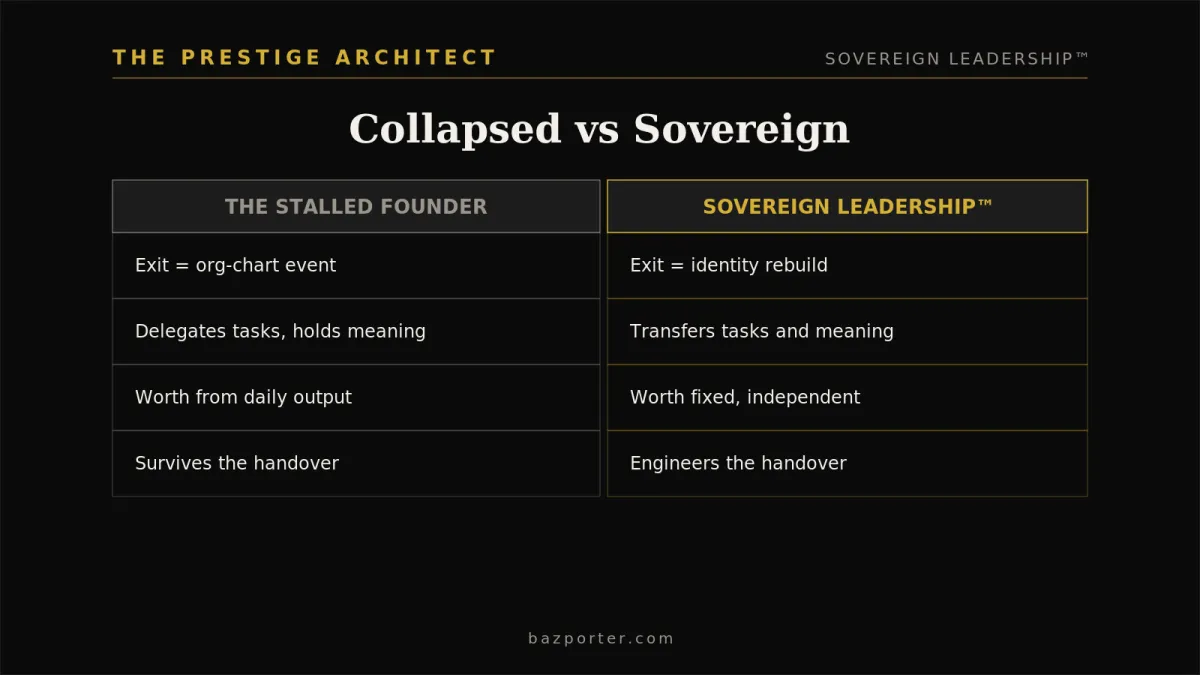
- Collapsed: answers every request. Sovereign: answers the few that are theirs.
- Collapsed: proves worth through volume. Sovereign: proves worth through judgment.
- Collapsed: the desk owns the day. Sovereign: the design owns the day.
- Collapsed: busy and unseen. Sovereign: focused and felt.
You were not hired to touch everything. You were hired to decide the few things that only you can decide. The rest is noise you agreed to carry.
If you want to see your own list fast, start with the free Fast Future Freedom Blueprint™. It is a 60-minute identity audit. It shows you the work that is truly yours and the work you can stop today.
A case from the work
A leader I counsel ran a team of forty. Every decision crossed their desk. Approvals. Disputes. Vendor emails. They worked twelve-hour days and felt invisible. The title was real. The leadership was gone.
We built one stop-doing list. Five items. They stopped approving routine spend under a threshold. They stopped joining status calls they only listened on. They stopped rewriting work their team had already finished. They stopped being the first reply on every thread. They stopped carrying problems that belonged one level down.
Nothing collapsed. The team rose to the gap. Within a month the leader had two clear hours each morning for the work only they could do. The seat filled with leadership again. That is return, not reward.
The architecture of your return
A stop-doing list is the first beam. It is not the whole structure. Under the list sits a deeper question. What is the irreducible work that only you can do? Until you name it, every task looks equal, and every fire feels like yours.
Return is architecture, not willpower. You name the work that is yours. You build the layer beneath you to hold the rest. You write what you will stop. Then you defend it, day after day, until the design holds without you watching it.
This is the work I do with leaders inside the container. If you are ready to find the work only you can do, begin with the free Fast Future Freedom Blueprint™. One audit. One hour. A clear map of what to keep and what to release.
Frequently asked questions
What should be the first item on a leader's stop-doing list?
Start with the task you do out of habit, not need. For most leaders that is approving low-stakes decisions. If the choice does not need your judgment, it does not need your hands. Remove it first and watch what happens. Usually nothing breaks.
How is a stop-doing list different from delegation?
Delegation hands a task to someone else. A stop-doing list asks whether the task should exist at all for you. Some items you delegate. Some you stop entirely. The list forces that second question, which most leaders skip.
Will stopping work make me look less committed?
It can feel that way at first. It is not true. Volume is not leadership. Judgment is. When you stop reacting to everything, your team sees what you actually protect. That reads as authority, not absence.
How often should I review my stop-doing list?
Review it once a week. The reactive day refills fast. New fires attach themselves to your desk without asking. A weekly pass keeps the list current and keeps the work that creeps back off your hands.
What if everything genuinely feels like it needs me?
That feeling is the symptom, not the fact. It means the work that is truly yours has never been named, so every task looks equal. Name the irreducible work first. Then most of the rest stops feeling like yours, because it is not.
About the author
Baz Porter® is The Sovereign Leadership Architect. He rebuilds the identity beneath high performance, so leaders decide, lead, and live from a self that is genuinely their own. He works with accomplished people who look strong on the outside and feel unseen on the inside. His work begins underneath the visible problem, at the level of state of being.