How to Stay Yourself Once You've Made It
You made it. The title, the number, the life that looks like the plan worked.
So why does it feel like you went missing somewhere along the way?
This is Silent Collapse™. Not burnout. It is the quiet discovery that you climbed by handing pieces of yourself away. The role kept them. You kept climbing. And now the person who arrived is not quite the person who set out.
The question is no longer how to get there. It is how to stay yourself now that you have. That begins with the manifesto behind this work.
Written by Baz Porter®
What this covers
Key takeaways
Losing yourself is not a character flaw. It is the predictable cost of an unexamined climb.
You do not stay yourself by trying harder. You stay yourself by design.
First you audit where the role runs your life instead of you.
Then you build rules that protect the real you when pressure is high.
Staying yourself is a system, not a feeling. It holds because it is built.
You can do this inside the success you have. You rarely need to walk away.
The short answer
To stay yourself once you have made it, stop relying on willpower and start building structure. Audit where the role runs your days, your money, and your relationships instead of you. Then set rules that keep the real person in charge when the pressure spikes. You do not protect yourself with good intentions. You protect yourself with a system.
Most leaders assume they will stay themselves automatically. They mean to. Then the next quarter arrives.
The self gets quietly outvoted. Not in one big decision. In a thousand small ones nobody tracked.
Staying yourself reverses that. You stop leaving it to intention. You build the life so the real you wins the small votes.
The hidden pattern
There is a reason the climb cost you so much of yourself. Psychologists call it self-concordance.
Sheldon and Elliot (1999, Journal of Personality and Social Psychology) found that goals pursued for integrated, authentic reasons sustain us. Goals pursued for introjected or external reasons drain us. Even when you reach them.
Read that again. You can win every target and lose yourself doing it. The targets were never fully yours.
Each absorbed goal asked for a small trade. A boundary here. A value there. A piece of how you actually wanted to live. You paid, because paying felt like ambition.
This is also why Ryan and Deci (2000, American Psychologist) place autonomy at the center of a life that holds. Not freedom from people. Congruence with yourself. When your days run on your own terms, you stay intact. When they run on borrowed ones, you fade.
So the problem is not your willpower. It is the absence of structure. You left staying yourself to good intentions, and good intentions lose to deadlines every time.
The RAMS™ reframe
The The Prestige Architect™ approach does not start with your mindset. It starts with the architecture under your life. RAMS™ runs across five pillars. Here is how each one helps you stay yourself.
Results. Redefine the result. The old metric was how far you climbed. The new metric is how much of yourself you kept while climbing. Track that one honestly.
Attitude. Stop treating the ache as weakness. It is accurate. It is telling you a trade went too far. Listen to it before it becomes collapse.
Authenticity. Staying yourself means staying the real self, not an ideal one. You are not trying to become someone better. You are refusing to keep becoming someone else. Name what is actually true about how you want to live.
Mastery. Staying yourself is a skill. You build it by audit and small repairs, not by one heroic exit. Each week you take back one piece the role was holding. Mastery is doing it in order, without drama.
Systems. Staying yourself is a system, not a mood. It holds because it is designed, not because you feel strong today. You set rules for your time. You set rules for your money. You set rules for who gets access to you. The rules keep the real you in charge when your resolve is low.
Collapsed versus Sovereign
Collapsed relies on willpower to stay itself. Sovereign relies on built rules.
Collapsed notices the loss years later. Sovereign audits the trades as they happen.
Collapsed waits for a clean exit to feel real again. Sovereign stays real inside the life it has.
Collapsed measures how far it climbed. Sovereign measures how much of itself it kept.
Collapsed treats the ache as weakness. Sovereign treats it as data.
Collapsed hopes to stay itself. Sovereign engineers it.
"Staying yourself is not a feeling you summon. It is a structure you build. The structure holds when your willpower does not."
If you cannot yet tell which parts of your life are yours and which belong to the role, start there. The Silent Collapse Diagnostic™ is built to surface that exact gap, so you know what to protect and what to take back.
What this looks like
A chief executive came to this work sure the problem was the company. She wanted out.
We ran the audit before we touched the exit.
Most of her life, it turned out, was still hers. The work she believed in. The people she loved. What was not hers was the operating pattern she had bolted on to prove she belonged. The always-on access. The yes to every ask. The quiet surrender of anything that was just for her.
She did not leave. She built the structure. She set hours that were hers and defended them. She set one rule for access and held it. She moved her calendar toward the person she wanted to be at sixty, not the one who impressed the board at forty.
A year on, she was still in the seat. She had simply stopped disappearing from it.
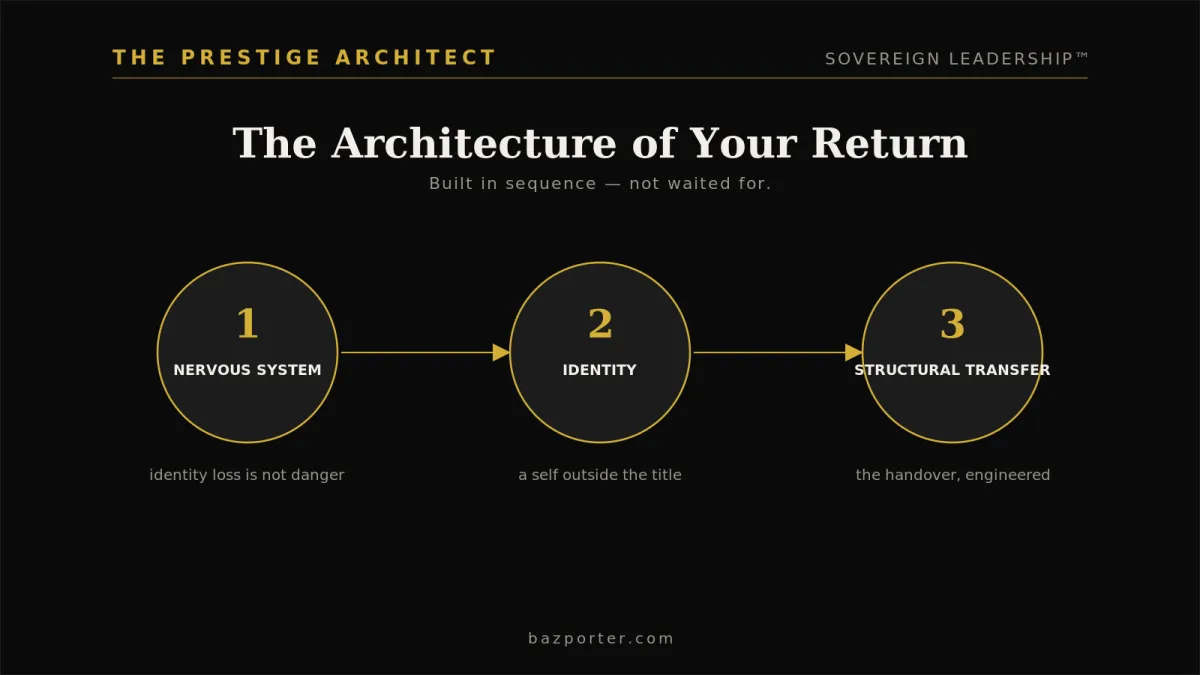
The architecture of your return
Staying yourself is not a leap. It is a build.
You begin with one honest audit. Where does the role run my life, and where do I. Then you pick one domain. Your time, your money, or your relationships. You set one rule that protects the real you this month.
Next month, another rule. You do not become a new person. You stop losing the one you are, piece by piece, until the person in the seat is actually you.
The Silent Collapse Diagnostic™ is how you run that first audit with precision, so you know which domain is bleeding you fastest.
That is the work I do with leaders who are done going missing inside their own success. If you are ready to build the structure, apply through the Fast Future Freedom Blueprint and we will map the first rule together.
Frequently asked questions
What does it mean to lose yourself in your career?
It means the role slowly took over the decisions that used to be yours. You traded boundaries, values, and preferences in small increments to keep succeeding. The success is real. So is the quiet sense that the person living it is not quite you anymore.
How do I stay myself as a leader under constant pressure?
Not by willpower, which fails under load. You stay yourself by building structure. Set rules for your time, your money, and your access that protect the real you before the pressure hits. The rules decide for you when you are too depleted to decide well.
Why do I feel lost even though I achieved everything I wanted?
Because many of the goals were likely introjected, chosen for external or absorbed reasons rather than integrated ones. Research on self-concordance shows these goals drain even when reached. The lost feeling is a signal that you climbed on targets that were never fully yours.
Do I have to leave my job to stop losing myself?
Usually not. Most leaders find the core of their life is still theirs. The damage is in the operating pattern bolted on to prove belonging. You can often rebuild your boundaries and structure inside the role you have, rather than walking away from it.
How do I start staying true to myself again?
Begin with an audit, not an exit. Name where the role runs your life and where you still do. Then pick one domain, time, money, or relationships, and set a single protective rule this month. Staying yourself is built in order, one rule at a time.
You climbed without losing the people. You can keep the one person who matters most, which is you. Start with the Fast Future Freedom Blueprint.
Baz Porter® is the founder of Sovereign Leadership Architecture and the creator of RAMS™. He works with executives and founders in Silent Collapse™ to return to themselves and stay themselves inside the lives they built.