Shiny Object Syndrome: Why You Chase Every New Idea
Written by Baz Porter®
You have twelve ideas and nothing shipped. A new one arrived this morning. It felt like oxygen. The old one now feels like a chore you resent. This is shiny object syndrome, and it is quietly running your week. It is also one of the surface signs of Silent Collapse™ in a capable leader.
You are not undisciplined. You are not lazy. You are a person whose nervous system has learned that the new idea is safer than the finished one. Every fresh start gives relief. Every finish line asks you to be judged. So you start again. And a small voice keeps score.
Read the manifesto if that last line landed. Then come back here.
On this page
Key takeaways
Shiny object syndrome is chasing the next idea while the current one stalls.
It is a nervous-system pattern, not a character flaw.
The new idea rewards you before you earn anything. The finish line does not.
Willpower does not fix it. A container does.
RAMS™ rebuilds the system that lets one thing land before the next begins.
What is shiny object syndrome in leaders?
Shiny object syndrome is the pull to chase every new idea at the cost of the one in front of you. In founders and executives it looks productive. It is not. You open the laptop and pivot. You rewrite the plan. You rebuild from zero most weeks. The work never compounds because nothing is allowed to finish. Underneath the motion sits a quiet fear that finishing will expose you.
It rarely announces itself. It hides inside good habits. You call it staying agile. You call it following your curiosity. You tell your partner it is fine. In private you keep the count. Twelve ideas open. None shipped. Each new week starts with a clean page and a heavier chest.
The hidden pattern: novelty is a reward
Here is what few people name. Novelty itself is a reward. Your brain treats a new idea as a prize before any result exists.
Neuroscience shows this directly. Bunzeck and Düzel found that novel images activate the dopamine midbrain, the same region that codes reward (Bunzeck and Düzel, 2006, Neuron). The new thing pays you in advance. The finish line makes you wait and risk being seen. So the pattern is not weakness. It is a nervous system choosing the cheaper reward.
Harvard Business Review makes the same point in plain terms. Focus is a strategic act, not a personality trait, and leaders who protect it outperform those who chase (Harvard Business Review). Forbes calls shiny object syndrome the biggest problem for today's entrepreneurs (Forbes). The demand for a real answer is loud. The answer is not more grit.
Grit assumes the problem is effort. The problem is design. You keep asking your willpower to beat your biology. Your biology wins by lunch. This is why the resolution to focus fails on day three. You did not lack resolve. You lacked a structure that made the new idea wait its turn.
The RAMS™ reframe across five pillars
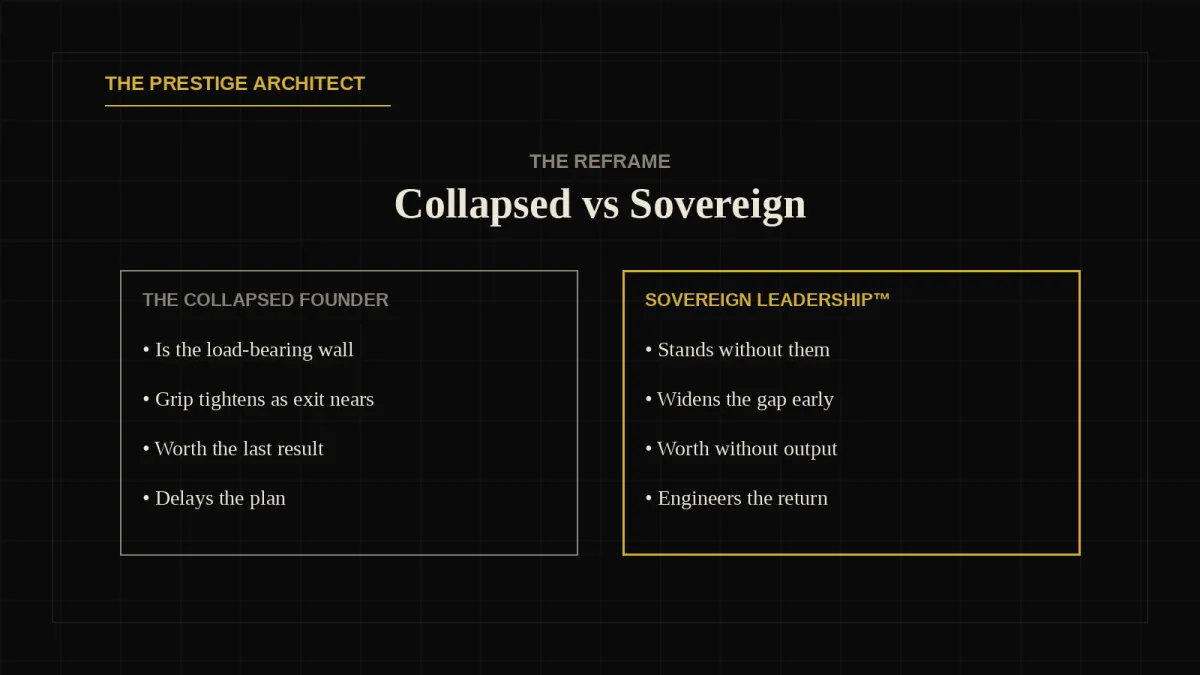
RAMS™ is the operating system I use with leaders: Results, Attitude, Authenticity, Mastery, Systems. Shiny object syndrome touches all five. Here is the collapsed pattern and the sovereign one.
Results
Collapsed: you measure motion. Twelve starts feel like progress.
Sovereign: you measure finished things. One shipped idea outweighs ten begun.
Attitude
Collapsed: the new idea feels like hope. The old one feels like failure.
Sovereign: the current idea is where your power lives. You give it your full attention.
Authenticity
Collapsed: the next idea is a mask. It hides the fear of being judged at the finish.
Sovereign: you name the fear out loud. Then it stops steering you in secret.
Mastery
Collapsed: you stay a beginner forever. Beginning is safe. Depth is exposing.
Sovereign: you stay with one craft long enough to get good. Mastery only lives past the boring middle.
Systems
Collapsed: no container. Every idea gets equal access to your day.
Sovereign: one active idea at a time. New ideas wait in a parking list until the current one lands.
Baz Porter does not motivate. He does not inspire. He architects. The new idea is not your problem. The missing container is.
If you keep starting and never landing, the pattern will not name itself. Book the Silent Collapse Diagnostic™. In sixty minutes we find the exact place your system leaks and the one change that stops it.
A leader I worked with
A founder came to me with nine live projects. She ran a real company. She had rewritten her ideal client four times that year. Each rewrite felt like a fresh start. Each one reset her to zero.
She was not confused about her market. She was avoiding the moment a finished offer gets tested. We built one rule. One active idea. Everything else went to a parking list she reviewed on Fridays. Within a month she shipped the offer she had circled for a year. The relief was not in the new idea. It was in finally landing one.
Nothing about her drive changed. The container changed. The ideas still arrived. They simply had to wait. That single boundary turned a year of motion into one finished thing. Then a second. The compounding she had chased for years began the moment she stopped restarting.
The architecture of your return
You do not need another idea. You need a container that lets one idea finish. That is architecture, not grit. It is quiet, repeatable, and built for a nervous system under load.
Most leaders try to think their way out of this. They read one more book on focus. They buy one more planner. The planner becomes the next shiny object. The pattern eats the cure. What breaks it is not information. It is a single enforced rule, held long enough to feel safe. One idea, finished, changes what your nervous system believes is possible.
This is the return from Silent Collapse™ to Sovereign Leadership™: power without the churn, output without self-betrayal. If you are ready to stop rebuilding from zero, apply for the Silent Collapse Diagnostic™. We map your system and name your one next move.
Questions leaders ask
What is shiny object syndrome?
Shiny object syndrome is the habit of chasing new ideas or trends while current priorities stall. In leaders it disguises avoidance as ambition. The tell is many starts and few finishes.
What causes shiny object syndrome in entrepreneurs?
The new idea pays a reward before any result exists, so your brain prefers it. Finishing asks you to be judged, which feels like risk. Fear of the finish line, not laziness, drives the chase.
Is shiny object syndrome the same as ADHD?
No. ADHD is a clinical attention difference. Shiny object syndrome is a behaviour pattern many capable leaders show under pressure. They can overlap, but chasing new ideas alone is not a diagnosis.
How do I stop chasing every new idea?
Run one active idea at a time. Send every new idea to a parking list you review weekly. Measure finished work, not starts. A container beats willpower every time.
Is chasing new ideas always a bad thing?
No. Curiosity built your company. The problem is unmanaged novelty that stops anything from landing. The goal is to keep the curiosity and add a system that protects the finish.
Baz Porter® is the founder of Baz Porter LLC® and The Prestige Architect™. He is a British Army veteran, an international bestselling author, and host of the Rise From The Ashes podcast on the C-Suite Network. He guides high-achieving leaders from Silent Collapse™ to Sovereign Leadership™: power without collapse, success without self-betrayal.